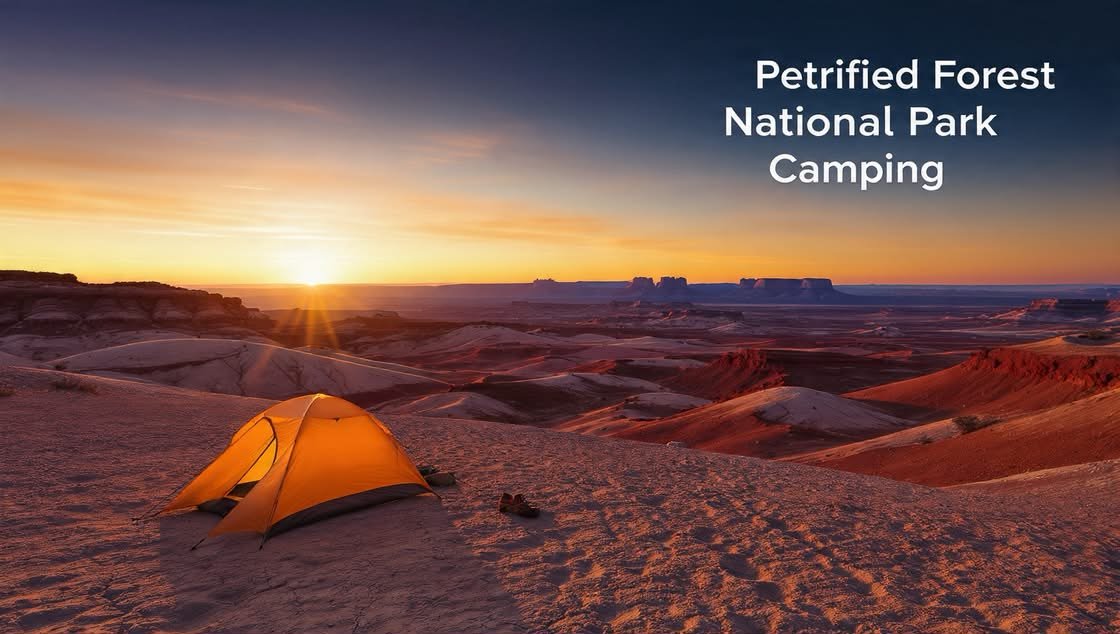
Petrified Forest National Park Camping: The 2026 Guide
Petrified Forest National Park has zero developed campgrounds, RV hookups, or front-country tent sites. Sleeping inside park boundaries requires backpacking into a desert wilderness zone.
The park’s official camping is a free, permit-based backcountry experience deep in the Painted Desert. Most road trippers miss the best overnight option by not packing a backpack.
This guide covers the park’s two distinct wilderness areas, the walk-up permit system, and critical water logistics. It also names the best nearby RV parks and dispersed spots outside the gate.
Petrified Forest National Park Camping
Petrified Forest National Park camping is exclusively backcountry, with no drive-up sites of any kind. You hike into a designated wilderness zone and disappear into the badlands.
The park preserves one of the largest concentrations of Late Triassic petrified wood on Earth. Camping here means sleeping among 225-million-year-old fossilized logs under zero light pollution.
First-time desert backpackers often fail here by carrying too little water. Experienced backcountry campers treat this as a one-night survival exercise with a heavy pack.
The nearest front-country camping for RVs and tents sits twenty-five miles west in Holbrook. The park is not built for quick overnight stops with vehicle access.
Key Takeaway: Petrified Forest camping is a hike-in backcountry experience. There is no car camping, no hookups, and no water anywhere on site.
Petrified Forest Backcountry Camping
Petrified Forest backcountry camping splits into two distinct zones. The north zone is the Painted Desert Wilderness, and the south zone is the Rainbow Forest Wilderness.
Both zones require a free permit and a hike at least one mile from your car. You must carry everything, including every drop of water you plan to drink.
Painted Desert offers the iconic badland views seen on postcards. Rainbow Forest delivers piñon-juniper woodlands and fallen petrified wood logs scattered across rolling grassland.
A GPS device with offline maps is mandatory equipment in both zones. The terrain lacks trails, and the striped hills create instant visual disorientation after sunset.
Families with young children should avoid this entirely. The water carry alone makes it a non-starter for groups needing frequent breaks or carrying small kids.
The backcountry rewards solitude seekers willing to hump a forty-pound pack over loose clay. Every sunset silhouette against the Painted Desert is completely private and silent.
Insider Tip:
Access both zones from the main park road by parking at an overlook. Then walk at least one mile perpendicular to the pavement into open desert.
Petrified Forest Wilderness Areas
The park holds two federally designated wilderness areas. The Painted Desert Wilderness dominates the north section near the I-40 corridor.
The Rainbow Forest Wilderness covers the southern end near the Rainbow Forest Museum. Both zones sit entirely inside Navajo and Apache counties in northeastern Arizona.
Painted Desert is a badlands landscape of bentonite clay, striped buttes, and naked sky. The bentonite turns to slick, glue-like mud in rain.
Rainbow Forest is higher, grassier, and dotted with massive petrified log fragments. The ground here is more forgiving for tent stakes but offers less dramatic open views.
First-time campers should choose Rainbow Forest for easier navigation and softer ground. Experienced desert hikers who want the iconic view must pick Painted Desert.
The wilderness designation prohibits all mechanized transport, including bikes and game carts. You walk in, walk out, and leave behind nothing but boot prints.
| Wilderness Zone | Terrain Type | Best Access Point | Navigation Difficulty |
|---|---|---|---|
| Painted Desert | Badlands, clay, open | Kachina Point or Lacey Point | High (visual disorientation) |
| Rainbow Forest | Grassland, piñon-juniper | Rainbow Forest Museum area | Moderate (log landmarks) |
Petrified Forest Camping Permit
A Petrified Forest camping permit is free and obtained in person on the day of your hike. No online reservations, no lotteries, and no advance bookings exist.
Visit the Painted Desert Visitor Center or the Rainbow Forest Museum during operating hours. You fill out a form listing your zone, vehicle plate, and intended return time.
The permit system is a safety net, not a quota system. Rangers need to know which badland drainage to search if you fail to return by your listed time.
Arrive before 3:00 PM local time to process your permit. Visitor centers close in the late afternoon, and rangers will not issue permits after closing.
Solo hikers should consider leaving a detailed route plan with their permit. This is especially critical in summer when heat emergencies become life-threatening within hours.
The National Park Service uses this permit to enforce the one-mile hike-in rule. Rangers may check that you camped beyond sight of the road.
Key Takeaway: Get your free walk-in permit at a visitor center before 3:00 PM. Give a return time and stick to it.
Painted Desert Wilderness Camping
Painted Desert Wilderness camping offers the most iconic Petrified Forest overnight views. Access it from Kachina Point behind the historic Painted Desert Inn.
Hike north across the open badlands on no formal trail. Aim for the rim of Lithodendron Wash about a mile from the pavement to legally camp.
The ground here is fragile cryptobiotic soil crust topped by a thin clay veneer. Walk in washes where possible to avoid crushing decades of biological soil growth.
The reward is a sunrise that fires the Tepees and Blue Mesa in layered bands of blue, purple, and rust. No other developed viewpoint inside the park delivers this angle.
Couples seeking a singular, quiet desert night should target this zone in October. Daytime highs stay bearable, and the night sky clarity is at its annual peak.
The honest limitation is exposure to wind, which can shred ultralight tents before midnight. Bring a four-season tent body or a bivy sack with a full bathtub floor.
According to the National Park Service, the bentonite clay in this zone becomes impassably slick when wet. Check the forecast and cancel your trip if rain appears.
Rainbow Forest Wilderness Camping
Rainbow Forest Wilderness camping is the easier, greener alternative to the northern badlands. Park at the Rainbow Forest Museum and hike south into the grassland.
The terrain here rolls gently through rabbitbrush, piñon pines, and junipers. Massive petrified tree trunks lie scattered across the ground like fallen columns.
Navigation in Rainbow Forest is easier because the logs provide clear visual landmarks. You still need a GPS, but disorientation is less immediate than in the north.
This zone is the better choice for experienced campers who want a shorter water carry. The grassy soil also accepts ultralight tent stakes more reliably than Painted Desert clay.
Budget campers planning a longer Southwest road trip can string together free nights here easily. The park entrance pass gets you in, and the backcountry stay costs nothing extra.
The trade-off is that you sacrifice the dramatic, sweeping badland overlooks for woodland quiet. You won’t see the Blue Mesa formations from camp, just open sky and grass.
Insider Tip:
Camp on the south side of a large petrified log. This blocks the prevailing wind and gives you a wind-free cooking zone for your canister stove.
Camping Near Petrified Forest National Park
Camping near Petrified Forest National Park means heading to Holbrook, or onto BLM land. There is no overnight parking or camping along the park’s scenic loop road.
Holbrook offers full-hookup RV parks, motels, and a KOA with a pool. This is the best option for RV travelers and families with children who need flush toilets.
Holbrook/Petrified Forest KOA provides pull-through sites, a camp store, and laundry. It sits directly off I-40, making the park access a quick twenty-five-minute drive east.
Free dispersed camping exists on Bureau of Land Management land south of I-40. These are undeveloped patches of dirt with no water, no tables, and no shade.
RV travelers should take a hard look at the KOA before attempting dispersed sites. Many boondocking tracks near the park turn to deep, impassable clay after monsoon storms.
The honest assessment is that any overnight option outside the park will feel like a compromise. The magic of the Petrified Forest is the dawn light inside the wilderness, not outside a Holbrook gas station.
- Holbrook/Petrified Forest KOA: Full hookups, pool, store, twenty-five minutes to park entrance.
- BLM land south of I-40: Free, no amenities, high-clearance vehicle recommended.
- Holbrook city parks: Often restrict overnight parking, check current city ordinances before relying on this.
Petrified Forest Backpacking
Petrified Forest backpacking is a dry, off-trail exercise in total self-sufficiency. There is no water source anywhere in either wilderness zone.
A summer overnight demands a water carry of two gallons per person, minimum. That is over sixteen pounds of water weight added to your pack before gear.
Your pack list must include a GPS device with offline topo maps and a power bank. Cell service vanishes completely a quarter mile from the paved road.
Stove selection matters here more than in forested parks. A canister stove with a windscreen is mandatory, as desert gusts kill burner flames in seconds.
First-time desert backpackers should test their entire water system on a front-country trip beforehand. Find out if your bladder leaks under the weight of that much liquid.
The reward for this effort is a level of solitude almost extinct in the national park system. You will likely not see another human from sunset to sunrise.
Key Takeaway: Pack two gallons of water per person, a GPS, and a windproof stove. Test your water carry system before arriving.
Petrified Forest Camping Rules
Petrified Forest camping rules are strict and enforced to protect the fossilized resource. Camp at least one mile from your vehicle and out of sight of any paved road.
Do not touch, move, or take petrified wood from the park. Do not even arrange small pieces near your tent for a photo.
Human waste must be packed out using a portable toilet system or wag bags. Digging a cathole is largely ineffective and often illegal in this hard clay environment.
Fires of any kind are strictly prohibited in the backcountry. Use a canister stove for cooking, and never build a wood fire ring near petrified logs.
The National Park Service will prosecute wood theft as a federal offense. Leaving a campfire scar next to a fossil log is both ecologically destructive and a guaranteed citation.
Pets are permitted in the wilderness areas but must remain on a six-foot leash. Bear in mind that your dog will walk on the same fragile soil crust you are required to avoid.
Petrified Forest Road Closures
Petrified Forest road closures are rare but impactful, as the main park road is the only pavement. The 28-mile scenic drive links I-40 in the north to Highway 180 in the south.
Winter snow and ice can close the park road for short periods, usually a day or two. The northern entrance near I-40 often closes first during storms.
Summer monsoon rains can wash debris over the road at low drainage crossings. The road itself is paved and rated for all passenger vehicles, RVs, and motorcycles.
Road work can occur in the 2026 season, causing single-lane closures and delays. These are published on the NPS Petrified Forest website under Alerts and Conditions.
For backcountry access, a road closure at one end means you must plan your permit pickup strategically. If the south entrance is open, get your permit at Rainbow Forest Museum.
Always call the visitor center directly to confirm both entrances are open before committing to a long drive. The phone line is answered during business hours, and rangers give straight answers.
Water Sources Petrified Forest
Water sources inside Petrified Forest National Park are nonexistent. There are no springs, no creeks, and no spigots beyond the visitor center bathrooms.
Every ounce of water for drinking, cooking, and hygiene must be packed on your back. This is the single most common point of failure for first-time visitors.
For a one-night trip in mild weather, carry one gallon per person strictly for drinking. A second gallon per person should cover cooking and a safety margin for heat.
High summer temperatures demand more water, but summer backpacking here is genuinely dangerous. The baked clay ground reflects heat upward, turning the wilderness into a convection oven by 10:00 AM.
You must treat the visitor center fountain as your final fill station. Do not count on collecting rain in a tarp, because bentonite clay will foul the water instantly.
According to experienced desert hikers on AllTrails, the weight of water is the price of admission for this landscape. Cut pack weight on gear, never on your H2O supply.
Key Takeaway: There is no natural water source. Start your hike with every drop you need, filled at the visitor center.
Loose Standing Petrified Wood Camping
Camping among loose standing petrified wood means sleeping in the Rainbow Forest Wilderness. This southern zone holds countless massive fossil logs in their natural scattered positions.
You must choose a tent site on open ground, not directly next to a fossilized tree. The Leave No Trace Center for Outdoor Ethics recommends avoiding contact with irreplaceable archaeological features.
Set up your tent and cooking area well away from the wood to prevent accidental damage. A stove tip-over near a fossil is not just clumsy, it is a violation of federal law.
Photographers should prioritize sunrise when the low angle turns quartz inclusions to crystal fire. The logs glow amber, rust, and electric blue against the grass.
Couples looking for a quiet, flat tent site surrounded by surreal geology will find it here. The trade-off is a complete absence of shade or topographic shelter from wind.
The honest limitation is that camping inside a field of protected artifacts demands constant spatial awareness. You cannot casually wander in the dark without a headlamp.
Blue Mesa Camping Access
Blue Mesa camping access is not from the Blue Mesa trailhead parking lot itself. Blue Mesa is a day-use only trail system with a gate that closes in the early evening.
To camp near this landmark, you must enter the Painted Desert Wilderness from the north. Hike from Kachina Point toward Lithodendron Wash and orient yourself south towards the Blue Mesa formations.
The hike is roughly two miles one way over trackless bentonite hills. You will see the banded blue, purple, and gray mesas dominating the southern horizon.
Camp at least a mile from the trailhead to stay compliant with park rules. The view of Blue Mesa in late afternoon alpenglow from this angle justifies the difficult off-trail plodding.
This access route is for experienced backpackers with strong route-finding skills. First-time backcountry campers should not attempt an off-trail approach to Blue Mesa as their first trip.
The park prohibits scrambling onto the Blue Mesa formations themselves. Camp at a respectful distance on the plain and treat the formations as a visual backdrop.
- Obtain your permit from the Painted Desert Visitor Center before 3:00 PM.
- Park at Kachina Point, cross the fence at the designated opening, and walk north.
- Bear south toward the Blue Mesa formations after one mile.
- Camp on flat ground with the mesas in view but do not climb on them.
Petrified Forest National Park Camping with Dogs
Camping with dogs in Petrified Forest National Park is permitted in the backcountry. They must remain on a six-foot leash at all times and be packed out with you.
The biggest threat to dogs is the sharp, chipped petrified wood fragments on the ground. These cut paw pads quickly, and the nearest vet is back in Holbrook.
Desert ground temperatures in direct sun can exceed 120 degrees Fahrenheit in May. Booties are mandatory for any dog walking outside the paved overlooks.
You must pack out all dog waste using the same backcountry sanitation bags you use for yourself. The park has no trash service in the wilderness areas.
The dry, silent landscape can cause sensory overstimulation in some high-strung dogs. If your dog barks at every scent in the wind, you will both have a rough night.
For most campers, leaving the dog with a sitter and going solo is the smarter play. The harsh environment multiplies every risk associated with backcountry pet travel.
Key Takeaway: Dogs are allowed but face sharp ground and extreme heat. Booties and ample water are mandatory.
Important Safety and Conditions Notes for Petrified Forest Backcountry Camping
The desert environment here can kill an unprepared hiker through dehydration or hyperthermia within hours.
Verify the following before your trip:
Current visitor center hours for permit pickup on the NPS official website.
The weekend weather forecast, focusing on wind gusts and rain probability.
Your GPS device’s offline map cache and battery charge before leaving cell service.
Your water container integrity under full load to prevent a catastrophic leak at camp.
Tell a ranger your route and commit to returning by your stated time without exception.
Frequently Asked Questions About Petrified Forest National Park Camping
Is there a campground inside Petrified Forest National Park?
No, there is no developed campground, no RV park, and no car camping site inside Petrified Forest National Park.
All overnight stays within park boundaries require a free backcountry permit and a hike of at least one mile.
The nearest developed campgrounds are in Holbrook, Arizona, twenty-five miles west on I-40.
How do I get a camping permit for Petrified Forest?
You get a free camping permit in person at the Painted Desert Visitor Center or Rainbow Forest Museum.
Permits are issued only on the day of your hike and cannot be reserved online or by phone.
You must arrive before the visitor center closes, typically in the late afternoon, to obtain your permit.
Can you camp anywhere in Petrified Forest National Park?
You can camp only inside the designated Painted Desert or Rainbow Forest Wilderness Areas after obtaining a permit.
Camping is illegal within sight of the paved park road and inside any day-use area, trailhead, or overlook.
You must be at least one mile from your vehicle and out of view of any road or building.
Are there RV camping options at Petrified Forest National Park?
No, there are zero RV camping options, dump stations, or hookups inside Petrified Forest National Park.
The park road is paved and accessible for RVs during the day, but overnight parking at overlooks is strictly prohibited.
The closest RV parks with full hookups are located in Holbrook, a short drive west on Interstate 40.
Is there dispersed camping near Petrified Forest National Park?
Free dispersed camping exists on Bureau of Land Management tracts south of Interstate 40, outside the park boundary.
These are primitive, undeveloped patches of dirt with zero water, shade, or restroom facilities.
Many access roads turn to slick, impassable mud after rain and require a high-clearance vehicle.
Can you have a campfire in Petrified Forest Wilderness?
No, campfires of any kind are strictly prohibited in the Petrified Forest backcountry.
You may use a contained canister stove for cooking, but a windscreen is essential in desert gusts.
The fire ban protects the petrified wood, fragile soils, and dark-sky quality of the park.
Closing Section
The only camping in Petrified Forest National Park is a silent, heavy-pack trek into desert wilderness. It rewards experience and preparation with a night sky almost unaltered by human light.
Your next step is to mark visitor center hours on your phone and pack a water bladder that holds two gallons without leaking. Confirm the park road status directly with the NPS before you drive.
Permit rules and visitor center operations may adjust for the 2026 season. A quick call to the Painted Desert Visitor Center ensures your trip starts without a paperwork surprise at a locked door.