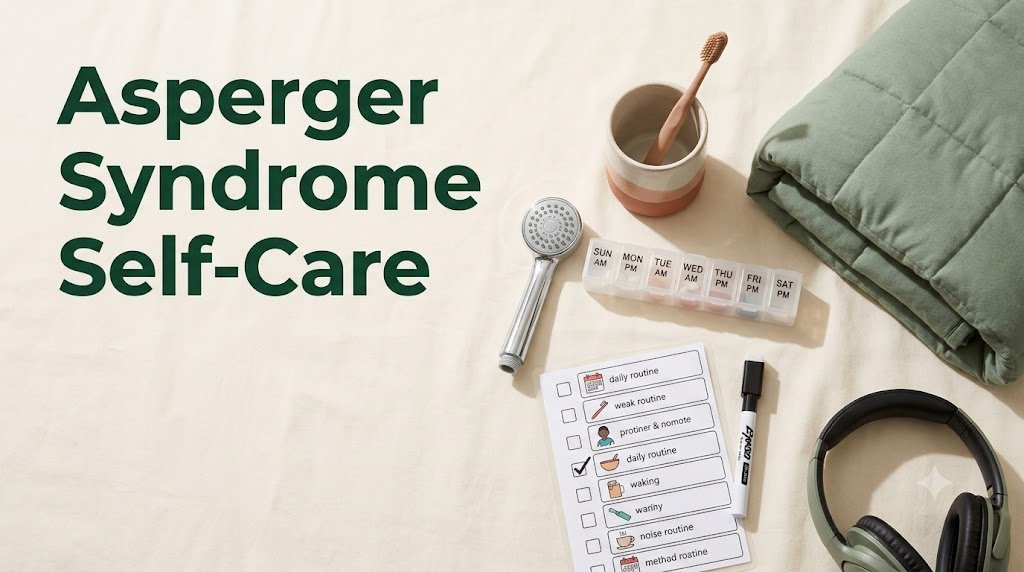
Asperger Syndrome Self-Care: A Practical 2026 Guide
Self-care for Asperger syndrome looks different than typical advice about bubble baths and planners. The real work involves creating systems that work with your autistic brain instead of fighting against it.
Research published in the Journal of Autism and Developmental Disorders shows that executive function differences and sensory processing variations directly impact daily living skills completion rates. Understanding these barriers is the first step to building self-care that actually sticks.
This guide covers sensory-friendly hygiene adaptations, visual scheduling techniques, task breakdown strategies, burnout recovery protocols, and when occupational therapy can help. Every strategy here comes from occupational therapy research or clinical practice guidelines for autistic adults.
What Is Self-Care for Asperger Syndrome
Self-care for Asperger syndrome means completing activities of daily living (ADLs) and instrumental activities of daily living (IADLs) using strategies that accommodate executive function differences and sensory processing patterns. This includes hygiene, meal preparation, sleep, medication management, and healthcare navigation.
The American Occupational Therapy Association (AOTA) defines self-care as the set of tasks an individual performs to maintain health and well-being in their living environment. For autistic adults, this definition expands to include the specific accommodations and supports that make these tasks possible.
Key Takeaway: Self-care is not about willpower. It is about building external systems that compensate for internal processing differences.
Why Self-Care Tasks Feel Harder With Asperger Syndrome
Three core differences make self-care tasks more challenging for people with Asperger syndrome. These are neurological differences, not personal failings.
Executive function differences affect task initiation, sequencing, switching between activities, and working memory. A 2018 study in Autism Research found that autistic adults showed significantly slower response times on task-switching paradigms compared to neurotypical controls, directly impacting the ability to move from one self-care step to the next.
Sensory processing differences mean that standard hygiene products and environments may register as painful or overwhelming. The CDC estimates that over 80 percent of autistic individuals experience atypical sensory responses affecting daily function.
Interoception differences reduce awareness of body signals that typically trigger self-care. You may not feel hungry until you are ravenous or notice you need to shower until someone points out the odor.
Key Takeaway: These three factors work together to make self-care objectively harder. Strategy, not effort, is the solution.
Sensory Barriers to Hygiene and Daily Self-Care
Sensory barriers fall into three categories that affect different self-care tasks. Understanding which apply to you makes accommodation possible.
| Sensory Barrier | Affected Tasks | Common Triggers |
|---|---|---|
| Tactile defensiveness | Showering, toothbrushing, hair washing | Water spray force, toothbrush bristles, hair on wet skin |
| Auditory sensitivity | Showering, using electric toothbrush, hand dryers | Water echo in shower, motor noise, sudden loud sounds |
| Olfactory sensitivity | Using soap, shampoo, toothpaste, cleaning products | Strong artificial fragrances, mint intensity, chemical smells |
| Visual sensitivity | Morning routine, medication sorting | Bright bathroom lights, multiple product bottles, small text |
Sensory barriers are not preferences. The Journal of Autism and Developmental Disorders classifies sensory aversions as neurologically based responses that activate the same threat pathways as physical pain in some individuals.
Quick Tip: Identify your specific sensory triggers before trying to force yourself through a standard routine. Work around them rather than through them.
Key Takeaway: Your sensory aversions are real and valid. Accommodations are not cheating; they are necessary access tools.
Building a Self-Care Routine That Actually Works
A functional self-care routine for Asperger syndrome requires three elements: environmental setup, visual structure, and timing consistency. Without these, routines rely on executive function that may not be reliably available.
Environmental setup means preparing your space before you need to use it. Lay out your toothbrush and toothpaste the night before. Place clean towels within reach before you undress for a shower. Reduce decision fatigue by keeping only the products you actually use visible.
Visual structure means having a written or pictorial sequence of steps for every routine. This removes the cognitive load of remembering what comes next. Executive function research shows that external memory aids improve task completion rates by 40 to 60 percent for autistic adults.
Timing consistency means anchoring self-care to existing daily events. Shower after breakfast, not at a specific clock time. Brush teeth before bed, not “sometime in the evening.” Habit stacking attaches new behaviors to established ones.
| Routine Anchor | Suggested Self-Care Pairing |
|---|---|
| After waking up | Medication + face washing |
| After breakfast | Showering + toothbrushing |
| Before leaving home | Deodorant + hair check |
| After dinner | Teeth flossing + evening medication |
| Before bed | Face washing + moisturizer |
Key Takeaway: Routines fail when they rely on memory and motivation. Build external supports instead.
Visual Schedules for Asperger Syndrome Self-Care
A visual schedule shows each step of a self-care routine in sequence using words, pictures, icons, or a combination. This externalizes the sequence so your brain does not have to hold it in working memory.
The American Journal of Occupational Therapy published findings that visual schedules reduce anxiety and improve task completion for autistic adults across multiple ADL domains. Effect sizes were largest for morning hygiene routines and medication management.
| Format | Best For | Tool Examples |
|---|---|---|
| Written checklist | People who read well, need portability | Index card, notebook, notes app |
| Picture schedule | People who process images faster than words | Laminated cards, photo sequences |
| App-based schedule | People who want phone reminders and timers | Tiimo, Brili, Choiceworks |
| Wall chart | People who need constant visibility | Bathroom wall poster, whiteboard |
Create your visual schedule by listing every step of a routine in order. For toothbrushing, this includes: pick up toothbrush, wet bristles, apply toothpaste, brush top teeth for 30 seconds, brush bottom teeth for 30 seconds, spit, rinse brush, put brush away, close toothpaste.
Quick Tip: Laminate paper schedules so you can check off steps with a dry erase marker and reuse them daily.
Key Takeaway: Visual schedules are not childish. Adults with traumatic brain injuries, memory disorders, and executive function conditions use them as standard accommodations.
Breaking Self-Care Tasks Into Manageable Steps
Task analysis is the process of breaking a complex self-care routine into individual actions. Each action must be small enough to complete without getting stuck.
Chaining teaches these steps in order, either forward (step one mastered, then add step two) or backward (last step mastered, then add the step before). Research in behavior analysis shows backward chaining produces faster independence for complex self-care tasks because the individual always ends on a successful, completed step.
Example of showering broken into steps for backward chaining:
- Turn off water (last step)
- Rinse conditioner for 10 seconds (second to last)
- Apply conditioner to ends only
- Rinse shampoo for 15 seconds
- Shampoo scalp with quarter-sized amount
- Step into water and wet hair
- Check water temperature before stepping in (first step)
Start with steps 7 and 6 only. Once those are comfortable, add step 5, then step 4, and so on.
Quick Tip: Do not attempt all steps at once. Master two or three steps, then add one more every few days.
Key Takeaway: Your current failure to complete a task likely means your steps are still too large, not that you lack ability.
Hygiene Routine for Adults With Asperger Syndrome
A complete hygiene routine includes five domains: bathing, oral care, toileting, hair care, and deodorant application. Each domain has standard expectations and accommodations available.
| Hygiene Domain | Standard Expectation | Sensory Accommodation |
|---|---|---|
| Bathing | Shower daily, wash entire body | Sponge bath every other day, fragrance-free soap, low-flow showerhead |
| Oral care | Brush twice daily, floss once daily | Silicone toothbrush, non-mint toothpaste, water flosser |
| Toileting | Wipe front to back, wash hands | Flushable wipes, unscented soap, automatic faucet |
| Hair care | Wash 2-3 times weekly | Dry shampoo between washes, leave-in conditioner |
| Deodorant | Apply daily | Unscented or lightly scented, gel or solid based on texture preference |
The key is matching the accommodation to your specific sensory barrier. Water pressure bothers you? Install a showerhead with adjustable settings. Cannot stand standard toothpaste foam? Try non-foaming toothpaste tablets or powder.
Key Takeaway: There is no moral value attached to how you achieve cleanliness. Only the outcome matters.
Sensory-Friendly Showering and Bathing Strategies
Water hitting skin is a common tactile trigger for people with Asperger syndrome. The unpredictability of spray, the sensation change from dry to wet, and water on the face can each cause significant distress.
Try these evidence-informed accommodations reported in occupational therapy literature:
- Install a handheld showerhead to control water direction and pressure
- Start water on your feet and legs before moving upward
- Use a washcloth as a barrier between spray and your face
- Shower with a swim shirt if torso sensitivity is an issue
- Try sponge baths using a wet washcloth when full showers feel impossible
- Use bath wipes (adult cleansing wipes) for effective cleaning without water
- Shower sitting down on a plastic stool to reduce sensory overwhelm
Temperature matters more than most people realize. Room temperature water (lukewarm) triggers fewer tactile receptors than hot or cold water. Test water with your elbow rather than your hand for a more accurate temperature gauge.
Quick Tip: Keep a dry washcloth within reach to wipe water off your face immediately. This reduces the trapped water sensation that triggers many people.
Key Takeaway: Partial showers are better than no showers. Every body surface cleaned is a win.
Toothbrushing and Oral Care for Sensory Sensitivities
Toothbrushing activates three sensory systems simultaneously: tactile (bristles on gums, teeth, tongue), gustatory (toothpaste taste), and olfactory (mint or flavor smell). For sensory-sensitive individuals, this combination can be overwhelming.
| Barrier | Accommodation | Evidence Level |
|---|---|---|
| Bristle texture too harsh | Ultra-soft bristles, silicone finger brush, bamboo charcoal brush | Clinical consensus |
| Mint flavor burning or overwhelming | Non-mint toothpaste (fruit, vanilla, unflavored), toothpaste tablets, brushing without paste | AOTA practice guidelines |
| Foam texture aversive | Non-foaming toothpaste, tooth powder, dry brushing with water only | Clinical consensus |
| Electric toothbrush noise | Manual toothbrush, electric with adjustable speed, brushing in another room from others | Occupational therapy reports |
| Gag reflex sensitive | Children’s toothbrush head, distraction techniques, brushing at different angle | Clinical consensus |
The American Dental Association confirms that mechanical brushing action matters more than toothpaste. Brushing without toothpaste removes plaque effectively. Add toothpaste only when you tolerate it.
Quick Tip: Brush your teeth while watching a video or listening to music. Distraction reduces sensory focus on the brushing sensation.
Key Takeaway: Any brushing is beneficial brushing. Do not let perfect oral care standards prevent you from doing something.
Meal Preparation and Cooking Independence
Cooking involves multiple sensory systems, executive function demands, and safety considerations. Breaking it into manageable components makes independent meal preparation achievable.
Start with no-cook meals before moving to cooking. Sandwiches, salads, yogurt bowls, cereal, and pre-made grocery store meals require assembly rather than cooking. Each of these builds the skill of combining ingredients without heat or timing pressure.
Kitchen safety for autistic adults requires specific accommodations:
- Use visual timers for cooking durations instead of relying on internal time sense
- Set multiple phone alarms for different cooking stages
- Post a written emergency procedure near the stove for grease fires (cover, do not use water)
- Use automatic shut-off appliances (electric kettle, rice cooker, Instant Pot)
- Keep a fire extinguisher visible and check its gauge monthly
- Practice the emergency procedure when calm, not during an actual emergency
Quick Tip: Cook the same three meals repeatedly until they feel automatic. Mastery of a small recipe set builds confidence better than variety.
Key Takeaway: Independence means feeding yourself adequately, not preparing gourmet meals from scratch.
Sleep Hygiene Strategies for Asperger Syndrome
Sleep disturbances affect an estimated 50 to 80 percent of autistic adults according to research in Autism Research. Standard sleep hygiene advice often fails because it does not account for autistic sleep physiology.
Effective sleep hygiene for Asperger syndrome includes:
- Same wake time every day including weekends (this matters more than same bedtime)
- Light management starting two hours before desired sleep (dim lights, blue light filters on screens)
- Temperature regulation (cool room, appropriate bedding, fans or white noise)
- Bed for sleep only (not for work, eating, or high-stimulation activities)
- Wind-down routine of 30 minutes with predictable, low-arousal activities
| Common Sleep Problem | Autistic-Specific Solution |
|---|---|
| Racing thoughts at bedtime | Write everything down in a bedside notebook, close the notebook, tell yourself it will be there tomorrow |
| Difficulty noticing tiredness | Schedule bedtime based on time rather than feeling, use sunset-mode phone settings as cue |
| Sensory seeking at night | Weighted blanket (10 percent of body weight), compression sheets, body pillow |
| Morning inertia | Gradual light exposure (sunrise alarm clock), temperature change (space heater on timer), scheduled caffeine |
Key Takeaway: Sleep is not optional for regulation. Protect your sleep schedule like a medical prescription.
Medication and Health Appointment Management
Healthcare self-management requires tracking multiple systems: medication timing and refills, appointment scheduling and attendance, symptom monitoring, and provider communication. Each of these relies on executive function.
Medication management tools ranked by evidence support:
- Weekly pill organizer with AM/PM compartments (reduces working memory load)
- Phone alarms labeled with specific medication names (not generic “med time”)
- Medication logging apps (Medisafe, Round Health)
- Automatic prescription refill through pharmacy (removes refill task)
- Pill bottle timer caps that show time since last opened
Healthcare appointment strategies:
- Schedule all appointments for the same day of week and time when possible
- Request email or text reminders from every provider
- Keep a written list of questions in your phone notes app
- Bring a support person to complex appointments
- Ask to record appointments on your phone (many providers permit this with permission)
Quick Tip: Ask the pharmacy to put your medications in blister packs (daily dose packets) rather than standard bottles. This removes the sorting step entirely.
Key Takeaway: Healthcare access is a self-care domain. Missing appointments or medications has health consequences that require accommodation.
Self-Care During Autistic Burnout
Autistic burnout is a state of physical, mental, and emotional exhaustion caused by prolonged life demands that exceed coping capacity. Research from the Journal of Autism and Developmental Disorders identifies burnout as distinct from depression, with recovery requiring reduction of demands rather than medication.
During burnout, standard self-care expectations become harmful. The demand to shower, cook, and maintain routines adds to your exhaustion rather than supporting recovery.
Burnout self-care protocol:
- Reduce all non-essential demands (cancel appointments, pause social obligations, stop masking)
- Switch to the lowest energy version of every self-care task
- Accept help from trusted people (meals delivered, laundry done by someone else)
- Rest without guilt. Burnout is a neurological injury requiring recovery time.
- Monitor for return of energy in small windows. Do not use early energy to return to full activity.
Quick Tip: Keep an emergency burnout kit with dry shampoo, body wipes, shelf-stable snacks, and a pre-written message explaining you are unwell and will respond later.
Key Takeaway: Burnout is not laziness. It is a documented phenomenon affecting autistic people who have exceeded their sustainable capacity.
Low-Energy Self-Care Adaptations
Not every day allows for full self-care routines. Pre-planned low-energy adaptations prevent the all-or-nothing cycle where a missed shower becomes a week without hygiene.
| Full Routine | Low-Energy Adaptation |
|---|---|
| Full shower | Wash face and private areas at sink, dry shampoo for hair |
| Brush teeth for 2 minutes | Brush for 30 seconds, use mouthwash, chew xylitol gum |
| Cook a meal | Heat a frozen meal, eat components separately (cheese, crackers, apple), order delivery |
| Change sheets | Sleep on top of made bed with a clean flat sheet over you |
| Sort and take medications | Use a pill organizer filled weekly, keep water by your bed |
The 20 percent rule applies: doing 20 percent of the task gives you 80 percent of the benefit. A 30 second brush is better than no brush. Wiping your face with a wet cloth is better than nothing.
Key Takeaway: Perfectionism kills consistency. A low-energy routine you actually do beats a complete routine you cannot start.
Occupational Therapy for Daily Living Skills
Occupational therapy (OT) is the standard professional intervention for self-care difficulties in autistic adults. OTs assess your specific barriers and design individualized strategies for each task.
The American Occupational Therapy Association recommends OT evaluation when:
- You cannot complete two or more basic ADLs (bathing, dressing, toileting, eating) consistently
- Self-care takes more than twice the typical duration
- Sensory aversions cause you to avoid essential hygiene tasks
- Burnout cycles repeat every few months
- You have fallen or had an accident during self-care
OT interventions for adult self-care include:
- Sensory integration therapy to reduce aversive responses
- Environmental modification assessment (lighting, setup, products)
- Task analysis and chaining protocols
- Compensatory strategy development (visual schedules, timers, checklists)
- Caregiver training when support is needed
Quick Tip: Search for an OT who lists adult autism or sensory integration in their practice areas. Call ahead to confirm they work with autistic adults, not only children.
Key Takeaway: Self-care difficulties are medical issues appropriate for professional intervention, not character flaws to overcome alone.
Self-Advocacy in Medical Settings
Healthcare settings present multiple self-care challenges: bright lights, waiting room sensory overload, verbal information delivery, fast-paced appointments, and filling prescriptions correctly.
Prepare before appointments using these strategies:
- Write a one-page summary of your medical history, medications, allergies, and current concerns
- List your sensory accommodations (dim lights, written instructions, extra time, no unnecessary physical contact)
- Bring a support person to take notes and help with information processing
- Ask for appointment notes to be emailed or printed before you leave
During appointments, use these scripts:
- “I process information better in writing. Can you write down the main points?”
- “I need a moment to think about that. Can we come back to it?”
- “The lights in here are difficult for me. Is there an exam room with dimmer lighting?”
- “I use a visual schedule to remember medications. Can you write the timing on this chart?”
Quick Tip: Request a copy of your after-visit summary before leaving the building. Review it in the waiting room while your provider is still available for clarification questions.
Key Takeaway: Self-advocacy is a learned skill. Practice your scripts at home with a friend before using them in appointments.
Building a Self-Care Support System
No one manages self-care entirely alone. A support system includes people who provide direct help, accountability, reminders, and backup during burnout.
| Support Type | Who Can Provide | What They Do |
|---|---|---|
| Direct care support | Paid caregiver, family member, roommate | Physical help with tasks you cannot do |
| Accountability partner | Friend, partner, sibling | Check-ins without judgment |
| Scheduling support | OT, coach, supportive person | Help creating and maintaining visual schedules |
| Backup contact | Family member, close friend | Emergency support during burnout or illness |
| Professional oversight | OT, primary care provider | Medical and therapeutic guidance |
Set up your support system before you need it. Identify who you would call for each type of support. Write down their contact information. Practice asking for help with small things so larger requests feel more natural.
Quick Tip: Join an online autistic adult community. Peer support for self-care strategies is free and available 24 hours a day through forums, Discord servers, and Facebook groups.
Frequently Asked Questions About Asperger Syndrome Self-Care
Why is self-care so hard with Asperger syndrome?
Self-care is harder due to three neurological differences: executive dysfunction (trouble starting and sequencing tasks), sensory processing variations (aversive responses to hygiene sensations), and interoception differences (reduced body awareness that typically triggers self-care). These are brain-based differences, not motivation problems.
What are the best visual schedule apps for autistic adults?
Tiimo is specifically designed for autistic and ADHD adults with visual schedules, timers, and routine tracking. Brili offers strong task breakdown features. Google Calendar with color-coded blocks works well for people who prefer simple tools. Test two or three apps to see which interface works with your processing style.
How do you shower when you hate the feeling of water?
Use a handheld showerhead to control water direction and pressure. Start water on your feet and legs before moving upward. Use a washcloth as a barrier between water spray and your face. Try sponge baths with a wet washcloth when showers feel impossible. Adult cleansing wipes provide effective cleaning without water exposure.
What helps with toothbrushing sensory aversion?
Switch to an ultra-soft or silicone toothbrush. Use non-mint toothpaste (fruit, vanilla, or unflavored options exist). Brush without toothpaste entirely; mechanical brushing alone removes plaque. Try tooth powder or non-foaming toothpaste tablets. Brush in a different room from others to reduce auditory echo.
How do you build a self-care routine after burnout?
Reduce expectations to the lowest possible version of each task. Use pre-made visual schedules rather than trying to remember steps. Anchor routines to existing daily events (shower after breakfast, not at a specific time). Accept help from support people. Add one small task back at a time over several weeks. Do not return to full activity immediately when energy returns.
When should someone with Asperger syndrome see an occupational therapist?
Seek occupational therapy when you cannot complete two or more basic self-care tasks consistently, self-care takes more than twice the typical duration, sensory aversions cause you to avoid essential hygiene tasks, or burnout cycles repeat every few months. OT is the standard professional intervention for self-care difficulties.
Self-care for Asperger syndrome is not about trying harder. It is about building external systems that work with your brain instead of against it. Visual schedules, sensory accommodations, task breakdowns, and burnout-aware adaptations are not cheating. They are access tools.
Start with one small change today. Pick the self-care task that causes you the most distress. Identify one sensory barrier. Make one accommodation. Try it for three days before judging whether it works. Then adjust or try a different strategy.
You deserve self-care that actually works for you.