Bottomless Lakes State Park Camping: Lea Lake & RV Guide 2026
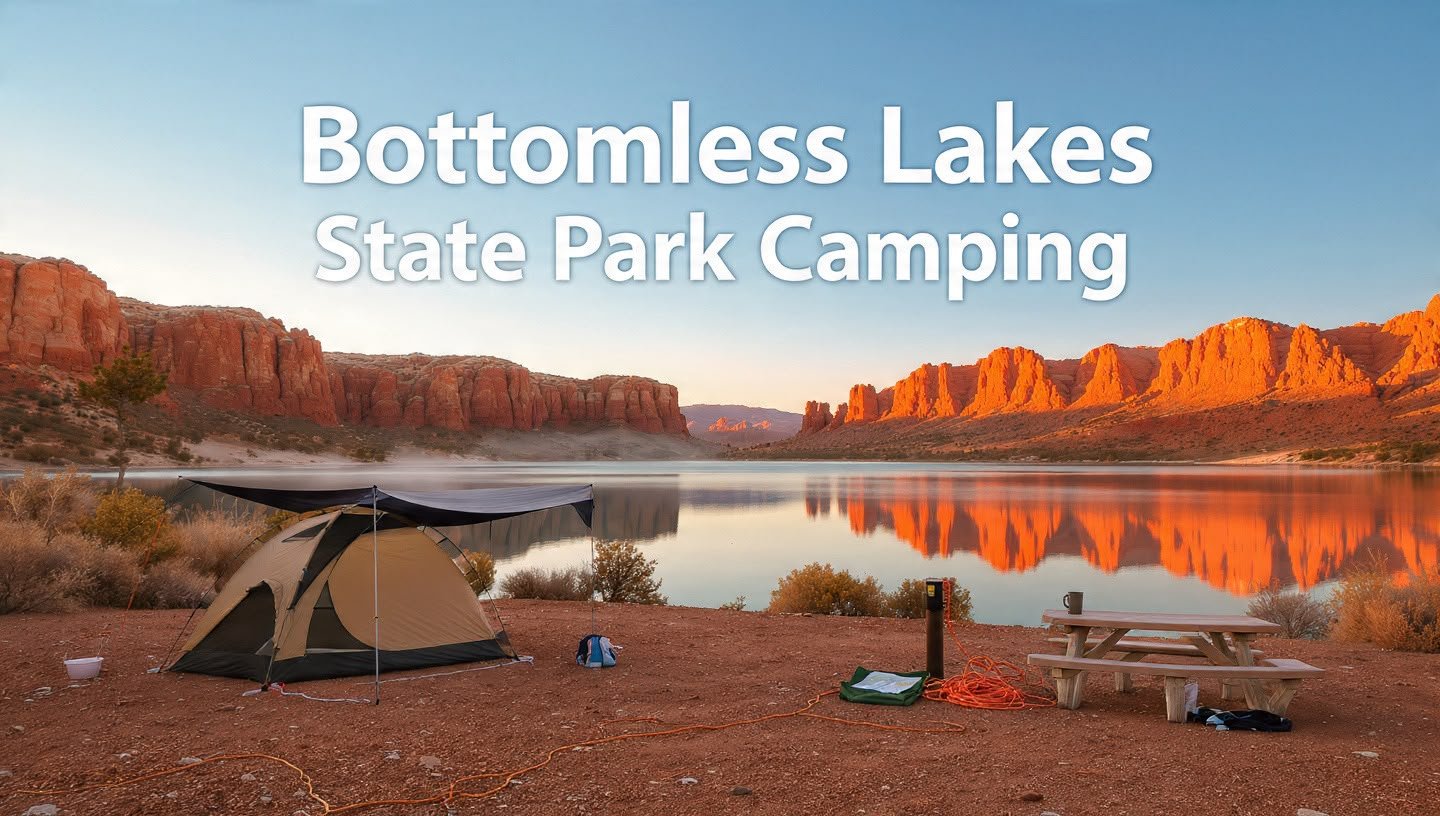
The best campsite at Bottomless Lakes State Park is a lakefront spot on the eastern edge of Lea Lake Campground. You wake up to still water reflecting red gypsum bluffs.
These nine sinkhole lakes formed when underground salt and gypsum dissolved and collapsed. The water is startlingly deep, alkaline, and a vivid blue-green that looks fake in photos.
This guide covers every campsite type, the reservation system, RV hookup specifics, and how to survive the summer heat. You will know exactly which loop to book before you reserve.
bottomless lakes state park camping
Bottomless Lakes State Park sits 12 miles southeast of Roswell, New Mexico. It protects nine sinkhole lakes in the Seven Rivers Basin of the Chihuahuan Desert.
The park offers one developed campground, named Lea Lake Campground, plus a group shelter area. Day-use areas with picnic tables and swim beaches ring several lakes.
All camping concentrates at Lea Lake Campground with electric and non-electric sites. The other lakes are strictly day-use, picnicking, hiking, or scuba diving access points.
Reservations are available through the New Mexico State Parks reservation system. Walk-in sites occasionally exist on weekdays during the off-peak fall and spring seasons.
First-time campers should know this park has zero shade trees on most sites. You must bring a shade canopy or you will bake in the desert sun.
Families with children thrive here because the shallow swim beach at Lea Lake is roped off. Experienced campers seeking solitude will find this campground too compact and social.
Spring and fall deliver ideal temperatures in the 70s and 80s Fahrenheit. Summer brings triple-digit heat and winter nights plunge well below freezing with unheated restrooms.
Most visitors underestimate the relentless spring wind that gusts through the Pecos River valley. Stake your tent with heavy-duty pegs or risk watching it cartwheel into the lake.
bottomless lakes new mexico camping
Camping at Bottomless Lakes means high-desert camping on the eastern plains of New Mexico. The terrain is flat, brushy, and dominated by red rock bluffs above alkaline lakes.
This is not forest camping with pine needles and mountain views. It is stark, open, and beautiful in the way wide desert horizons are beautiful.
The park is a reliable spring and fall destination for RV snowbirds moving through southeastern New Mexico. It makes a logical overnight stop between Carlsbad Caverns and points north.
Tent campers should look closely at the two walk-in sites near the lake’s edge. These are the only sites with any real separation from the main RV rows.
Budget travelers benefit from New Mexico’s state park fee structure. Nightly rates run lower than private campgrounds in Roswell and far lower than national park lodges.
Couples seeking a quiet romantic night should book site numbers in the upper loop furthest from the playground. Weekdays in October are nearly empty and perfectly still at sunset.
The nearest alternative camping is at Bitter Lake National Wildlife Refuge north of Roswell. That area has no developed campgrounds, only open-space day use and wildlife viewing.
Bottomless Lakes works best as a two-night maximum stay unless you are scuba diving for certification dives. There simply is not enough trail mileage or activity variety for a long stay.
Key Takeaway: Bottomless Lakes is a high-desert spring and fall campground, not a forested mountain retreat.
roswell nm camping
Roswell offers exactly one developed public campground within a 30-mile radius. That campground is Lea Lake at Bottomless Lakes State Park, and it is 12 miles away.
Most Roswell visitors come for the International UFO Museum and Research Center downtown. They discover too late that camping options are extremely limited within the city.
Private RV parks in Roswell include Red Barn RV Park and Trailer Village RV Park. These are gravel-lot operations with full hookups, laundry facilities, and no lake access.
Red Barn sits right on US-285 on the north side of town. It is convenient for a one-night road trip stop but has zero scenic appeal.
Bottomless Lakes State Park offers the only camping with a view and a swim beach. The trade-off is the 15-minute drive back into Roswell for groceries or restaurants.
Budget campers should compare the nightly state park fee plus day-use fee against a private RV park’s single nightly rate. The state park can be less expensive for families using the beach.
Families with alien-obsessed kids should camp at the state park and drive into Roswell for the day. The campground feels like an outdoor adventure, not a parking lot.
Solo road trippers wanting a quick overnight will find the private RV parks efficient but dull. Bottomless Lakes gives you a sunrise over the bluffs that makes the extra drive worthwhile.
Key Takeaway: Bottomless Lakes is your only scenic camping base near Roswell for a combined alien-tourism and outdoor trip.
lea lake campground
Lea Lake Campground is the sole overnight camping area inside Bottomless Lakes State Park. It loops around the north and west shores of the park’s largest and deepest lake.
The campground divides into two distinct sections with radically different experiences. There is a lakefront loop with electric hookups and an upper bluff loop set further back.
Lakefront sites on the eastern side sit directly above the water with a retaining wall. These sites have the best views, the most wind exposure, and the highest demand.
Upper bluff sites sit on a terrace about 100 yards back from the lake. These sites have slightly more wind protection from scrubby mesquite but zero water views.
Three walk-in tent sites occupy a small peninsula on the lake’s north shore. You park in a small lot and carry gear about 100 feet down a dirt path.
First-time visitors should know the lakefront electric sites book out weeks ahead for spring weekends. The bluff sites are easier to get but far hotter with less breeze off the water.
RV travelers dominate the electric loop, especially from February through April and October through November. Tent campers mix in on the walk-in sites and a few non-electric bluff pads.
The campground road is paved and navigable for any vehicle including large motorhomes. The inner turnaround at the far end of the lakefront loop is tight for rigs over 35 feet.
bottomless lakes rv sites
Lea Lake Campground offers approximately 20 sites with electric hookups suitable for RVs. The remaining sites are non-electric pads where RVs can still park for dry camping.
Maximum RV length accommodates rigs up to roughly 45 feet on the outer pull-throughs. The inner loop sites are back-in and realistically top out around 35 feet due to turning radius.
A dump station sits near the campground entrance road for registered campers. There is no sewer hookup at individual sites, so plan your tank capacity accordingly.
The electric service provides standard 30-amp and 50-amp pedestals at designated sites. Water spigots are shared between pairs of sites rather than individually dedicated to each pad.
RV travelers should know that the lakefront electric row has zero shade coverage over the asphalt pads. Your air conditioner will run constantly from May through September to maintain a livable temperature inside.
The upper bluff loop electric sites have a slight elevation advantage for wind. That breeze helps with cooling but also means you must secure awnings and slide-outs against sudden gusts.
Experienced RV campers should book site numbers near the dump station for easier departure mornings. The farthest lakefront sites require a long loop-around to reach the exit.
Big rigs over 40 feet should call the park directly before booking to confirm current road conditions. Verify the turnaround clearance at the far end has not been reduced by recent erosion or construction.
Key Takeaway: The lakefront electric sites are the prize but demand early booking, while bluff sites offer easier availability with more wind.
bottomless lakes tent camping
Tent camping at Bottomless Lakes works best during the shoulder seasons of spring and fall. Summer tent camping here is genuinely punishing with no shade and ground temperatures that radiate heat all night.
The three walk-in tent sites on the north shore peninsula are the park’s best-kept secret. Each site sits on packed dirt with a clear sightline across the lake to the eastern bluffs.
These walk-in sites have no electric hookups and share a water spigot with the nearby restroom. They feel more private than the RV rows, separated by a thin line of salt cedar.
Several non-electric sites on the upper bluff loop also accommodate tents on gravel tent pads. These pads are level and well-drained but completely exposed to the sun and wind.
Spring tent campers must use heavy-duty stakes rated for loose sand and high wind. The standard thin aluminum stakes that come with most tents will pull right out of the desert soil.
A freestanding dome tent with a full-coverage rainfly gives you the best wind protection. Tunnel tents with broad sidewalls catch wind like a sail and perform poorly here.
First-time tent campers should practice setting up their tent before arriving. The wind often kicks up by late morning and pitching a tent in a sandblasting gust is a miserable introduction to desert camping.
The campground is quiet after 10 p.m. with a strict noise policy that the camp host enforces. You will hear the wind through the mesquite and the occasional splash from Lea Lake.
bottomless lakes state park reservations
Reservations for Lea Lake Campground are made through the New Mexico State Parks reservation system. This system is a branded portal powered by Reserve America’s booking engine.
You can book online or by calling the New Mexico State Parks reservation line. Same-day walk-in sites are sometimes available midweek during the fall and winter off-season.
Reserve America handles the transaction but the specific park manages on-site check-in. Print your confirmation or save a screenshot because cell service can be spotty at the park entrance.
Peak season booking lead time for the lakefront electric sites runs four to six weeks ahead. Spring weekends from March through May are the single hardest reservation to secure for these specific pads.
The bluff loop electric sites usually have availability within two weeks of arrival. The walk-in tent sites are the last to book and sometimes remain open on weekdays throughout the year.
Families booking for spring break should reserve the moment their travel dates firm up. The park fills completely during Roswell’s UFO Festival weekend in early July, so book months ahead for that event.
A day-use fee is separate from the camping fee and applies per vehicle on entry. Annual camping permit holders for New Mexico State Parks pay the camping fee but may receive a discount on the day-use charge.
Verify the reservation platform and cancellation policy directly with New Mexico State Parks before booking. Third-party sites sometimes advertise availability that does not exist on the official system.
new mexico state parks reservation system
The New Mexico State Parks reservation system operates through a co-branded Reserve America portal. You create a free account, search for the park, and select a specific campsite by number.
The site map shows which loops have electric hookups and which are non-electric. Each site listing includes pad dimensions, surface type, and maximum vehicle length where applicable.
Booking windows typically open six months in advance for most New Mexico State Parks. Bottomless Lakes falls under this standard policy, but verify the exact window for your intended dates.
The system charges a per-night camping fee plus a non-refundable reservation processing fee. You pay the full camping amount at the time of booking, not on arrival.
First-time users of the New Mexico system should select a specific site number rather than accepting any available. The lakefront row and the upper bluff row are completely different experiences, as this guide has detailed.
The online interface lets you view photos of the view from individual sites in some cases. These are not always current, so consult recent The Dyrt or Campendium reviews for updated site condition reports.
Solo travelers and couples should filter for sites at the far ends of loops away from the playground. Families with young children should book sites within sight of the swim beach for easy supervision.
If you miss the reservation window, call the park directly at the visitor center number. Cancellations sometimes open up lakefront sites a few days before weekend dates.
Key Takeaway: Book by site number, not availability, and know the difference between the lakefront and bluff loops before you click reserve.
bottomless lakes rv hookups
RV electric hookups at Lea Lake Campground are 30-amp and 50-amp pedestals on designated lakefront and bluff sites. There are no individual water or sewer hookups at any site in the campground.
Potable water spigots are shared, typically positioned between every two sites along the loops. Bring a long drinking-water hose of at least 25 feet to reach the spigot from your fill port.
The dump station near the campground entrance handles gray and black water for registered guests. There is a rinse-water hose at the station, but it is non-potable for cleaning use only.
RV travelers with onboard generators can boondock on the non-electric bluff sites without hookups. Generator hours are restricted, typically quiet hours run from 10 p.m. to 7 a.m., so plan battery charging accordingly.
The electrical boxes are modern and well-maintained according to recent user reviews on The Dyrt. Still, carry a surge protector because desert thunderstorms can cause brief power fluctuations during monsoon season.
Big rigs should target the pull-through sites on the outer edge of the bluff loop. These sites are marked on the reservation system map and provide the easiest exit without a multi-point turn.
The lakefront electric row is a back-in configuration with a retaining wall directly behind the pad. Take care backing up because the drop-off to the lake is unprotected beyond the wall.
Check the specific amp rating of your assigned site on the reservation confirmation. Adapters are available at hardware stores in Roswell if your rig’s plug does not match the pedestal configuration.
bottomless lakes state park showers
Lea Lake Campground has a shower facility with flush toilets near the lakefront loop. The showers are coin-operated and provide hot water with decent pressure according to recent visitor reports.
This shower building is the only one in the campground and can get busy on summer mornings. The line forms early, especially on weekends when families are cleaning up after swim beach visits.
A second restroom with vault toilets services the upper bluff loop and tent sites. This facility has no running water for showers but has a hand-washing station with potable water.
First-time campers should bring quarters for the shower timer. The park office does not always have change available, and the nearest ATM is 12 miles away in Roswell.
The showers are cleaned daily by park staff but expect desert dust to accumulate quickly. Flip-flops or water shoes are essential because the concrete floor stays wet and gritty all day.
RV travelers with onboard showers can avoid the coin-op system entirely by using their own facilities. This is a significant advantage at this park, especially during peak weekend hours.
Solo travelers should use the showers mid-afternoon when the facility is nearly empty. Families dominate the morning slot and couples tend to shower after sunset.
The shower building closes during winter months when freezing temperatures risk pipe damage. Verify the current operational status and hours with the park before visiting between November and February.
Key Takeaway: Bring quarters, flip-flops, and plan to shower mid-afternoon to avoid weekend family rush.
bottomless lakes state park directions
Bottomless Lakes State Park is on New Mexico Highway 409, about 12 miles southeast of Roswell. The signed turnoff from US-380 is unmistakable and leads south for roughly four miles to the entrance.
From Roswell, take US-380 east toward the town of Dexter. Turn right onto NM-409 at the large brown Bottomless Lakes State Park sign and follow it straight to the fee station.
The road is paved in its entirety from US-380 to the park entrance and campground loops. Any vehicle can make this drive with no ground clearance or four-wheel-drive concerns.
A park entrance fee is collected at a self-pay kiosk or visitor center during operating hours. Have cash or a card ready because the self-pay kiosk does not always process mobile payments reliably.
First-time visitors should know that the campground is not visible from the entrance road. You pass Lea Lake on the right, then the road curves left and climbs gently to the campground entry.
The visitor center sits near the entrance before the campground turn. Stop here to check in, get a park map, and ask about current trail conditions or dive permit requirements.
GPS directions typically route correctly to the park address on NM-409. Download an offline Google Map of the area before leaving Roswell because cell service drops in patches along the highway.
Travelers arriving after dark should note that NM-409 has no streetlights. The park entrance is lit but the campground interior roads are dark and the pedestrian crossing near the shower building is not illuminated.
driving from roswell to bottomless lakes
The drive from downtown Roswell to Bottomless Lakes State Park takes about 15 to 18 minutes. It covers 12 miles on US-380 east and then NM-409 south with minimal traffic at any time of day.
Google Maps shows a driving time of 14 minutes with no stops. Plan for 20 minutes if you are fueling up or grabbing groceries at the stores on North Main Street before heading out.
The closest full grocery store is the Albertsons on North Main Street in Roswell. Stock up here because there is no camp store inside the park selling food, ice, or firewood.
Fuel stations cluster around the intersection of US-380 and US-285 in Roswell. Fill your tank before heading southeast because the nearest gas to the park is back in Roswell or tiny Dexter.
RV drivers should know that US-380 is a wide four-lane highway through Roswell before narrowing to two lanes east of town. It is well-maintained with broad shoulders and no steep grades.
NM-409 is a narrow two-lane road with no centerline in some sections. Drive cautiously because local farm trucks and dive-school vans use this road and the shoulder drops off into gravel.
Dexter, a small farming town three miles east of the NM-409 turnoff, has a convenience store with basic snacks and drinks. Do not count on it for camping supplies or hot food after dark.
The open fields along NM-409 are a known area for dust storms during spring wind events. If visibility drops, pull well off the road, turn off your lights, and wait it out.
Key Takeaway: Stock up in Roswell, fill your tank, and download offline maps before the 12-mile drive southeast.
best time to camp bottomless lakes
The best months for camping at Bottomless Lakes are late March through early May and late September through early November. Daytime temperatures hover in the 70s and 80s with cool, comfortable nights.
Spring brings the park’s wildflower bloom when desert marigolds and verbena color the lake edges. The trade-off is frequent high-wind days with sustained gusts over 30 miles per hour.
Fall delivers the most stable weather of the year at this park. October is the single best month for calm mornings, warm afternoons, and spectacular desert sunsets reflecting on Lea Lake.
Winter camping from December through February is feasible for RVs with onboard heating. Tent campers will face overnight lows in the 20s Fahrenheit and restroom facilities with no heat.
Summer from June through August tests the limits of tent camping in the Chihuahuan Desert. Daytime highs routinely exceed 100 degrees Fahrenheit and the unshaded sites hold heat well past midnight.
RV travelers in summer should book an electric site and run air conditioning continuously. The lakefront breeze helps somewhat but it is still extreme, unrelenting desert heat.
Families with school-age children often have no choice but to camp in July. Book a lakefront electric site, bring a sun shelter, and plan activities for the early morning and evening hours only.
Wind season peaks from March through April across eastern New Mexico. The Pecos River valley funnels gusts that can snap fiberglass tent poles and send unsecured canopies airborne.
bottomless lakes summer heat
Summer heat at Bottomless Lakes State Park is severe, with daytime highs regularly exceeding 100 degrees Fahrenheit from June through August. Overnight lows often stay above 75 degrees, offering little relief for tent campers.
The campground has no shade trees anywhere on the camping loops. The sun beats down on asphalt pads, gravel tent sites, and the metal picnic tables from sunrise until well after 6 p.m.
RV travelers with functioning air conditioning can manage a summer stay on an electric site. Tent campers without a portable fan or shade structure should seriously reconsider a July or August visit.
The most dangerous time for heat exposure is between 1 p.m. and 5 p.m. The park’s swim beach at Lea Lake is the only practical refuge during these hours.
Lea Lake’s water is alkaline and stays cool at the surface even in midsummer. Swimming provides genuine relief, but you must reapply sunscreen constantly because the water reflects UV rays.
Dehydration risk is high because the dry desert air wicks moisture from your skin rapidly. Carry at least one gallon of water per person per day and drink it before you feel thirsty.
Heat exhaustion symptoms include headache, nausea, and cold clammy skin despite the high temperature. The nearest emergency room is in Roswell, a 20-minute drive from the campground.
Park staff recommends limiting outdoor activity to before 10 a.m. and after 6 p.m. during extreme heat days. The hiking trails have no shade and no water sources anywhere along their routes.
Key Takeaway: Summer tent camping here is an endurance test; RV air conditioning and the swim beach make it survivable.
bottomless lakes hiking trails
Bottomless Lakes State Park has a modest trail system with three named routes. These are the Wetland Trail, the Bluff Trail, and an unmarked connector path along the park road.
The Wetland Trail is a short boardwalk loop near Cottonwood Lake. It crosses a cattail marsh fed by a spring and is the best bird-watching spot in the park for herons and red-winged blackbirds.
This boardwalk is flat, wheelchair-accessible, and less than half a mile long. Families with young children can complete it in 20 minutes and see turtles basking on logs in the marsh.
The Bluff Trail climbs from the day-use area near Lea Lake up onto the red rock rim. It is roughly a half-mile out and back with a steep, rocky scramble at the upper section.
Hikers on the Bluff Trail reach an overlook that gives the best park-wide view of Lea Lake. You can see the campground, the swim beach, and the full outline of the sinkhole from this perch.
Do not hike the Bluff Trail during the midday summer heat. The red rock reflects heat upward and the trail surface is loose gypsum scree that offers poor footing when you are tired.
The unmarked road-side path connects the campground to the Devil’s Inkwell overlook. It is a packed-dirt track with no signage but easy to follow along the park road’s edge.
Experienced hikers seeking real trail mileage should drive to Lincoln National Forest two hours west. Bottomless Lakes is for short walks, bird-watching, and overlook views, not all-day treks.
scuba diving bottomless lakes
Scuba diving is a unique permitted activity at Bottomless Lakes State Park. Lazy Lagoon and Devil’s Inkwell are the two designated dive lakes with specific entry protocols.
Divers must check in at the park visitor center and present an active dive certification card. A dive permit is required, and the park enforces this policy through ranger patrols of the dive sites.
Lazy Lagoon is the more popular dive site with a gently sloping entry and submerged training platforms. The water is clear and alkaline, with visibility that varies from 10 to 30 feet depending on recent wind.
Devil’s Inkwell is the deepest sinkhole in the park, plunging past 90 feet. It is a narrow, steep-walled hole with a small surface area and a ladder for entry and exit.
The alkaline water feels silky on the skin and is so buoyant from mineral content that divers need extra weight. First-time divers at this altitude and alkalinity should adjust their weight belt accordingly.
Scuba schools from Roswell and across New Mexico conduct certification dives at Lazy Lagoon on weekends. The park can feel like a dive training center on Saturday mornings in spring and fall.
Campers who dive can walk from the Lea Lake Campground to the dive lakes in about 10 minutes. This is the single best reason to camp here for a full weekend as a diver.
Never dive alone and always log your dive with the park. Cell service is spotty at Devil’s Inkwell and an emergency requires a rapid drive to the visitor center for radio contact.
Key Takeaway: Bottomless Lakes is a genuine scuba destination, not a novelty, and campers who dive get the most complete park experience.
Comparison Table: Lea Lake Campground Site Types
| Site Category | Hookup Type | Shade | Best Profile | Honest Note |
|---|---|---|---|---|
| Lakefront Electric | 30/50 amp | None | RV travelers, families | Best views, highest demand, bakes in afternoon sun |
| Upper Bluff Electric | 30/50 amp | Minimal | RV travelers, snowbirds | More wind, less demand, no lake view |
| Upper Bluff Non-Electric | Water nearby | None | Budget tent campers | Exposed gravel pads, no privacy |
| Walk-In Tent (Peninsula) | None | Slight from salt cedar | Couples, solo tent campers | Best privacy, short carry from lot, no hookups |
Important Safety and Conditions Notes for Bottomless Lakes
Wind and heat are the two primary hazards at this park. Either one can ruin your trip if you arrive unprepared with the wrong gear or unrealistic expectations.
Verify the following before your trip:
- Current wind forecast for Roswell and eastern New Mexico plains via the National Weather Service
- Fire restriction status, which changes by season and drought condition, on the New Mexico State Parks website
- Shower facility operational status during winter months by calling the park visitor center directly
- Scuba diving permit requirements and current visibility conditions with the park ranger station
- Road conditions on NM-409 after heavy monsoon rain, which can cause temporary shoulder washouts
Secure your tent and canopy with stakes rated for sand and high wind. The single most important action before leaving camp for any activity is checking that nothing is loose.
Frequently Asked Questions About Bottomless Lakes State Park Camping
Do you need a reservation for Bottomless Lakes State Park camping?
Reservations are strongly recommended for all lakefront electric sites during spring and fall weekends.
Walk-in sites may be available midweek during the off-peak winter and late summer months.
Book through the New Mexico State Parks reservation system via Reserve America up to six months in advance.
Are there RV hookups at Bottomless Lakes State Park?
Yes, Lea Lake Campground has 30-amp and 50-amp electric hookups on designated lakefront and bluff loop sites.
There are no individual water or sewer hookups at any site, but shared water spigots and a dump station exist.
Verify your assigned site’s specific amp rating on the reservation confirmation before arrival.
Can you swim in Bottomless Lakes near Roswell, NM?
Yes, swimming is permitted only at the designated Lea Lake swim beach with its roped-off shallow area.
The other lakes are restricted to scuba diving with a permit or are closed to all water access.
The alkaline water is clean and buoyant, but goggles are recommended because the mineral content stings eyes.
What is the best time of year to camp at Bottomless Lakes?
Late March through early May and late September through early November offer the best weather.
October is the single finest month with calm mornings, warm afternoons, and cool desert nights.
Avoid mid-summer tent camping and be prepared for high wind during the spring months of March and April.
Is there dispersed camping near Bottomless Lakes State Park?
No, there is no legal dispersed camping inside the park boundaries or on the immediate surrounding state land.
Bureau of Land Management parcels exist further west and north of Roswell where dispersed camping may be allowed.
Always verify current BLM Roswell Field Office regulations and fire restrictions before attempting any dispersed camping nearby.
How far is Bottomless Lakes State Park from Carlsbad Caverns?
The drive from Bottomless Lakes State Park to Carlsbad Caverns National Park takes about one hour and 40 minutes.
The route goes south on US-285 through Artesia and Carlsbad, covering roughly 95 miles one way.
It is a manageable day trip for campers using Lea Lake Campground as a base for both Roswell and Carlsbad explorations.
Plan Your Bottomless Lakes Camping Trip
Bottomless Lakes State Park delivers a specific and memorable high-desert camping experience for the right traveler at the right time. Lakefront electric sites are the prize here and they book first.
Open the New Mexico State Parks reservation system and pick a specific site number, not just a site type. Know whether you are booking the lakefront row with the view and the sun or the bluff loop with the breeze and easier availability.
State park fees, reservation windows, and fire restriction levels all change without notice. Verify everything with the New Mexico State Parks Division directly before you confirm your reservation and pack your gear.