Skincare Consultation: What to Expect and How to Prepare in 2026
A skincare consultation is a structured, one-on-one assessment with a trained professional who evaluates your skin health, identifies concerns, and develops a personalized routine or treatment plan based on clinical findings rather than marketing claims. You walk away with a clear understanding of what your skin actually needs, what it does not need, and the exact order and frequency of products or treatments to follow.
According to the American Academy of Dermatology, the distinction between who performs your consultation matters clinically: board-certified dermatologists diagnose and treat medical skin conditions including skin cancers, while licensed estheticians focus on cosmetic skin health, product selection, and non-medical treatments within their state-defined scope of practice. A 2023 survey published in the Journal of the American Academy of Dermatology found that nearly 40% of patients who sought skincare advice online had never had an in-person skin assessment, which means a substantial number of people are building routines without knowing their actual skin type, barrier function status, or whether their concerns have a medical component requiring diagnosis.
This article covers every phase of the skincare consultation process: what happens before, during, and after your appointment. You will learn how to choose between provider types, what to bring, which questions generate useful answers, how consultations differ for acne, anti-aging, and sensitive skin, what red flags signal a poor consultation, and how to track whether the recommendations are actually working over time.
Skincare Consultation
A skincare consultation is a professional skin assessment where a qualified provider examines your skin, reviews your history, identifies conditions or concerns, and recommends a specific routine, product categories, in-office treatments, or medical interventions based on what they observe and what you report.
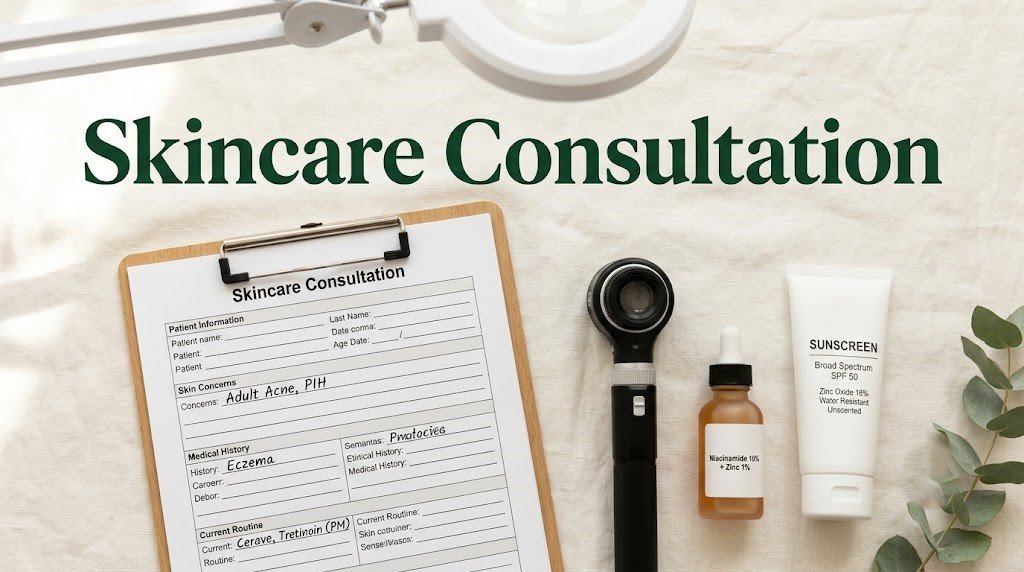
This is not the same as a quick product recommendation at a beauty counter or an online skin quiz that assigns you a routine based on three multiple-choice questions. A legitimate skincare consultation involves direct visual examination, often with magnification or imaging technology, and structured questioning about your history, triggers, previous product reactions, medications, sun exposure, and lifestyle factors that affect skin biology. The consultation produces a plan that should explain not only what to use but why each step exists, in what order, and with what expected timeline for results.
Think of a skincare consultation like taking your car to a mechanic who opens the hood instead of someone who tells you what to buy based on the car’s paint color. The assessment goes beneath the surface to identify what is actually happening at the stratum corneum, in the sebaceous glands, and within the dermal matrix where collagen and elastin reside. A good provider will use tools ranging from a Wood’s lamp (which reveals pigmentation irregularities and bacterial presence under UV light) to a corneometer (which measures stratum corneum hydration levels) to a dermatoscope (which magnifies skin structures for lesion assessment). These tools provide objective data that routine recommendations can be built on.
Provider qualifications matter here in ways that affect what can legally and safely be recommended. A board-certified dermatologist has completed medical school, a dermatology residency, and board examinations, and they can prescribe medications including tretinoin, oral antibiotics, spironolactone, or isotretinoin. A licensed esthetician has completed state-required training hours and passed licensing exams, and they can perform cosmetic treatments like facials, extractions, and chemical peels within their scope but cannot diagnose medical conditions or prescribe medications. Understanding this distinction before you book determines whether you receive medical treatment, cosmetic guidance, or both.
Key Takeaway: A skincare consultation is a clinical or professional skin assessment, not a product recommendation session; the provider’s credentials determine what can be diagnosed and recommended.
Skincare Consultation What to Expect
A skincare consultation typically follows a three-part structure: intake and history review, physical skin examination, and treatment or routine plan development with product or procedure recommendations delivered before you leave.
The intake phase starts when you arrive and complete a health history form, which a quality consultation will require even if you booked a cosmetic-focused appointment. Expect questions about current medications (including over-the-counter supplements and hormonal contraceptives, which directly affect skin through androgen pathway modulation), known allergies, previous product reactions, diagnosed skin conditions, pregnancy or nursing status, and what products you currently use with their application frequency. A provider who skips this step is not practicing safely, because your tretinoin prescription interacts with waxing services, your doxycycline interacts with sun exposure recommendations, and your pregnancy status contraindicates retinoids entirely.
The examination phase involves your provider looking at your skin under bright, even lighting, often with magnification. You may be asked to remove any makeup, which is why arriving bare-faced matters. The provider should examine not just your face but your neck, chest, and potentially other areas if you have body skin concerns. For people with Fitzpatrick skin types IV through VI, this examination should pay particular attention to hyperpigmentation patterns, since post-inflammatory hyperpigmentation is the most common presenting concern in deeper skin tones and treatment approaches must account for melanocyte sensitivity. A dermatoscope or Wood’s lamp may be used to examine specific lesions or pigmentation patterns more closely.
The recommendation phase should produce a written or printed plan. This plan should name product categories (not necessarily specific brands, though many providers will recommend products they trust), the order of application, AM versus PM distinction, and timelines for introduction. If a product is recommended that the provider sells in-office, this should be disclosed transparently. You should leave knowing what to start immediately, what to introduce slowly, and when to schedule a follow-up. The American Academy of Dermatology advises that any routine recommendation should include sunscreen guidance regardless of the primary concern being addressed.
Key Takeaway: Expect intake paperwork, a bare-skin examination under magnification, and a written plan with product categories, timing, and follow-up instructions before you leave.
Skincare Consultation vs Dermatologist Appointment
A skincare consultation focuses on routine building and cosmetic skin health optimization, while a dermatologist appointment can additionally diagnose medical conditions, perform skin cancer screenings, prescribe medications, and treat disease processes affecting the skin.
The overlap between these two types of visits exists because many dermatologists now offer cosmetic consultations alongside medical services, and some estheticians work within dermatology practices. But the core difference remains the clinical scope. If you have a lesion that could be skin cancer, a dermatologist performs a biopsy and sends it to a dermatopathologist for analysis; an esthetician cannot and should not attempt to diagnose or treat it. If you have cystic acne that may require isotretinoin, only a dermatologist, or in some states a physician assistant or nurse practitioner under dermatologist supervision, can prescribe that medication and monitor the required monthly blood work.
A 2022 study in the Journal of the American Academy of Dermatology examining patient understanding of provider qualifications found that nearly 30% of patients could not accurately distinguish between a board-certified dermatologist and other skincare providers. This confusion leads people to book the wrong type of appointment for their actual concern. Here is how to decide:
If your concern includes any of the following, book a dermatologist appointment: a changing mole or new growth, persistent rash that has not responded to over-the-counter treatments, severe cystic or nodular acne, hair loss, nail changes, or any skin condition causing pain, bleeding, or functional impairment. If your concern is primarily cosmetic: dullness, texture irregularity, mild to moderate acne without scarring, fine lines, product selection guidance, or routine optimization, a skincare consultation with a licensed esthetician or a cosmetic dermatology consultation may serve you well.
Insurance coverage differs between these visit types. Medical dermatology visits for diagnosed conditions are typically covered by health insurance with standard copays and deductibles applying. Cosmetic skincare consultations are generally out-of-pocket. Know which type you are booking and what your insurance covers before you arrive, because the billing codes differ substantially and the cost difference can be hundreds of dollars.
Key Takeaway: A dermatologist treats medical skin conditions and can prescribe; a skincare consultation with an esthetician addresses cosmetic concerns and routine optimization; know which you need before you book.
Esthetician vs Dermatologist for Skincare Routine
A licensed esthetician builds skincare routines around cosmetic products, in-office treatments, and non-prescription actives, while a board-certified dermatologist can additionally incorporate prescription-strength ingredients, diagnose underlying conditions that affect routine tolerance, and manage medication interactions with skincare products.
This distinction shapes what your routine looks like depending on who you see. An esthetician’s routine will typically include professional-grade but OTC products: cleansers with salicylic acid or glycolic acid at concentrations up to 2% and 10% respectively, serums with niacinamide, ascorbic acid, or bakuchiol, moisturizers with ceramides and sodium hyaluronate, and broad-spectrum sunscreens with zinc oxide or titanium dioxide. They may also recommend in-office treatments like chemical peels, microdermabrasion, or LED therapy that complement the home routine.
A dermatologist’s routine often includes prescription actives that work at the cellular level with greater potency: tretinoin (all-trans-retinoic acid) at 0.025%, 0.05%, or 0.1%, which binds directly to retinoic acid receptors in keratinocyte nuclei without requiring conversion steps that OTC retinol requires, or azelaic acid at 15% or 20% for rosacea and post-inflammatory hyperpigmentation, concentrations not available without a prescription. Dermatologists can also prescribe oral medications like spironolactone for hormonal acne or doxycycline for inflammatory acne that work systemically to reduce sebum production and inflammation in ways no topical product can replicate.
For many people, the ideal arrangement is a dermatologist who diagnoses and manages medical skin conditions combined with a skilled esthetician who handles the cosmetic routine and maintenance treatments, both communicating with each other. This dual-provider model works because the dermatologist ensures nothing in the routine conflicts with medical treatment and the esthetician provides the hands-on care and product expertise that medical visits often lack time for. The FDA does not regulate estheticians at the federal level, so scope of practice varies by state; check your state’s cosmetology board for specific definitions.
If you have a diagnosed condition like rosacea, atopic dermatitis, or psoriasis, start with a dermatologist. Your skin barrier is compromised in ways that change which ingredients are safe, and an esthetician’s standard exfoliation protocol could trigger a flare that a dermatologist would have anticipated and avoided.
Key Takeaway: Estheticians excel at cosmetic routine building with professional-grade OTC products; dermatologists add prescription potency and medical oversight; the best outcomes often come from both working in coordination.
Virtual Skincare Consultation
A virtual skincare consultation delivers professional skin assessment and routine recommendations through video conferencing, using high-resolution imaging, structured intake forms, and patient-reported data to approximate an in-person evaluation without requiring physical presence.
Telemedicine and virtual esthetic consultations expanded dramatically since 2020, and the 2026 landscape includes refined protocols that make these appointments more useful than they were five years ago. According to a 2024 review published in the British Journal of Dermatology, teledermatology consultations achieved diagnostic agreement with in-person visits in approximately 80% of cases when supported by high-quality patient-submitted photographs and complete intake documentation. For routine skincare consultations focused on cosmetic concerns rather than diagnostic questions, the effectiveness gap narrows further.
The process works like this: You receive an intake form electronically, often 24 to 48 hours before your appointment. You will be asked to submit photographs taken in specific lighting conditions (natural daylight, no direct sun, multiple angles including both sides of the face and close-ups of any areas of concern). During the video call, your provider reviews these images with you, asks the same structured history questions an in-person consultation would include, and develops a routine plan based on what they can observe plus what you report.
Virtual consultations have specific limitations you should understand before booking. A provider cannot palpate your skin to assess texture, elasticity, or lesion depth through a screen. They cannot use a Wood’s lamp, dermatoscope, or corneometer, which means certain diagnostic information is simply unavailable. If your concern includes a lesion that needs ruling out for malignancy, a virtual consultation is not appropriate and you need an in-person dermatology visit with dermatoscopy. For routine acne, anti-aging, texture, and sensitivity concerns where the diagnosis is already clear, virtual consultations provide genuine value with the convenience of doing them from home.
Cost for virtual skincare consultations in 2026 ranges from $75 to $250 depending on the provider’s credentials and the consultation length. Insurance rarely covers cosmetic virtual consultations, though some teledermatology visits for medical concerns may be billable.
Key Takeaway: Virtual skincare consultations work well for cosmetic routine guidance and follow-ups, but cannot replace in-person visits when lesion examination, palpation, or diagnostic tools are needed.
How to Prepare for Skincare Consultation
Preparing for a skincare consultation means arriving with clean, bare skin, a complete list of your current products and medications, specific photographs of your skin at its best and worst, and a written list of your top three skin concerns ranked by priority.
The single most important preparation step is stopping actives 48 to 72 hours before your appointment if your skin can tolerate the pause without a flare. This means no retinoids, no alpha-hydroxy acids, no beta-hydroxy acids, no physical exfoliants, and no harsh cleansing brushes. The reason is clinical: an active-ingredient-compromised barrier, with visible peeling or redness from recent tretinoin use, looks different from your baseline skin and can lead the provider to misidentify your actual skin type and sensitivity level. If you have rosacea or atopic dermatitis and stopping your prescription creates an immediate flare risk, do not stop it; instead, note the last application date and inform your provider at the start of the consultation.
Second, document everything you are currently using. Write down the exact product names, not just “a vitamin C serum” but “15% L-ascorbic acid serum, applied every morning.” List the frequency (daily, twice daily, every other day, weekly). Note any products you stopped in the past three months and why, especially if you discontinued something because you suspected a reaction. This history gives your provider information about what your skin has tolerated and what it has rejected, which is more informative than starting from a blank slate.
Third, bring photographs of your skin across time if you have them. A photo taken six months ago when a particular product seemed to work well, or a photo from last month during a breakout, gives your provider longitudinal data that a single-snapshot examination cannot provide. For people with cyclical hormonal acne, a photo series across different points in the menstrual cycle is especially valuable because it demonstrates the pattern in ways a description cannot.
Fourth, prepare your questions. Write them down. A consultation where you forget to ask the thing you most wanted to know wastes your time and money. The questions section later in this article provides specific phrases and topics to cover, but the principle is simple: if it matters to your skin, it belongs on the list.
Key Takeaway: Arrive with bare skin stopped from actives 48 to 72 hours prior, a written product and medication list, skin photos over time, and your top questions written down.
What to Bring to Skincare Consultation
Bring to your skincare consultation your current product containers or clear photographs of ingredient lists, your medication list with dosages, identification and insurance card if applicable, a notepad or phone for recording recommendations, and any previous skincare or dermatology records.
The product containers matter more than the product names because ingredient lists tell your provider exactly what concentrations and formulations you are using. A moisturizer called “barrier repair cream” might contain ceramide NP, ceramide AP, and cholesterol at effective ratios, or it might contain primarily dimethicone with a trace of ceramides for label appeal. Your provider cannot evaluate your current routine without seeing the INCI lists. If bringing containers is impractical, take clear, legible photographs of each product’s full ingredient panel and the product name.
Your medication list must include everything: prescription medications with dosages, over-the-counter drugs, supplements, and hormonal contraceptives. Spironolactone directly reduces sebum production through androgen receptor blockade, which changes how your provider evaluates your oiliness and acne. Oral contraceptives with anti-androgenic progestins like drospirenone similarly alter sebum profiles. Biotin supplements can interfere with certain lab tests relevant to thyroid and hormone panels if your dermatologist orders blood work. Your provider needs the complete pharmacological picture to make safe recommendations.
If you have seen another dermatologist, esthetician, or healthcare provider for your skin previously, bring any records, photographs, or treatment plans from those visits. A history of what was tried and what did or did not work prevents your new provider from recommending something that already failed or duplicating diagnostic work that has already been completed. This is particularly important if you received prescription treatments that were discontinued for side effects; your new provider needs to know which specific medication caused which reaction.
Your notepad or phone is for recording the recommendations. A good consultation produces specific information: product categories, ingredient names, application order, frequency, introduction timelines, and follow-up intervals. You will not remember all of it accurately an hour later. Write it down or ask permission to record the recommendation portion of the visit.
Key Takeaway: Bring product containers or full ingredient-list photos, your complete medication and supplement list, prior skincare records, and a way to record the recommendations.
Skincare Consultation Form
A skincare consultation form is the structured intake document that collects your medical history, medication list, allergy status, current skincare routine, skin concerns, lifestyle factors, and treatment goals before the provider sees your skin.
The form serves clinical, legal, and practical functions simultaneously. Clinically, it surfaces information the provider needs to make safe, effective recommendations: that you are currently using adapalene 0.1% nightly, that you had an allergic reaction to a product containing benzoyl peroxide two years ago, that you are six months postpartum and still nursing, that you take doxycycline for an unrelated condition and photosensitivity is therefore a heightened concern. Legally, it documents that the provider asked about and you disclosed these factors, which protects both parties if a complication arises. Practically, it structures the consultation so the provider can spend the limited appointment time on examination and planning rather than gathering basic history verbally.
A well-designed consultation form will ask specific questions about your skin across multiple dimensions. Current skin concerns, ranked. Onset and duration of each concern. What makes each concern better or worse. Previous treatments tried and results. Current skincare routine with product names and frequency. Medications and supplements. Known allergies to skincare ingredients, medications, or environmental triggers. Skin cancer history, personal and family. Sun exposure patterns and sunscreen use. Pregnancy, nursing, or pregnancy planning status. Previous cosmetic procedures including injectables, lasers, and peels. Your goals for your skin in specific, observable terms rather than vague aspirations.
If you receive a form that only asks for your name, contact information, and one line about your skin concern, that is a red flag. A consultation built on that thin of an intake cannot be safely or effectively personalized.
Some providers now use digital intake systems that analyze your responses to flag potential contraindications before the provider even enters the room. For example, if you indicate current tretinoin use and also request a chemical peel, the system may alert the provider to a potential conflict that requires discussion. This technology does not replace clinical judgment but improves the safety net around the consultation.
Key Takeaway: The consultation form should collect complete medication, allergy, routine, and health history; a form that skips these is a safety and quality red flag.
Skincare Consultation Intake Form Questions
Skincare consultation intake form questions typically cover eight categories: current concerns, medical history, medication and supplement use, current skincare routine, allergy and sensitivity history, lifestyle factors, prior treatments, and treatment goals.
The questions should be specific enough to generate actionable information. Here is what a thorough intake form asks in each category:
Current concerns: What specific skin issues are you seeking to address? How long has each been present? What triggers make each concern worse? What, if anything, has improved each concern? Rate the severity of each concern on a scale where it affects your daily life.
Medical history: Have you been diagnosed with any skin conditions (rosacea, eczema, psoriasis, perioral dermatitis, seborrheic dermatitis, melasma, vitiligo, or other)? Do you have a personal or family history of skin cancer? Do you have any autoimmune conditions? Are you currently pregnant, nursing, or planning pregnancy within the next year? Do you have a history of hypertrophic scarring or keloid formation? Do you have cold sores or a history of herpes simplex virus outbreaks?
Medication and supplement use: List all prescription medications with dosages. List all over-the-counter medications. List all supplements including vitamins, minerals, herbal products, and protein or collagen powders. Are you currently using any prescription topical medications on your skin? Are you using hormonal contraception or hormone therapy?
Current skincare routine: List every product you currently use on your skin, including cleansers, toners, serums, moisturizers, oils, sunscreens, masks, and treatments. For each product, note how often you use it. Have you introduced or discontinued any products in the past three months?
Allergy and sensitivity history: Have you ever had an allergic reaction to a skincare product? What product, and what was the reaction? Do you have known allergies to any ingredients, fragrances, preservatives, or botanical extracts? Have you ever had a reaction to a cosmetic procedure?
Lifestyle factors: What is your typical daily sun exposure? What sunscreen do you use, what SPF, and how often do you reapply? Do you smoke or vape? How many hours do you typically sleep per night? Describe your typical diet in terms of what you eat most days. What is your typical weekly alcohol consumption? What is your occupation and does it involve sun, chemical, or environmental exposure?
Prior treatments: Have you had any previous skincare consultations? What was recommended and what were the results? Have you had professional chemical peels, microdermabrasion, microneedling, laser treatments, IPL, injectables, or other cosmetic procedures? When and with what results?
Treatment goals: What would you like your skin to look and feel like after following the recommended routine for three months? Be as specific as possible.
Providers who review your answers before entering the room demonstrate respect for your time and information. Providers who skim the form in front of you for the first time during the consultation are not adequately prepared.
Key Takeaway: A thorough intake form covers eight categories and the provider should have reviewed it before entering the examination room.
What Happens at a Skincare Consultation
During a skincare consultation, the provider reviews your intake form, examines your skin under magnification with bright lighting, discusses what they observe, develops a treatment or routine plan with you, and provides written recommendations including product categories, application order, frequency, and follow-up timing.
The physical examination is the core of the appointment. After reviewing your intake form and asking clarifying questions, the provider will look at your skin closely, typically beginning at the forehead and working down systematically. They will note skin type indicators across your entire face: oil production in the T-zone, dryness patterns on cheeks, visible capillaries around the nose, pore size distribution, comedone presence, hyperpigmentation patterns and depth, fine line location, texture irregularities, and any lesion characteristics that warrant closer examination. For people with Fitzpatrick skin types IV through VI, the examination should include specific assessment of the periorbital and perioral areas where hyperpigmentation commonly manifests and where treatment requires particular care to avoid post-inflammatory darkening.
Tools that may be used include a magnifying lamp or loupes, a Wood’s lamp which reveals pigmentation depth, bacterial presence (corynebacterium shows coral-pink under Wood’s light), and certain fungal infections, a dermatoscope for examining specific lesions with polarized light that removes surface reflection and reveals pigment networks and vascular patterns, and sometimes a corneometer or sebumeter for objective hydration and oil measurements. Not every consultation uses every tool; the provider selects based on what they observe.
After the examination, your provider will explain what they found. This explanation should be in plain language: “Your skin type is combination with an oily T-zone and normal to dry cheeks. Your primary concern is post-inflammatory hyperpigmentation from previous acne, and I can see some active comedones along your jawline that suggest hormonal influence. Your barrier appears intact, which means we can start with active ingredients without a preparatory barrier repair phase.” This education matters because it tells you why the subsequent recommendations exist.
The plan development should be collaborative. A provider who dictates without asking about your budget, time constraints, or willingness to use multiple products is writing a plan likely to fail in practice. The recommendations should cover: product categories for AM and PM, order of application, how to introduce new actives (which one first, at what frequency, what to watch for), expected adjustment period symptoms, timeline for expected visible improvement, and when to return for follow-up.
Key Takeaway: Expect a systematic skin examination under magnification, plain-language explanation of findings, and a collaborative treatment plan that accounts for your real-life constraints and preferences.
Skincare Consultation Questions to Ask
Ask these skincare consultation questions to extract the information you genuinely need: “What is my skin type and how did you determine it?” “Which product can I expect to see results from first, and when?” “What should I stop using immediately?” “What will the adjustment period feel like?” “How do I reintroduce products if I get irritated?” and “When should I follow up?”
The question about skin type with the “how did you determine it” follow-up is revealing. A provider who says “you have oily skin because your T-zone is shiny” is observing surface oil. A provider who says “you have combination skin with barrier impairment on the cheeks based on visible fine dehydration lines and some stinging reported with product application, while your T-zone shows sebaceous activity typical of oilier skin types” is giving you clinical data you can use. The depth of the answer tells you about the depth of the assessment.
Asking which product will show results first, and when, forces the provider to give you a timeline. A provider who cannot approximate a timeline may not understand ingredient onset well enough to set expectations properly. Niacinamide can show visible improvement in pore appearance and redness within two to four weeks. Retinoids typically require eight to twelve weeks for initial visible improvement in photodamage and acne. Humectant-based hydration improvements show within days. If your provider cannot distinguish these timelines, question the specificity of their knowledge.
“What should I stop using immediately?” identifies products in your current routine that are actively harming your skin barrier or conflicting with the new plan. This question may surface that your current physical exfoliant is damaging your barrier, or that your vitamin C serum has oxidized and is now potentially pro-oxidant on your skin, or that your moisturizer contains fragrance compounds known to be contact sensitizers.
“What will the adjustment period feel like?” is especially important if your new routine includes retinoids or exfoliating acids. You need to know what is normal: mild flaking with tretinoin initiation is expected, stinging or burning with moisturizer application is not and signals barrier impairment, purging (increased breakouts in areas where you normally break out) can occur with retinoids and acids for four to six weeks, while breaking out in new areas is not purging and signals irritation or product incompatibility.
Key Takeaway: Ask “what is my skin type and how did you determine it,” “what results should I see first and when,” and “what will the adjustment period feel like” to evaluate the quality of your consultation.
Skincare Consultation for Acne
A skincare consultation for acne should include comedone type identification, inflammatory lesion assessment, hormonal pattern evaluation, current and previous acne treatment history, and a routine plan that distinguishes between active treatment, barrier support, and sun protection with clear timelines for each category.
Acne presents differently across individuals and a consultation that treats all acne with the same salicylic acid and benzoyl peroxide approach is inadequate. The provider should distinguish between comedonal acne (closed and open comedones, often forehead and chin) which responds to retinoids and salicylic acid, inflammatory acne (papules and pustules) which additionally requires antimicrobial and anti-inflammatory ingredients like benzoyl peroxide or azelaic acid, and nodulocystic acne (deep, painful lesions) which frequently requires prescription intervention including oral antibiotics, spironolactone, or isotretinoin. If you have nodulocystic acne and your provider recommends only topical products without discussing prescription options, they may be practicing beyond their scope if they are not a prescribing provider, or underestimating the severity if they are.
Hormonal pattern assessment is particularly relevant for women. Jawline and chin distribution, premenstrual flares, and onset in adulthood rather than adolescence all point toward hormonal influence. The provider should ask about menstrual cycle correlation, current contraception, and any signs of hyperandrogenism such as hirsutism or hair loss. If these patterns are present, a referral to a dermatologist who can prescribe spironolactone or a combined oral contraceptive may be indicated.
The routine plan for acne must balance treatment potency with barrier preservation, because an irritated barrier produces more inflammation and worsens acne over time. A well-designed plan will introduce one active at a time, typically starting with a leave-on treatment like adapalene 0.1% (OTC) or prescription tretinoin applied every third night, with frequency increased slowly as tolerance develops. Benzoyl peroxide, if included, should be timed to avoid oxidizing retinoids: apply BP in the morning and retinoid at night, or use a BP wash rather than leave-on product to minimize contact oxidation. Sunscreen is non-negotiable because retinoids and many acne treatments increase photosensitivity and because UV exposure darkens post-inflammatory hyperpigmentation.
For people with Fitzpatrick skin types IV through VI, acne treatment must prioritize hyperpigmentation prevention from the start, not as an afterthought. This means aggressive sun protection, early incorporation of tyrosinase inhibitors like azelaic acid or tranexamic acid, and careful retinoid introduction to avoid the irritation that triggers post-inflammatory hyperpigmentation.
Key Takeaway: An acne consultation should identify your specific acne type and distribution, assess hormonal patterns, introduce actives slowly with barrier support, and prioritize hyperpigmentation prevention for deeper skin tones.
Skincare Consultation for Anti-Aging
A skincare consultation for anti-aging should evaluate photodamage patterns, collagen and elastin status indicators, skin thickness and elasticity, hyperpigmentation distribution, and dynamic versus static wrinkle differentiation before recommending a routine that addresses prevention, repair, and protection in that order of priority.
Photodamage, not chronological aging, causes an estimated 80% of visible skin aging according to the American Academy of Dermatology. A thorough anti-aging consultation therefore begins with a photodamage assessment: hyperpigmentation distribution (diffuse versus discrete, superficial versus dermal depth under Wood’s lamp), actinic keratoses (rough, scaly patches that represent precancerous changes and require dermatologist evaluation rather than cosmetic treatment), and telangiectasia patterns that indicate cumulative UV damage to dermal vasculature. This assessment determines whether your concerns are primarily cosmetic and treatable with skincare versus whether there are precancerous changes requiring medical intervention.
Collagen and elastin status cannot be directly measured without biopsy, but clinical indicators give your provider information. Skin that appears thin, crepey, or lax when pinched suggests dermal matrix degradation. Dynamic wrinkles (present only with expression) versus static wrinkles (present at rest) indicate how far muscle movement patterns have etched into the dermis. Static wrinkles require more intensive intervention, potentially including neuromodulators or fractional laser, to see meaningful improvement because topical products cannot fully reverse deeply established dermal changes.
The anti-aging routine typically centers on three categories. Prevention: broad-spectrum sunscreen with SPF 30 or higher, applied every morning and reapplied every two hours during sun exposure, using zinc oxide or titanium dioxide formulations for those with sensitive or reactive skin. Repair: a retinoid applied at night, starting with OTC retinol at 0.25% to 0.5% and potentially advancing to prescription tretinoin, because retinoids are the most extensively studied topical agents for photodamage repair with randomized controlled trial evidence demonstrating improvement in fine lines, texture, and hyperpigmentation over 12 to 24 weeks. Protection: antioxidants applied in the morning under sunscreen, with L-ascorbic acid at 10% to 20% being the most researched, to neutralize UV-generated free radicals before they can degrade collagen and trigger melanogenesis.
People with Fitzpatrick skin types IV through VI seeking anti-aging consultation should have hyperpigmentation addressed as a primary concern, because visible pigmentation irregularities often register as “aging” before wrinkles do in deeper skin tones. The consultation should include specific guidance on tyrosinase inhibitors and careful active introduction to avoid triggering post-inflammatory hyperpigmentation.
Key Takeaway: Anti-aging consultations should distinguish photodamage from chronological aging, identify any precancerous lesions requiring medical care, and build routines around prevention, repair, and protection in that order.
Skincare Consultation for Sensitive Skin
A skincare consultation for sensitive skin must first distinguish between true allergic contact dermatitis, irritant contact dermatitis, underlying conditions like rosacea or perioral dermatitis, and compromised barrier function before making any product recommendations, because each requires a fundamentally different approach.
Sensitive skin is not a single condition. The term describes a pattern of reactivity that can have multiple distinct causes. A consultation that lumps all sensitivity together and recommends “gentle products” without investigating the mechanism is inadequate. Your provider should ask specific questions to differentiate: Does your skin sting, burn, or itch with product application? Which products trigger this? How quickly after application does the reaction occur (immediate suggests irritant, delayed 24 to 72 hours suggests allergic)? Have you been diagnosed with any skin conditions? Do you have seasonal allergies, asthma, or eczema, which often co-occur with skin sensitivity?
According to a 2023 review in the International Journal of Cosmetic Science, approximately 50% of people who identify as having sensitive skin actually have an underlying dermatological condition that has not been diagnosed. Rosacea, atopic dermatitis, perioral dermatitis, and seborrheic dermatitis all present with sensitivity symptoms but each requires specific treatment and specific ingredient avoidance. Treating undiagnosed rosacea with standard anti-aging actives can trigger severe flares.
The routine for sensitive skin follows a “barrier first” principle regardless of the underlying cause. Before introducing any active ingredients, the skin barrier must be stabilized. This means a gentle, non-foaming cleanser with a pH between 5.0 and 5.5 that does not strip stratum corneum lipids, a moisturizer containing the correct ratio of ceramides (specifically ceramide NP, ceramide AP, and ceramide EOP), cholesterol, and free fatty acids to replace barrier lipids, and a mineral-only sunscreen with zinc oxide or titanium dioxide because chemical UV filters are more likely to irritate compromised skin. This basic routine should be maintained for at least two to four weeks before any active ingredient is introduced.
When actives are introduced, they should be added one at a time, starting at the lowest available concentration, at low frequency (once every three days), with a full two-week observation period before increasing frequency or adding another active. Niacinamide at 2% to 5% is often the first active recommended because it improves barrier function by increasing ceramide synthesis and reduces inflammation, making it both therapeutic and tolerable. Azelaic acid at 10% to 15% is another early option for those with rosacea-associated sensitivity because it reduces both inflammatory papules and the erythema component.
Key Takeaway: A sensitive skin consultation must differentiate between allergic, irritant, and condition-driven sensitivity; the routine must rebuild the barrier for two to four weeks before any active ingredient is introduced.
Key Takeaway: An acne consultation should identify your specific acne type and distribution, assess hormonal patterns, introduce actives slowly with barrier support, and prioritize hyperpigmentation prevention for deeper skin tones.
What Not to Say at a Skincare Consultation
What not to say at a skincare consultation includes vague descriptions like “my skin is just bad,” withholding information about medications or previous treatments, insisting on specific products you saw on social media without context, and dismissing professional assessment in favor of internet-derived self-diagnosis.
“My skin is bad” or “my skin is awful” tells your provider nothing actionable. Instead, describe what you see: “I have raised red bumps along my jawline that appear the week before my period,” or “my cheeks flush deep red and feel hot after I exercise,” or “I have dark spots on my cheeks that showed up after a beach vacation and haven’t faded in six months.” Specific descriptions of location, timing, triggers, and appearance give your provider diagnostic information. Vague emotional statements do not.
Withholding medication information is a safety risk, not a privacy preference. Your provider cannot safely recommend products if they do not know you take spironolactone (which means your oil production is artificially suppressed, and stopping it would change your skin dramatically), or that you use an inhaled corticosteroid (which can thin skin around the mouth with long-term use and change treatment tolerance), or that you are trying to conceive (which contraindicates retinoids and several oral medications). The consultation is a confidential medical or professional interaction. Withholding information to avoid judgment undermines your own outcome.
Demanding a specific product because an influencer recommended it bypasses the entire purpose of professional assessment. Your provider may agree that the product is appropriate, or they may identify that the product’s pH, concentration, or formulation is wrong for your skin type and that an alternative with similar active ingredients but better excipients would work better. Let the provider do the assessment before you request the product.
Dismissing the professional assessment with “but I read online” is unhelpful. The internet contains accurate dermatological information alongside marketing claims, anecdotal reports, and outright misinformation. If you have read something that contradicts your provider’s recommendation, ask about the contradiction directly: “I read that niacinamide and vitamin C can’t be used together. Is that current, and does it apply to this routine you are recommending?” This approach gets you the information you want without undermining the professional relationship.
Key Takeaway: Be specific about what you see on your skin, disclose all medications and treatments, let assessment precede product requests, and ask about information conflicts rather than dismissing professional guidance.
Skincare Consultation Red Flags
Skincare consultation red flags include a provider who does not ask about your medical history or medications, recommends an immediate full routine of five or more new products at once, pushes their own product line without explaining ingredient rationale, makes promises about specific outcomes or timelines that sound too precise, or dismisses your questions or previous negative experiences.
The medical history skip is the most dangerous red flag. If your provider does not ask about medications, allergies, health conditions, pregnancy status, or previous skin reactions, they are not practicing safely. Leave. A provider who recommends tretinoin without confirming you are not pregnant, or who suggests a chemical peel without asking about your cold sore history, is missing basic safety protocols.
Recommending a full new routine of multiple actives introduced simultaneously is the second major red flag. Any skin can react to new products, and introducing five products at once makes it impossible to identify which product caused which response. A competent provider will phase the introduction: cleanser, moisturizer, and sunscreen first, then one active at a time with observation periods between. A provider who tells you to start everything at once is either inexperienced or prioritizing product sales over your skin’s safety.
The product-line push becomes a red flag when the provider cannot explain what specific ingredients in their products address your specific concerns and why their formulation is superior to alternatives. If the answer to “why this product?” is “because it is our clinical line” rather than “because it contains 15% L-ascorbic acid with vitamin E and ferulic acid at a pH of 3.2, which the formulation patent data shows improves stability and penetration,” the recommendation is brand loyalty, not clinical reasoning.
Promises that sound too precise are red flags. “Your acne will clear in exactly four weeks” or “this treatment will erase your wrinkles” are claims that no ethical provider makes because skin biology does not work on guaranteed timelines and individual variation is substantial. A good provider gives ranges, probabilities, and what-to-do-if-it-doesn’t-work plans.
Dismissiveness toward your previous experiences, especially if previous treatments failed or caused reactions, indicates poor clinical listening. If you say a product burned your skin and the provider says “that product cannot cause burning,” they are prioritizing theory over your reported reality, and they will likely dismiss your feedback during treatment as well.
Key Takeaway: Red flags include skipping medical history, recommending many new products at once, pushing brand without ingredient rationale, making overly precise promises, and dismissing your reported experiences.
Skincare Consultation Follow Up
A skincare consultation follow up appointment, typically scheduled 4 to 12 weeks after the initial consultation depending on the actives introduced, assesses your skin’s response to the recommended routine, adjusts product frequency or concentration, addresses any irritation or intolerance, and updates the treatment plan based on observed results.
The follow-up is not optional if your routine includes prescription-strength or high-potency actives. Tretinoin, for example, has an adjustment period during which frequency should be titrated based on tolerance, and the appropriate frequency for month one (every third night) often differs from month three (nightly or every other night). A provider who prescribes a retinoid without scheduling a follow-up is leaving you to manage potential irritation alone.
During the follow-up, the provider will re-examine your skin and ask structured questions about your experience: What did you notice first? Did you experience any stinging, burning, peeling, or redness? How long did it last? Did you modify the recommended frequency? Have you seen any improvement in your primary concerns? What photographs or notes did you bring? Your answers guide adjustments. If you tolerated a retinoid every third night without irritation, the frequency may increase. If azelaic acid caused stinging that did not resolve after two weeks, an alternative active or a lower concentration may be substituted.
The follow-up is also when results are first measurable. The provider may repeat any objective measurements taken at the initial consultation (corneometer readings, standardized photography, lesion counts) and compare them to baseline. This data tells both of you whether the plan is working and by how much. If there is no measurable or visible improvement at the 12-week point in a well-adhered-to routine, the plan needs significant revision, and the lack of response itself is diagnostic information.
Many providers build the follow-up cost into the initial consultation fee or charge a reduced rate. Ask about this structure when you book. If follow-ups are prohibitively expensive, ask whether virtual follow-ups are available at a lower cost, since much of the follow-up assessment can be conducted through photographs and structured questioning.
Key Takeaway: Schedule your follow-up 4 to 12 weeks after the initial consultation; it is when adjustments are made, results are measured, and the plan is refined based on your skin’s actual response.
How to Track Skincare Consultation Results
Track skincare consultation results by taking standardized photographs in consistent lighting every two weeks, maintaining a simple log of product introduction dates and any reactions, noting the start and resolution dates of any irritation or purging, and measuring your primary concerns against the timeline your provider gave you.
Standardized photography is the single most useful tracking tool. Take photos in the same location, at the same time of day, with the same lighting, from the same angles (front, left profile, right profile), with the same camera or phone. Natural daylight is best but any consistent lighting works as long as it is consistent. Do this before starting the new routine to establish a baseline, then every two weeks. Most people cannot accurately remember what their skin looked like two months ago, and the photos provide objective data that prevents both unwarranted discouragement (“nothing is changing”) and false optimism (“everything is fixed”) based on daily mirror fluctuations.
Your tracking log does not need to be elaborate. Note the date you started each new product. Note any reaction: what it felt like (stinging, burning, itching, tightness), where it occurred, how long it lasted, and what you did in response (stopped product, reduced frequency, added moisturizer). This log becomes the information your provider needs at follow-up. “My skin felt tight for three days after starting the glycolic acid, then normalized” is actionable. “I think I had some irritation at some point” is not.
Compare your results to the timeline your provider gave you. If your provider said the niacinamide should improve pore appearance within four weeks, check your week-four photos and assess whether that has happened. If it has not, that is information for the follow-up discussion. It does not mean the consultation failed; it means the plan needs adjustment, which is what follow-ups are for.
For specific concerns, use condition-appropriate tracking. Acne: count the number of active inflammatory lesions and comedones weekly. Hyperpigmentation: note whether spots are fading, staying the same, or darkening. Sensitivity: track the number of days per week your skin feels reactive. Texture: run a clean finger over a consistent area and note roughness changes.
Key Takeaway: Standardized photos every two weeks, a simple product and reaction log, and concern-specific measurements let you and your provider know objectively whether the consultation plan is working.
Key Takeaway: Red flags include skipping medical history, recommending many new products at once, pushing brand without ingredient rationale, making overly precise promises, and dismissing your reported experiences.
Frequently Asked Questions About Skincare Consultation
How much does a skincare consultation cost in 2026?
A skincare consultation with a licensed esthetician typically costs $75 to $200 depending on location and consultation length, while a cosmetic dermatology consultation ranges from $150 to $400.
Medical dermatology visits billed to insurance for diagnosed conditions involve your standard copay or deductible rather than a flat consultation fee.
Always confirm the cost structure, what is included, and whether follow-up visits are separately billed when you book.
Can a skincare consultation be done online?
Yes, virtual skincare consultations are widely available in 2026 through both dermatology practices and independent estheticians, typically using HIPAA-compliant video platforms with photograph submission beforehand.
They work best for cosmetic concerns like routine building, acne management, and product selection rather than for diagnosing new lesions or rashes that require in-person examination tools.
The British Journal of Dermatology reports approximately 80% diagnostic agreement between teledermatology and in-person visits when supported by high-quality submitted images.
What is the difference between a dermatologist and an esthetician for skincare advice?
A board-certified dermatologist is a medical doctor who diagnoses skin diseases, prescribes medications, and performs skin cancer screenings, while a licensed esthetician provides cosmetic skincare services, product recommendations, and non-medical treatments within their state-regulated scope of practice.
Dermatologists can prescribe tretinoin, oral medications, and medical-grade treatments; estheticians work with professional-grade OTC products and in-office cosmetic procedures like facials and chemical peels.
For medical concerns including suspicious lesions, severe acne, rashes, or diagnosed skin conditions, start with a dermatologist.
How do I know if my skincare consultation was good?
A good skincare consultation includes a thorough medical and product history review, a systematic skin examination under magnification, a clear explanation of your skin type and how it was determined, a phased introduction plan for new products, specific timelines for expected results, and an answer to every question you asked without dismissiveness.
You should leave with a written plan that names product categories and active ingredients, explains the order and frequency of application, and tells you when to follow up and what to watch for as normal versus concerning reactions.
Should I stop using my current products before a skincare consultation?
Stop exfoliating acids and retinoids 48 to 72 hours before your consultation so your provider can see your baseline skin without active-ingredient-induced peeling or redness, unless stopping would trigger a flare of a diagnosed condition.
Continue your gentle cleanser, moisturizer, and sunscreen as normal; these products do not alter your skin’s appearance in ways that interfere with assessment.
Arrive with bare, clean skin and bring your product containers or clear photographs of each product’s ingredient list.
How long after a skincare consultation will I see results?
Visible results from a post-consultation routine depend on the products and concerns involved: hydration improvements from humectants like sodium hyaluronate show within days, niacinamide can improve pore appearance and redness within two to four weeks, and retinoids require eight to twelve weeks for initial visible improvement in photodamage and acne.
Your provider should give you specific timelines for each recommended product category.
If no improvement is visible at 12 weeks despite consistent use, a follow-up appointment to adjust the plan is warranted.
A skincare consultation is only as valuable as what you do with it. The most expertly developed routine plan means nothing if it sits in a drawer while you continue with the products that were not working. The single most useful action you can take after reading this article is to implement the consultation recommendations exactly as prescribed for the full timeline your provider gave you before deciding whether the plan works or needs adjustment.
If you have not booked a consultation yet, start with the provider selection framework here: medical concern means dermatologist, cosmetic routine means licensed esthetician, and if your skin sits somewhere in between, start with the dermatologist to rule out underlying conditions before moving to cosmetic optimization. Gather your product containers, medication list, and skin photos now so you are prepared when your appointment arrives. Your skin has been communicating with you this whole time. A good consultation translates what it has been trying to say into a plan you can follow.
The best skincare consultations feel like someone finally explained your skin to you in a language you understand. That is what you deserve. Book the right provider, bring the right information, ask the right questions, track the right results, and trust the process long enough to see if it works.