Chalazion Self-Care Guide: What Really Works in 2026
Chalazion self-care is a real, evidence-supported approach that resolves most eyelid bumps within four to eight weeks when done consistently and correctly. The key word is “correctly,” because the most common self-care mistake (a lukewarm cloth held against the eye for two minutes) does not generate enough heat for long enough to actually liquefy the blocked gland secretion causing the problem.
According to the American Academy of Ophthalmology (AAO), warm compress therapy is the first-line, recommended home treatment for chalazion. The evidence base supporting it comes from clinical ophthalmology practice and smaller observational studies showing resolution rates are meaningfully higher in patients who apply heat at adequate temperature for adequate duration compared to those who do not. The self-care approach matters more than most people realize because chalazion is largely a mechanical and inflammatory problem, not an infectious one, which means home heat and hygiene protocols address the actual cause.
This article covers what a chalazion is and how it forms, how to tell it apart from a stye, what the warm compress protocol actually looks like at a clinically useful temperature, how to do eyelid massage correctly, which lid hygiene products and ingredients have real evidence behind them, how underlying conditions like rosacea and meibomian gland dysfunction drive recurrence, what dietary changes may reduce future episodes, and exactly when to stop managing this at home and see a board-certified ophthalmologist.
What Is a Chalazion?
A chalazion is a sterile, painless granulomatous lesion on the eyelid caused by the obstruction and subsequent rupture of a meibomian gland, the oil-secreting gland embedded in the eyelid’s tarsal plate. The word “sterile” is key here: unlike a stye, a chalazion is not caused by a bacterial infection. It forms when a meibomian gland becomes blocked, the lipid secretion (called meibum) backs up and eventually leaks into the surrounding eyelid tissue, and the body responds by walling off that escaped lipid with an inflammatory granuloma.
The meibomian glands run vertically through the tarsal plate of each eyelid. There are approximately 25 to 40 glands in the upper eyelid and 20 to 30 in the lower eyelid. Their job is to secrete meibum, a complex lipid mixture that forms the outermost layer of the tear film, slowing evaporation. When a gland’s duct gets clogged, meibum thickens, accumulates, and eventually the gland’s contents extravasate into the surrounding tissue.
The body cannot break down the released lipids easily. So it encapsulates them. The result is a firm, rounded nodule inside the eyelid, typically 2 to 8 mm in size, that you can feel rolling under the skin. It is not fixed to the overlying skin, which is one clinical feature that distinguishes it from some more serious eyelid lesions. According to the National Eye Institute, chalazia are among the most common eyelid conditions seen in both primary care and ophthalmology practice.
According to the American Academy of Ophthalmology, the vast majority of chalazia (particularly those under 8 mm in diameter) will respond to self-care measures when applied consistently over four to six weeks. Larger lesions or those present for longer than several months are less responsive to home treatment alone.
| Feature | Chalazion | Hordeolum (Stye) |
|---|---|---|
| Cause | Sterile meibomian gland obstruction | Bacterial infection (typically Staphylococcus aureus) |
| Pain | Typically painless after initial days | Painful, tender to the touch |
| Location | Within the eyelid (tarsal plate) | At the eyelid margin or base of a lash |
| Appearance | Firm, round nodule under skin | Red, swollen, may have a visible pus point |
| Onset | Gradual, over days to weeks | Rapid, typically within 24 to 48 hours |
| Self-care response | High (with consistent warm compress) | High for early-stage; antibiotics for persistent cases |
Chalazion vs Stye: How to Tell the Difference
A chalazion and a stye feel different, look different, and have entirely different causes despite forming in the same location. Getting this distinction right matters for self-care because the approach is similar but the urgency and medical escalation thresholds differ.
A stye (formally called a hordeolum) is an acute bacterial infection, most commonly caused by Staphylococcus aureus, affecting either the gland of Zeis at the base of an eyelash (external hordeolum) or a meibomian gland (internal hordeolum). It appears quickly, within 24 to 48 hours, and is painful, red, and swollen. It may develop a visible yellow point, like a small pimple. A chalazion typically takes days to weeks to develop, feels firm rather than tender, and is usually not painful once the initial inflammatory phase settles.
Location is also a useful distinguishing feature. A stye typically sits at the very edge of the eyelid margin, at the base of an eyelash. A chalazion sits deeper within the eyelid tissue, away from the lash line. When you flip the eyelid, the redness or elevated area of a chalazion is visible on the inner eyelid surface (the conjunctival side).
- A chalazion: painless or mildly uncomfortable, firm, round, away from lash margin, slow-developing, no pus point
- A stye (hordeolum): painful, red, swollen, at or near the lash margin, rapid onset, may have a visible white or yellow tip
- An important caveat: a stye can convert to a chalazion if the acute bacterial inflammation resolves but the blocked gland remains obstructed, leaving behind a sterile granuloma
If you are genuinely unsure which you have, and the lesion is painful, rapidly growing, or associated with generalized eyelid redness and swelling, a board-certified ophthalmologist should evaluate it. Cellulitis of the eyelid and orbit are medical emergencies that can look superficially similar to a severe stye.
Chalazion Causes and Risk Factors
A chalazion forms when meibomian gland secretion becomes too thick, too waxy, or too slow-moving to exit the gland’s duct opening properly. The causes of that disruption range from local eyelid conditions to systemic skin diseases.
The meibomian glands normally secrete a liquid lipid mixture that flows easily to the eyelid margin. In meibomian gland dysfunction (MGD), this lipid becomes abnormally viscous, sometimes partly solidified, and the duct opening may narrow due to chronic inflammation or keratinization. Blocked secretion backs up. Pressure builds. Eventually the gland wall gives way and lipid escapes into the surrounding eyelid stroma.
Several conditions significantly increase chalazion risk:
- Meibomian gland dysfunction: the most direct cause; present in the majority of people with chalazia
- Blepharitis (both anterior and posterior types): chronic eyelid margin inflammation that compromises gland function
- Rosacea: particularly ocular rosacea, in which meibomian gland inflammation is a defining feature
- Seborrheic dermatitis: Malassezia yeast overgrowth on the eyelid margin contributes to blepharitis and subsequent gland obstruction
- Demodex folliculorum and Demodex brevis infestation: mite colonization of eyelash follicles and meibomian gland orifices physically obstructs gland openings and triggers inflammatory responses
- Acne vulgaris: sebaceous gland hyperactivity may influence meibomian gland behavior
- Prior chalazion: one of the strongest predictors of a new chalazion is having had a previous one, particularly without addressing the underlying gland dysfunction
A 2022 review published in the British Journal of Ophthalmology identified meibomian gland dysfunction as the most common modifiable risk factor for chalazion recurrence, reinforcing that effective self-care must address gland health, not just the individual bump.
People with Fitzpatrick skin types I and II (fair skin, often associated with rosacea) may be at elevated risk due to the strong rosacea-chalazion link. However, people across all skin tones develop chalazia; the condition is not phototype-specific in its primary mechanism.
Chalazion Symptoms: What to Look and Feel For
The most identifiable symptom of a chalazion is a firm, round, painless nodule inside the eyelid that you can feel when you touch the outer eyelid surface. It moves slightly under the skin rather than feeling fixed or attached.
Early on, when the inflammatory response is still active (the first few days of formation), the area around the developing chalazion may feel mildly tender, and the overlying eyelid skin may appear slightly red or puffy. This early phase can be mistaken for a stye. As the granuloma forms and the acute inflammation settles, the lump becomes firmer and less tender, and any surrounding redness typically fades.
Symptoms to recognize:
- A firm, rounded lump within the upper or lower eyelid, typically 2 to 8 mm in size
- Mild initial tenderness that usually resolves within a few days, leaving a painless nodule
- Eyelid heaviness or a feeling of fullness on the affected side
- If the chalazion is large enough to press against the eyeball, mild blurring of vision (a temporary effect from the pressure on the cornea’s surface, not a sign of corneal damage)
- Visible redness on the inner eyelid surface (the tarsal conjunctiva side) that may appear as a pale, grey-white elevated area once the lesion is established
- For a chalazion on the upper eyelid: drooping of the eyelid (ptosis) if the mass is large enough to weigh down the lid
Quick Tip:
- Run a clean fingertip gently across the outside of the eyelid: a chalazion feels like a small pea, smooth-edged, mobile, and distinct from surrounding tissue
- Look in the mirror with the room well-lit and gently pull the lower eyelid down or evert the upper lid: a grey-white elevated area on the inner eyelid surface confirms the lesion site
- If the nodule is fixed to the overlying skin, not mobile, ulcerating, or recurring in exactly the same spot repeatedly, a board-certified ophthalmologist should evaluate it promptly to rule out sebaceous gland carcinoma, which can mimic a recurrent chalazion
Key Takeaway: A chalazion is a sterile granuloma from a blocked meibomian gland, not an infection. Treating the blockage with heat and consistent lid hygiene addresses the actual cause rather than just the symptom.
Chalazion Self-Care: The Warm Compress Protocol
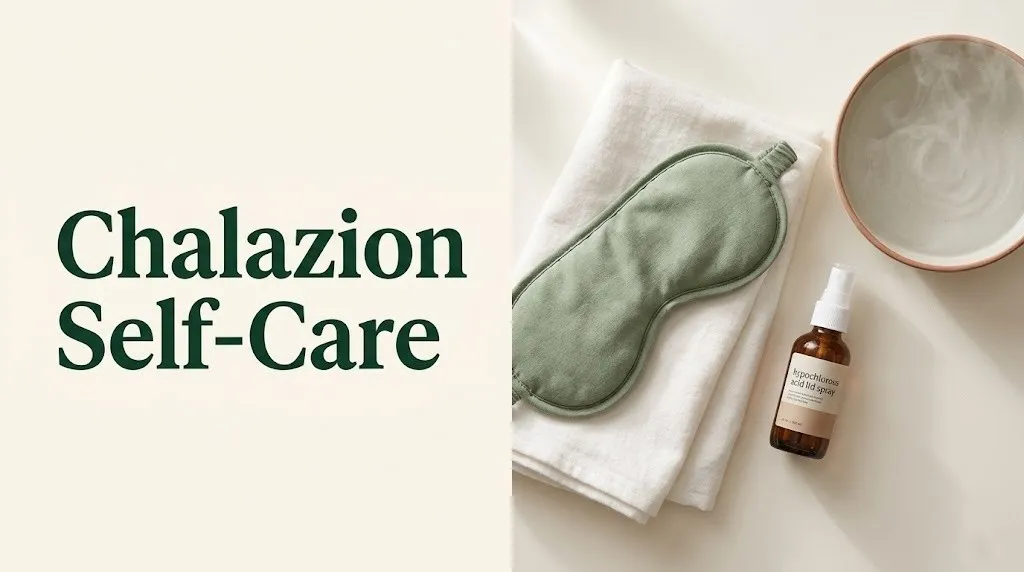
The warm compress is the cornerstone of chalazion self-care and works by raising the eyelid surface temperature high enough to liquefy solidified meibum, allowing the blocked gland to drain. Getting the temperature and duration right is what separates effective self-care from ineffective.
The physiological target here is the melting point of meibum in a dysfunctional meibomian gland. Healthy meibum melts at approximately 28°C. In meibomian gland dysfunction, the altered lipid composition raises that melting point to approximately 35°C or above, according to research published in the British Journal of Ophthalmology on meibomian lipid thermography. To reliably exceed that threshold at the level of the tarsal plate (which sits behind several layers of tissue), the external surface of the eyelid needs to reach 38 to 42°C and hold that temperature for a sustained period.
A standard cloth soaked in tap water cools to ambient temperature within two to three minutes. That is not enough. A heated eye mask (the reusable, microwave-heated type designed for eyelid warming) maintains temperature better and delivers more consistent therapeutic heat.
Step-by-step warm compress protocol:
- Wash your hands thoroughly with soap and warm water before touching your eyelid area.
- Use a clean microwave-safe eye mask (designated for eyelid warming) or a clean flannel cloth. If using a cloth, soak it in the hottest tap water you can access, wring it firmly, and fold it to a compact pad.
- Test the temperature on the inside of your wrist first. It should feel warm to hot but not scalding. The target is 38 to 42°C at the eyelid surface.
- Place the compress gently over the closed eyelid. Do not press hard.
- Hold in place for 10 to 15 minutes minimum. Reheat a cloth compress every 3 to 4 minutes to maintain therapeutic temperature. A reusable heated eye mask maintains temperature more consistently across the full session.
- After the compress session, immediately perform eyelid massage (covered in the next section) before the eyelid cools.
- Repeat three to four times daily, ideally morning, midday, and twice in the evening. Consistency over days and weeks matters more than any single session.
Contact lens wearers must remove their lenses before each compress session and not replace them until the eye has fully returned to ambient temperature and any product residue has been cleared.
Chalazion Massage Technique
Eyelid massage immediately after a warm compress session helps physically express the liquefied meibum from the blocked gland, making it the necessary second step in any effective self-care sequence. Done correctly, it increases the mechanical efficacy of the warm compress significantly.
Think of the meibomian glands like tubes of refrigerated wax. The warm compress melts the wax. The massage squeezes it out. Without the massage step, the liquefied meibum simply re-solidifies in the gland duct as the eyelid cools back to normal temperature, and you gain no drainage benefit.
How to perform chalazion massage correctly:
- Complete your full 10 to 15 minute warm compress session first. Do not skip or shorten it.
- Wash your hands again immediately before touching your eyelid.
- Using a clean fingertip (index or middle finger), place it on the outer surface of the eyelid directly over the chalazion.
- Apply gentle but firm pressure. Do not press so hard it causes pain.
- Move the finger in slow, circular motions over the lump for 30 to 60 seconds, then use a gentle sweeping motion toward the eyelid margin (toward where the lashes are). This direction follows the anatomy of the meibomian gland ducts, which open at the eyelid margin.
- For a lower eyelid chalazion: sweep gently downward toward the lower lash line. For an upper eyelid chalazion: sweep gently upward toward the upper lash line.
- Repeat the circular-plus-sweep sequence for approximately 1 to 2 minutes total.
- Perform this massage while the eyelid is still warm from the compress. Once the tissue cools, the meibum re-solidifies and massage loses its mechanical advantage.
The American Academy of Ophthalmology recommends warm compress followed by gentle eyelid massage as the primary self-care sequence for chalazion. The evidence base for this sequence is grounded in clinical ophthalmology practice and the well-established thermodynamics of meibum liquefaction.
People with very thin or sensitive periocular skin (common in atopic dermatitis and eczema) should use the lightest effective pressure. Aggressive rubbing of the periocular area can worsen inflammation and contribute to post-inflammatory hyperpigmentation in people with Fitzpatrick skin types III through VI.
Lid Hygiene for Chalazion: Products and Ingredients That Work
Lid hygiene is the daily maintenance practice that reduces eyelid margin bacteria, disrupts biofilm formation, and keeps meibomian gland orifices clear enough to reduce future blockages. It is not optional if you want to prevent chalazion recurrence.
The eyelid margin hosts a delicate microbiome. In healthy eyelids, this community of bacteria stays balanced. In blepharitis (which often underlies chalazion formation), Staphylococcus aureus and Staphylococcus epidermidis overgrowth, along with biofilm formation, contributes to chronic inflammation of the gland orifices.
Lid scrub products work by physically removing debris, desquamated skin cells, and bacterial biofilm from the eyelash base and the eyelid margin where meibomian gland openings sit. The choice of product matters, both for efficacy and safety.
Lid hygiene product options with evidence context:
| Product | Active Ingredient | Mechanism | Evidence Strength for Chalazion/MGD |
|---|---|---|---|
| Hypochlorous acid (HOCl) eyelid spray | HOCl at 0.01% | Anti-bacterial, anti-biofilm, anti-inflammatory | Clinical studies in blepharitis; clinically informed for chalazion prevention |
| Diluted baby shampoo | Surfactants (amphoteric); no-tears formula | Mechanical debridement of lid margin debris | Long clinical history; lower anti-inflammatory efficacy than HOCl |
| Commercial lid wipes (pre-moistened) | Varies; often include HOCl or surfactants | Mechanical plus chemical debridement | Varies by formulation; convenient delivery |
| Tea tree oil lid scrub (terpinen-4-ol based) | Terpinen-4-ol (standardized) | Demodex reduction; antimicrobial | Preliminary-to-moderate evidence for Demodex-positive cases specifically |
| Raw essential oil (tea tree, etc.) | Unstandardized terpinen-4-ol | Varies | Do not use near eyes: corneal cytotoxicity risk |
How to perform lid hygiene:
- Wash hands thoroughly.
- Apply chosen product (HOCl spray or diluted baby shampoo on a clean cotton pad or commercial lid wipe) to the eyelid margin area.
- With the eye closed, gently scrub along the base of the lashes using small horizontal strokes. Focus on the area where the lashes emerge from the skin.
- Rinse with clean warm water if using a rinse-off product. HOCl sprays designed for eyelids typically do not require rinsing.
- Perform once daily as maintenance, or twice daily during an active chalazion episode.
Hypochlorous Acid and Lid Scrubs for Chalazion Care
Hypochlorous acid (HOCl) at a 0.01% concentration is one of the most well-supported modern eyelid hygiene ingredients for managing blepharitis and the underlying eyelid margin conditions that drive chalazion formation. It represents a genuine evidence-based step forward from the traditional baby shampoo recommendation.
HOCl is produced naturally by neutrophils as part of the immune response to bacterial pathogens. At the dilute concentration used in eyelid formulations, it disrupts bacterial cell membranes, breaks down biofilm (the sticky matrix of bacteria and their secretions that clings to eyelid margins), and reduces inflammatory cytokine activity at the eyelid margin. A 2020 study published in the Journal of Cosmetic Dermatology found that HOCl formulations used on the eyelid margin reduced bacterial counts and inflammatory markers in blepharitis patients, with a favorable safety profile and minimal irritation.
Importantly, HOCl is not an acid in the corrosive sense. At 0.01%, it is isotonic with the ocular surface and generally well tolerated. It should not be confused with higher-concentration HOCl used in wound care settings, which are not appropriate for periocular use.
For people with seborrheic blepharitis (where Malassezia yeast plays a role), HOCl alone may not be sufficient. Selenium sulfide shampoo or ciclopirox-based formulations are sometimes used on the scalp for seborrheic dermatitis, but these should never be applied near the eyes without explicit guidance from a board-certified ophthalmologist or dermatologist.
Baby shampoo at a 1:1 dilution with sterile water remains a low-cost and widely accessible alternative. It mechanically removes debris effectively. Its limitation is that it has minimal anti-biofilm activity compared to HOCl and may disrupt the tear film’s lipid layer with prolonged daily use due to its surfactant content. For occasional or initial use, it’s a reasonable starting point. For ongoing lid hygiene maintenance, HOCl-based formulations have a more favorable long-term profile.
People with known contact allergy to any preservatives (particularly benzalkonium chloride, which appears in some commercial eyelid products) should check formulation ingredients carefully. A board-certified allergist can perform patch testing if eyelid skin reactions occur with lid hygiene products.
Key Takeaway: Warm compresses must reach and hold 38 to 42°C for 10 to 15 minutes to actually liquefy blocked meibomian gland secretions. A cloth that cools in 2 minutes is not doing the job. Follow immediately with eyelid massage.
Meibomian Gland Dysfunction and Chalazion Connection
Meibomian gland dysfunction (MGD) is the underlying condition present in the vast majority of people who develop chalazia, particularly those who have more than one. Understanding MGD is what separates managing a single chalazion from preventing the next five.
The meibomian glands produce meibum, a complex lipid mixture with both polar lipids (wax esters and cholesterol esters) and non-polar lipids. In MGD, several things go wrong simultaneously. The lipid composition changes (less liquid wax esters, more waxy, high-melting-point lipids). The gland duct opening may become narrowed by keratinization of the duct epithelium. Secretion slows and thickens. The conditions for blockage and chalazion formation are set.
MGD is exceptionally common. The American Academy of Ophthalmology has described MGD as a leading cause of dry eye disease globally, affecting an estimated 38 to 70% of populations studied (with variation by geographic region and diagnostic criteria used). Its association with chalazion is direct: treat the MGD and chalazion recurrence rates drop substantially.
Self-care for MGD overlaps significantly with chalazion self-care:
- Warm compresses to maintain gland secretion fluidity
- Eyelid massage to facilitate meibum expression
- Daily lid hygiene to prevent duct orifice obstruction
- Omega-3 fatty acid consideration (discussed in a later section) for potential meibum composition improvement
What self-care cannot address in advanced MGD: significant glandular atrophy (detected by meibography imaging) or extensive gland dropout requires in-office procedures such as meibomian gland probing, intense pulsed light (IPL) therapy, or thermal pulsation devices (LipiFlow). These are not home-based options. A board-certified ophthalmologist specializing in ocular surface disease can determine whether MGD in your case has progressed past the range that self-care alone can meaningfully address.
People who have had LASIK or other refractive surgery have a higher incidence of post-surgical MGD, which increases chalazion risk in the months and years following surgery.
Chalazion and Rosacea or Seborrheic Dermatitis Overlap
Rosacea and seborrheic dermatitis are the two skin conditions most commonly associated with recurrent chalazion, and managing either condition without addressing its eyelid component significantly limits how effective any self-care protocol can be.
Ocular rosacea affects an estimated 58 to 72% of people with cutaneous rosacea, according to data cited by the National Rosacea Society. In ocular rosacea, the meibomian glands are directly involved: chronic inflammation of the eyelid margin disrupts gland function, alters meibum composition, and creates the exact MGD profile that drives chalazion formation. Many people discover they have rosacea only after developing recurrent eyelid problems.
The self-care additions for rosacea-associated chalazion:
- All standard warm compress and lid hygiene steps remain the foundation
- Avoidance of eyelid skincare products containing fragrances, alcohols, and any potential rosacea triggers (menthol, eucalyptus, essential oils in general)
- Sun protection for periocular skin (using mineral sunscreen with zinc oxide or titanium dioxide, applied carefully around but not directly on the eyelid margin)
- Discussion with a board-certified dermatologist about systemic or topical rosacea management (oral doxycycline, topical ivermectin, azelaic acid) as these treatments reduce the inflammatory load that feeds chalazion recurrence
Seborrheic dermatitis causes flaking and redness along the scalp, eyebrows, and eyelid margins. The Malassezia yeast involved in seborrheic dermatitis contributes to anterior blepharitis, which in turn affects meibomian gland orifice health. Effective management of scalp and facial seborrheic dermatitis with antifungal treatments (selenium sulfide, zinc pyrithione shampoos used on the scalp) can reduce the inflammatory burden reaching the eyelid margin.
A 2021 review in the Journal of the American Academy of Dermatology confirmed the bidirectional relationship between seborrheic dermatitis and eyelid margin inflammation, underscoring that treating only the eyelid while leaving facial seborrheic dermatitis uncontrolled is incomplete management.
People with rosacea and Fitzpatrick skin types III through VI face an additional consideration: periocular post-inflammatory hyperpigmentation after chalazion resolution. This is more likely when the chalazion was large, inflamed, or treated with intralesional corticosteroid injection (which carries a small but documented risk of periocular skin lightening in people with more melanin-rich skin).
Demodex Folliculorum and Recurrent Chalazion
Demodex folliculorum and Demodex brevis are microscopic mites that naturally inhabit hair follicles and sebaceous glands in small numbers. When their population becomes excessive on the eyelid, they become a significant driver of recurrent chalazion.
Demodex brevis specifically colonizes the meibomian glands themselves. The mites’ waste products and the inflammatory response they trigger cause granulomatous reactions at the gland level. This is functionally the same process that forms a chalazion: a granulomatous response to material the body cannot clear. In Demodex-positive blepharitis, the stimulus is ongoing rather than a single gland rupture event, which is why Demodex infestation is associated with persistently recurrent chalazia rather than isolated episodes.
Demodex infestation is strongly associated with rosacea (both cutaneous and ocular subtypes) and increases with age. A 2019 review in Cornea found Demodex positivity rates significantly higher in patients with recurrent chalazia compared to age-matched controls without eyelid lesions.
The specific self-care intervention for Demodex:
- Standard lid hygiene alone does not effectively reduce Demodex numbers
- Terpinen-4-ol, the active component in tea tree oil (Melaleuca alternifolia leaf oil, INCI), has shown Demodex-killing (demodecidal) activity in small clinical studies and in vitro work
- Terpinen-4-ol must be used only in a properly formulated lid scrub product at a diluted, standardized concentration (commercial Demodex-targeted lid scrubs specify 4 to 5% terpinen-4-ol in a buffered carrier). Raw tea tree oil applied to the eyelid is corneal-cytotoxic and dangerous. This distinction is absolute.
- Treatment courses for Demodex blepharitis typically run 4 to 6 weeks, according to clinical protocols from the American Academy of Ophthalmology
A board-certified ophthalmologist can confirm Demodex infestation by microscopic examination of an epilated eyelash under a slit lamp. If Demodex is confirmed in a person with recurrent chalazia, prescription options (including topical ophthalmic lotilaner 0.25% drops, which received FDA clearance for Demodex blepharitis) are now available alongside the OTC terpinen-4-ol approach.
Key Takeaway: If your chalazion keeps coming back, Demodex mite infestation, meibomian gland dysfunction, or an unmanaged skin condition like rosacea is almost certainly the underlying driver. Treating the bump without addressing its cause is why recurrence is so common.
Diet, Omega-3 Fatty Acids, and Chalazion Prevention
Omega-3 fatty acids, specifically eicosapentaenoic acid (EPA) and docosahexaenoic acid (DHA), have been studied for their potential to improve meibomian gland health by modifying the fatty acid composition of meibum and reducing the inflammatory signaling that contributes to gland dysfunction.
The proposed mechanism is biologically plausible. EPA and DHA are incorporated into the cell membranes of meibomian gland acinar cells. They also serve as precursors to anti-inflammatory eicosanoids (prostaglandins, leukotrienes, and resolvins of the omega-3 pathway), which may reduce the chronic low-grade inflammation at the eyelid margin that contributes to gland duct narrowing and blockage.
The evidence, however, requires careful framing. The landmark DREAM study (Dry Eye Assessment and Management), a large randomized controlled trial published in the New England Journal of Medicine in 2018, found that omega-3 supplementation at 3,000 mg EPA+DHA daily was not superior to an olive oil placebo for primary dry eye disease endpoints. This was a well-designed, adequately powered RCT, and its results tempered earlier enthusiasm for omega-3 supplementation in ocular surface management.
Smaller studies have suggested benefits in meibum quality specifically (a different endpoint than the DREAM study’s primary outcomes), and the NIH National Center for Complementary and Integrative Health notes the evidence for omega-3 in eye health remains mixed and context-dependent. Using omega-3 supplementation as one supportive strategy rather than a standalone intervention is reasonable, with expectations appropriately calibrated.
Practical dietary approach:
- Prioritize food sources: fatty fish (salmon, mackerel, sardines) two to three times per week deliver meaningful EPA and DHA
- If supplementing: 1,000 to 2,000 mg EPA+DHA daily is a commonly used range in ophthalmic research contexts; discuss dose with a primary care physician or registered dietitian before starting, particularly if taking blood thinners, as omega-3 at higher doses has anticoagulant properties
- Avoid trans fats and excess saturated fats: some observational data suggests these influence meibum composition unfavorably, though this is not established at the level of RCT evidence specific to chalazion
Diet changes alone will not resolve an active chalazion and are best understood as a long-term supportive strategy for gland health, not a treatment for an existing lesion.
Chalazion in Children and During Pregnancy
Chalazion self-care in children and during pregnancy follows the same foundational principles (warm compress, lid hygiene, eyelid massage) but with specific modifications that matter for safety.
Chalazion in children:
Chalazia are not rare in children, particularly those with blepharitis, atopic dermatitis, or a family history of skin conditions associated with meibomian gland dysfunction. The American Academy of Ophthalmology recommends warm compress as first-line management in pediatric chalazion as in adults, with these modifications:
- Temperature should be at the lower end of therapeutic range (closer to 38°C) to account for children’s thinner and more sensitive eyelid skin
- Sessions should be shorter if the child is very young: 5 to 10 minutes, three times daily, is more achievable and still clinically useful
- No tea tree oil-based lid scrubs in children under 12; the sensitization risk and cytotoxicity potential outweigh any benefit
- Diluted baby shampoo (no-tears formula, 1:1 with sterile water) is the safest lid hygiene option for children
- A pediatric ophthalmologist should evaluate any pediatric chalazion that does not show reduction after 4 to 6 weeks of consistent care, as children often require in-office intervention and tolerate this differently than adults
Chalazion during pregnancy:
Warm compress and gentle eyelid massage are safe throughout pregnancy. The modifications are primarily about product avoidance:
- Do not use tea tree oil (Melaleuca alternifolia leaf oil) or any essential oil-based product on the periocular area during pregnancy; essential oil safety in pregnancy has insufficient data and general caution is warranted
- HOCl-based lid sprays at 0.01% are generally considered safe for periocular use in pregnancy, but the evidence base for HOCl in pregnancy specifically is limited; discuss with a prenatal care provider before starting any new topical product
- Do not take omega-3 supplements beyond dietary food sources without discussing dose with an obstetrician, as high-dose omega-3 supplementation has blood-thinning effects
Any eyelid lesion in pregnancy that is growing rapidly, becomes very inflamed, or is associated with vision change should be evaluated by a board-certified ophthalmologist without delay.
How Long Does a Chalazion Last and What to Expect
A chalazion managed with consistent self-care typically shows measurable reduction within four to eight weeks, though the timeline depends heavily on lesion size, consistency of the self-care protocol, and whether any underlying conditions are being managed simultaneously.
According to the American Academy of Ophthalmology, small chalazia (under 5 mm) that receive consistent warm compress therapy three to four times daily have the highest likelihood of complete self-resolution. Larger lesions (8 mm or greater) are significantly less likely to resolve without medical intervention, even with excellent self-care adherence.
Week-by-week realistic expectations:
- Weeks 1 to 2: No visible change is normal and expected. Granulomatous lesions resolve slowly. The inflammation may soften slightly with consistent heat and massage, but visible size reduction is rarely apparent this early.
- Weeks 3 to 4: Gradual softening and possible slight size reduction, particularly in smaller chalazia. The lesion may feel less firm.
- Weeks 5 to 8: Visible reduction in the majority of small to medium chalazia that have received consistent, adequate-temperature self-care. Some will resolve completely. Others will plateau.
- Beyond 8 weeks without improvement: this is the threshold at which most ophthalmology clinical guidance recommends moving to medical evaluation and consideration of in-office procedures.
One important note on chalazion versus resolved chalazion: a chalazion can resolve the visible lump but leave behind a thin fibrous residue under the eyelid skin. This small, barely palpable thickening may persist for months and does not indicate treatment failure. It is scar tissue and is functionally harmless if asymptomatic.
People who use isotretinoin (for acne) may experience altered meibomian gland function, with decreased gland activity and altered meibum secretion. This changes the chalazion timeline and recurrence profile. A board-certified dermatologist managing isotretinoin therapy should be informed of any recurrent eyelid issues.
Key Takeaway: Chalazia in small to medium sizes (under 8 mm) resolve with self-care in most cases, but expect 4 to 8 weeks of consistent daily effort. Visible change in the first 2 weeks is rare and does not mean the treatment is failing.
When Chalazion Self-Care Is Not Enough: Medical Treatment Options
Chalazion self-care has a defined scope. It addresses the majority of small to medium lesions effectively. But there are clear clinical thresholds at which home management is no longer the right primary approach and professional evaluation becomes necessary.
Seek evaluation from a board-certified ophthalmologist in any of the following circumstances:
- The chalazion has not begun to reduce after four to six weeks of consistent, correctly performed self-care (three to four warm compress sessions daily at adequate temperature)
- The lesion is larger than approximately 8 mm in diameter
- The lesion is affecting your vision (blurring, double vision, or eyelid drooping that affects the visual field)
- The chalazion is becoming more painful, more inflamed, or developing overlying skin changes (suggesting secondary infection or a different diagnosis)
- You have had three or more chalazia in the same eyelid location, which raises the concern for sebaceous gland carcinoma (a rare but serious eyelid malignancy that can mimic recurrent chalazion)
- The lesion is in a child under 12 who has not responded to 4 to 6 weeks of conservative management
Medical treatment options:
| Procedure | What It Involves | Best For | Considerations |
|---|---|---|---|
| Intralesional corticosteroid injection | Triamcinolone acetonide injected into the lesion; reduces granulomatous inflammation | Lesions unresponsive to self-care; avoiding surgery | Risk of periocular skin depigmentation (higher concern in Fitzpatrick types IV-VI); requires ophthalmologist |
| Incision and curettage (I&C) | Minor surgical procedure; internal eyelid incision, contents drained | Larger lesions; failed corticosteroid injection | Definitive; minimal scarring with correct technique; typically requires local anesthetic |
| Combined steroid injection + I&C | Both approaches used in same session | Larger or chronically inflamed lesions | Higher resolution rate than either alone |
| Meibomian gland probing | Instrument passed into the gland duct | Advanced MGD with significant gland dropout | Not standard for acute chalazion; targets underlying MGD |
The American Academy of Ophthalmology notes that both intralesional corticosteroid injection and I&C have comparable resolution rates for most chalazia, with patient factors (size, location, skin type, patient preference) guiding the choice. For people with Fitzpatrick skin types IV through VI, a board-certified ophthalmologist or oculoplastic surgeon should discuss the depigmentation risk of intralesional triamcinolone acetonide specifically before proceeding.
Frequently Asked Questions About Chalazion Self-Care
Can I pop or squeeze a chalazion at home?
No. Squeezing a chalazion introduces bacteria into a sterile granulomatous lesion and can cause secondary infection, cellulitis, or eyelid scarring.
A chalazion resolves through liquefaction of the blocked meibum using heat and massage, not through external pressure or puncture.
If the lump feels ready to burst, that is a sign of secondary infection (converting it to a hordeolum) that warrants same-week evaluation by a board-certified ophthalmologist.
How many times a day should I do a warm compress for a chalazion?
The American Academy of Ophthalmology recommends three to four warm compress sessions daily for active chalazion management.
Each session should last 10 to 15 minutes at a temperature of 38 to 42°C, followed immediately by gentle eyelid massage.
Fewer sessions at the correct temperature and duration are more effective than frequent sessions with a compress that cools too quickly to be therapeutic.
What is the difference between a chalazion and a stye?
A chalazion is a sterile, painless granuloma formed by a blocked meibomian gland; a stye (hordeolum) is an acute bacterial infection at the eyelid margin or base of a lash.
Styes appear rapidly within 24 to 48 hours, are painful and red, and may have a visible pus point. Chalazia develop slowly and are typically painless once the initial inflammation settles.
A stye can convert to a chalazion if the bacterial infection clears but the gland blockage remains.
How long does it take for a chalazion to go away with self-care?
Most small to medium chalazia (under 8 mm) show measurable reduction within four to eight weeks of consistent, correctly performed self-care.
The first two weeks typically show no visible change, which is normal for granulomatous lesions.
A chalazion that has not started reducing after six weeks of three-to-four daily sessions warrants evaluation by a board-certified ophthalmologist to consider in-office treatment.
Is tea tree oil safe to use on a chalazion?
Undiluted tea tree oil (Melaleuca alternifolia leaf oil) should never be applied to the eyelid or near the eye; it is corneal-cytotoxic and a known skin sensitizer.
Properly formulated lid scrubs containing a standardized 4 to 5% terpinen-4-ol concentration (the active Demodex-targeting component) are the safe form of tea tree oil-based eyelid hygiene, and only when Demodex blepharitis is a confirmed or suspected contributing factor.
Children under 12 and pregnant women should avoid tea tree oil-containing products near the eye entirely.
When should I see a doctor for a chalazion?
See a board-certified ophthalmologist if a chalazion has not reduced after four to six weeks of consistent self-care, if it is larger than approximately 8 mm, or if it is affecting your vision.
Any chalazion that is recurring in exactly the same location three or more times should be evaluated promptly to rule out sebaceous gland carcinoma, which can mimic a recurrent chalazion.
Children, immunocompromised individuals, and pregnant women should have a lower threshold for seeking professional evaluation: four weeks of non-responsive self-care warrants an appointment rather than continued waiting.
Chalazion self-care, done correctly and consistently, resolves most eyelid bumps without medical intervention. The difference between self-care that works and self-care that fails comes down to temperature, duration, and daily consistency. A warm compress held for 15 minutes at 38 to 42°C, followed immediately by eyelid massage, repeated three to four times daily, addresses the actual mechanism. Adding a daily lid hygiene step with a hypochlorous acid-based product or diluted baby shampoo clears the eyelid margin environment that makes recurrence likely.
The bigger picture here is meibomian gland health. One chalazion managed and resolved leaves the underlying gland dysfunction intact if nothing changes. Address the root cause, whether that is uncontrolled rosacea, Demodex blepharitis, or meibomian gland dysfunction, and the likelihood of managing a chalazion again drops substantially.
If your lump is still present after six weeks of diligent self-care, make an appointment with a board-certified ophthalmologist. Incision and curettage and intralesional steroid injection are both highly effective, quick procedures. You do not need to wait indefinitely. What you do need is the right information to give self-care a genuine, evidence-based chance first.