Sheet Mask Before or After Skincare: A Complete 2026 Routine Guide
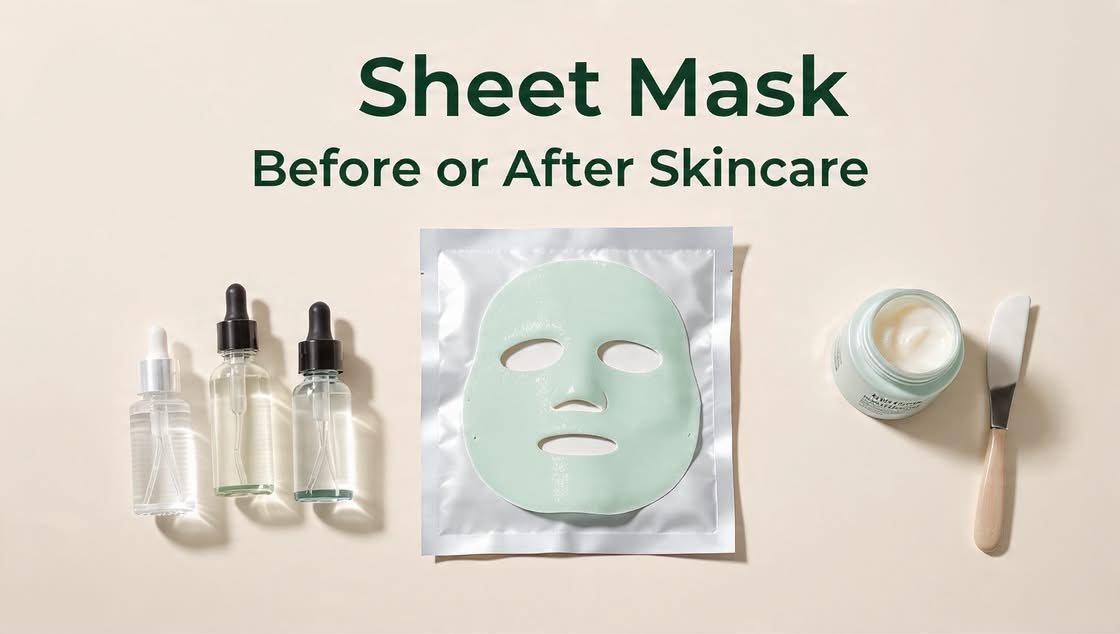
A sheet mask belongs after toner and serum but before moisturizer in a standard skincare routine. This placement uses the mask’s temporary occlusion barrier to press water-soluble active ingredients deeper into the stratum corneum, then locks everything in with an occlusive or emollient moisturizer once the sheet comes off. If you skip moisturizer after masking, the hydration gained during those 15 to 20 minutes evaporates faster through transepidermal water loss (TEWL) than it would with an intact moisture seal.
Placement order genuinely matters because sheet masks do something no other product in your routine does. They create a physical barrier that temporarily slows TEWL while simultaneously saturating the top layers of skin with a concentrated water-based essence. According to the American Academy of Dermatology, occlusion can increase stratum corneum hydration significantly within minutes, but that hydration is temporary. You need the right steps afterward to convert temporary water saturation into lasting barrier function improvement.
This guide walks you through the exact sequence, explains the skin biology behind each placement decision, gives you specific guidance for actives like retinol and vitamin C, and provides complete routine maps for sensitive skin and acne-prone skin. By the end, you will know not just where the mask goes, but why it goes there.
Key Takeaway: The sheet mask step is a booster, not a finisher. It prepares your skin to absorb what follows it, but it cannot do the job of a moisturizer.
where does sheet mask go in skincare routine
A sheet mask goes directly after water-based treatment steps (toner, essence, water-based serum) and before any oil-based serum, moisturizer, or facial oil. The core rule is thinnest to thickest, and sheet mask essence fits as a water-based layer that benefits from occlusion before heavier products seal the surface.i
The standard full sequence runs: oil cleanser (PM only), water-based cleanser, toner, sheet mask, serum (if not already applied under the mask), moisturizer, facial oil (optional), and sunscreen (AM only). If your serum is a lightweight water-based formula, you can apply it under the mask to use the occlusion period for enhanced penetration. Anhydrous or oil-based serums always go after the mask comes off.
The reasoning sits in how the stratum corneum accepts water versus oils. Hydrated skin is more permeable to water-soluble compounds, and the sheet mask drives those compounds in while preventing backward evaporation. Once the mask comes off, you have a window of maximal hydration where any product applied on top will spread more evenly and absorb into a more pliable corneocyte layer. Layering an oil or thick cream before the mask would block that penetration entirely.
Product Type Layer-by-Layer
| Step Order | Product Type | Applied Before or After Mask | Function |
|---|---|---|---|
| 1 | Oil Cleanser | Before | Removes makeup and sunscreen |
| 2 | Water-Based Cleanser | Before | Cleanses skin surface |
| 3 | Toner | Before | Rehydrates and preps skin |
| 4 | Water-Based Serum | Before (optional, under mask) | Active delivery enhanced by occlusion |
| 5 | Sheet Mask | This is the step | Concentrated occlusion hydration |
| 6 | Oil-Based Serum | After | Active delivery without occlusion risk |
| 7 | Moisturizer | After | Seals hydration and reduces TEWL |
| 8 | Facial Oil | After | Final occlusive layer if needed |
| 9 | Sunscreen | After (AM only) | Photoprotection |
sheet mask before or after skincare
Sheet mask application falls in the middle of a skincare routine, after cleansing and toning but before moisturizing. The mask is not a replacement for your leave-on products. It temporarily supercharges hydration and presses existing water-based actives into the skin, then needs a moisturizer applied afterward to lock the benefit in place.
Think of the sheet mask like a weighted blanket for your skin. The physical layer of microfiber, hydrogel, or cotton sits against the surface and applies gentle, consistent pressure that keeps the essence in continuous contact with the stratum corneum. This is fundamentally different from patting serum on with your fingers. The mask material eliminates the evaporation window, giving humectants like glycerin and sodium hyaluronate uninterrupted time to pull water into the outer skin layers.
A 2019 study in the Journal of Cosmetic Dermatology found that occlusion significantly increases stratum corneum water content compared to the same serum formulation applied openly. The mask’s physical barrier is the variable that changes the absorption dynamic. Without the mask material, the same serum would begin evaporating within minutes. Under occlusion, the contact time extends to 15 to 20 minutes, and penetration depth increases measurably.
This also means the mask amplifies anything you put under it. A soothing toner with centella asiatica becomes more effective. A fragrance-heavy toner, however, becomes a bigger problem. The occlusion that helps humectants also pushes potential irritants deeper into the skin. What you layer before the mask matters just as much as the mask itself.
Key Takeaway: A sheet mask is a mid-routine event that enhances what is already on your skin. It is never a standalone product and never the final step.
order of skincare with face mask
The order of skincare with a face mask is cleanse, tone, mask, moisturize, with serums placed either under the mask (water-based) or after the mask (oil-based). This sequence respects the chemistry of water-phase and oil-phase products and uses the mask’s occlusion window for maximum benefit without trapping incompatible ingredients against the skin.
| Step | Product | Purpose During Mask Routine |
|---|---|---|
| 1 | Oil cleanser (PM) | Dissolves sunscreen, makeup, sebum |
| 2 | Water-based cleanser | Removes residue and sweat |
| 3 | Toner or mist | Replenishes water content |
| 4 | Water-based serum (optional) | Active treatment, penetration enhanced by mask |
| 5 | Sheet mask (15 to 20 min) | Occlusive hydration, pushes actives in |
| 6 | Oil-based serum (if used) | Deliver oil-soluble actives |
| 7 | Eye cream (optional) | Treat thinner periorbital skin |
| 8 | Moisturizer | Seals all layers, prevents TEWL |
| 9 | Facial oil (optional) | Final occlusive seal for very dry skin |
| 10 | Sunscreen (AM only) | Broad-spectrum UV protection |
This ordering prevents the single most common mistake people make with sheet masks: applying a thick occlusive moisturizer first, then placing the mask on top. An occlusive layer blocks water from moving in either direction. The sheet mask essence will sit on top of the cream, the water-soluble actives will not penetrate, and you will have wasted 20 minutes with the equivalent of a wet paper towel on a sealed jar.
skincare steps with face mask
The complete skincare steps with a face mask are identical to a standard routine with one addition inserted mid-sequence. Your full routine expands by roughly 20 minutes on masking days but does not change structurally. You are adding a step between toner and moisturizer, not replacing anything.
Start with a thorough double cleanse if wearing makeup or sunscreen. The skin surface must be free of oil, dirt, and product residue before the mask goes on. A 2022 study in the International Journal of Cosmetic Science confirmed that stratum corneum hydration from masking is measurably higher when the skin is cleansed properly beforehand, because sebum and product buildup create a partial barrier to water penetration.
Apply toner or mist immediately after cleansing while skin is still slightly damp. This primes the corneocytes with an initial water infusion. Hyaluronic acid in the toner and the sheet mask essence work synergistically rather than redundantly. The pre-hydrated skin accepts the mask essence more readily than bone-dry skin would.
Open the mask packet, unfold carefully without tearing, and align the eye, nose, and mouth cutouts with your face. Smooth the material from center outward, pressing out air bubbles. The mask needs full contact with every area it covers. Gaps between the sheet and your skin defeat the occlusion purpose. Leave on for 15 to 20 minutes, remove, pat the remaining essence in with clean fingers, then proceed directly to moisturizer while the skin is still damp from the essence.
Quick Tip:
- Apply excess essence from the packet to your neck and the backs of your hands. The skin there benefits from the same occlusion-driven hydration.
- Store masks flat, not upright. The essence distributes evenly across the sheet this way.
- Never use a mask that was left open or appears dry in the package. The preservative system may have been compromised.
sheet mask before or after toner
Sheet mask application always follows toner, never precedes it. Toner restores the skin’s slightly acidic pH after cleansing and delivers the first wave of hydration that the sheet mask’s occlusion effect will amplify. Skipping toner and applying a mask directly to freshly cleansed skin means missing a preparation step that makes the mask more effective.
Cleansers, even gentle ones, temporarily raise skin pH and strip some of the water-soluble natural moisturizing factors (NMFs) from the stratum corneum. A toner with humectants like glycerin, sodium hyaluronate, or panthenol begins replenishing those lost compounds immediately. When the sheet mask goes on top, the occlusion traps that toner-delivered hydration in place and prevents evaporation. The mask essence and the toner work as a hydration team rather than as competing products.
A toner containing niacinamide or centella asiatica provides specific skin-soothing benefits that the occlusion window amplifies. Niacinamide at 2% to 5% concentration has well-documented barrier-supporting effects, including increased ceramide synthesis in the stratum corneum. Masking over a niacinamide toner gives the compound extended contact time with the skin surface, potentially increasing its delivery into the upper epidermis.
For people with sensitive or reactive skin, the toner-under-mask step is especially important. A pH-balancing, fragrance-free toner can act as a buffer between the skin and the sheet mask essence, reducing the likelihood of stinging or redness from concentrated mask formulations. The toner essentially preconditions the skin barrier before the prolonged essence contact begins.
sheet mask before or after serum
A water-based serum goes before the sheet mask. An oil-based or anhydrous serum goes after. This distinction is determined entirely by whether the serum’s vehicle is water or oil, because the sheet mask’s occlusion mechanism only enhances penetration of water-soluble compounds.
Water-based serums with ingredients like ascorbic acid (vitamin C), niacinamide, peptides, or sodium hyaluronate can be applied directly to toned skin, then covered by the sheet mask. The occlusion will press those actives deeper into the stratum corneum over the 15-to-20-minute wear period. This is one of the few times in a skincare routine where you can intentionally enhance active penetration without prescription-strength delivery systems.
Oil-based serums, squalane-based formulations, and retinoid products in lipid vehicles must wait until after the mask is removed. Oil repels water. Placing a sheet mask saturated with a water-based essence over an oil-based serum means the two phases physically separate. The water cannot penetrate the oil film, and the actives in the oil-based serum are trapped under a wet sheet that is doing nothing for them.
Serum Placement Decision Table
| Serum Type | Vehicle | Before or After Mask | Example Actives |
|---|---|---|---|
| Lightweight serum | Water | Before | Niacinamide, ascorbic acid, peptides |
| Gel serum | Water | Before | Sodium hyaluronate, centella asiatica |
| Emulsion | Water-in-oil | After | Ceramides in lipid base |
| Oil serum | Oil | After | Retinol in squalane, bakuchiol in oil |
| Suspension | Silicone or oil | After | Dimethicone-based formulas |
sheet mask before or after moisturizer
Sheet mask application happens before moisturizer, never after. Moisturizer creates a partial or full occlusive seal on the skin surface. That seal blocks the water-based mask essence from penetrating, rendering the entire mask step functionally useless and wasting both product and time.
The purpose of a sheet mask is to deliver water-soluble ingredients into a hydrated, permeable stratum corneum. If you apply a moisturizer first, the occlusive agents in that moisturizer (dimethicone, petrolatum, shea butter, or heavier plant oils depending on the formula) sit on the skin surface and prevent the passage of water in either direction. The mask essence cannot get in. The moisturizer’s occlusive layer essentially turns the sheet mask into a decorative face covering.
After the mask is removed and the remaining essence is patted in, the skin is at its peak hydration state. This is the ideal moment to apply moisturizer. The corneocytes are plumped with water. The surface is slightly damp. The moisturizer will spread easily, trap the water inside the skin, and create the long-term TEWL barrier that converts short-term masking hydration into lasting skin barrier improvement.
Skipping moisturizer after masking is the most common mistake dermatologists report seeing in patients who sheet mask regularly. The hydration spike from the mask begins to evaporate within minutes of removal. By the 30-minute mark, TEWL has already pulled a measurable amount of moisture back out of the skin. Moisturizer applied immediately prevents that loss.
Key Takeaway: Moisturizer is the lid on the hydration pot. The sheet mask fills the pot. You need both, in that exact order.
do you wash face after sheet mask
No, you do not wash your face after a sheet mask. The essence left on the skin after the sheet is removed is the entire point of the product. Rinsing it off discards the active ingredients, humectants, and hydration that the mask just spent 15 to 20 minutes delivering into your stratum corneum.
Pat the remaining essence into your skin with clean fingertips. Use gentle pressing motions, not rubbing. The skin surface should feel damp but not dripping when you move on to your next product. If excess essence is pooling or feels sticky, you can blot gently with a clean tissue, but full washing removes ingredients your skin just absorbed.
There is one exception to this rule. If the sheet mask contains a high concentration of ingredients your skin is reacting to (visible redness, stinging that does not subside within a minute, or immediate warmth and discomfort), rinse immediately with lukewarm water. This is not standard practice. This is an adverse reaction response. In normal, comfortable masking, the essence stays on.
Some older beauty advice recommended rinsing off sheet mask essence because of concerns about stickiness or product buildup. Modern sheet mask formulations are designed to leave behind a lightweight, fast-absorbing serum finish that integrates into your subsequent moisturizer step. Rinsing is a holdover from the era of heavier wash-off masks and does not apply to sheet masks.
how to layer sheet mask with actives
Layering a sheet mask with actives requires understanding which ingredients benefit from occlusion-enhanced penetration and which become irritating under that same occlusion. Water-based actives like niacinamide, ascorbic acid (in water-based serums), peptides, and centella asiatica go under the mask. Potentially irritating actives with known occlusion-amplified side effects like retinoids, alpha-hydroxy acids, and beta-hydroxy acids should stay out from under the mask.
The guiding principle is that occlusion increases percutaneous absorption of most water-soluble compounds. This is the mechanism that makes the mask effective. It is also the mechanism that makes it risky when the compound being absorbed has a known irritation profile at higher concentrations or deeper penetration depths.
For example, a 2% salicylic acid serum applied under a sheet mask will penetrate more deeply than the same serum applied openly. For someone with oily, non-sensitive skin, this might deliver enhanced pore-clearing benefit. For someone with a compromised barrier or sensitive skin, the same combination can trigger redness, peeling, and perioral dermatitis flares. The AAD notes that salicylic acid’s effect is concentration-dependent, and occlusion effectively increases the concentration delivered to living skin layers.
Active Ingredient Mask Compatibility Chart
| Active Ingredient | Under Mask? | After Mask? | Notes |
|---|---|---|---|
| Niacinamide | Yes, water-based | Not needed | Safe occlusion amplifier |
| Ascorbic Acid (Vitamin C) | Yes, water-based only | Not ideal | Low pH formulas may sting under occlusion |
| Hyaluronic Acid | Yes | After is fine too | No irritation risk either way |
| Peptides | Yes, water-based | After if in cream | Non-irritating under occlusion |
| Centella Asiatica | Yes | After if in cream | Soothing, safe under mask |
| Retinol | No | Yes, after mask removed | Occlusion amplifies irritation risk |
| Tretinoin (Rx) | Absolutely not | Yes, after mask | Prescription-strength, never occlude |
| Salicylic Acid (BHA) | Only if skin is tolerant | Yes, after mask | Occlusion risk varies by concentration |
| Glycolic Acid (AHA) | No | Yes, after mask | AHA irritation amplifies under occlusion |
| Lactic Acid (AHA) | No | Yes, after mask | Gentler AHA but still avoid occlusion |
| Bakuchiol | No, if in oil base | Yes, after mask | Oil vehicles cannot go under mask |
| Azelaic Acid | Yes, if water-based | After if in cream | Generally well-tolerated under occlusion |
| Benzoyl Peroxide | No | Not on same night | Avoid entirely with masking sessions |
sheet mask and retinol same night
A sheet mask and retinol can share the same evening routine, but the mask must come first and the retinol must be applied after the mask is removed and the skin has been moisturized. Never apply retinol under a sheet mask. Occlusion amplifies retinol’s penetration and irritation potential to a degree that consistently triggers barrier disruption.
Retinol and prescription tretinoin work by accelerating epidermal cell turnover and stimulating collagen production in the dermis. These effects are desirable but dose-dependent. The standard guidance from dermatologists for introducing retinol is to start with a pea-sized amount, applied to dry skin, two to three nights per week. Adding occlusion on top of that (whether from a sheet mask, a thick balm, or petroleum jelly) is a known method for increasing retinoid penetration, often used therapeutically under medical supervision, but it sharply raises the risk of retinoid dermatitis when done without that supervision.
The safer sequence is: double cleanse, tone, sheet mask, pat in essence, moisturizer, wait 10 to 15 minutes until skin is completely dry, then apply retinol. The moisturizer step between the mask and the retinol acts as a partial buffer that reduces the occlusion amplification effect while still allowing the retinol to function. This is the same sandwich method principle used when introducing retinol to sensitive skin.
People with oily, resilient skin may tolerate applying retinol directly after the mask essence dries down, without the buffer step. This is individual variation. Anyone new to retinol or using a concentration above 0.3% should use the moisturizer buffer the first few times they combine masking and retinol on the same night.
Key Takeaway: Mask before retinol, always. Mask after retinol is asking for a red, peeling face the next morning.
sheet mask with vitamin C serum
Vitamin C serum in a water-based formulation belongs under the sheet mask to maximize absorption of ascorbic acid into the skin. The mask’s occlusion effect enhances penetration of this notoriously unstable but highly effective antioxidant, potentially improving its delivery to the epidermis where it neutralizes UV-generated free radicals and supports collagen synthesis.
Ascorbic acid at concentrations between 10% and 20% is the most studied form of vitamin C for topical use. Its primary challenge has always been formulation stability and penetration. Ascorbic acid is water-soluble, charged at skin surface pH, and does not cross the stratum corneum easily on its own. Formulators work around this with low pH environments (ideally pH 3.5 or below) and penetration enhancers. The sheet mask adds a physical penetration enhancement mechanism that can complement those formulation strategies.
One important caution applies. A low-pH vitamin C serum (pH 2.5 to 3.5) under a sheet mask may produce a mild tingling or warming sensation that would not occur with open application. This is the acid pH interacting with temporarily hydrated skin. It is generally not a sign of damage, but if the sensation escalates to stinging, remove the mask and rinse. People with sensitive skin or rosacea should patch test the serum-under-mask combination on a small area before a full-face application.
Apply the vitamin C serum to clean, toned skin. Let it absorb for 30 seconds. Then apply the sheet mask on top. When the mask comes off, follow with moisturizer and, in the AM routine, sunscreen. Vitamin C under sunscreen provides a known photoprotection boost through its antioxidant mechanism, and applying the mask in the morning before this combination can improve the vitamin C’s bioavailability in the skin.
can I use a sheet mask after exfoliating
You can use a sheet mask after exfoliating, but only with specific ingredients and only if your skin barrier is intact and healthy. The mask must contain soothing, hydrating, and barrier-supporting ingredients rather than additional exfoliants or high concentrations of actives. Exfoliation removes dead corneocytes and temporarily increases skin permeability, so what goes on immediately after matters more than usual.
Chemical exfoliation with alpha-hydroxy acids (glycolic acid, lactic acid) or beta-hydroxy acids (salicylic acid) dissolves the intercellular glue between surface corneocytes. This creates a smoother texture but also removes part of the stratum corneum’s protective outer layer. Physical exfoliation with scrubs or tools abrades the surface directly. In both cases, the skin is more permeable to whatever product follows.
A hydrating sheet mask with ceramide NP, panthenol, centella asiatica, sodium hyaluronate, and allantoin is an excellent post-exfoliation choice. These ingredients replenish water content and support barrier repair while the skin is in a receptive state. Avoid any mask containing glycolic acid, salicylic acid, lactic acid, high-concentration ascorbic acid, or strong botanical extracts in the hours immediately after exfoliation. Stacking exfoliation on exfoliation is how barrier damage begins.
The Journal of the American Academy of Dermatology identifies over-exfoliation as a leading cause of acquired sensitive skin and impaired barrier function in otherwise healthy adults. A single sheet mask after a moderate exfoliation session is unlikely to cause damage if the mask is formulated for hydration rather than further exfoliation. Making a habit of this combination with aggressive products on both sides of the routine will eventually compromise the moisture barrier.
sheet mask AM or PM routine
Sheet masking fits into both AM and PM routines, but PM masking is generally preferred because it allows the skin to move through its natural overnight repair cycle with peak hydration and because you avoid the rushed morning schedule that often leads to sunscreen skipping after a mask. AM masking works well for a hydration boost before makeup but requires strict sunscreen application afterward.
PM masking benefits from the circadian rhythm of skin barrier function. Research published in the Journal of Investigative Dermatology has shown that TEWL increases at night, meaning skin loses water more rapidly during sleep than during the day. Applying a sheet mask in the evening, followed by a substantial moisturizer, counteracts this nocturnal water loss. The skin also undergoes peak cell proliferation and repair during sleep, and adequate hydration supports these processes.
AM masking is practical for people who wake up with dehydrated skin, want a smoother makeup canvas, or need visible depuffing before events. The key difference is the sunscreen obligation. Freshly masked skin is hydrated, slightly more permeable, and must be protected from UV exposure. Sunscreen cannot be skipped, delayed, or applied in an insufficient amount just because the morning routine ran long. If AM masking causes you to rush or skip SPF, switch to PM masking.
Morning masking also limits the types of actives you can use beforehand. Photosensitizing ingredients like retinol and AHAs are PM-only. Vitamin C under an AM mask is a strong combination because ascorbic acid provides antioxidant photoprotection alongside sunscreen, but the mask step adds time to a routine where most people are already pressed for minutes. Practical adherence matters as much as theoretical optimization.
Key Takeaway: PM masking supports the skin’s natural repair cycle and avoids the morning rush. AM masking works if you commit to the full SPF finish.
how long to leave sheet mask on
Fifteen to 20 minutes is the standard, safe, and effective wear time for a sheet mask. Leaving the mask on longer does not increase benefits. Once the sheet material begins to dry, it reverses the hydration gradient and starts pulling moisture out of the skin through an osmotic effect known as reverse TEWL.
Sheet masks are designed to maintain a moisture-saturated environment against the skin for a specific window. The essence is a water-based solution containing humectants that pull water into the stratum corneum. As long as the sheet remains wet, the water movement is inward. When the sheet dries past a certain point, the humectants in the now-dry material begin drawing moisture from wherever they can find it, and the most available source becomes the skin underneath.
A 2020 study in the Journal of Cosmetic Dermatology examined hydration levels at different mask wear times and found that hydration peaked between 15 and 20 minutes. Extended wear beyond 25 minutes showed a decline in measured skin moisture compared to the 20-minute mark, consistent with the reverse-osmosis effect. The researchers concluded that exceeding the manufacturer’s recommended time offers no additional benefit and may cause net moisture loss.
Remove the mask when the material still feels damp to the touch but is no longer dripping. If the mask has become papery or dry in spots, you have left it on too long. Do not reuse a dried mask. Do not sleep in a sheet mask. Both are common mistakes that defeat the purpose of the product and can irritate the skin.
sheet mask routine for sensitive skin
A sheet mask routine for sensitive skin prioritizes barrier-soothing ingredients, eliminates common irritants, and places the mask after a gentle toner but before a fragrance-free moisturizer. The mask itself must be selected strictly based on its ingredient list, not its marketing claims.
Sensitive skin reacts to sheet masks primarily through three mechanisms: fragrance and essential oil irritation amplified by occlusion, preservative sensitivity during prolonged wet contact, and pH disruption from acidic mask formulations on a compromised barrier. Avoiding fragrance (including “natural fragrance” and essential oils like lavender, eucalyptus, peppermint, and citrus oils) eliminates the most common trigger. Preservative sensitivity is harder to predict, but masks with shorter ingredient lists and fewer preservative types reduce the probability of reaction.
Sensitive Skin Sheet Mask Routine
| Step | Product Criteria | Example Ingredients to Look For |
|---|---|---|
| 1. Cleanse | Fragrance-free, cream or milk cleanser | No SLS, no foaming agents |
| 2. Tone | Alcohol-free, fragrance-free, pH 5.0-5.5 | Glycerin, centella asiatica, panthenol |
| 3. Mask | Fragrance-free, essential-oil-free, minimal preservatives | Ceramide NP, beta-glucan, allantoin, madecassoside |
| 4. Moisturize | Fragrance-free, contains ceramides and fatty acids | Ceramide NP, cholesterol, fatty acids |
Patch testing a new sheet mask before full-face use is non-negotiable for sensitive skin. Apply a small amount of the essence from the corner of the packet to the skin behind your ear or on the inner forearm. Wait 24 hours. If no redness, itching, or bumps appear, proceed to a full-face application. A 2021 review in the Journal of Clinical and Aesthetic Dermatology identified fragrance and preservative allergies as the most common causes of sheet-mask-induced contact dermatitis in sensitive-skinned individuals.
sheet mask for acne-prone skin routine
A sheet mask routine for acne-prone skin uses oil-free, non-comedogenic, lightweight essence formulations and places the mask after a salicylic acid or niacinamide treatment for enhanced pore-clearing benefit. The key is selecting masks that hydrate without adding occlusive oils or pore-clogging emollients to skin that already struggles with sebum regulation.
Acne-prone skin benefits from sheet mask ingredients that address multiple acne pathology factors simultaneously. Niacinamide at 2% to 5% concentration regulates sebum production and has anti-inflammatory properties that reduce active lesion redness. Salicylic acid at 0.5% to 1% in the mask essence can provide mild ongoing exfoliation inside the pore. Centella asiatica calms the inflammatory component of acne without adding oil. Tea tree oil at low concentrations has documented antimicrobial effects against Cutibacterium acnes, but it must be properly diluted in the formulation.
Avoid sheet masks with coconut oil, palm oil, isopropyl myristate, or heavy plant butters listed in the essence. These can be comedogenic under occlusion, meaning the prolonged contact time of a sheet mask turns a mildly comedogenic ingredient into a more significant pore-clogging event. The occlusion effect that helps humectants penetrate also helps comedogenic oils penetrate deeper into the follicle.
Acne-Prone Skin Mask Selection Criteria
| Criterion | Look For | Avoid |
|---|---|---|
| Base | Water, glycerin, butylene glycol | Coconut oil, palm oil, shea butter |
| Active | Niacinamide, salicylic acid (low %), centella asiatica | High alcohol content, witch hazel |
| Preservative | Phenoxyethanol, sodium benzoate | Methylisothiazolinone (common sensitizer) |
| Fragrance | Fragrance-free | Fragrance, essential oils, limonene, linalool |
| Mask Material | Hydrogel, thin microfiber | Thick cotton (can feel occlusive on active acne) |
After masking, use an oil-free, non-comedogenic moisturizer. Gel and gel-cream formulations are typically better suited to acne-prone skin than heavy creams. The hydration from the mask creates a window for the moisturizer to seal in water without needing heavy occlusive agents that might trigger breakouts.
Key Takeaway: Acne-prone skin needs hydration from masking without occlusion-related breakouts. The mask material and essence formulation both matter for the final result.
do you rinse after sheet mask
You should not rinse after a standard sheet mask. The essence is the product. Removing it with water wastes the active ingredients, humectants, and hydration the mask delivered. Pat the remaining essence into your skin until absorbed, then proceed with moisturizer.
The rinse-after-masking advice occasionally appears online because some people dislike the tacky or sticky finish that certain sheet mask essences leave behind. The solution to that sensory preference is choosing a different mask formulation with a more elegant dry-down, not rinsing off product your skin just spent 20 minutes absorbing.
There is one scenario where rinsing is appropriate. If the sheet mask contains a significant amount of dimethicone or other silicones and your subsequent products are all water-based, the silicone film can impede the absorption of those products. In that specific case, a quick rinse with lukewarm water removes the silicone barrier and allows your leave-on products to function. This is a formulation-dependent exception, not a general rule.
For the vast majority of sheet masks, leaving the essence on and moving directly into moisturizer produces the best short-term hydration result and the most sustained barrier improvement over time. The AAD emphasizes that moisturizers are most effective when applied to damp skin. The post-mask window is the dampest, most receptive skin surface you can create in a routine.
================================================================
FAQ SECTION
Frequently Asked Questions About Sheet Mask Placement
Should I use a sheet mask before or after my skincare routine?
A sheet mask goes in the middle of your skincare routine, after cleansing and toning but before moisturizer. It is not a standalone treatment and should not be your first or last step.
Can I use a sheet mask and retinol on the same night?
Yes, but the sheet mask must come first and the retinol must go on after the mask is removed, the essence is patted in, and your moisturizer has been applied. Never put retinol under a sheet mask because occlusion amplifies retinoid irritation significantly.
Do you wash your face after using a sheet mask?
No. The essence left behind is the product you are paying for. Pat it into your skin with your fingertips and apply moisturizer on top. Only wash your face after masking if you experience burning, stinging, or an allergic reaction.
How long should you leave a sheet mask on?
Fifteen to 20 minutes is the correct wear time. Once the mask material begins to dry, it can pull moisture back out of your skin. Never sleep in a sheet mask or leave it on past the point where the sheet feels damp.
Can I use a sheet mask every day?
Daily sheet masking is safe if your skin tolerates it well and the mask formulas are gentle, fragrance-free, and hydrating rather than active-heavy. Most people benefit from one to three masks per week. Daily use with highly active or fragranced masks increases irritation risk.
What goes first, serum or sheet mask?
A water-based serum goes first, under the mask, where occlusion enhances its absorption. An oil-based or anhydrous serum goes after the mask is removed, because oil blocks the water-based mask essence from penetrating.
================================================================
The correct placement of a sheet mask in your routine changes the entire return you get on that 20-minute self-care investment. When the mask lands in the right spot after toner and before moisturizer, it pulls its weight as a genuine treatment step. When it is thrown on randomly, it becomes a damp piece of fabric that smells nice and does roughly nothing for your skin.
Start tonight. Pull a sheet mask from your stash. Read the ingredient list with the same scrutiny you would give a leave-on serum. Place it after your toner. Set a timer for 15 minutes. When it comes off, follow through with your moisturizer while your skin is still damp from the essence. That sequence is the difference between masking as a ritual and masking as an evidence-backed skincare intervention.
Your skin is going to lose water to the air around it whether you mask or not. The entire point of placing the mask where you do, when you do, and following it with what you follow it with, is to make sure the water stays where it belongs. That is the game. Now you know exactly how to play it.