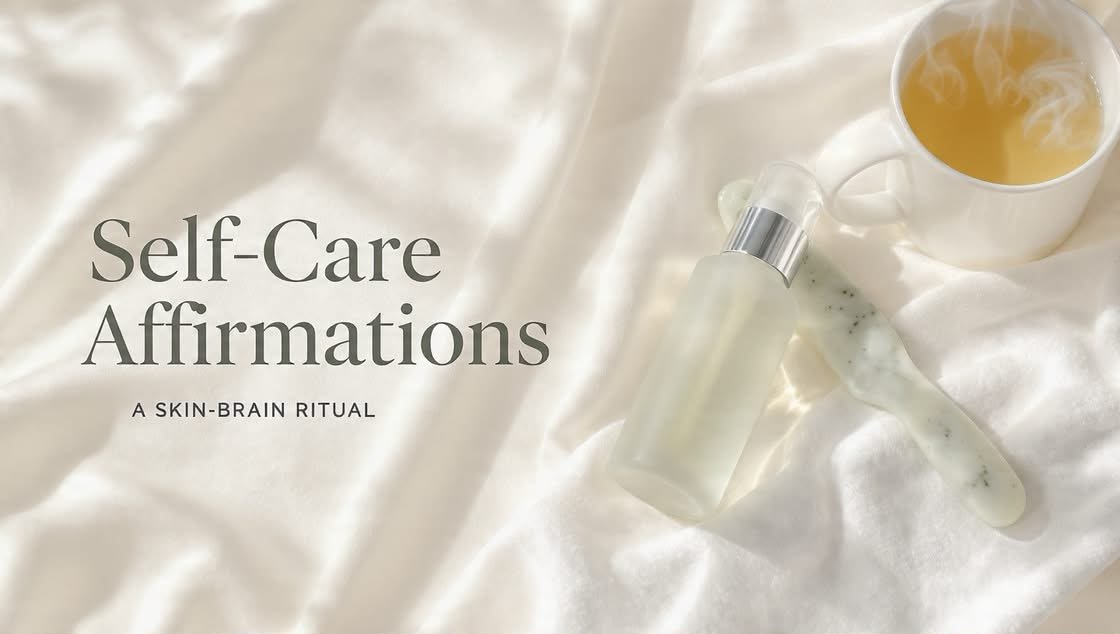
Self Care Affirmations: The Skin-Brain Ritual for Calm
Self care affirmations are brief, value-based statements you repeat to yourself to intentionally shift your brain’s stress response, and when paired with a skincare routine, they can tangibly reduce the skin-damaging effects of chronic cortisol elevation. They are not just decorative quotes. The most effective affirmations ground you in a core personal value, which neuroscientific research shows quiets the brain’s threat detection center and protects your skin’s barrier function. This article provides the specific psychological mechanism, a 2026-ready ritual for pairing words with your skincare, and a curated list of statements organized by skin concern and time of day.
A 2015 fMRI study published in Social Cognitive and Affective Neuroscience demonstrated that self-affirmation activates the ventromedial prefrontal cortex, the brain region involved in processing self-relevance and positive valuation. This activation pattern is not about wishful thinking. It reflects a measurable neural buffer against the cortisol surge that can degrade your skin’s collagen and ceramide production. You are about to learn how to turn two minutes of your skincare routine into a neurologically grounded stress-management practice that dermatologists acknowledge can support clearer, more resilient skin. We’ll cover the exact brain mechanism, how to script affirmations that bypass the brain’s inner critic, and how to anchor them to the physical sensation of applying your serum or moisturizer. You’ll walk away with a morning and evening protocol and a categorized list of statements to use starting tonight.
What Are Self Care Affirmations? A Psychodermatology Definition
Self care affirmations are carefully chosen, value-congruent statements that, when repeated, engage the brain’s self-relevant processing systems to reduce defensive threat responses. In a psychodermatology context, this psychological act becomes a physiological intervention. By lowering the brain’s perception of threat, the practice reduces the release of cortisol and other stress hormones that directly compromise the skin’s stratum corneum barrier and accelerate inflammatory skin conditions. This is not a spiritual bypass. It is a targeted cognitive tool to down-regulate the hypothalamic-pituitary-adrenal (HPA) axis, which directly communicates with your skin cells.
The distinction between a self care affirmation and a generic positive platitude is everything. A self care affirmation must be personally credible. Telling yourself “I am perfectly clear-skinned and beautiful” while staring at an active acne breakout will often generate a counter-reaction in the brain, as noted by self-affirmation theory researcher Claude Steele. An effective affirmation acknowledges a deeper truth, such as “I am providing my skin the patience and care it needs to heal,” which shifts focus from appearance to action and core values. This shift activates the brain’s reward centers instead of its error-detection systems.
For a skincare enthusiast, self care affirmations function as a mental complement to topical antioxidants or barrier-repair creams. You can apply a ceramide-rich moisturizer to repair your lipid barrier while using an affirmation to repair the psychological stress that triggered the barrier damage in the first place. This dual approach is the foundation of a modern psychodermatological self-care practice, addressing the external skin and the internal emotional environment simultaneously.
The Science of Self Care Affirmation Quotes: How Words Calm the Brain
A self care affirmation quote works by providing the brain with a structured, value-affirming narrative that competes with and quiets the brain’s default-mode rumination patterns. When you are stressed, your brain’s amygdala triggers a cascade of electrical and hormonal signals designed for immediate survival. This threat response is critical for escaping physical danger, but it is destructive when chronically activated by social evaluation, body image worries, or work pressure. Researchers at UCLA have used fMRI to show that reflecting on a core personal value during a stressful task reduces cortisol output by making the threat feel less personally destabilizing.
The neural mechanism is precise. The ventromedial prefrontal cortex (VMPFC), which is rich in self-relevant processing circuits, shows increased activity during affirmation. This heightened activity subsequently dampens the amygdala’s threat signaling. The result is a quieter stress signal, less cortisol release from the adrenal glands, and a faster return to baseline after a stressful event. This is not about suppressing negative thoughts. It is about broadening your self-view so that any single criticism, skin imperfection, or setback does not define your entire concept of who you are.
Key Takeaway: A self care affirmation is not magical thinking. It is a targeted neural exercise that strengthens the brain’s internal braking system on the body’s cortisol stress response, a response that directly damages skin collagen and barrier lipids.
Self-Affirmation Theory and Cortisol: The Real Biological Mechanism
Self-affirmation theory, first proposed by social psychologist Claude Steele in the 1980s, posits that people are motivated to maintain a global sense of self-integrity. When this integrity is threatened, a psychological alarm sounds, triggering the body’s fight-or-flight physiology. The cortisol reducing mechanism of affirmations works by reminding the individual of sources of self-worth that are unrelated to the threatened domain. If your self-worth is threatened by a cystic acne lesion, reminding yourself that you are a competent professional, a loyal friend, or a disciplined person restores your global self-integrity, telling your brain the threat is manageable and not identity-destroying.
This psychological process has direct endocrine consequences. A landmark 2009 study led by David Creswell and published in Psychological Science found that participants who engaged in a self-affirmation exercise before a stressful laboratory task had a significantly lower cortisol response compared to controls. More precisely, the affirmed group’s cortisol levels did not spike above baseline, while the non-affirmed group showed a dramatic rise. This is the specific biological pathway that makes the practice of self care affirmations relevant to your skin. Cortisol stimulates sebaceous glands to overproduce oil, ramps up systemic inflammation, and degrades collagen type I and III through the activation of matrix metalloproteinases.
Reducing chronic cortisol levels through a consistent mental practice is a non-negotiable, non-topical intervention for managing inflammatory skin conditions like acne, rosacea, and perioral dermatitis. This is why a board-certified dermatologist will ask about your stress levels during a consultation. The conversation about stress is not a lifestyle tangent. It is a clinical assessment of a primary driver of your skin’s inflammatory response.
Key Takeaway: Validated by fMRI and cortisol assays, self-affirmation theory shows that reflecting on your core values acts as a hormonal circuit breaker, protecting your skin from stress-induced inflammation at the biological level.
The Stress and Skin Connection: What Happens to Your Skin’s Barrier
When psychological stress activates the brain’s HPA axis, the body releases cortisol and other stress mediators that directly attack the skin’s structural integrity. Cortisol tells your sebaceous glands to ramp up oil production, creating an environment where acne-causing bacteria can thrive. Simultaneously, glucocorticoids reduce the production of critical epidermal lipids like ceramides, cholesterol, and free fatty acids. The result is a measurable increase in transepidermal water loss (TEWL). Think of your skin barrier as a meticulously mortared brick wall. Stress is like a jackhammer that systematically weakens the mortar while also cranking the internal humidity, creating a fragile, leaky, and inflamed structure that is prone to both dryness and breakouts.
This connection is extensively documented. A 2001 study published in the Archives of Dermatology and frequently cited by the American Academy of Dermatology demonstrated that psychological stress impairs the recovery of the skin barrier permeability barrier after it is disrupted. In the study, exam stress in medical students correlated with a slower repair of tape-stripped skin. This means stress not only causes skin problems but also actively prevents your skin from healing efficiently. Your high-tech peptide serum cannot work as well if your cortisol is silencing the fibroblasts responsible for synthesizing new collagen.
For individuals with chronic inflammatory conditions like atopic dermatitis or psoriasis, stress is a recognized primary trigger for flares. The mechanism involves stress-induced release of pro-inflammatory neuropeptides like substance P from nerve endings in the skin, which directly activates mast cells and drives the itch-scratch cycle. Understanding this biological cascade transforms your self-care routine from a cosmetic indulgence into a physiologically necessary anti-inflammatory practice. The words you say to yourself are not separate from your skin’s reality. They are chemically modulating the environment in which your skin cells operate.
How to Pair Affirmations With Your Skincare Routine for Anchoring
To pair affirmations with your skincare routine, you use the established tactile sequence of cleansing, treating, and moisturizing as a physiological anchor for a new cognitive habit. This technique leverages a behavioral psychology principle called habit stacking, where a new habit is attached to an already ingrained one. The sensory input of water temperature, product texture, and scent creates a rich neural context. When you consistently repeat a specific affirmation while patting on your hyaluronic acid serum, the brain links the physical sensation to the verbal meaning, making the affirmation more embodied and less abstract.
Start by assigning one key affirmation to one specific step in your routine. For example, during your cleansing step, which is about removal and renewal, use an affirmation about releasing the day’s stress, such as “I wash away the stress that is not mine to carry.” The physical act of rinsing becomes the somatic enactment of the mental statement. Next, during your treatment step with a targeted serum, like a vitamin C antioxidant in the morning, use an affirmation that mirrors the serum’s function. While applying it, repeat “I am actively protecting my skin and building resilience from the inside out.” The meaning of the antioxidant protection is reinforced by the cognitive statement.
This ritual turns a 5-minute routine into a psychodermatological practice. The mirror is a powerful tool here. Looking at your own eyes in the mirror while silently stating your affirmation can feel more vulnerable but is exponentially more potent for self-relevant processing in the VMPFC. Avoid scanning your face for flaws during this ritual. Keep your gaze soft, either at your own eyes or away from the mirror entirely if that induces anxiety. The goal is to fill the sensory experience of your skincare routine with a protective neural narrative, creating a daily, non-negotiable space of psychological safety that your skin biology responds to with less reactive inflammation.
Key Takeaway: Anchor a single, specific affirmation to the physical sensation of applying your moisturizer or serum. The tactile ritual transforms abstract words into a felt biological signal of safety for your skin.
Morning Self Care Affirmations: 5 Statements to Start Your Routine
Morning self care affirmations are designed to build a psychological shield of self-worth and agency before you engage with the external stressors of the day. This is when your cortisol awakening response is naturally highest, typically peaking 30 to 45 minutes after you wake up. Instead of immediately checking your phone and stimulating a reactive stress pathway, you can use your skincare routine to channel that cortisol peak into focused, positive self-definition. This sets the homeostatic tone for your brain and your skin barrier.
1. “I am preparing my skin, and my mind, to receive the day with calm resilience.”
This affirmation pairs perfectly with the application of a morning antioxidant serum. It frames the act of skincare as a protective ritual, not a corrective one.
2. “My value is not measured by the clarity of my skin today.”
Directly targets the self-esteem threat that often triggers a morning stress spike when looking in the bathroom mirror. It broadens your self-concept beyond your appearance, a core tenet of self-affirmation theory.
3. “I am disciplined in the care I give myself, because I am worthy of that commitment.”
Use this while applying your sunscreen. It re-frames a sometimes tedious health behavior into a meaningful act of self-respect, reinforcing the habit loop with a positive identity-based statement.
4. “I choose how I respond to this day.”
A concise, powerful reminder of your agency. The ventromedial prefrontal cortex activation is stronger when affirmations emphasize personal choice and control. State this as you finish your routine and take a final cleansing breath.
5. “The light I protect my skin from today cannot dim my internal steadiness.”
This links the physical act of sun protection to a psychological state of emotional protection. It uses the imagery of your SPF as a shield for your inner peace as much as for your melanocytes and collagen.
Evening Self Care Affirmations: 5 Statements for a Restorative Night
Evening self care affirmations are crafted to shift your nervous system from a sympathetic fight-or-flight state to a parasympathetic rest-and-digest state. This transition is critical for your skin. At night, blood flow to the skin increases, and the epidermal stem cells responsible for barrier repair undergo peak proliferation. Prolactin and growth hormone, released during deep sleep, drive cellular regeneration. If you are mentally ruminating on a stressful meeting while applying your retinol, you are flooding the tissue with the very glucocorticoids that will blunt this overnight repair work.
1. “I release the identity of ‘problem-solver’ and claim my right to rest.”
This affirmation is the mental equivalent of your first cleansing balm. It melts away the day’s cognitive load. Say it while massaging your cleansing oil or balm into dry skin, visualizing the stress dissolving into the oil.
2. “My skin cells are intelligent; they know how to repair, and I am giving them permission to do so now.”
Use this while applying your nighttime treatment, like a retinol or bakuchiol serum. It reinforces the biological truth that your skin is an active, self-repairing organ, not a passive canvas for degradation. The language of “permission” signals safety to the brain.
3. “I am grateful for my hands, which provide the daily labor of my care.”
This shifts focus from analyzing facial flaws to appreciating the body’s capability. Say it while pressing your moisturizer into your skin. This is a somatic self-compassion practice.
4. “Tonight, my body heals. My skin barrier fortifies. My mind quiets.”
A declarative, physiological scripting. The brain responds to factual commands. Stating what the body does during sleep can paradoxically reduce the performance anxiety that keeps people awake.
5. “I did enough today. I am enough right now.”
A non-negotiable anchor for anyone with perfectionist tendencies. This directly counters the nocturnal rumination that delays sleep onset. State this as your final step, perhaps while pressing a cool jade roller or gua sha stone over your lymph nodes.
Self Care Affirmations for Skin Conditions: Managing Acne and Flare-Ups
Self care affirmations for skin conditions like acne, eczema, or rosacea are specifically designed to dismantle the harmful psychodermatological loop where anxiety about the condition triggers more stress hormones, which in turn worsen the inflammatory skin disease. This is not about pretending the condition doesn’t exist. The affirmation must acknowledge the difficult reality while shifting your identity from a “patient suffering helplessly” to an “active participant in healing.” This cognitive reframe is clinically relevant for conditions like atopic dermatitis, where the stress-itch cycle is a primary driver of barrier destruction.
For someone with active, painful cystic acne, staring in the mirror and saying “My skin is flawless” is cognitively jarring and proven to backfire. Instead, use affirmations rooted in action and values. A more effective statement is: “I am consistently providing my skin with evidence-based care, and that consistency is a form of profound self-respect.” This shifts the focus to the care process, which is under your control, rather than the outcome, which is temporarily not. Another powerful affirmation is: “My inflammation is communicating that something internal needs my gentle attention, not my punishment or hatred.”
For chronic and visible conditions like psoriasis or severe rosacea, which can trigger significant social anxiety, an appropriate affirmation is: “Other people’s curiosity or misunderstanding about my skin does not define my worth. My integrity is unaffected by their gaze.” This builds a psychological buffer against perceived stigma. A dermatologist treating recalcitrant inflammatory conditions will often note that the patients who show the best clinical outcomes are those who cultivate a non-hostile, patient, and compassionate internal dialogue toward their skin. Your words are a co-factor in your treatment plan, alongside your topical corticosteroids or biologics.
| Skin Condition | Harmful Thought Pattern | Helpful Affirmation Frame |
|---|---|---|
| Active Acne | “I am disgusting and broken.” | “I am taking active steps to heal. This is a temporary state of imbalance, not a reflection of my character.” |
| Rosacea Flush | “Everyone is staring at me.” | “My skin’s reaction is a physical message. I am listening to it with compassion, not controlling what others perceive.” |
| Eczema Itch | “I need to scratch to get relief.” | “My barrier needs cooling and lipids. I am the guardian of this skin, and I choose the balm over the damage.” |
| Hyperpigmentation | “My skin is permanently ruined.” | “My melanocytes are overactive in protecting me. With patience and protection, I am evening my tone over time.” |
Affirmations for Body Image and Aging Skin: A Self-Compassion Practice
Affirmations for body image and aging skin must directly challenge a culture that pathologizes the normal, biological process of aging, replacing shame and fear with the psychological research-backed practice of self-compassion. Dr. Kristin Neff’s model of self-compassion identifies three core components: self-kindness versus self-judgment, common humanity versus isolation, and mindfulness versus over-identification. Applying this to skin means treating your laugh lines not as a personal failure to be erased, but as a shared, human record of emotion and time that connects you to every other aging person.
A self-compassionate affirmation for a deepening nasolabial fold or new forehead line is: “This line is a record of the tension I held, the laughter I released, and the decades my skin has faithfully protected me. I am grateful for its service, and I now offer it gentle support.” This is not a resignation to not using active ingredients. You can still apply your retinoid or peptide serum. The affirmation changes the reason you apply it. You are no longer applying it from a place of panic or hatred for the aging process. You are applying it from a place of offering nourishment to an organ that has served you. This emotional shift is critical because stress-induced cortisol is itself an aging accelerator in the skin.
For confronting the daily onslaught of highly filtered images on social media, a practical affirmation to use while doing your skincare is: “The digitally altered images I see on screens are not a realistic benchmark for my living, moving, expressive face. My face is not a static image to be perfected, but a dynamic interface for human connection.” This uses cognitive restructuring to dismantle an impossible standard. By pairing this with the act of moisturizing, you are literally hydrating the skin while mentally de-hydrating the power of the comparison. This creates a daily ritual that protects your mental health and your skin’s health simultaneously.
Affirmations for Setting Boundaries: Lowering Stress to Protect Your Skin
Affirmations for setting boundaries are a proactive psychological tool to reduce the allostatic load, the chronic wear and tear on your body caused by unrelenting stress, that directly worsens inflammatory and barrier-compromised skin conditions. The inability to say no, delegate, or disengage from toxic interactions is a primary source of the chronic stress that keeps cortisol levels elevated. By rehearsing boundary-affirming statements, you build the neural architecture needed to execute these difficult conversations in real life, thereby reducing your future stress exposure. This is a long-term skin health investment.
An effective boundary affirmation rehearses the specific discomfort you will tolerate. You are not affirming a stress-free life. You are affirming the courage to endure the temporary stress of a boundary in order to eliminate a chronic stressor. For example: “I am willing to disappoint others momentarily in order to not betray my own need for rest. My peace is not a secondary priority.” Another critical boundary affirmation is: “I am not a receptacle for another person’s unprocessed anxiety or anger. I can be compassionate without absorbing their emotional debris.” This is vital because emotional absorption is a cognitive-behavioral pattern that directly translates into physical tension in the jaw, neck, and facial muscles, and a sustained cortisol drip.
Integrate this into your evening ritual, the time when rumination over a guilt-inducing email or a family member’s request is most likely to occur. As you apply your facial oil or night cream, visualize the boundary as a lipid-rich layer sealing your skin, not just from transepidermal water loss, but from the energetic leakage of people-pleasing. Say to yourself: “My barrier is now sealed. My internal resources remain mine for repair and rest. I release all obligations that do not belong to my nervous system right now.” A licensed clinical psychologist would identify this as a somatic anchoring of cognitive behavioral therapy (CBT) principles.
Key Takeaway: A rehearsed boundary affirmation, paired with the physical sealing act of applying a moisturizer, trains your brain to associate self-assertion with a feeling of biological safety rather than guilt.
How to Write Your Own Self Care Affirmations in 3 Steps
Writing your own self care affirmations is necessary because the neural reward of self-affirmation is contingent on the statement being personally relevant and value-congruent. A generic quote copied from a list will not consistently light up your ventromedial prefrontal cortex like a self-scripted, specific truth. The process involves identifying a specific threat to your self-integrity, identifying a core value that transcends that threat, and then scripting a statement that bridges the two.
Step 1: Identify the Recurring Threat.
Scan your last week for a moment when your self-worth felt attacked. Was it when you caught your reflection and felt disgust? Was it when you said yes to something you resented? Was it scrolling through social media and feeling inadequate? Name the specific trigger. Write it down: “I felt worthless when I saw my forehead lines,” or “I felt small when my boss dismissed my idea.”
Step 2: Identify a Core, Unattacked Value.
Ask yourself: What value do I possess that has nothing to do with this specific threat? If the threat is an aging face, your core value might be “I am a deeply present and emotionally available parent.” If the threat is a work dismissal, your value might be “I am a disciplined and creative problem-solver in my personal life.” The brain needs to hear about a domain where your integrity is fully intact.
Step 3: Script the Bridge Statement.
Write a single sentence that acknowledges the challenge but anchors you firmly in the value. The formula is: “Even though [specific threat], I remain [core value].” For the aging face threat: “Even though I notice my skin changing with time, I remain a person whose value is rooted in my capacity for presence and deep listening.” For the work stress: “Even though my contribution was dismissed today, I remain a creative problem-solver who builds meaningful systems in my life.” This is the precise linguistic structure that self-affirmation research supports.
Your Daily Self Care Affirmations List: A Thematic Breakdown
This daily self care affirmations list is organized by therapeutic function, not just as a random collection of feel-good quotes. Select one affirmation from the category that aligns with your current psychodermatological need, and use it as your anchor for that day’s routine.
For General Self-Worth and Resilience:
- “My worth is intrinsic and is not determined by my productivity, my appearance, or the approval of others.”
- “I am building a life that feels peaceful on the inside, not one that just looks perfect on the outside.”
- “I trust my capacity to handle what today holds.”
For Skin-Specific Anxiety and Body Image:
- “I care for my skin as an act of devotion, not as an act of war against my perceived flaws.”
- “My face is a map of my humanity, not a simulation of a filter. I honor its unique topography.”
- “The goal of my skincare is healthy function: a strong barrier and calm tissue. A ‘flawless’ aesthetic is a marketing construct.”
For Boundary Setting and Stress Reduction:
- “A clear, calm boundary is an act of service to my skin, which bears the biological cost of my stress.”
- “I release the fantasy of controlling how others perceive me. Their story about me is not my responsibility.”
- “My nervous system deserves a quiet, uncluttered environment. I create it by saying no.”
For the Act of Self-Care Application:
- “With this cleanser, I wash away what is not mine. With this serum, I deliver protection. With this cream, I seal in safety.”
- “This routine is the daily evidence that I am a person who shows up for myself.”
- “The warmth of my hands on my face is a signal of safety. My body receives this signal and begins to repair.”
How to Create a Complete Self Care Ritual With Affirmations in 4 Steps
Creating a self care ritual with affirmations involves converting your automatic skincare routine into a sacred, sensorily rich, psychodermatological intervention. It is the difference between swallowing a protein bar and sitting down to a nourishing meal. The ritual structure signals to your brain, through specific sensory inputs, that you are entering a state of safety and repair, which amplifies the cortisol-lowering effect of the words.
Step 1: Set the Environmental Anchor.
Choose one sensory element unique to this ritual. This could be a specific playlist of ambient music, a single unscented candle, or a few drops of a calming hydrosol on a cotton pad that you inhale before beginning. This environmental cue tells the limbic system, the brain’s emotional center, that the transition to “repair mode” has begun.
Step 2: Initiate with Tactile Presence.
Before you apply a single product, press your freshly cleansed hands together and feel the pressure. Take one conscious, slow breath. This somatic grounding is a prerequisite. A dysregulated, shallow-breathing person cannot effectively process a cognitive affirmation. State your first breath-related affirmation: “I am here, in this body, in this moment.”
Step 3: Pair the Product with the Statement.
As you apply each product, speak your assigned affirmation either silently or in a low whisper. The volume is irrelevant; the intentionality is everything. Coordinate the rhythm. For example, while massaging your cleansing balm in slow circles, repeat the release affirmation. While pressing a serum into your skin, repeat the resilience affirmation. The kinesthetic motion and the linguistic meaning fuse.
Step 4: The Occlusive Seal and Final Release.
The final step, typically a heavier moisturizer or face oil, serves a dual purpose. Physically, it occludes the skin, sealing in hydration and actives. Psychologically, it seals the ritual. As you press this occlusive layer over your face, use a final consolidating affirmation: “I seal in this care. I am complete. My work of self-attention is done for now.” This action closes the loop, providing a definitive end point that prevents the practice from dissolving into ambient anxiety.
How to Make Affirmations Stick: Habit Stacking for Neural Rewiring
To make affirmations stick, you must bypass the novelty-seeking brain that gets bored of a new practice after three days by hardwiring the affirmation into a basal ganglia-mediated habit loop. The most effective method is to choose a cue that is already an automatic behavior. Your skincare routine is an ideal cue because it occurs at the same time and in the same location every day. When the affirmation becomes neurologically linked to, for instance, the feeling of cool toner on a cotton pad, the action triggers the thought automatically.
The loop is: Cue (picking up your moisturizer jar) -> Routine (stating your value-based affirmation while applying) -> Reward. The reward must be consciously registered at first. The natural reward is a felt sense of calm and emotional protection. You can amplify this by doing a 5-second body scan after your routine to notice that your jaw is less clenched or your shoulders have dropped. This deliberate acknowledgment of the physiological reward tells the brain to encode this habit loop for the long term. The dopamine from the positive feeling of completing the ritual reinforces the neural pathway, making the new self-talk more automatic over a period of 21 to 60 days.
Journaling about the ritual five minutes later can further solidify the rewiring. Write down not what you did, but what you felt. The translation of somatic experience into written language consolidates the memory in a different brain network. A board-certified dermatologist might see the clinical result in a follow-up visit as a reduction in stress-related flares, but the mechanism was laid down in these quiet, consistent, two-minute daily practices where you chose your words as carefully as your serums.
Key Takeaway: The habit loop of a consistent cue, a practiced affirmation routine, and a consciously felt reward of calm will rewire your default neural response from threat reactivity to self-safety, a change your skin cells will chemically register and reflect.
Frequently Asked Questions About Self Care Affirmations
What is a good self care affirmation?
A good self care affirmation is specific, value-congruent, and stated in the present tense.
For example, “I am providing my skin the patience and care it needs to heal” is effective because it focuses on actionable self-compassion rather than an appearance-based outcome you might not believe.
How do self care affirmations work?
Self care affirmations work by activating the brain’s ventromedial prefrontal cortex, a region involved in processing self-relevant value.
This activation dampens the amygdala’s threat response and reduces the secretion of the stress hormone cortisol.
Can affirmations reduce stress and help my skin?
Yes, a consistent affirmation practice can measurably reduce cortisol levels.
Since cortisol stimulates oil production, degrades collagen, and impairs barrier repair, lowering it through cognitive practices can directly support clearer, more resilient skin function.
How often should you say self care affirmations?
You should say self care affirmations at least once daily, ideally paired with a habitual cue like your morning or evening skincare routine.
Consistent daily practice over weeks is what rewires the neural pathways for a more automatic stress-buffering effect.
What is the difference between affirmations and positive thinking?
Affirmations are targeted statements reflecting core personal values, while positive thinking is often a more general attempt to suppress negative thoughts.
Research suggests that value-based affirmations are more effective because they bypass the brain’s resistance to statements that clash with your current self-view.
Can I write my own self care affirmations?
Yes, you can and should write your own self care affirmations.
The most effective ones are personally scripted to reflect your unique core values and specific challenges, which makes the neural activation stronger than with generic quotes.
The most potent ingredient in your skincare regimen is not found in a bottle. It is the internal chemical environment you create for your body through the thoughts you practice and the stress you release. When you pair a lipid-rich moisturizer with a value-rich affirmation, you are treating your skin at two interdependent layers of biology: the stratum corneum and the ventromedial prefrontal cortex. Your skin is the outermost reflection of your inner state, and you now have a neurologically grounded, ritualized method to transform that state from one of threat to one of profound safety.
Start tonight. Do not wait for a perfect, crisis-free life. Choose the one affirmation from the evening list that felt most resonant, even if you did not fully believe it at first read. Anchor it to the physical act of applying your moisturizer. The belief is not a prerequisite. The practice is. You are not convincing yourself of a lie. You are training your brain to access a deeper truth about your worth, a truth your skin will respond to with calmer, less inflamed, and more resilient function over the months ahead. Your words are a tool. Use them with the same intention you use your serums.