Post Accutane Skincare Routine: 2026 Recovery Guide
Your post Accutane skincare routine needs to prioritize barrier repair, hydration, and sun protection before any active ingredients return to your shelf. Isotretinoin, the medication commonly known by the brand name Accutane, permanently shrinks your sebaceous glands and leaves your skin with a thinner, more vulnerable outer layer for weeks after your final pill. Rebuilding that barrier with a simple, consistent routine is the single most effective step you can take to protect your results and prevent new irritation.
According to the American Academy of Dermatology, isotretinoin remains the most effective treatment for severe nodulocystic acne, with long-term remission rates that are unmatched by any topical regimen. The tradeoff is that your skin spends months in a fragile state, with reduced oil production, compromised water retention, and heightened sensitivity to sunlight and topical products. A 2020 review in the Journal of the American Academy of Dermatology noted that most isotretinoin-related skin side effects resolve within weeks to months, but the recovery curve is heavily influenced by how you care for your skin during that window.
This guide walks you through exactly what to use, what to skip, when to reintroduce actives, and how to maintain your results for years after your course. You will learn the correct product order, the specific ingredients that repair an isotretinoin-compromised barrier, and the timeline for safely bringing back retinoids, acids, and pigment-fading actives.
Post Accutane Skincare Routine
A post Accutane skincare routine is a simplified three-step system focused on cleansing, moisturizing, and sun protection for the first four to eight weeks after your final dose. Your skin is not ready for the full multi-step routines that dominate skincare content. Isotretinoin depletes your sebaceous output to near zero, which means your skin loses its natural lipid shield and cannot hold water the way it did before treatment. The routine that works best right now is the one with the fewest steps and the most barrier-supportive ingredients.
The first month after Accutane is not the time to experiment. Every new product you introduce during this window carries a higher risk of irritation, stinging, and contact dermatitis than it would on a normal skin barrier. Your sebaceous glands are functionally inactive, and your stratum corneum, the outermost layer of dead skin cells, is thinner and more permeable. That permeability cuts both ways: beneficial humectants penetrate more easily, but so do fragrances, preservatives, and potential irritants.
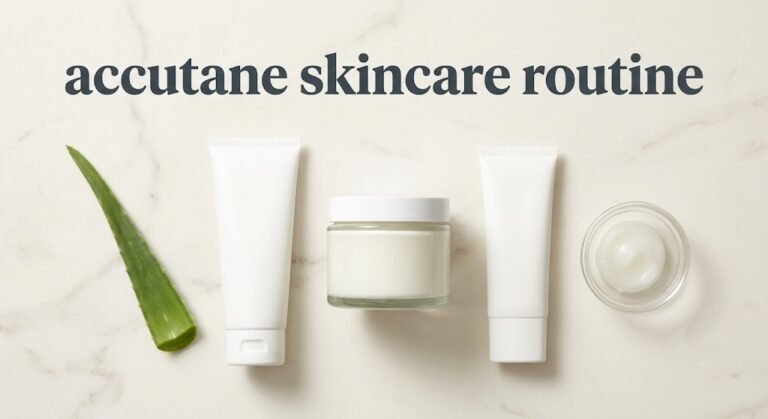
Your immediate routine should look like this each morning and night. In the morning, rinse with lukewarm water or a gentle non-foaming cleanser, apply a fragrance-free moisturizer containing ceramides and humectants, and finish with a broad-spectrum sunscreen of at least SPF 30. At night, cleanse with the same gentle cleanser, apply a slightly richer moisturizer or a thin layer of an occlusive like dimethicone, and stop. That is the entire routine. Nothing else for the first month.
For people with Fitzpatrick skin types IV to VI, post-inflammatory hyperpigmentation from old acne lesions may be visible during this window. It is tempting to reach for a lightening serum. Resist it for now. Your barrier is too vulnerable. Pigment-correcting actives like azelaic acid and tranexamic acid can enter the routine later, once the skin has rebuilt enough to tolerate them without triggering new inflammation.
Skincare After Accutane
Skincare after Accutane means transitioning from the medication’s effects to a maintenance routine that preserves clear skin without overloading your compromised barrier. The mistake most people make is treating their skin as if it is already back to normal the day after their last pill. It is not. Isotretinoin alters your sebaceous gland function at the cellular level, and that change persists for months. Your oil production will gradually return, but it rarely reaches its pre-treatment level, which is partly why the medication works so well long term.
The first four weeks after Accutane are a recovery period. The next four to twelve weeks are a rebuilding period. After three months, most people can start thinking about actives again. This timeline matters because your stratum corneum takes roughly 28 to 40 days to fully renew itself in a healthy adult. When that renewal process is slowed by medication, as it is with isotretinoin, the barrier stays thinner and weaker for longer. A 2021 study in the Journal of Investigative Dermatology reported that isotretinoin reduces epidermal thickness during treatment and that recovery of normal thickness takes several weeks after discontinuation.
Realistically, most post Accutane skin needs about two to three months of consistent moisturizer and sunscreen use before any active ingredient will be tolerated. People with naturally sensitive skin or a history of eczema may need longer. People with oily skin pre-treatment may find their skin tolerates actives sooner, but that is not a reason to rush. The rule is simple: if your skin stings when you apply a basic moisturizer, actives are off the table.
The best thing you can do during this window is observe. Watch how your skin responds to warm water, fragrance, dry air, and sunscreen. These observations tell you exactly when your barrier is ready for more.
Key Takeaway: Treat your skin as medically fragile for at least one month after Accutane, then slowly rebuild over the following two months before reintroducing actives.
Skincare Routine After Accutane
A skincare routine after Accutane should follow a strict product order: cleanser, moisturizer, sunscreen in the morning, and cleanser plus moisturizer at night. Product order matters because the thinnest, most water-based products need to go on first, followed by thicker creams and finally occlusives that seal everything in. This is the same ordering principle used in all dermatology, but it matters more after Accutane because your skin’s absorption is unpredictable when the barrier is compromised.
Think of your post-Accutane skin like a brick wall that has lost some of its mortar. The keratinocytes are still there, but the lipids that hold them together, the ceramides, cholesterol, and free fatty acids, are depleted. Water escapes through the gaps. Irritants get in. Layering products in the correct order, thinnest to thickest, helps fill those gaps and create a temporary barrier while your skin rebuilds its own.
In the morning, start with a lukewarm water rinse. If you have a truly gentle cleanser, one without sulfates, use it. Pat your face dry, but not completely. Apply your moisturizer to damp skin. This is a critical step because humectants like glycerin and sodium hyaluronate pull water into the skin, and they need that water to come from somewhere. Applying moisturizer to damp skin gives them the water they need. Let it absorb for one to two minutes, then apply sunscreen.
At night, cleanse once. Double cleansing is unnecessary and potentially irritating during this recovery window. Apply your moisturizer, then add a thin layer of an occlusive like dimethicone or petrolatum if your skin feels tight. Petrolatum reduces transepidermal water loss by up to 98 percent, making it the single most effective barrier ingredient available without a prescription.
For people with compromised barriers, dermatologists generally advise patch testing any new product on a small area of the jaw or behind the ear for 48 hours before applying it to the entire face. This is especially important in the first month after Accutane, when your barrier may react unpredictably.
Best Moisturizer After Accutane
The best moisturizer after Accutane is a fragrance-free formula containing ceramides, humectants, and a light occlusive to replace the lipids your skin stopped producing during treatment. Isotretinoin depletes sebum, and sebum is not just oil. It is a complex mixture of triglycerides, wax esters, squalene, and free fatty acids that forms the skin’s natural moisturizing layer. Without it, water evaporates quickly, and your skin feels tight, rough, and reactive.
Ceramide NP, ceramide AP, and ceramide EOP are the three most relevant ceramides to look for on a moisturizer label. These lipid molecules make up roughly half of your stratum corneum’s intercellular matrix. Without them, the barrier leaks. A 2018 randomized controlled trial published in the Journal of Cosmetic Dermatology found that a ceramide-containing moisturizer applied twice daily significantly reduced transepidermal water loss and improved skin hydration within two weeks in subjects with disrupted barriers.
Humectants are equally important. Glycerin pulls water into the skin and is one of the most effective, well-tolerated humectants in cosmetic chemistry. Sodium hyaluronate, the salt form of hyaluronic acid, works similarly but at a higher molecular weight, sitting more on the skin’s surface. Both are useful. Apply them to damp skin, then seal them with a light occlusive like dimethicone or a small amount of petrolatum.
Look for these product labels: fragrance-free, non-comedogenic, and free of essential oils. Post-Accutane skin can be temporarily reactive to botanical extracts that never bothered it before. People with atopic dermatitis or a history of eczema should be especially cautious with essential oils, which can trigger contact dermatitis on a compromised barrier.
Key Takeaway: A fragrance-free ceramide moisturizer applied to damp skin is the single most important product in your post-Accutane routine.
Barrier Repair After Isotretinoin
Barrier repair after isotretinoin is the process of rebuilding your stratum corneum’s lipid matrix and restoring normal water retention after the medication thins and dries your skin. This is not a passive process that happens on its own. It requires consistent moisturizer use, gentle cleansing, and time. The stratum corneum needs roughly four to six weeks to fully rebuild its lipid matrix after a disruptive event, and isotretinoin creates one of the longest disruptions in dermatology.
Isotretinoin reduces sebaceous gland size and activity by up to 90 percent during treatment, according to research published in the Journal of the American Academy of Dermatology. Your oil glands do not shut down forever, but they shrink dramatically, and their recovery takes weeks to months. Meanwhile, your skin’s natural production of ceramides, filaggrin, and other barrier proteins also dips. The combined effect is a barrier that leaks water at a much higher rate than normal. This leak is measured clinically as transepidermal water loss, or TEWL, and it is the single most important number in barrier recovery.
To reduce TEWL effectively:
- Cleanse with a sulfate-free, fragrance-free cleanser no more than once or twice daily
- Apply a ceramide-containing moisturizer to damp skin twice daily
- Add a thin occlusive layer at night if skin feels tight
- Avoid hot water, which strips the remaining barrier lipids
- Use a humidifier if you live in a dry climate or sleep with heat on
The lipid matrix of your stratum corneum is like the mortar in a brick wall. Ceramides, cholesterol, and free fatty acids fill the spaces between dead skin cells. When that mortar is stripped away, the wall crumbles. Moisturizer supplies temporary mortar while your skin manufactures its own.
People who took higher cumulative doses of isotretinoin may experience a longer barrier recovery period. Cumulative dosing is calculated as the total milligrams of the drug taken over the entire course, and higher cumulative doses are associated with more prolonged skin dryness. If your skin still feels tight at month three, you are not abnormal. Some individuals need six months for full barrier restoration.
How Long Does Accutane Make You Sensitive to the Sun
Accutane makes your skin more sensitive to the sun for the entire duration of treatment and for at least four to eight weeks after your last dose. The sensitivity does not disappear the day you stop taking the medication. Isotretinoin alters the structure of your stratum corneum, thinning it and reducing the natural UV protection provided by a healthy, intact outer layer. This is not a theoretical concern. The American Academy of Dermatology specifically advises patients on isotretinoin to use broad-spectrum sun protection throughout treatment and to continue that protection after the course ends.
The mechanism is structural rather than chemical. Isotretinoin does not make your skin produce a photosensitizing compound. It simply removes the physical thickness of dead cells that normally absorb and scatter UV radiation. A thinner stratum corneum allows more UV to reach the living epidermis below, increasing the risk of sunburn, hyperpigmentation, and long-term photoaging. This effect is most pronounced during treatment but persists as long as the barrier remains thin.
For people with darker skin tones, Fitzpatrick types IV to VI, the visible sunburn response may be less obvious, but the hyperpigmentation risk is higher. Post-inflammatory hyperpigmentation from old acne lesions can darken rapidly with even brief midday sun exposure. The AAD recommends a broad-spectrum sunscreen with SPF 30 or higher every day, regardless of skin tone or weather.
Treat your post-Accutane sun sensitivity as a four to eight week minimum window. If you spend significant time outdoors, extend your caution. The barrier rebuilds gradually, and no blood test can tell you exactly when your skin has regained its full UV protection. Daily sunscreen is the only reliable strategy.
Key Takeaway: Continue broad-spectrum SPF 30+ daily for at least two months after Accutane, because your skin’s natural UV protection is still rebuilding even after the medication leaves your system.
Best Sunscreen After Accutane
The best sunscreen after Accutane is a broad-spectrum mineral formula containing zinc oxide or titanium dioxide, with an SPF of 30 or higher and no added fragrance. Mineral sunscreens sit on the skin’s surface and physically scatter UV radiation, which makes them less likely to trigger irritation than chemical UV filters on a post-Accutane barrier. Zinc oxide is particularly well tolerated and offers broad protection against both UVA and UVB wavelengths.
Chemical sunscreens work by absorbing UV energy and converting it to heat. They are effective and generally safe, but on a compromised, post-Accutane barrier, they can sometimes cause stinging or contact irritation. The American Academy of Dermatology recognizes both mineral and chemical sunscreens as effective broad-spectrum options, but for skin that is still rebuilding, mineral is the gentler first choice.
Look for these qualities on the label:
- Broad-spectrum coverage
- SPF 30 or higher
- Zinc oxide at 5% or higher, or titanium dioxide at 3% or higher
- Fragrance-free
- Non-comedogenic
A common complaint about mineral sunscreens is the white cast they leave on deeper skin tones. This is a legitimate concern. Tinted mineral sunscreens using iron oxides can reduce the white cast while adding protection against visible light, which plays a role in hyperpigmentation. For Fitzpatrick types IV to VI, a tinted mineral sunscreen with iron oxides is often the best combination of gentleness, elegance, and pigment protection.
Reapply every two hours if you are outdoors, sweating, or swimming. The vitamin D question deserves a quick note here. Daily sunscreen use does not cause vitamin D deficiency in most people, and the benefits of sun protection after Accutane far outweigh any theoretical concern. If you have a documented vitamin D deficiency, speak with your primary care physician about supplementation rather than skipping sunscreen.
When Can I Use Retinol After Accutane
You can use retinol after Accutane only after your skin barrier has fully recovered, which typically means waiting at least three to six months after your final dose. Retinol is a vitamin A derivative that converts to retinoic acid in the skin and increases cell turnover, which is exactly what your skin is already struggling to do during isotretinoin recovery. Adding retinol too early re-disrupts a barrier that is not yet stable.
Isotretinoin and retinol both belong to the retinoid family. Isotretinoin is a systemic retinoid. Retinol is a topical, much weaker retinoid. They share a mechanism: both increase keratinocyte turnover and thin the stratum corneum during initial use. Starting topical retinol while your skin is still thin from isotretinoin compounds the effect and can lead to severe dryness, peeling, redness, and even a dermatitis flare.
A board-certified dermatologist can provide personalized timing, but the standard clinical guidance is to wait at least one full skin cycle, roughly one to three months, before considering any active retinoid. Most dermatologists advise three to six months for retinol specifically, because even low-strength retinol can be irritating. Tretinoin, the prescription-strength retinoid, should be reintroduced only under the direct guidance of the prescribing dermatologist.
When you do start retinol:
- Use a low concentration, 0.25% to 0.5% retinol, not prescription tretinoin
- Apply once per week for the first month
- Sandwich it between two layers of moisturizer
- Never use it on the same night as any other active
- Stop immediately if stinging, redness, or flaking lasts more than 48 hours
People with a history of severe isotretinoin-related dryness should expect to wait longer. Your pre-Accutane tolerance for retinol is irrelevant. Your skin is not the same skin you had before treatment.
Can I Use Salicylic Acid After Accutane
You can use salicylic acid after Accutane only after your barrier has fully recovered, which usually means waiting at least two to three months after your final dose. Salicylic acid is a beta-hydroxy acid that exfoliates the skin’s surface and clears pores by dissolving the bonds between dead cells. On a post-Accutane barrier, that exfoliation is exactly what you do not want during the recovery window.
Salicylic acid works by penetrating the stratum corneum and breaking down the intercellular glue that holds dead skin cells together. It is lipid-soluble, which allows it to penetrate oil-filled pores, and it is a proven treatment for comedonal acne. The American Academy of Dermatology lists salicylic acid as an effective over-the-counter acne treatment. But effectiveness on normal or oily skin does not translate to safety on a thinned, dry, post-isotretinoin barrier.
Using salicylic acid during the first two months after Accutane will not improve your skin. It will strip the fragile lipids your barrier needs, increase transepidermal water loss, and potentially trigger irritant contact dermatitis. The result is red, flaky, stinging skin that looks worse than the acne it was meant to prevent.
Wait until the following signs are consistently present:
- Your skin feels comfortable after cleansing
- Moisturizer no longer stings
- You have had no episodes of unexplained redness for at least one month
- Your skin tolerates warm water without tightness
When those signs are stable, introduce salicylic acid at a low concentration, 0.5% to 1%, once or twice weekly. Never combine it with retinol or other exfoliating acids on the same night. People with Fitzpatrick types IV to VI should be especially cautious with salicylic acid, as over-exfoliation can trigger post-inflammatory hyperpigmentation.
Key Takeaway: Active exfoliation, including salicylic acid, should wait until your barrier has been stable for at least one month, not just until you finish your isotretinoin course.
How Long to Wait Before Using Exfoliants After Isotretinoin
You should wait at least two to three months, and often longer, before using exfoliants after isotretinoin. Exfoliants include alpha-hydroxy acids like glycolic acid and lactic acid, beta-hydroxy acids like salicylic acid, and physical scrubs. All of them remove surface skin cells by either chemical or mechanical means. Your skin has just spent months being thinned by a systemic retinoid, and the last thing it needs is more cellular removal.
The stratum corneum is supposed to shed its outer cells in a controlled, orderly process called desquamation. Isotretinoin disrupts this process and thins the entire layer. Adding an exfoliant on top of that disruption creates a barrier that cannot hold water, cannot resist irritants, and cannot protect against UV radiation. The result is predictable: redness, stinging, peeling, and increased sensitivity.
A useful analogy is sanding a wooden table. When the wood is fresh and thick, light sanding smooths it. When the wood has already been sanded down to a thin veneer, more sanding goes straight through to the base. Post-isotretinoin skin is the thin veneer. Give it time to regrow before you sand again.
Polyhydroxy acids, like gluconolactone, are the gentlest chemical exfoliant option and may be suitable for some people at the four to six month mark. They have a larger molecular size, which limits their penetration and irritation. Even so, introduce them slowly, starting once every two weeks, and monitor your skin for 48 hours after each application.
If you have a history of post-inflammatory hyperpigmentation, avoid aggressive exfoliation entirely for at least six months. Hyperpigmentation-prone skin, especially Fitzpatrick types IV to VI, can develop dark patches in response to exfoliant irritation. A gentle hydrating routine with niacinamide and azelaic acid will fade those marks more safely than any acid.
Post Inflammatory Hyperpigmentation After Accutane
Post inflammatory hyperpigmentation after Accutane is the residual dark or red marks left behind after acne lesions heal, and it is one of the most common post-treatment concerns for people with Fitzpatrick skin types IV to VI. Isotretinoin clears the active acne, but the pigment changes from old lesions can linger for months. These marks are not scars. They are temporary pigment deposits in the skin that fade as your natural cell turnover processes the excess melanin.
The pigment forms when inflammation from an acne lesion stimulates melanocytes, the pigment-producing cells in your skin, to overproduce melanin. That melanin deposits in the epidermis, creating a flat brown, red, or purplish mark that can last for weeks to months. The Journal of the American Academy of Dermatology reports that post-inflammatory hyperpigmentation is significantly more common and more persistent in people with darker skin tones.
The most important thing you can do during the post-Accutane window is wear sunscreen every single day. UV exposure darkens existing hyperpigmentation and makes it last longer. A broad-spectrum SPF 30 or higher, applied every morning and reapplied every two hours outdoors, is the single most effective intervention for this condition.
Once your barrier is stable at the two to three month mark, these pigment-fading ingredients can help:
- Niacinamide at 2% to 5%, which blocks melanosome transfer to keratinocytes
- Azelaic acid at 10% to 15%, which reduces melanocyte activity
- Tranexamic acid at 2% to 3%, which reduces UV-induced pigment production
- Licorice root extract, a gentler botanical alternative with mild tyrosinase inhibition
Do not reach for hydroquinone or strong chemical peels without the direct supervision of a board-certified dermatologist. These are powerful pigment treatments that can cause rebound hyperpigmentation if used incorrectly on darker skin tones.
Fading Acne Marks After Isotretinoin
Fading acne marks after isotretinoin requires patience, daily sun protection, and a slow, ingredient-specific approach that begins only after your barrier is stable. The marks left behind are either post-inflammatory hyperpigmentation, which is flat pigment, or post-inflammatory erythema, which is flat redness from dilated blood vessels. Both respond to different ingredients, and using the wrong one can make the marks worse.
Post-inflammatory erythema is more common in fair skin, Fitzpatrick types I to III, and appears as persistent red or pink marks. It fades as the blood vessels that formed during inflammation slowly retract. Niacinamide at 2% to 5% can help by improving barrier function and reducing ongoing inflammation. Azelaic acid at 10% to 15% also helps both pigment and redness.
Post-inflammatory hyperpigmentation is more common in darker skin, Fitzpatrick types IV to VI, and appears as brown or grayish patches. It fades as excess melanin is shed through normal cell turnover, a process that takes longer when the skin’s renewal is slowed, as it is after isotretinoin.
Your timeline for fading these marks realistically:
- First month: sunscreen only, no actives
- Months two to three: introduce niacinamide twice daily
- Month three to four: add azelaic acid every other morning
- Month six and beyond: consider tranexamic acid if marks are still visible
This is a slow process. Expect marks to fade over three to six months, not three to six weeks. A 2021 clinical trial in the Journal of Cosmetic Dermatology found that a combination of niacinamide and azelaic acid significantly reduced post-inflammatory hyperpigmentation over 12 weeks when used with daily sunscreen. That is the realistic timeline.
Key Takeaway: Sunscreen is the fastest hyperpigmentation-fading product you own. Without daily SPF, every pigment-correcting active is working against an open door.
Azelaic Acid After Accutane
Azelaic acid after Accutane is one of the safest and most effective actives to reintroduce first, typically at the three to four month mark, because it treats residual acne, redness, and hyperpigmentation without exfoliating the barrier. It is a naturally occurring dicarboxylic acid that works differently from alpha and beta-hydroxy acids. Instead of dissolving the bonds between dead skin cells, azelaic acid reduces inflammation, clears clogged pores, and inhibits melanin production.
This makes azelaic acid uniquely suited for post-Accutane skin. Your barrier is still rebuilding, and you need an active that does not strip it. Azelaic acid has been shown in multiple randomized controlled trials to improve both acne and post-inflammatory hyperpigmentation without causing the dryness and peeling associated with retinoids and hydroxy acids. The American Academy of Dermatology includes azelaic acid in its acne treatment guidelines as an effective topical option.
Start with 10% azelaic acid. Apply a pea-sized amount every other morning, after moisturizer, to reduce initial stinging or itching. Azelaic acid commonly causes a brief, mild itching or prickling sensation when first applied. This usually subsides within 15 to 30 minutes and diminishes with continued use. If it persists or worsens, stop and speak with a dermatologist.
For people with Fitzpatrick types IV to VI, azelaic acid is a preferred pigment-correcting agent because it works on melanocytes without disrupting the barrier. It is also safe to use during pregnancy, which is relevant for people who finished isotretinoin and are planning for pregnancy in the future, though this should be discussed with a board-certified dermatologist or obstetrician before starting any new active.
Does Acne Come Back After Accutane
Acne comes back after Accutane for some people, but most achieve long-term remission. The American Academy of Dermatology states that isotretinoin is the closest thing to a cure for severe acne, with approximately 80% of patients achieving permanent clearance after one full course. The remaining 20% may experience some recurrence, which is usually milder than the original acne and often responds well to topical maintenance therapy.
Recurrence is more likely if you stopped treatment early, took a lower cumulative dose than your dermatologist recommended, or were under 16 at the time of treatment. Hormonal acne in adult women, especially perimenopausal or polycystic ovary syndrome-related acne, also has a higher recurrence rate. A 2019 meta-analysis in the Journal of the American Academy of Dermatology found that cumulative dose was the strongest predictor of long-term remission, with doses of 120 to 150 mg/kg of body weight associated with the lowest relapse rates.
If acne does return, the first step is not to restart a full isotretinoin course. Most recurrences are mild and respond to topical maintenance therapy with adapalene, azelaic acid, or a benzoyl peroxide wash. A board-certified dermatologist can assess whether a short topical course is sufficient or whether a second isotretinoin course is warranted.
The best thing you can do to prevent recurrence is not to neglect your maintenance routine. A simple nightly application of a prescription retinoid like adapalene, which is available over the counter at 0.1%, or tretinoin, if prescribed, can keep pores clear for years after isotretinoin. Consistent use matters more than intensity.
Key Takeaway: Roughly one in five people will see some acne return after Accutane, but it is usually milder and often manageable with topical maintenance rather than a second systemic course.
Long Term Skincare After Isotretinoin
Long term skincare after isotretinoin is a maintenance routine that preserves your results with a gentle cleanser, daily sunscreen, a barrier-supporting moisturizer, and one or two targeted actives used consistently. You do not need a complicated multi-step regimen to keep clear skin. In fact, complexity is the enemy of long-term adherence, and adherence is what keeps acne from returning.
Your long-term routine should be built around consistency. A cleanser that does not strip, a moisturizer that maintains your barrier, a sunscreen you actually wear every day, and a prescription or over-the-counter retinoid used a few nights per week. That is the foundation. Everything else, serums, essences, toners, is optional and should earn its place by delivering a specific, measurable benefit.
A board-certified dermatologist can recommend a maintenance regimen based on your skin type and recurrence risk. For people with a history of severe nodulocystic acne, prescription tretinoin applied two to three nights per week is a common maintenance standard. For those with milder recurrence risk, adapalene 0.1% gel is an effective over-the-counter option.
The most important long-term active is the one you will actually use. If tretinoin irritates you, use adapalene. If retinoids in general are too drying, azelaic acid is a reasonable substitute for maintenance. The best maintenance routine is the one you can follow every night without dread.
People with Fitzpatrick types IV to VI should maintain daily sunscreen indefinitely, not just during post-Accutane recovery. Long-term UV protection is the single most effective strategy for preventing hyperpigmentation recurrence and darkening of residual marks.
Diet for Skin After Accutane
Diet for skin after Accutane does not need to be dramatically different from a standard balanced diet, but staying hydrated and maintaining adequate intake of omega-3 fatty acids may support your skin’s lipid recovery. Isotretinoin often causes dry lips, dry skin, and increased thirst during treatment, and some of that dryness persists into the recovery window. Hydration and specific dietary fats can help your skin rebuild its natural moisture barrier.
Omega-3 fatty acids, found in fatty fish like salmon, mackerel, and sardines, support the skin’s anti-inflammatory pathways and contribute to the lipid matrix of the stratum corneum. A 2018 study in the Journal of Cosmetic Dermatology found that omega-3 supplementation improved skin hydration and reduced inflammation-related skin redness in subjects with dry, sensitive skin. This is supportive, not curative. Omega-3s help, but they cannot replace topical barrier repair.
Vitamin C is another relevant nutrient. Your skin uses ascorbic acid to synthesize collagen, the structural protein that supports skin integrity. Citrus fruits, bell peppers, strawberries, and broccoli are good sources. Dietary vitamin C supports overall skin health but does not need to be supplemented unless you have a documented deficiency.
One important note: isotretinoin is typically taken with a high-fat meal to improve absorption, but once treatment ends, this dietary requirement ends too. You can return to your normal eating pattern. If you have questions about supplements, especially fat-soluble vitamins like A and E, speak with a registered dietitian or your prescribing dermatologist, because high-dose vitamin A supplementation can be harmful.
Key Takeaway: Hydration and a balanced diet with adequate healthy fats support skin recovery after Accutane, but topical barrier repair and daily sunscreen matter more than any single food choice.
Frequently Asked Questions About Post Accutane Skincare
How long after Accutane can I start using skincare products?
You can use gentle skincare products, specifically a mild cleanser and fragrance-free moisturizer, immediately after finishing Accutane.
Wait at least two to three months before adding actives like retinoids or hydroxy acids.
Your skin barrier needs time to rebuild before it can tolerate active ingredients.
Can I use retinol a month after Accutane?
No, using retinol one month after Accutane is too early for most people.
Isotretinoin and retinol both thin the stratum corneum, and combining them too soon causes severe dryness and irritation.
Wait at least three to six months, or until your dermatologist confirms your barrier has recovered.
What is the best moisturizer after Accutane?
A fragrance-free moisturizer containing ceramide NP, ceramide AP, and ceramide EOP is the best choice after Accutane.
These ceramides rebuild the lipid matrix your skin lost during isotretinoin treatment.
Look for added humectants like glycerin or sodium hyaluronate, and apply to damp skin twice daily.
How long does Accutane make you sensitive to the sun?
Accutane makes your skin more sun-sensitive for the entire treatment period and for at least four to eight weeks after your last dose.
Isotretinoin thins the stratum corneum, reducing your skin’s natural UV protection.
Use broad-spectrum SPF 30 or higher every day during this window, regardless of skin tone.
Will my acne come back after Accutane?
Approximately 80% of people achieve long-term clearance after one full Accutane course, according to the American Academy of Dermatology.
The remaining 20% may see some recurrence, usually milder than before.
Recurrence is more likely with lower cumulative doses, younger age, or hormonal acne in adult women.
Can I use salicylic acid after Accutane?
You can use salicylic acid after Accutane, but only after your skin barrier has been stable for at least one month.
For most people, that means waiting two to three months after the final dose.
Start at 0.5% to 1% once or twice weekly, and never layer it with retinol on the same night.
Your post-Accutane skin is not the same skin you had before treatment, and that is a good thing. It is clearer, calmer, and now has a better chance of staying that way for life if you protect it during the recovery window and beyond. The single most important product you own right now is sunscreen, followed closely by a fragrance-free ceramide moisturizer. Everything else can wait.
Give your barrier four to eight weeks of simple care before you reintroduce anything. Watch for signs of stability: no stinging, no tightness, no unexplained redness. When those signs have been consistent for a month, add actives one at a time and slowly. Your skin will tell you when it is ready.
You have already done the hard part. Now let your skin heal.