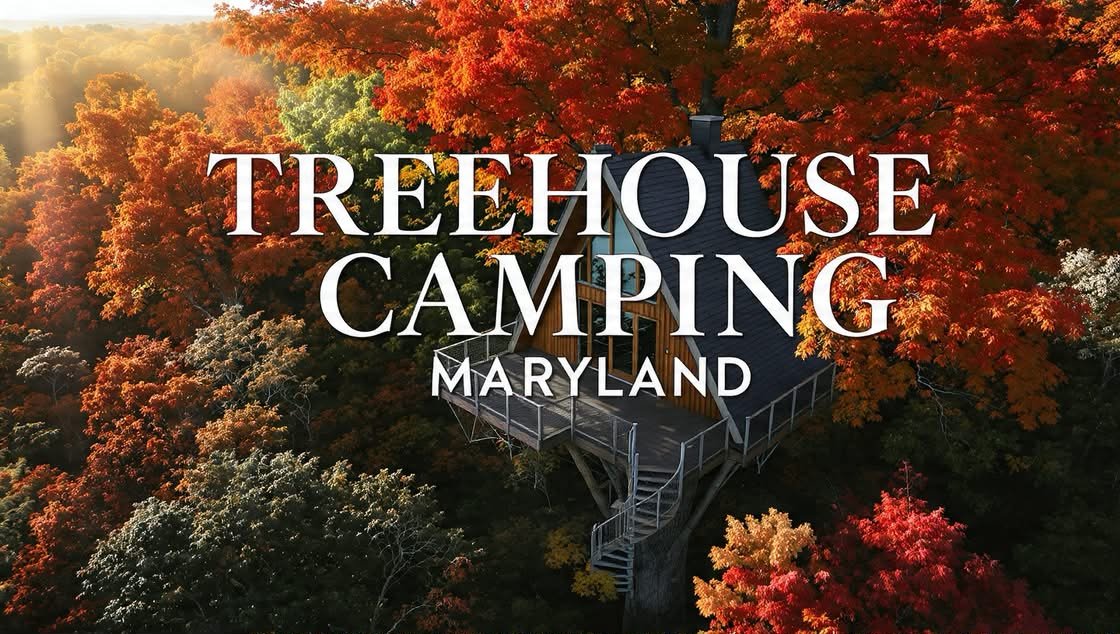
Maryland Treehouse Camping: 2026 Guide to Canopy Stays
Maryland treehouse camping puts you in the canopy, not in a tent on the forest floor. The experience ranges from primitive platform shelters to multi-room luxury rentals with heat.
Most people searching this term do not realize half the options are on private land only fifty feet from the owner’s house. This guide names the sites, the solitude ratings, and the exact booking logic for 2026.
Treehouse Camping Maryland: Why Sleep in the Canopy?
Treehouse camping in Maryland trades a ground-level tent pad for a platform elevated among branches, removing the dampness and ground-level pests of standard camping. The experience is a novelty destination stay, not a backcountry isolation exercise.
The state offers three distinct tiers. State parks provide elevated tent platforms, private outfitters offer rustic primitive cabins, and luxury rentals deliver insulated treehouses with modern plumbing and air conditioning.
The reservation method splits sharply between these tiers. Public platforms in state forests, like those near Catoctin, use the Maryland Park Service reservation system with rolling six-month booking windows that fill fastest for October weekends.
Private treehouse rentals book direct or through vacation rental platforms often twelve months ahead. First-time treehouse campers routinely underestimate the physicality of hauling gear up a spiral staircase or ladder system in the dark.
Key Takeaway: Treehouse camping is a novelty accommodation style, not a wilderness backpacking substitute. Set expectations based on the structure type, not the forest around it.
Luxury Treehouse Rentals Maryland: Full-Service Escapes
Luxury treehouse rentals in Maryland offer queen beds, indoor plumbing, and climate control, creating a hotel room experience wrapped around a live tree. Blue Moon Rising near Deep Creek Lake defines this category with architect-designed cabins that suspend between necessity and whimsy.
These units provide full bathrooms, mini-kitchens, and often private hot tubs on elevated decks. A stay here costs significantly more than a standard state park cabin but removes every rough edge of camping for couples who prize ambience over roughing it.
Book these high-end units ten to twelve months before a target autumn weekend. Midweek January stays, while starkly beautiful after a snowfall, often offer better availability and lower minimum-night requirements than October’s leaf-peeping frenzy.
Families with toddlers may find the steep interior staircases and low cable railings a constant source of low-grade anxiety. The true limitation of this tier is proximity: most luxury treehouses cluster on private acreage where you can hear the neighboring rental’s music through the trees.
The Western Maryland mountain region features the highest concentration of these premium stays. Garrett County’s elevation provides cooler summer nights, making open-window sleeping feasible from June through early September when lower elevations feel muggy.
Primitive Treehouse Camping Maryland: The Rustic Experience
Primitive treehouse camping strips away plumbing and power, giving you a roofed wooden platform with open sides or screened windows. Maple Tree Campground in Rohrersville remains the gold standard for this tier, offering tree cottages with bunk beds and a shared bathhouse a short walk away.
You haul your gear up a flight of wooden stairs to reach a single room with mattresses, a lantern hook, and little else. The appeal is the creak of the tree and the sound of the night wind, which a sealed luxury unit blocks entirely with insulation.
Reservations for Maple Tree’s primitive tree cottages open on their proprietary booking system and summer Saturdays disappear within hours of release. For first-timers, this is the sweet spot: a real treehouse without a second mortgage, but with access to flush toilets and potable water at the bathhouse.
Budget campers get the highest value at this tier, paying a modest premium over a tent site for the novelty of sleeping elevated. Couples seeking absolute privacy should book the most isolated cottage on the property edge rather than the ones clustered near the communal fire pit where families gather until quiet hours.
Cooking happens at a ground-level fire ring, so you climb up and down with each meal component. Pack your gear in soft duffels, not hard plastic totes, because rigid containers jam on tight stair landings and trap your fingers against railings in the dark.
Key Takeaway: Primitive sites deliver the genuine treehouse sounds and sway without luxury markup, but require strong knees and organized packing for the repeated ladder climbs.
Family Treehouse Camping Maryland: Sites Kids Love
Family treehouse camping thrives at properties where structures sit close to the ground with wide, railed staircases, and where noise from excited children won’t draw glares. The Treehouse Camp at Sandy Spring offers bunk-bed cottages with screened windows on a flat property ideal for bike riding between the trees.
The campground includes communal fire rings, open fields, and easy access to bathrooms with flush toilets and hot showers. This removes the two primary stressors for parents of young children: fear of a child falling from a high platform and midnight bathroom logistics.
Select a tree cottage within a one-minute walk of the bathhouse. A three-minute walk with a half-asleep four-year-old at 2 a.m. through dark woods becomes a genuine ordeal that ruins the next day’s mood for everyone.
Experienced camping families handle primitive treehouses well if the kids are over eight and can manage a ladder independently. First-time camping families should book a luxury treehouse with an indoor bathroom or stick to the Sandy Spring model with its gentle learning curve.
Catoctin Mountain’s state-run sites offer a middle path for families wanting a public-land experience with basic amenities. The campground loops here are paved and manageable, but the elevated platforms still require careful supervision of younger children near the edges.
Romantic Treehouse Getaways Maryland: Secluded Canopy Stays
Romantic treehouse getaways in Maryland require two non-negotiable elements: a heat source for temperature control and genuine visual isolation from other rental units. Youghiogheny Hollow treehouses in Western Maryland deliver this combination with units spaced far apart on steep, wooded parcels where you never see another cabin from your deck.
These rentals feature king beds, indoor fireplaces or wood stoves, and large windows framing the forest canopy. The lack of cellular service in the Youghiogheny River valley becomes a feature, not a bug, for couples actively trying to disconnect from work notifications.
Book a unit advertised as “secluded” or “end-of-road” specifically. Do not trust wide-angle photos that crop out the neighboring rental’s roofline. Contact the owner directly and ask one question: “Is any other rental structure visible from my private deck?”
The cost premium for a private hot tub on a treehouse deck is justified for romantic stays in winter. A heated soak at 15 degrees with steam rising into bare branches creates the experience that Instagram photos promise but rarely deliver without the shivering context.
Avoid romantic treehouse bookings during peak family travel windows, specifically Memorial Day weekend and the week between Christmas and New Year’s. Even secluded properties share access roads that turn into noisy thoroughfares of minivans and family reunion traffic during these dates.
Key Takeaway: True romantic seclusion requires questioning the host about sightlines to other units. A hot tub under bare winter branches justifies the seasonal cold-weather markup.
Treehouse Camping Maryland State Parks: Public Land Options
Maryland state parks offer the most affordable and logistically straightforward treehouse camping through elevated tent platforms and rustic cabins, though these book through the state’s central reservation system with fierce competition. Catoctin Mountain Park, managed by the National Park Service, and nearby Cunningham Falls State Park serve as the anchors for public-land canopy stays in the Catoctin ridgeline.
The state park reservation system opens bookings on a rolling basis that extends months into the future, and the most desirable elevated platform sites vanish for October weekends the moment the window unlocks. First-time state park campers receive a far gentler introduction to elevated sleeping than private treehouse novices because park rangers patrol regularly and a camp store is usually within driving distance.
Families with young children benefit most from state park platform camping because the infrastructure, including flush toilets, hot showers, and level parking pads, removes the unpredictability of private off-grid rentals. The genuine limitation is noise: state park campgrounds operate at high density during peak months, and the elevated wooden platforms transmit every footstep and zipper pull from neighboring sites directly into your sleeping bag.
Treehouse Camping Near Deep Creek Lake MD: Western Mountain Stays
Deep Creek Lake anchors Maryland’s highest-elevation treehouse cluster, where Garrett County’s mountain climate provides cool nights even during July heat waves. The private rental market around the lake includes at least a dozen treehouse structures, ranging from converted deer blinds to architect-designed post-and-beam constructions.
The elevation at Deep Creek, roughly 2,400 feet, means nighttime temperatures in summer stay 10 to 15 degrees cooler than Baltimore or DC. This eliminates the muggy canopy conditions that make low-elevation treehouses uncomfortable for sleeping during August’s peak humidity.
Winter stays here require serious preparation because Garrett County receives significant lake-effect snow. Confirm with the property owner that the access road and driveway are plowed by contract, and that a four-wheel-drive vehicle is not a suggestion but a requirement for the final unplowed approach if a storm hits during your stay.
The Deep Creek area is not a secret, and Wisp Resort at the lake’s north end draws crowds year-round for skiing, mountain biking, and a mountain coaster. The treehouse clusters on the lake’s quieter southern coves offer more solitude, but require a twenty-minute drive to reach groceries or a restaurant in McHenry.
Treehouse Camping Catoctin Mountain Maryland: Forested Ridge Stays
Catoctin Mountain provides the closest treehouse experience to the Washington and Baltimore metro areas, with a mix of public-land platform camping and private rental cottages tucked into hardwood forests. The Catoctin ridgeline runs north-south through Frederick County, offering east-facing sunrise views that filter through the canopy at dawn.
The National Park Service’s Catoctin Mountain Park does not operate dedicated treehouses but its adjacent private inholdings and the state-run Cunningham Falls area offer elevated camping structures. The proximity to Camp David means the airspace is restricted and the surrounding forest feels unusually secure and quiet for being only 90 minutes from the Capital Beltway.
The chief logistical mistake first-timers make is confusing the three separate jurisdictions: the federal park, the state park, and the municipal watershed, each with different rules about campfires, alcohol, and quiet hours. Verify which specific agency manages the land under your treehouse before assuming standard campground freedoms apply.
Fall weekends here are the most competitive treehouse booking window in the state because Catoctin’s hardwood forest produces exceptional color, and DC-based weekend warriors can leave after work on Friday and reach their platform by dark. Book six months ahead for October, or target the first two weeks of November when color still holds and demand drops sharply.
Key Takeaway: Catoctin’s proximity to DC makes it the most competitive fall treehouse market in Maryland. Target early November for color without the six-month booking knife fight.
Treehouse Camping Eastern Shore Maryland: Coastal Woodland Stays
Treehouse camping on Maryland’s Eastern Shore shifts the backdrop from mountain hardwoods to loblolly pine and tidal creek views. The coastal plain offers a milder climate and a flatter landscape, producing treehouses built into stands of pine that smell sharply of sap on hot afternoons.
Pocomoke River State Park anchors the public-land options, with its Shad Landing area offering elevated tent platforms near the cypress-lined river that defines the region. The humidity here from June through August is the genuine deal-breaker, a thick, buggy blanket that mountain treehouses avoid by sheer elevation advantage.
The best months for an Eastern Shore treehouse are April through mid-May and October through early November. These windows provide comfortable sleeping temperatures and, critically, avoid the peak mosquito and biting fly seasons that can make a sunset on the deck feel like a blood donation drive.
Private treehouse rentals dot the shoreline of the Chesapeake Bay and its tributaries in Talbot and Dorchester counties. These units often face water, not just woods, and the view of a sunrise over a marsh from a treehouse deck is an experience the western mountain properties cannot replicate at any price point.
The terrain is flat, so the treehouses here are not dramatically elevated like their mountain counterparts, and the “canopy” sensation is subtler. Couples seeking a quiet water view paired with seafood dinners in towns like St. Michaels or Berlin will find this region the best match for a relaxed weekend that balances nature with civilization.
Glamping Maryland Treehouses 2026: Comfort in the Trees
Glamping treehouses in Maryland for 2026 continue a strong push toward insulated structures with full bathrooms, Wi-Fi, and climate control, blurring the line between camping and boutique hotel. The 2026 season sees several existing properties adding heat pumps for shoulder-season comfort, expanding their bookable months from a narrow summer window to nearly year-round operation.
The term “glamping” in Maryland’s treehouse context generally means a real bed with linens provided, a private flush toilet, and some form of temperature control beyond a basic space heater. These amenities justify the steep nightly rate for a specific subset of travelers: couples who want the Instagram aesthetic of a treehouse with the sleep quality of a Westin.
First-time outdoor travelers find glamping treehouses the ideal entry point because the structure handles all the camping discomforts on their behalf while providing the novel thrill of sleeping among branches. Experienced campers often find the glamping tier frustrating because the sealed windows and soundproofed walls eliminate the specific thing, the night wind and branch creak, that makes a treehouse more than just a wooden hotel room.
Verify the specific “glamping” definition with each property before booking. One operator’s glamping setup includes a Nespresso machine and heated tile floors, while another’s uses the term to describe a primitive platform with a Coleman lantern and a slightly thicker sleeping pad. The price difference between these two interpretations can be fourfold, so read the amenity list with forensic attention.
Maryland Treehouse Camping Winter: Four-Season Stays
Winter treehouse camping in Maryland is viable only at properties specifically designed or retrofitted with sealed walls, insulation, and a primary heat source that does not require you to wake every two hours to feed a wood stove. The majority of primitive treehouse structures in the state close from December through March because uninsulated wooden platforms become dangerously cold and the access roads become impassable.
Garrett County’s luxury treehouses near Deep Creek Lake offer the most reliable winter treehouse experience in the state, combining serious insulation with backup heating systems and plowed private roads. A winter treehouse stay here, with snow piled on the roof and a wood stove radiating inside, delivers a hygge-level coziness that summer stays cannot match.
The risk is a power outage during an ice storm, which cuts the electric heat and the well pump, leaving you in a dark box with a dwindling wood pile and no running water. Ask the owner directly about backup heat sources and water storage protocols before booking a treehouse for January or February, and pack sleeping bags rated to zero degrees Fahrenheit even if the listing promises central heat.
Couples without children make the best winter treehouse candidates because the romantic isolation of a snowbound canopy cabin appeals far more to them than to parents who must entertain snowed-in toddlers in a single room with no yard access. The winter sky through bare branches is spectacular and star-clear, an optical reward for braving the cold that summer’s thick leaf canopy actively obscures.
Key Takeaway: Winter treehouse stays demand structures with real insulation and a backup heat plan. Garrett County’s high-elevation luxury units handle this best.
Maryland Treehouse Rentals With Heat: Three-Season vs. Wood Stove
A treehouse rental listed as “heated” in Maryland spans a massive spectrum from a properly insulated mini-split heat pump system to a decorative electric fireplace that warms a three-foot radius. The presence or absence of real heat determines whether your stay in April or November is atmospheric or genuinely miserable.
Wood stoves are the most common heat source in mid-tier treehouses and they provide excellent warmth, but they demand a skill set that many first-time glampers lack. You must understand how to start a fire with damp wood, how to adjust the damper without smoking out the room, and how to wake every three hours to reload, turning a romantic getaway into a shift-work sleep-deprivation exercise.
Treehouses with electric baseboard heat or a properly sized heat pump offer set-it-and-forget-it comfort that wood stoves cannot match. These units cost more per night but the premium is justified for anyone who has ever arrived at a cold treehouse at 10 p.m. and spent an hour fumbling with kindling in the dark while their partner shivered in a parka on the bed.
Families with young children should filter exclusively for thermostat-controlled heat because a hot wood stove is a burn hazard and a cold room guarantees a night of everyone piling into one bed for warmth. Couples comfortable with a learning curve may genuinely enjoy the wood stove ritual as part of the experience, but only if both partners share this enthusiasm equally.
Pet Friendly Treehouse Camping Maryland: Bringing Your Dog
Pet-friendly treehouse camping in Maryland is rare and comes with specific restrictions that rule out the most photogenic elevated properties with steep ladder access. A dog cannot climb a spiral staircase or a narrow ladder, so the treehouse must have a wide, railed stairway or a ground-level ramp entrance for a pet to access the structure safely.
Maple Tree Campground allows dogs in select tree cottages with stair access, but the pet fee and the requirement to keep dogs leashed and off furniture mirror standard cabin rules. The genuine challenge is the night: a dog accustomed to a backyard will find the elevated platform disorienting and may bark at every raccoon, owl, and branch creak throughout the night, destroying the sleep quality for your entire stay and for anyone in a neighboring rental.
The best pet-friendly treehouse setups are the luxury units with a fenced ground-level deck or a small enclosed yard at the base of the stairs. These let the dog handle its business without you navigating a ladder while holding a leash and a flashlight in the rain at 3 a.m.
Eastern Shore treehouses built on flat ground with stair access tend to be more dog-compatible than mountain treehouses perched on steep slopes. Before booking any pet-friendly listing, confirm the specific physical path from the treehouse door to the designated pet relief area, and verify that no part of that path requires you to carry a dog down a ladder or a staircase without railings.
Key Takeaway: Pet-friendly treehouse camping works only when wide stair access meets a ground-level relief area. Ask about the exact path from door to grass before booking.
Booking Maryland Treehouses Recreation.gov vs. Private Platforms
Booking a Maryland treehouse splits between government reservation systems for public land platforms and a patchwork of private platforms for everything else. Recreation.gov handles the National Park Service’s Catoctin Mountain Park sites, while Maryland State Parks uses its own centralized reservation portal for Cunningham Falls and other state-run elevated camping structures.
These public systems open reservations on a rolling window, and a summer Saturday at a state park platform is competitive in a way that private treehouse bookings are not. You compete against every tent camper, RV traveler, and cabin seeker for the same release moment, and the elevated platforms are a tiny fraction of the total inventory, so they sell out in seconds, not hours.
Private treehouses book through three main channels: the property’s direct website, larger vacation rental platforms like Airbnb and VRBO, or niche outdoor booking sites like Hipcamp. Direct booking avoids platform service fees that can add a substantial percentage to your total, but it also removes the standardized cancellation protections that the major platforms build into their terms of service.
First-time treehouse campers should book private rentals through a platform with a clear, published cancellation policy rather than a direct Venmo deposit to a property owner they have never met. Experienced return visitors to a known property can safely book direct and save the platform fee, but only after they have physically visited the site and confirmed that the photos match the reality.
What to Pack for Treehouse Camping Maryland: The Ladder Factor
Packing for a Maryland treehouse requires a fundamental shift from standard camping logic because every item you bring must climb a ladder, staircase, or spiral stair in your arms. Soft-sided duffel bags and backpacks replace hard plastic totes, which catch on railings, bruise your shins, and cannot be compressed to fit through narrow treehouse doors.
A headlamp is non-negotiable, not a flashlight. You will need both hands free to grip railings, carry gear, and steady yourself on narrow steps, and a handheld light leaves you one hand short for safety in the dark. Pack a headlamp with a red light mode to preserve night vision during midnight bathroom trips to the ground-level facility.
Pack earplugs regardless of how remote the listing appears. The forest is loud at night, and a treehouse amplifies every branch scratch, owl call, and acorn drop into a soundscape that first-time treehouse sleepers find startling rather than soothing. The wind moving through the canopy creates creaks and groans that a ground tent never transmits, and earplugs are the difference between a fascinated 4 a.m. wake-up and a rested morning.
Bedding requirements vary widely by property tier. Luxury glamping units provide linens, pillows, and comforters as standard. Primitive tree cottages at places like Maple Tree Campground provide a mattress only, and you supply your own sleeping bag or sheets and blankets, a detail that first-timers miss when they open the door to a bare bunk at 9 p.m. with temperatures dropping.
Key Takeaway: Soft bags, a headlamp, and earplugs are the three non-negotiable items unique to treehouse camping that standard tent packing lists overlook.
Accessible Treehouse Rentals Maryland: No-Ladder Options
Accessible treehouse rentals in Maryland are extremely limited, and the term “accessible” in this context requires honest scrutiny because most treehouses, by their core design concept, are elevated structures reached by stairs or ladders. A true accessible treehouse rental needs a ramp or ground-level entry, wide doorways, and a bathroom configured for mobility device use, and fewer than a handful of properties in the state meet this standard.
The Treehouse Camp at Sandy Spring offers several cottages with ramp access and ground-level entry points, built more like raised cabins than traditional treehouses. These structures provide the aesthetic of sleeping in the woods with tree-trunk views from the windows without the barrier of a staircase or the physical challenge of climbing into a canopy platform.
Luxury glamping units at Blue Moon Rising include some designs with wide, gently sloped walkways rather than steep stairs, though the entrance paths often involve gravel or packed earth that can pose challenges for wheeled mobility devices, particularly after rain. Call the property and describe your specific mobility needs directly to the manager rather than relying on an “accessible” checkbox on a booking platform that has never physically inspected the site.
The primary limitation is that a ground-level treehouse structure lacks the defining feature, the elevated canopy perch, that most people associate with treehouse camping. If the view through the windows into the tree trunks at eye level satisfies the treehouse experience for you, the accessible cottage options at Sandy Spring and similar properties deliver this well, with the critical bonus of bathrooms you can actually reach and use comfortably.
Frequently Asked Questions About Treehouse Camping in Maryland
Is treehouse camping in Maryland safe for kids?
Yes, treehouse camping is safe for kids when you choose a structure with wide, railed staircases rather than ladders or spiral stairways.
Properties like the Treehouse Camp at Sandy Spring build with family safety in mind, using solid staircases and enclosed sleeping spaces.
Primitive sites with open-air platforms and ladders are a genuine fall risk for children under eight and require constant close supervision that most parents find exhausting rather than relaxing.
Do Maryland treehouse rentals have bathrooms?
Some do, and the presence of a bathroom is the single largest dividing line between luxury glamping and primitive treehouse camping in Maryland.
Luxury units from Blue Moon Rising and similar operators include full private bathrooms with flush toilets, hot showers, and sinks inside the treehouse itself.
Primitive tree cottages at places like Maple Tree Campground use a shared bathhouse a short walk from the structure, requiring a ground-level trip for every bathroom need.
How far in advance can I book a Maryland treehouse?
Private luxury treehouse rentals often accept reservations twelve months ahead, and the most desirable fall weekends at the best properties book within days of the window opening.
Maryland State Park elevated platforms open on a rolling six-month window through the state’s central reservation system.
Set a calendar reminder for the exact date your target window opens and book immediately, because state park treehouse platforms are a tiny fraction of total inventory and sell out in seconds for peak weekends.
What is the best season for treehouse camping in Maryland?
Late September through October is the best season for treehouse camping in Maryland, combining peak fall foliage with cool, bug-free sleeping temperatures.
May and early June offer a strong second window with fresh green canopy and pleasant daytime highs before summer humidity sets in.
Avoid July and August in non-air-conditioned treehouses on the Eastern Shore, where the humidity turns an elevated wooden box into a stifling oven by mid-morning.
Are there any treehouses you can rent in a Maryland state park?
Maryland State Parks offer elevated tent platforms and rustic elevated shelters rather than traditional enclosed treehouses with walls and roofs.
Cunningham Falls State Park and Pocomoke River State Park provide these platform experiences in scenic locations with standard campground amenities.
Book these through the Maryland Park Service reservation portal, not through private rental platforms, and expect fierce competition for autumn weekend dates.
Do you need to bring your own bedding for treehouse camping in Maryland?
Check the specific property listing, because bedding policies split sharply between luxury and primitive treehouse rentals in Maryland.
Luxury glamping treehouses provide full linens, pillows, and comforters as part of the nightly rate.
Primitive tree cottages provide a bare mattress only, and you must bring your own sleeping bag or sheets and blankets, a detail often discovered too late on arrival night.
Your Maryland Treehouse Night Starts With an Honest Search
Maryland’s treehouse camping scene splits into three honest tiers: public platform camping that books like a state park tent site, primitive private cottages that deliver authentic canopy creaks at a fair price, and luxury rentals that blur the line between camping and a boutique hotel. The right choice depends entirely on whether you want to climb a ladder with a headlamp in your teeth or walk up a gently lit staircase to a heated room with a view.
Identify your non-negotiable: a private bathroom, a heat source beyond a decorative fireplace, or a genuinely pet-accessible entry path. Then book that specific property category directly through the owner’s verified platform or the appropriate state reservation portal, paying close attention to the cancellation terms that govern your dates.
Campground fees, firewood quarantine rules, and reservation windows change without notice. Verify the current booking platform, heat source status, and access road conditions directly with the property owner or the Maryland Park Service before you commit to a non-refundable stay.
The canopy is waiting, and with the right preparation, your first night in a Maryland treehouse will be the deeply unusual, satisfying sleep among the branches that your ground-tent memories can’t touch.