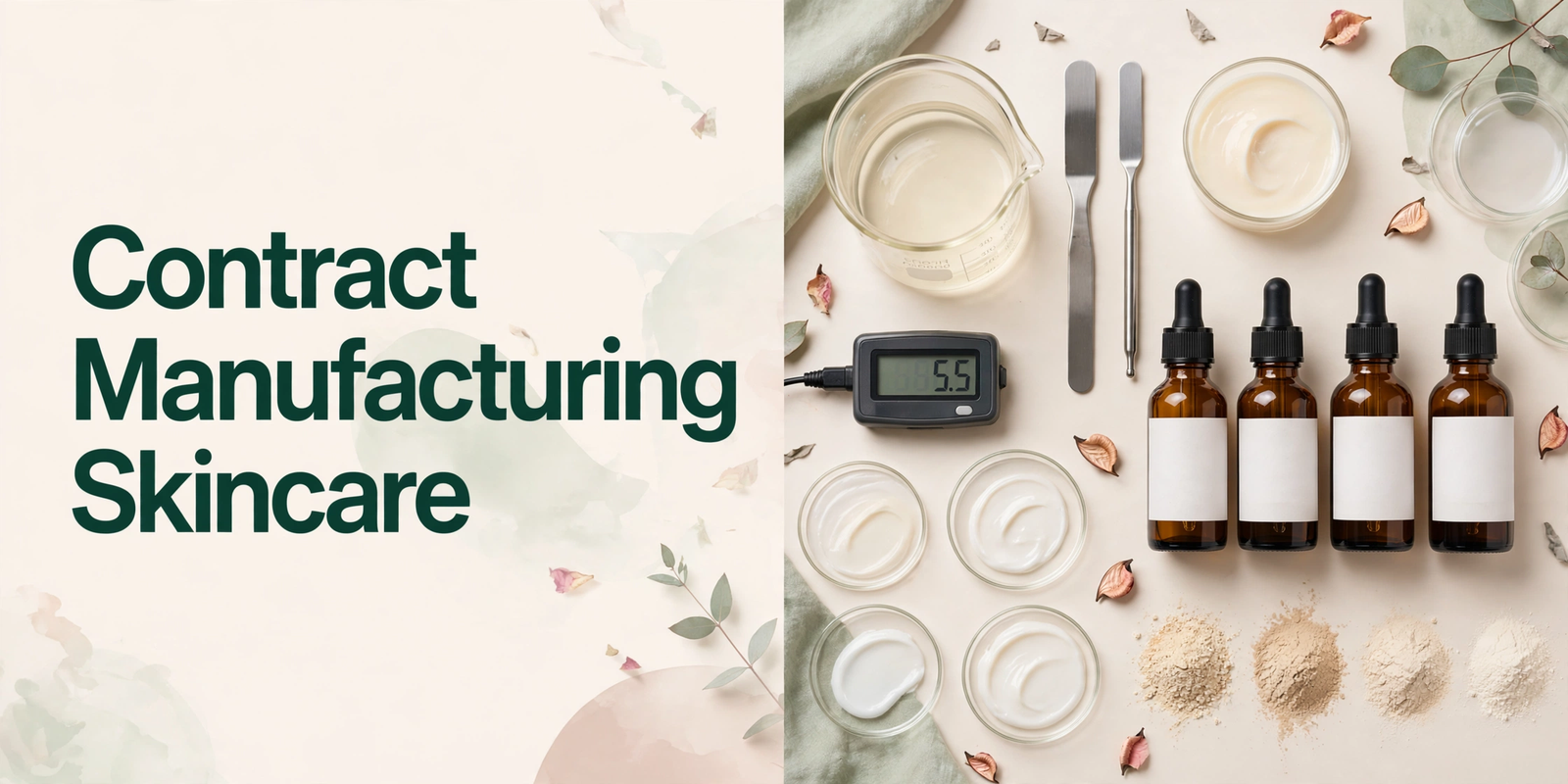
Contract Manufacturing Skincare: 2026 Guide for Brand Founders
Contract manufacturing skincare is the process of hiring a specialized facility to formulate, produce, fill, and package your skincare products under your brand name. In 2026, choosing the right manufacturing partner requires understanding MoCRA regulations, GMP standards, and the specific quality control measures that separate legitimate facilities from marketing-heavy operations that outsource production to the lowest bidder.
According to the US Food and Drug Administration (FDA), all cosmetic manufacturing facilities must now be registered and all products listed under the Modernization of Cosmetics Regulation Act of 2022 (MoCRA), a requirement that became mandatory in July 2023 and remains fully enforced in 2026. This means the baseline for what counts as a compliant skincare manufacturer has risen, but it has not eliminated the wide variation in formulation quality, preservative system integrity, and ingredient transparency across the industry.
This guide walks you through everything a brand founder needs to know before committing money to a contract manufacturer. You will learn the differences between private label and custom formulation, the full manufacturing process, the regulatory requirements you are legally responsible for, the quality tests that should never be skipped, and the specific questions to ask before signing any agreement.
Contract Manufacturing Skincare: What It Actually Means in 2026
Contract manufacturing skincare refers to outsourcing the production of skincare products to a third-party facility that handles formulation, compounding, filling, and packaging under your brand name. The manufacturer operates the equipment and holds the regulatory certifications, while you own the brand identity, customer relationships, and final product responsibility.
A contract manufacturer can provide three distinct service levels. Original equipment manufacturing (OEM) means the manufacturer produces formulas they already own and simply applies your label. Private label manufacturing lets you select from an existing catalog of stock formulas with some customization options for fragrance, color, or packaging. Custom formulation, also called original design manufacturing (ODM), involves a cosmetic chemist developing a new formula from scratch based on your specifications.
The skincare contract manufacturing industry has grown substantially since 2020, driven by the direct-to-consumer boom and lowered barriers to brand creation. The International Organization for Standardization (ISO) reports that ISO 22716 certification, the global standard for cosmetic GMP, has become a baseline expectation for legitimate manufacturers rather than a differentiator. In 2026, brand founders need to understand that the facility making your product carries legal obligations, but so do you as the brand owner.
Key Fact: Under MoCRA, the “responsible person” for a cosmetic product is the brand owner whose name appears on the label, not the contract manufacturer. If your product causes an adverse reaction, you bear the legal responsibility, which means you must verify every manufacturing claim your partner makes.
What Is Contract Manufacturing in Skincare
Contract manufacturing in skincare is a business arrangement where a brand hires a third-party facility to produce skincare products according to specified formulations, quality standards, and packaging requirements. The contract manufacturer supplies the production infrastructure, regulatory compliance documentation, and often the formulation expertise, while the brand supplies the concept, marketing, and customer relationships.
Understanding the full scope of what manufacturers offer matters because the term covers a wide range of service levels. Some facilities only provide filling and packaging services, requiring you to supply the formula and ingredients. Others offer full turnkey services that include formulation development, ingredient sourcing, stability testing, filling, packaging, labeling, and even warehousing.
A turnkey manufacturer handles the entire process from raw material procurement to finished product delivery. This is the simplest model for brand founders without formulation experience, but it also means you have less control over ingredient quality and sourcing decisions. The trade-off between convenience and transparency becomes a central factor in manufacturer selection.
According to the Personal Care Products Council, the trade association representing cosmetic manufacturers, contract manufacturing accounts for a substantial portion of cosmetic products sold in the United States, though exact figures are not publicly disclosed. The prevalence of contract manufacturing means most skincare brands you see on shelves are not made in-house, including many premium-priced products.
| Service Type | What the Manufacturer Provides | What You Provide | Control Level |
|---|---|---|---|
| OEM (Stock Formulas) | Ready-made formula, production, packaging | Brand name, label design | Low |
| Private Label | Existing formula with limited customization | Brand concept, label, some ingredient choices | Medium |
| Custom Formulation (ODM) | Chemist-developed formula, full production | Full ingredient specifications, target product profile | High |
| Turnkey | Everything from formula to packaging | Brand vision, budget, approval at each stage | Medium |
Private Label vs Custom Formulation Skincare: Which Model Fits Your Brand
Private label skincare involves selecting a pre-existing formula from a manufacturer’s catalog and applying your branding to it, while custom formulation requires a cosmetic chemist to develop a unique product based on your specific ingredient and performance requirements. The choice between these two models shapes your initial investment, time to market, and the degree of differentiation your brand can claim.
Private label products launch faster because the formula already exists and has typically undergone stability testing. You can often have product in hand within four to eight weeks, depending on packaging lead times and minimum order quantities. The limitation is that hundreds of other brands may be selling the same base formula with different labels, which makes meaningful product differentiation nearly impossible without significant marketing spin.
Custom formulation takes six to eighteen months from concept to finished product, depending on complexity, testing requirements, and iteration cycles. The investment is substantially higher, typically starting at five thousand to fifteen thousand dollars for formulation development alone, before production costs. However, you own the formula, control ingredient sourcing decisions, and can genuinely claim product uniqueness in a crowded market.
For brands targeting specific skin concerns with active ingredients, custom formulation allows you to specify exact concentrations of ingredients like niacinamide, ascorbic acid, or salicylic acid. A private label formula may advertise these ingredients without disclosing that they appear at concentrations below the level needed for documented efficacy, a common issue in stock formulations.
Key Takeaway: Private label gets you to market fast and cheap but sacrifices differentiation, while custom formulation costs more and takes longer but gives you genuine control over ingredient quality and product claims.
Skincare Manufacturing Process Step by Step
The skincare manufacturing process moves through formulation development, raw material sourcing, batching and compounding, filling, packaging, and quality control testing. Each step requires specific documentation and verification to ensure the final product meets both regulatory requirements and the safety standards you are legally responsible for as the brand owner.
Formulation development begins with a product brief that specifies the target skin concern, desired texture, pH range, preservative system requirements, and any marketing claims you intend to make. A cosmetic chemist then selects ingredients, calculates percentages, and creates a bench sample for evaluation. This bench phase involves multiple iterations before the formula is stable and aesthetically acceptable.
Batching and compounding occurs in large mixing vessels where ingredients are combined under controlled conditions. Temperature-sensitive ingredients like retinol, ascorbic acid, and certain peptides require specific handling protocols to maintain stability. The compounding process must follow the master formula exactly, with every ingredient weighed and recorded.
Filling and packaging transfers the finished bulk product into jars, bottles, tubes, or airless pumps. Packaging compatibility testing ensures the container does not react with the formulation, leach chemicals, or allow microbial contamination over the product’s shelf life. After filling, finished goods undergo final inspection before shipping.
- Raw material verification: Every incoming ingredient batch requires a certificate of analysis (COA) confirming identity, purity, and contaminant levels
- Master batch record: Documents exact weights, mixing times, temperatures, and operator initials for every production run
- In-process checks: pH, viscosity, and appearance verification at specified intervals
- Finished product testing: Microbiological testing, preservative efficacy confirmation, and visual inspection
- Packaging compatibility: Stability testing in final packaging to detect interaction problems
FDA Regulations for Skincare Manufacturing: What You Must Know
FDA regulations for skincare manufacturing govern facility registration, product listing, adverse event reporting, and labeling requirements under the Federal Food, Drug, and Cosmetic Act as amended by MoCRA in 2022. The FDA does not pre-approve cosmetic products or ingredients before they go to market, which means your manufacturing partner’s compliance practices are your first and only line of defense against regulatory violations.
Cosmetic products in the United States are defined by the Federal Food, Drug, and Cosmetic Act as articles intended to be applied to the body for cleansing, beautifying, promoting attractiveness, or altering appearance without affecting structure or function. The moment your product claims to treat a skin condition, prevent wrinkles, or alter skin biology, it crosses into drug territory and requires pre-market approval through the new drug application process.
MoCRA introduced several mandatory requirements that changed cosmetic manufacturing permanently. Facilities must register with the FDA and renew that registration every two years. Brand owners must list each product with the FDA, including ingredient information. Adverse events must be reported to the FDA within 15 days when they involve serious health consequences. These requirements apply regardless of whether you manufacture in-house or use a contract manufacturer.
The FDA conducts facility inspections and can issue warning letters, recalls, or import alerts for products manufactured in non-compliant facilities. In 2026, the agency has increased inspection frequency for high-risk cosmetic categories, including products marketed for sensitive skin, baby care, and leave-on products used around the eyes.
Regulatory Distinction: Your product is a cosmetic if it claims to cleanse, moisturize, or improve appearance. It becomes a drug if it claims to treat acne, reduce wrinkles through biological action, or alter skin structure. The label language you choose determines which regulatory pathway applies, and this decision should be made before formulation begins.
MoCRA Compliance for Cosmetics: The 2026 Requirements
MoCRA compliance for cosmetics includes mandatory facility registration, product listing, adverse event reporting, safety substantiation, and labeling of fragrance allergens. The Modernization of Cosmetics Regulation Act of 2022 represents the first significant update to US cosmetic regulations since 1938, and its requirements are now fully enforceable in 2026.
Facility registration requires the manufacturer to submit basic information about their production location to the FDA. This is not an approval process, but registration creates a legal obligation to allow FDA inspection and maintain current records. Your contract manufacturer should provide their facility registration number and proof of current status before you commit to working with them.
Product listing requires the responsible person, typically the brand owner, to submit each cosmetic product’s ingredient information to the FDA. This includes the complete INCI ingredient list, product category, and the facility where the product is manufactured. Failure to list products can trigger regulatory enforcement, including product detention or recall.
Adverse event reporting requires brands to submit a report to the FDA within 15 business days when they become aware of a serious adverse event. Serious adverse events include death, hospitalization, significant disability, birth defects, or required medical intervention. Non-serious adverse events must be maintained in records for six years but do not require immediate FDA reporting.
| MoCRA Requirement | Who Is Responsible | Deadline or Frequency | Key Detail |
|---|---|---|---|
| Facility Registration | Manufacturer | Every 2 years | Must renew; not a one-time filing |
| Product Listing | Brand owner (responsible person) | Annually | Complete INCI ingredient list required |
| Adverse Event Reporting | Brand owner | Within 15 business days | Serious events only; records kept 6 years |
| Safety Substantiation | Brand owner | Before market entry | Must have evidence supporting safety |
| Fragrance Allergen Labeling | Brand owner | Before market entry | Specific allergens listed individually |
| Professional Use Labeling | Brand owner | Before market entry | Required for certain product categories |
Cosmetic GMP Guidelines for Skincare: What Good Manufacturing Practices Actually Require
Cosmetic GMP guidelines for skincare establish the minimum quality standards for manufacturing facilities covering personnel training, equipment maintenance, raw material handling, production documentation, and quality control testing. ISO 22716 is the internationally recognized GMP standard for cosmetics, and legitimate contract manufacturers should maintain certification or operate to equivalent standards.
Good Manufacturing Practices exist to prevent contamination, ensure batch consistency, and create traceability when quality problems arise. A GMP-compliant facility maintains written standard operating procedures for every process, documents every batch production run, and retains samples and records for specified periods. Without GMP, you cannot trace a quality issue back to its source or demonstrate to regulators that your product was produced under controlled conditions.
Personnel requirements under GMP include hygiene protocols, protective clothing, and training specific to their role in production. Equipment must be cleaned and sanitized between batches to prevent cross-contamination, and cleaning procedures must be documented and verified. Raw materials must be quarantined until identity and quality are confirmed through certificate of analysis review and, where appropriate, in-house testing.
For brand founders, GMP compliance is not an optional add-on. It is the manufacturing standard that makes your product defensible if a customer experiences a reaction, a contamination issue emerges, or a regulator questions your production process. A manufacturer that cannot produce batch records, cleaning logs, or raw material COAs on request should be disqualified immediately.
| GMP Element | What It Requires | Why It Matters for Your Brand |
|---|---|---|
| Written SOPs | Documented procedures for every process | Traceability and consistency |
| Personnel Training | Documented training per role | Prevents operator error |
| Equipment Maintenance | Cleaning and calibration logs | Prevents contamination |
| Raw Material Verification | COA review, quarantine procedures | Prevents substandard ingredients |
| Batch Records | Complete production documentation | Traceability for recalls |
| Quality Control Testing | Micro testing, pH, viscosity verification | Product safety substantiation |
Skincare Formulation Stability Testing: Why It Matters and How It Works
Skincare formulation stability testing verifies that a product maintains its physical, chemical, and microbiological integrity throughout its claimed shelf life under normal storage conditions. A product that separates, changes color, loses active ingredient potency, or supports microbial growth after three months is not ready for market, regardless of how good the formula looked on day one.
Stability testing evaluates multiple parameters over time. Physical stability checks for phase separation, color changes, odor development, and texture alterations. Chemical stability verifies that active ingredients like ascorbic acid, retinol, and niacinamide remain at effective concentrations. Microbiological stability confirms that the preservative system continues to prevent contamination after the product is opened and used.
Accelerated stability testing exposes product samples to elevated temperatures, typically 40 to 45 degrees Celsius, for defined periods to predict long-term stability. While accelerated testing provides useful early signals, it cannot fully replace real-time stability testing at room temperature. The FDA expects safety substantiation to include stability data relevant to the product’s intended use and shelf life.
Real-time stability testing follows the product under normal storage conditions for the full claimed shelf life, typically 24 to 36 months. Samples are pulled at scheduled intervals and tested for pH, viscosity, microbial content, and active ingredient concentration. Freeze-thaw cycle testing simulates temperature fluctuations during shipping and storage by cycling samples between freezing and room temperature.
Key Fact: According to the International Journal of Cosmetic Science, preservative efficacy can decline over time even in well-formulated products, which is why stability testing must include repeated challenge testing at multiple time points rather than a single test at production.
Preservative Efficacy Testing for Cosmetics: Protecting Your Product and Your Customers
Preservative efficacy testing for cosmetics, also called challenge testing, verifies that a product’s preservative system can kill or inhibit microbial growth when the product is deliberately contaminated with bacteria, yeast, and mold. This test is the difference between a product that remains safe after opening and one that becomes a contamination risk within weeks.
The standard method for preservative efficacy testing in the United States follows United States Pharmacopeia (USP) Chapter <51>, which specifies the test organisms and acceptance criteria. Products are inoculated with Staphylococcus aureus, Pseudomonas aeruginosa, Escherichia coli, Candida albicans, and Aspergillus brasiliensis. The preservative must reduce microbial populations by defined percentages within 7, 14, and 28 days.
ISO 11930 is the international standard used by many contract manufacturers, particularly those exporting to European markets. The test organisms and acceptance criteria differ slightly from USP <51>, but the fundamental question is the same: can the preservative system prevent microbial growth under realistic use conditions?
Water-containing formulations require preservatives because water provides the environment microorganisms need to multiply. Anhydrous products like balms or oil-based serums have lower contamination risk but may still require preservation if water could be introduced during use. A manufacturer that skips preservative efficacy testing on water-based products is producing a product that cannot be substantiated as safe.
| Test Organism | Product Type | USP <51> Acceptance | Clinical Relevance |
|---|---|---|---|
| Staphylococcus aureus | Bacteria | 99.9% reduction at day 14 | Skin infection risk |
| Pseudomonas aeruginosa | Bacteria | 99.9% reduction at day 14 | Eye infection risk |
| Escherichia coli | Bacteria | 99.9% reduction at day 14 | Fecal contamination |
| Candida albicans | Yeast | 90% reduction at day 28 | Fungal infection |
| Aspergillus brasiliensis | Mold | 90% reduction at day 28 | Mold growth on product |
Key Takeaway: Preservative efficacy testing is not optional for water-based skincare products. It is the test that proves your product will not grow bacteria or mold once a customer opens it and uses it for months.
Skincare Product Safety Substantiation: What the FDA Requires
Skincare product safety substantiation means the brand owner has adequate evidence that each product is safe for its intended use under labeled conditions. This requirement existed before MoCRA but is now explicitly codified in law, and the FDA can inspect your safety substantiation records.
Safety substantiation typically includes preservative efficacy testing results, stability data, toxicology assessments of individual ingredients, and, where appropriate, patch testing or human repeat insult patch testing (HRIPT). The Cosmetic Ingredient Review (CIR) Expert Panel publishes safety assessments for individual ingredients, and these assessments form the foundation of safety documentation for most formulations.
The type and depth of safety substantiation scales with product risk. A leave-on face cream requires more thorough testing than a rinse-off cleanser. Products used around the eyes, on infants, or on compromised skin carry elevated risk and require correspondingly stronger safety evidence. Your contract manufacturer should be able to explain what safety data exists for your specific formula.
If a manufacturer cannot provide safety substantiation for a stock private label formula, walk away. You inherit legal responsibility for that product’s safety the moment your brand name appears on the label, and “the manufacturer said it was safe” does not constitute an adequate safety substantiation defense in regulatory or civil liability contexts.
INCI Naming Requirements for Skincare: Understanding Cosmetic Ingredient Labels
INCI naming requirements for skincare mandate that all ingredients be listed on product labels using International Nomenclature of Cosmetic Ingredients names, a standardized system maintained by the Personal Care Products Council. INCI names create a universal language for cosmetic ingredients across countries and regulatory frameworks.
The INCI system assigns specific names that may differ from common or marketing names. Vitamin C is listed as ascorbic acid. Vitamin E is listed as tocopherol. Shea butter is listed as Butyrospermum Parkii (Shea) Butter. The botanical Latin names follow international botanical nomenclature, while chemical ingredients follow standardized chemical naming conventions.
Ingredients must be listed in descending order of concentration, with ingredients present at less than one percent listed after the one percent threshold in any order. Colorants follow a separate naming system using FD&C or D&C designations. Fragrance components may be listed simply as “fragrance,” though MoCRA now requires disclosure of specific fragrance allergens above threshold concentrations.
Accurate INCI labeling is legally required and must match the formulation exactly. A manufacturer that cannot provide a complete, accurate INCI list before production is a red flag. The INCI list is also your label’s legal document, and discrepancies between the actual formula and the printed INCI list create regulatory liability.
Quick Tip:
- Ask your manufacturer for the complete INCI list in writing before signing any production agreement
- Verify that every ingredient in the formula appears on the INCI list
- Confirm the concentration order matches the actual formula percentages
- Keep a copy of the final INCI list as part of your safety substantiation file
pH Testing for Skincare Formulations: The Difference Between Safe and Irritating
pH testing for skincare formulations verifies that a product’s acidity or alkalinity falls within a range compatible with skin health and ingredient stability. Human skin has a natural pH of approximately 4.5 to 5.5, and products that fall significantly outside this range can disrupt barrier function, increase transepidermal water loss, and trigger irritation.
The pH of a formulation affects more than skin compatibility. Active ingredients have pH-dependent stability and efficacy profiles. Ascorbic acid requires a pH below 3.5 to penetrate skin effectively but becomes increasingly irritating at very low pH. Niacinamide is most stable at pH 5 to 7. Chemical exfoliants like glycolic acid and salicylic acid have pH-dependent penetration and activity.
pH is not a static property after formulation. Many ingredients drift in pH over time due to hydrolysis, oxidation, or interaction with packaging materials. This is why pH must be tested during development, after compounding, and at stability testing intervals. A formula that starts at pH 5.2 but drifts to 6.8 over six months has changed its ingredient activity profile.
The testing method matters. pH is measured using a calibrated pH meter with a temperature-compensated electrode, not pH strips. The product may need dilution or direct electrode measurement depending on viscosity and water content. Your manufacturer should provide pH specifications and verified testing data for every batch.
| Product Type | Target pH Range | Why This Range |
|---|---|---|
| Daily moisturizer | 5.0 to 6.0 | Matches skin’s natural acid mantle |
| Vitamin C serum (ascorbic acid) | 2.5 to 3.5 | Required for ascorbic acid penetration |
| AHA exfoliant (glycolic acid) | 3.5 to 4.0 | Balances efficacy and irritation risk |
| Cleanser (gentle, non-foaming) | 5.0 to 6.5 | Minimizes barrier disruption |
| Toner (hydrating) | 4.5 to 5.5 | Prepares skin without over-acidifying |
Key Takeaway: A manufacturer that cannot tell you the target pH range for your formula and show you batch testing data verifying that pH is not making skincare to a professional standard.
Cosmetic Ingredient Sourcing for Small Brands: What to Ask Your Manufacturer
Cosmetic ingredient sourcing for small brands means understanding where raw materials come from, how quality is verified, and whether your manufacturer can provide documentation for every ingredient in your formula. Ingredient quality varies substantially across suppliers, and the same INCI name can represent materials of very different purity, potency, and contamination profiles.
Every ingredient that enters a manufacturing facility should arrive with a certificate of analysis (COA) from the supplier. The COA confirms the material identity, purity, and absence of specified contaminants. For active ingredients like ascorbic acid or retinol, the COA should include assay results verifying the ingredient concentration matches what the supplier claims.
Ingredient traceability matters when problems arise. If a batch of moisturizer develops discoloration, you need to trace the issue back to a specific ingredient lot, supplier, and production run. A manufacturer with rigorous ingredient tracking can pinpoint the source quickly. A manufacturer with loose ingredient controls cannot.
For brands marketing claims around ingredient quality, the sourcing story matters. If you claim your product contains pharmaceutical-grade niacinamide or sustainably sourced shea butter, you need documentation from the manufacturer verifying those claims. Marketing claims must match documented sourcing reality, or you expose your brand to regulatory and civil liability.
Questions to Ask a Skincare Contract Manufacturer Before You Sign
Asking the right questions before signing a contract manufacturing agreement can save you tens of thousands of dollars and prevent you from launching a product that creates legal, safety, or quality problems. The questions below should be asked in writing and the answers kept as part of your due diligence file.
First, ask about regulatory standing. Request the facility registration number, proof of current registration status, and documentation of ISO 22716 certification or equivalent GMP compliance. Ask specifically whether the manufacturer has been inspected by the FDA and whether any inspection resulted in findings or warning letters. A manufacturer that hesitates to provide regulatory documentation is disqualifying itself.
Second, ask about formulation ownership and confidentiality. If you are pursuing custom formulation, clarify who owns the formula, whether the manufacturer can sell the same formula to other brands, and how your proprietary information is protected. Many contract manufacturers retain formula ownership even when brands pay for custom development, which limits your ability to move production elsewhere.
Third, ask about testing protocols. Request documentation of stability testing results, preservative efficacy testing, and microbiological testing for the specific formula you will be using. Ask whether testing is conducted in-house or by third-party laboratories. Independent third-party testing provides stronger assurance than in-house testing that may have conflicts of interest.
| Question Category | Specific Question to Ask | Red Flag Response |
|---|---|---|
| Regulatory | What is your FDA facility registration number? | Hesitation or refusal to provide |
| Quality | Can you provide batch records for your last production run? | “We don’t share that information” |
| Testing | What third-party lab performs your preservative efficacy testing? | “We test in-house only” |
| Formulation | Who owns the formula if we pursue custom development? | Unclear ownership terms |
| Sourcing | Can you provide COAs for every ingredient in our formula? | “Suppliers handle that” |
| Compliance | Have you had any FDA warning letters or import alerts? | Deflection or minimization |
Red Flags When Choosing a Skincare Manufacturer: Warning Signs to Watch For
Red flags when choosing a skincare manufacturer include vague claims about regulatory compliance, reluctance to provide documentation, unusually low pricing that suggests skipped testing, and pressure to sign quickly without due diligence. These warning signs indicate that a manufacturer may be cutting corners in ways that become your legal problem once your brand name is on the product.
Any manufacturer that uses the phrase “FDA-approved” to describe their facility or products is misrepresenting their status. The FDA registers facilities and lists products but does not approve cosmetics, cosmetic ingredients, or manufacturing facilities. A manufacturer that makes this claim is either ignorant of basic regulatory reality or deliberately misleading you, and neither option is acceptable.
Pricing that is dramatically lower than market averages signals that something is being skipped. Stability testing, preservative efficacy testing, and third-party microbiological testing all cost money. If a manufacturer quotes you a price that seems too good to be true, ask which specific tests are included. You will often find that the low price excludes the testing that makes your product legally defensible.
Pressure to commit quickly is a universal red flag across manufacturing industries. Legitimate manufacturers understand that brand founders need time for due diligence and are comfortable answering detailed questions. A manufacturer that pushes you to sign before you have verified their claims is probably aware that their claims will not survive scrutiny.
- Claims of “FDA approval” for cosmetics or facilities
- Refusal to provide batch records or COAs
- No evidence of preservative efficacy testing on existing formulas
- Unwillingness to disclose ingredient sourcing
- Pressure to sign before completing due diligence
- Pricing that excludes testing costs without clear disclosure
- No written standard operating procedures
- No adverse event reporting system in place
Minimum Order Quantities for Private Label Skincare: What to Expect
Minimum order quantities for private label skincare vary widely across manufacturers, with typical ranges from 500 to 5,000 units per SKU depending on the manufacturer’s equipment capabilities, packaging complexity, and formulation type. Understanding MOQs before you begin helps you budget realistically and avoid committing to volumes you cannot sell.
Small-batch manufacturers serving startup brands may offer MOQs as low as 100 to 500 units, though per-unit costs are substantially higher at these volumes. Mid-sized manufacturers typically require 1,000 to 5,000 units per SKU. Large manufacturers serving established brands may require 10,000 units or more. The trade-off between low MOQs and per-unit economics is fundamental to production planning.
Airless pumps and specialized packaging often carry their own MOQs from packaging suppliers that may be higher than the manufacturer’s filling minimum. If your manufacturer requires 1,000 units but the packaging supplier requires 5,000 components, you are stuck with 4,000 unused components or forced to order more product than planned.
For new brands testing the market, starting with a single SKU at a manageable MOQ is usually the right call. A 500-unit run of a moisturizer allows you to validate demand, collect customer feedback, and refine your formula before committing to larger volumes. The per-unit cost will be higher, but the risk reduction justifies the premium for most startups.
| Manufacturer Type | Typical MOQ Range | Per-Unit Cost | Best For |
|---|---|---|---|
| Small-batch specialist | 100 to 500 units | High | Market testing, limited runs |
| Mid-sized manufacturer | 1,000 to 5,000 units | Moderate | Growing brands |
| Large manufacturer | 10,000+ units | Low | Established brands |
Key Takeaway: Match your manufacturer’s MOQ to your realistic sales projections, not your optimistic ones. Ordering 5,000 units of a product you can only sell 500 of creates inventory waste, cash flow problems, and eventually expired product.
Pricing for Custom Skincare Formulation: Realistic Budget Planning
Pricing for custom skincare formulation starts with formulation development fees ranging from five thousand to fifteen thousand dollars for simple formulas and rising to twenty-five thousand dollars or more for complex formulations with multiple active ingredients or specialized delivery systems. Production costs are separate and calculated per unit based on ingredient costs, filling costs, and packaging.
Ingredient costs vary dramatically based on quality and sourcing. A formula using pharmaceutical-grade niacinamide from a certified supplier costs more per kilogram than a formula using commodity-grade material from an unverified source. Active ingredients like bakuchiol, specialized peptides, or encapsulated retinol add substantial cost per unit compared to basic moisturizer ingredients.
The total cost to bring a custom skincare product to market includes more than formulation and production. You need to budget for stability testing, preservative efficacy testing, microbiological testing, packaging, labeling, regulatory consulting if needed, and insurance. A realistic budget for a single custom skincare product from concept to market-ready inventory often falls between twenty-five thousand and fifty thousand dollars, and that is before marketing spend.
Working with a manufacturer that offers transparent pricing breakdowns helps you understand where your money goes and identify areas where you can reduce costs without compromising quality. A manufacturer that gives you a single bottom-line number without itemization is not giving you enough information to make informed decisions.
| Cost Component | Typical Range | What It Covers |
|---|---|---|
| Formulation development | $5,000 to $25,000+ | Chemist time, bench samples, iterations |
| Stability testing | $1,000 to $5,000 | Real-time and accelerated testing |
| Preservative efficacy testing | $500 to $2,000 | USP <51> or ISO 11930 challenge testing |
| Production (per unit) | $2 to $15 per unit | Raw materials, filling, labor |
| Packaging | $0.50 to $8 per unit | Bottles, pumps, labels, boxes |
| Regulatory consulting | $2,000 to $10,000 | Product listing, labeling review |
Batch Records and Documentation in Cosmetic Manufacturing: Your Legal Protection
Batch records and documentation in cosmetic manufacturing provide the traceability, quality verification, and legal defense you need if a product quality issue, customer reaction, or regulatory inquiry arises. A master batch record documents exactly how a product should be made, while individual batch records document what actually happened during each production run.
The master batch record includes the complete formula with exact ingredient weights, the sequence of addition, mixing times and temperatures, pH targets, and any specific processing instructions. This document represents the formula’s manufacturing instructions and should be controlled and current. Changes to the master batch record require formal change control procedures.
Individual batch records capture the actual production data for each run. Operators record the actual weights of each ingredient added, the actual mixing times and temperatures achieved, pH measurements taken during processing, and any deviations from the master formula. A complete batch record allows you to trace any quality issue back to a specific ingredient lot, operator, or processing step.
For brand founders, batch records are not an internal manufacturer concern. They are your product’s birth certificate and your primary legal defense if a customer claims your product caused harm. If you cannot produce batch records showing that a specific product was manufactured according to a documented, verified process, you cannot demonstrate that your product was safe and properly made.
Key Takeaway: Your legal exposure does not end when your product leaves the manufacturing facility. Complete, accurate batch records are the documentation that protects you when something goes wrong, and a manufacturer that cannot provide them is exposing you to liability you cannot defend against.
Frequently Asked Questions About Contract Manufacturing Skincare
How much does contract manufacturing for skincare cost?
Contract manufacturing for skincare costs between $15,000 and $50,000 to bring a single product to market when you include formulation development, testing, production, packaging, and regulatory compliance. Private label products with existing formulas cost significantly less, often $3,000 to $10,000 for initial inventory, because formulation development and testing are already complete.
The per-unit production cost typically ranges from $2 to $15 depending on ingredient quality, packaging, and order volume. Your total investment depends on how many units you order at your manufacturer’s minimum order quantity.
What is the minimum order quantity for private label skincare?
Minimum order quantities for private label skincare typically range from 500 to 5,000 units per SKU at mid-sized manufacturers. Small-batch manufacturers may offer MOQs as low as 100 units, while large manufacturers often require 10,000 units or more per product.
The lower the MOQ, the higher your per-unit cost, which means you need to balance production economics against the risk of over-ordering. For new brands, a 500-unit run of a single product is usually the right starting point.
Do I need FDA approval to sell skincare products?
You do not need FDA approval to sell cosmetic skincare products in the United States. The FDA does not approve cosmetic products, cosmetic ingredients, or manufacturing facilities before products go to market.
However, you must comply with FDA requirements including facility registration, product listing, safety substantiation, and accurate labeling. If your product makes drug claims, such as treating acne or reducing wrinkles through biological action, it requires FDA drug approval before marketing.
What is the difference between private label and custom formulation?
Private label uses a pre-existing formula from the manufacturer’s catalog with your branding applied, while custom formulation involves a cosmetic chemist developing a new formula specific to your requirements. Private label products launch in weeks with lower costs but offer no meaningful differentiation from competitors using the same base formula.
Custom formulation takes months and costs substantially more but gives you control over ingredient sourcing, active concentrations, and product uniqueness. The choice depends on whether your brand strategy prioritizes speed or differentiation.
How long does skincare product development take?
Skincare product development takes six to eighteen months for custom formulations from initial concept to market-ready inventory. Private label products can launch in four to eight weeks because the formula already exists and has completed stability testing.
The timeline includes formulation development, bench sample iterations, stability testing, preservative efficacy testing, packaging development, production, and final quality control. Stability testing alone requires at least three months of accelerated testing plus ongoing real-time testing.
What safety testing is required for cosmetic products?
Required safety testing for cosmetic products includes preservative efficacy testing, stability testing, and microbiological testing, though the FDA does not mandate specific test methods. The brand owner must have adequate safety substantiation demonstrating each product is safe for its intended use.
For water-containing formulations, preservative efficacy testing following USP <51> or ISO 11930 is the industry standard. Human repeat insult patch testing may be appropriate for leave-on products or formulations targeting sensitive skin.
Choosing a contract manufacturing partner for your skincare brand is a decision that determines whether your product survives regulatory scrutiny, maintains quality over time, and protects your customers from contamination or irritation. The manufacturer you select becomes your quality control department, your regulatory documentation source, and your production infrastructure all at once.
Start your search by verifying regulatory standing and GMP compliance before anything else. Request facility registration numbers, ISO 22716 certification documentation, and evidence of preservative efficacy testing on existing formulas. Walk away from any manufacturer that cannot provide these basics.
The documentation trail you build during manufacturer selection becomes the foundation of your legal defense if anything goes wrong after launch. Keep written records of every claim the manufacturer makes, every test result they provide, and every question they answer. Your brand’s survival depends on the quality of the manufacturing partner you choose today.