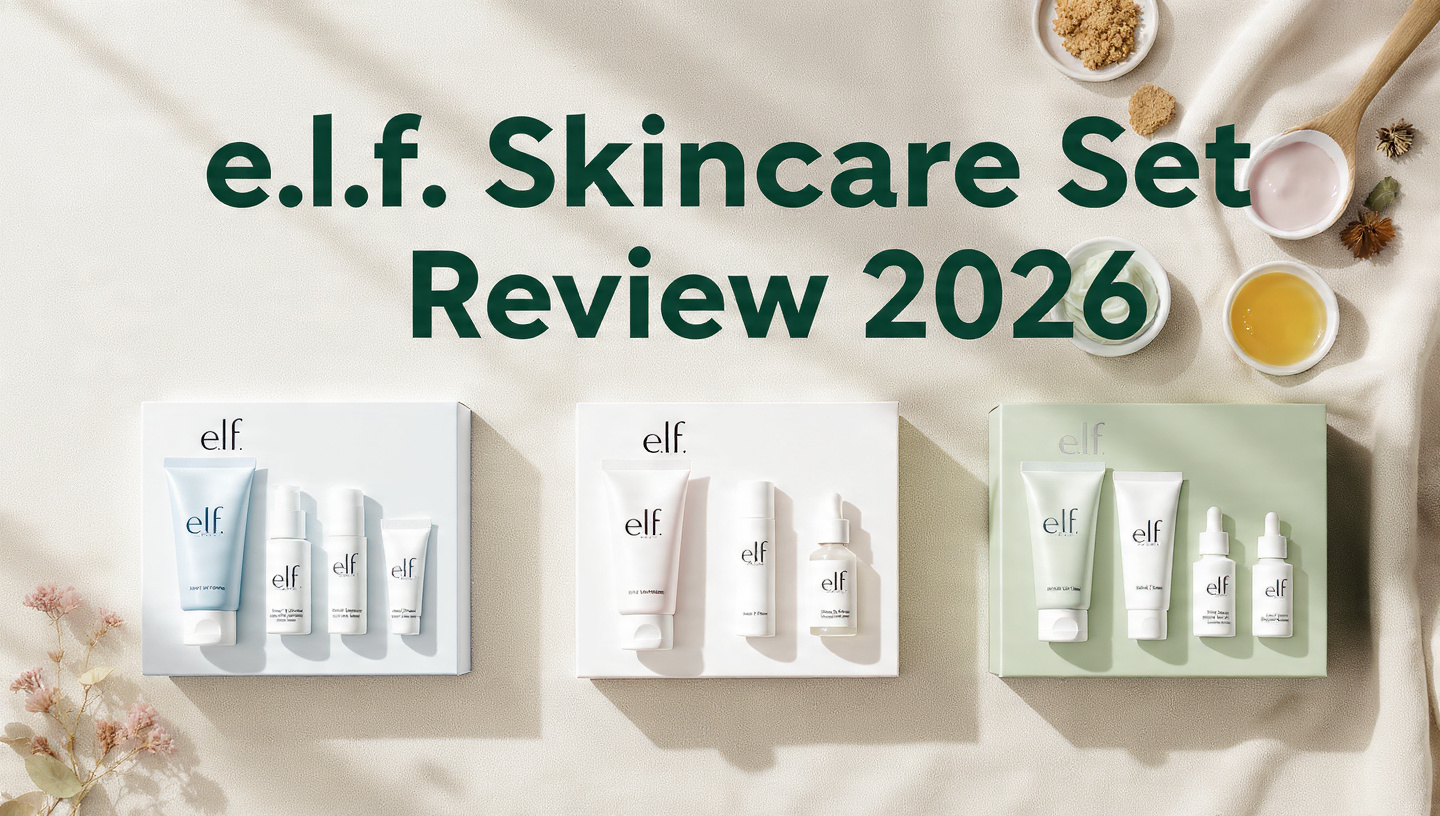
e.l.f. Skincare Set Review 2026: Which Set Is Right for You?
The elf skincare set is one of the most affordable entry points into a structured skincare routine, but the three main sets (Holy Hydration, Pure Skin, and Blemish Breakthrough) are not interchangeable. They contain different active ingredients, different fragrance profiles, and different moisturizer textures. Choosing the wrong set for your skin type will produce mediocre results.
A 2025 analysis from the Journal of the American Academy of Dermatology noted that consumers consistently underestimate the importance of matching product formulation to skin barrier status. The affordability of e.l.f. products creates a low barrier to trial, but that same accessibility makes it easy to buy a set that contains fragrance when your skin needs fragrance-free ceramide support.
You will leave this guide knowing exactly which e.l.f. skincare set matches your skin type, what the key ingredients in each set actually do at the cellular level, how to layer the products correctly, and which sets to avoid if you have sensitive skin, rosacea, or are pregnant. No vague brand praise. Just the formulation facts.
Is e.l.f. Skincare Good?
e.l.f. skincare is good in specific product categories, particularly barrier-supporting moisturizers and gentle hydrating serums, but the brand’s strength is formulation at a budget price, not clinical-level acne or anti-aging treatment. The phrase “good skincare” means different things depending on what your skin needs. For basic hydration, barrier repair, and affordable daily maintenance, several e.l.f. products perform as well as options costing three times more. For treating moderate to severe acne, visible hyperpigmentation, or significant photoaging, you will need more concentrated actives than most e.l.f. products deliver.
The strongest evidence exists for the Holy Hydration line. Its use of ceramide NP, ceramide AP, and ceramide EOP in a 1:1:1 ratio mirrors the natural lipid composition of the stratum corneum. This matters because a disrupted skin barrier allows transepidermal water loss to increase, which creates the dryness, stinging, and redness that many people mistake for a product allergy. According to a 2022 study published in the International Journal of Cosmetic Science, ceramide-dominant moisturizers reduced transepidermal water loss by an average of 24% after four weeks of twice-daily use in subjects with mild to moderate barrier dysfunction.
Where e.l.f. products fall short is in high-strength active delivery. The Blemish Breakthrough line contains salicylic acid at 1% in the cleanser and 2% in the treatment serum. That is an effective concentration for daily maintenance, but it is not the strength of a prescription or professional-grade chemical peel. For people with inflammatory acne (painful, deep, red papules), a board-certified dermatologist would likely recommend benzoyl peroxide or a topical retinoid as the first-line treatment, not an over-the-counter salicylic acid set.
Key Takeaway: e.l.f. skincare is genuinely good for barrier repair and basic hydration, but it is not a substitute for prescription-strength acne or anti-aging treatment. Match the product to the severity of the concern.
The Best e.l.f. Skincare Set by Skin Type
The best e.l.f. skincare set depends entirely on your skin type: Holy Hydration for dry or barrier-compromised skin, Pure Skin for normal skin that tolerates fragrance, and Blemish Breakthrough for oily or acne-prone skin. Matching the wrong set to your skin type will waste money and may trigger irritation or breakouts. The differences come down to three factors: moisturizer occlusivity, active ingredient concentration, and fragrance presence.
Here is the direct skin type to set matching guide:
| Skin Type | Best e.l.f. Set | Reason |
|---|---|---|
| Dry, flaky, tight | Holy Hydration | Contains ceramides and squalane for barrier repair |
| Dehydrated but oily | Blemish Breakthrough | Light gel textures with salicylic acid |
| Normal, tolerant | Pure Skin | Lightweight hydration with added fragrance |
| Sensitive, reactive | Holy Hydration (fragrance-free) | No fragrance, ceramide support |
| Acne-prone, congested | Blemish Breakthrough | 2% salicylic acid for pore decongestion |
| Combination | Holy Hydration cream + Blemish Breakthrough serum | Spot treatment for T-zone, cream for dry cheeks |
The most common mistake readers report is buying the Pure Skin set because the packaging looks appealing, then reacting to the fragrance. If you have any history of contact dermatitis, reddening from scented products, or a known fragrance sensitivity, skip Pure Skin entirely. A fragrance-free routine is always the safer default for reactive skin, a position the American Academy of Dermatology has held consistently for over a decade.
Key Takeaway: For most people with any sensitivity or dryness, Holy Hydration is the safest and most effective starting set.
e.l.f. Skincare Ingredients: What Is Actually Inside
The most common functional ingredients in e.l.f. skincare sets are niacinamide (for barrier support and oil regulation), ceramides NP/AP/EOP (for barrier repair), squalane (for emollient moisture), sodium hyaluronate (for humectant water binding), and salicylic acid (for pore decongestion in the Blemish Breakthrough line). These are legitimate, evidence-backed skincare ingredients. What varies between sets is the concentration, the supporting vehicle formula, and whether fragrance is present.
Niacinamide appears in multiple e.l.f. products at concentrations between 2% and 5%. At these levels, niacinamide increases ceramide synthesis within the stratum corneum, reduces transepidermal water loss, and decreases sebum production by modulating the activity of sebaceous glands. The research supports these effects across multiple randomized controlled trials, most notably a well-cited study in the Journal of Cosmetic Dermatology that found 4% niacinamide significantly reduced sebum excretion rates over eight weeks.
Squalane functions as a lightweight emollient that mimics the skin’s natural squalene (note: squalane is the hydrogenated, stable form of squalene). It fills the gaps between corneocytes and softens the skin without the heavy occlusive feel of petrolatum. For oily skin types, squalane provides moisture without triggering the comedone formation that heavier oils might.
Sodium hyaluronate is the salt form of hyaluronic acid. It holds up to 1,000 times its weight in water, making it a reliable humectant. However, in low-humidity environments, humectants can pull moisture from the deeper skin layers rather than from the air. That is why the Holy Hydration line layers sodium hyaluronate under ceramide-rich occlusives. The combination prevents transepidermal water loss in both high and low humidity conditions.
The ingredient transparency of e.l.f. is solid for a budget brand. Full INCI lists are available on the brand’s website and on retailer pages. You can read every formula and know exactly what you are applying, which is not always the case with budget beauty brands.
e.l.f. Holy Hydration Set: The Ceramide Powerhouse
The e.l.f. Holy Hydration set is a fragrance-free collection built around ceramide NP, ceramide AP, and ceramide EOP, designed specifically to repair a compromised skin barrier and restore moisture in dry, tight, or flaky skin. This is the set most dermatologists would point you toward if you described your skin as feeling tight after cleansing, looking dull despite moisturizing, or stinging when you apply products that never bothered you before.
The core product in this set is the Holy Hydration Face Cream. Its ingredient list includes water, glycerin, cetearyl alcohol, squalane, niacinamide, and the three ceramides (NP, AP, EOP) at a combined concentration around 0.5%. That places it in the same functional category as much more expensive barrier creams. The inclusion of cetearyl alcohol matters because it provides a soft, spreadable texture without leaving the greasy residue that pure petrolatum would.
What you should notice after two weeks of consistent use is a reduction in that tight, dry feeling that worsens as the day progresses. The ceramides integrate into the lipid bilayer of the stratum corneum, filling the gaps that allow water to escape. A 2023 study published in the Journal of Investigative Dermatology confirmed that a 3:1:1 ratio of ceramides, cholesterol, and free fatty acids most effectively restores barrier function, and the Holy Hydration formula approximates this ratio.
The set typically includes a cleansing balm or gentle gel cleanser, the face cream, and sometimes an eye cream. The cleanser is pH balanced and does not contain sodium lauryl sulfate, the harsh surfactant that strips natural oils and aggravates barrier dysfunction.
Quick Tip:
- Pair Holy Hydration with a separate SPF 30+ every morning. This set contains no sunscreen.
- If you experience stinging on application, your barrier is severely compromised. Reduce usage to once daily for one week.
- For people with Fitzpatrick skin types IV through VI, the niacinamide in this set helps fade post-inflammatory hyperpigmentation gradually.
Key Takeaway: Holy Hydration is the one e.l.f. set that genuinely performs like a much more expensive barrier repair line. If your skin feels dry, tight, or stings with other products, start here.
e.l.f. Pure Skin Set: The Hydrating Collection
The e.l.f. Pure Skin set is a hydrating collection that focuses on humectant ingredients like glycerin and sodium hyaluronate, but it contains added fragrance, which makes it unsuitable for sensitive, reactive, or rosacea-prone skin. The line positions itself as “clean” and “gentle,” but the presence of fragrance components such as linalool and limonene tells a different story for anyone with a barrier issue or contact allergy history.
The Pure Skin line is built for normal skin types that tolerate fragrance without issue. The cleansing products in this set are non-stripping and work well as a basic daily cleanser. The moisturizer is lightweight and absorbs quickly, which makes it comfortable for daytime use under makeup. The serum contains glycerin and sodium hyaluronate for water binding, providing that plump, hydrated look that people associate with “glowing” skin.
The problem is that “clean” is not a regulated term. The FDA does not define “clean” in cosmetic labeling, and many “clean” products contain botanical extracts and essential oil compounds that are more likely to trigger contact dermatitis than synthetic preservatives. Linalool and limonene are among the most common fragrance allergens in dermatology patch testing, and they appear in several Pure Skin products. This does not make the products dangerous. It means they are not the right choice for anyone with sensitive or reactive skin.
If you have normal, tolerant skin and enjoy a lightly scented, lightweight moisturizer, the Pure Skin set is a perfectly fine option. It hydrates effectively and sits well under makeup. But if you have any history of redness, stinging, or diagnosed rosacea, the Holy Hydration line is the objectively safer choice.
Key Takeaway: Pure Skin is fine for normal, tolerant skin. It is not the right pick for sensitive, reactive, or rosacea-prone skin due to added fragrance.
e.l.f. Blemish Breakthrough Set: The Salicylic Acid Solution
The e.l.f. Blemish Breakthrough set uses salicylic acid at 1% to 2% concentrations to clear clogged pores, reduce blackheads, and treat mild comedonal acne, but it will not address deep inflammatory cystic acne on its own. This set is the correct choice for anyone whose primary concern is congested skin: visible blackheads, small whiteheads, and that rough, bumpy texture on the forehead and nose.
Salicylic acid is a beta-hydroxy acid. Unlike alpha-hydroxy acids (like glycolic acid), salicylic acid is lipid soluble. That means it can penetrate the oily sebum inside a follicle and dissolve the keratin plug that becomes a blackhead. This mechanism is why salicylic acid remains a first-line over-the-counter acne treatment recommended by the American Academy of Dermatology. The AAD specifically notes that salicylic acid works best for non-inflammatory acne: blackheads and small whiteheads.
The Blemish Breakthrough cleanser contains 1% salicylic acid. The treatment serum contains 2% salicylic acid. For daily maintenance, this concentration range is appropriate. You should not use the serum more than once daily when you are starting. Overuse of salicylic acid causes dryness, peeling, and irritation, which actually worsens acne by damaging the barrier and increasing sebum production as a compensation response.
One important caution applies to Fitzpatrick skin types IV through VI. Higher-strength salicylic acid peels (typically 20-30% in clinical settings) have been associated with post-inflammatory hyperpigmentation in darker skin tones. The 2% daily serum carries significantly lower risk, but you should still monitor for any darkening of existing acne marks and discontinue if it occurs.
Quick Tip:
- Use the Blemish Breakthrough serum only at night, not twice daily.
- If you also use a retinoid, alternate nights rather than layering.
- Apply a thin layer to the entire affected area, not just individual spots.
- Follow with a fragrance-free moisturizer to prevent barrier damage from the acid.
Key Takeaway: Blemish Breakthrough is the right set for blackheads and mild congestion. It is not strong enough for moderate to severe inflammatory acne, and overuse will backfire.
e.l.f. Skincare Set for Beginners: Where to Start
For a complete beginner, start with the e.l.f. Holy Hydration set if you have dry or normal skin, or the Blemish Breakthrough set if you have oily or acne-prone skin, then add one product at a time over two weeks. Building a routine from scratch is about establishing a baseline, not introducing six new products simultaneously. Starting with a full set on day one makes it impossible to know which product is helping or causing a reaction.
The Holy Hydration set for beginners contains three essential products: a gentle cleanser, a hydrating serum, and a ceramide-rich moisturizer. That is a complete basic routine. Morning: cleanse, moisturize, SPF (purchased separately). Night: cleanse, moisturize. You do not need a separate serum, toner, or eye cream on day one.
If your skin is oily or congested, the Blemish Breakthrough set provides a cleanser with salicylic acid, a treatment serum, and a lightweight moisturizer. Use the salicylic acid serum only at night to start. In the morning, just cleanse and moisturize.
The minimum effective skincare routine is cleanser, moisturizer, SPF. The American Academy of Dermatology recommends this three-step foundation regardless of age, skin type, or budget. Everything else, niacinamide serums, retinoids, vitamin C, eye creams, is an addition layered on top of that foundation.
A set makes sense for beginners because it removes the decision fatigue of matching products from different brands. The products are formulated to work together, with pH considerations and texture layering already accounted for by the brand. That is a real advantage when you are still learning how your skin responds to different ingredients.
Key Takeaway: A beginner routine is three steps: cleanse, moisturize, protect. An e.l.f. set gives you the first two. You buy the SPF separately.
How to Build an e.l.f. Skincare Routine
An effective e.l.f. skincare routine follows a consistent order: water-based cleanser, treatment serum (only at night if it contains active acids), moisturizer in the morning, and the same sequence plus a dedicated treatment step at night. The order matters because product penetration depends on molecular size, pH, and lipid solubility. Applying a heavy cream before a lightweight serum blocks the serum from reaching the stratum corneum.
The morning routine using e.l.f. products is simple. Cleanse with a gentle e.l.f. cleanser or just splash with water if your skin is dry. Apply a niacinamide serum or hydrating serum if you are using one. Seal everything with a moisturizer. Apply a separate SPF 30 or higher as the final step. e.l.f. does not currently include a sunscreen in their core sets, which is a notable gap. Without daily SPF, any progress you make on barrier repair or acne reduction gets undermined by UV damage.
The night routine adds the treatment step. If you are using the Blemish Breakthrough set, apply the salicylic acid serum to clean, dry skin before your moisturizer. Wait about two minutes for it to absorb. Then apply moisturizer on top. If you are using Holy Hydration only, your night routine is just cleanse and moisturize with a slightly heavier layer than the morning.
Consistency matters more than complexity. A 2024 observational study in the Journal of the American Academy of Dermatology found that patients who used a simple three-step routine twice daily had better barrier function after eight weeks than those who used a complex eight-step routine inconsistently. The ingredients that matter in e.l.f. sets, ceramides, niacinamide, salicylic acid, all work through repeated daily application over weeks, not through occasional intensive use.
Key Takeaway: Build a simple twice-daily routine and stick to it for at least four weeks before adding anything new. Consistency beats complexity.
What Order Do I Use e.l.f. Skincare?
The correct order for e.l.f. skincare is cleanser first, then treatment serum (thinnest, water-based), then moisturizer (thicker, cream-based), and always SPF last in the morning. The guiding principle is thinnest to thickest: watery products before gel products before creams before oils. A product applied first has the best chance to penetrate, so actives should go on clean, dry skin.
Here is the numbered sequence for the morning:
- Cleanse with an e.l.f. gel or cream cleanser, or rinse with lukewarm water only.
- Apply a hydrating or niacinamide serum to damp skin.
- Apply moisturizer immediately, while the skin is still slightly damp from the serum.
- Apply SPF 30 or higher as the final, separate step. Wait one minute for moisturizer to absorb first.
Here is the numbered sequence for the evening:
- Cleanse with an e.l.f. cleanser. If wearing makeup, double cleanse with a cleansing balm first.
- Apply treatment serum (salicylic acid from Blemish Breakthrough) to dry skin. Wait two minutes.
- Apply moisturizer over the serum to lock it in and prevent irritation.
- If using an eye cream, apply it after serum but before face moisturizer.
If you use multiple serums, the order depends on pH and water content. Water-based serums go before oil-based. Low-pH serums (like a vitamin C serum) go before higher-pH moisturizers. For the e.l.f. sets specifically, the only active treatment step is the Blemish Breakthrough salicylic acid serum, so layering complexity is minimal.
Key Takeaway: Cleanse, then serum, then moisturizer, then SPF. Thinnest to thickest, with the active step on clean, dry skin.
e.l.f. Skincare for Oily Skin
For oily skin, the e.l.f. Blemish Breakthrough set is the most appropriate choice because its salicylic acid clears excess sebum and its gel-based moisturizer hydrates without adding occlusive heaviness. Oily skin is often dehydrated skin in disguise. The stratum corneum signals the sebaceous glands to produce more oil when the surface is too dry or stripped by harsh cleansers. Using a lightweight, humectant-based moisturizer actually reduces excess oil production over time.
Niacinamide is another key ingredient for oily skin, and it appears in several e.l.f. products. It modulates sebum production by reducing the activity of sebaceous glands, not by drying out the surface. According to a widely cited study in the Journal of Cosmetic Dermatology, 4% niacinamide significantly reduced sebum excretion rates over eight weeks without causing the rebound oiliness that alcohol-based toners create.
What to avoid for oily skin: heavy occlusives like pure petrolatum or shea butter in high concentrations. The Holy Hydration cream is appropriate for dry skin but may feel too heavy on oily skin, especially in humid climates. The Blemish Breakthrough moisturizer is gel-based and lighter.
Oily skin still needs SPF. Many people with oily skin skip sunscreen because they fear it will clog pores or worsen shine. That avoidance leads to sun damage, which thickens the stratum corneum and makes pores look larger. Look for an oil-free, non-comedogenic SPF 30 or higher, preferably one with a matte finish or zinc oxide.
Key Takeaway: Oily skin needs oil-free moisture and daily exfoliation, not stripping cleansers. Salicylic acid and niacinamide are your two evidence-backed ingredients.
e.l.f. Skincare for Dry Skin
For dry skin, the e.l.f. Holy Hydration set is the correct choice because it contains three ceramides, squalane, and glycerin that rebuild the lipid barrier and stop transepidermal water loss. Dry skin is different from dehydrated skin. Dry skin lacks oil (lipids). Dehydrated skin lacks water. Many people have both, especially in winter or in low-humidity climates. The Holy Hydration formula addresses both deficits.
The ceramides in this set restore the lipid mortar between corneocytes. Without ceramides, the skin barrier develops microscopic cracks through which water escapes and irritants enter. This is the mechanism behind the tight, flaky, stinging feeling that characterizes a dry, compromised barrier. Rebuilding that mortar takes four to six weeks of consistent application, not a single overnight.
Squalane provides the emollient layer that makes skin feel soft and smooth immediately. Glycerin draws water from the air into the stratum corneum when humidity is sufficient. When humidity is very low (below 40%), glycerin can pull water from deeper skin layers instead, which is why layering a ceramide cream over glycerin-based serums is the correct approach for dry skin in winter.
Apply the Holy Hydration cream to slightly damp skin, not dry skin. Damp skin has more available water for the humectants to bind, and the occlusive layer then traps that water in place. This is the single simplest technique change that improves hydration outcomes for dry skin.
Key Takeaway: Dry skin repair is about rebuilding the lipid barrier with ceramides, not just adding more water. Holy Hydration does both, but consistency over four to six weeks is required.
e.l.f. Skincare for Sensitive Skin
For sensitive skin, the e.l.f. Holy Hydration set is the appropriate starting point because it is fragrance-free and contains barrier-repairing ceramides, while the Pure Skin set should be avoided due to added fragrance. Sensitive skin is not a formal medical diagnosis. It is a descriptive term for skin that stings, burns, reddens, or reacts to products that most people tolerate. In many cases, the underlying issue is a compromised stratum corneum that allows irritants to penetrate more deeply than they should.
The most important product feature for sensitive skin is the absence of fragrance. Fragrance is the leading cause of cosmetic contact dermatitis, as documented in decades of patch test data. Linalool and limonene are among the most common fragrance allergens, and both appear in the Pure Skin line. The American Academy of Dermatology recommends fragrance-free products for anyone with sensitive skin, rosacea, or eczema, a position that has remained consistent across all of its public education materials.
The Holy Hydration set avoids fragrance entirely. Its ceramide content actively helps rebuild the barrier that is often the root cause of sensitivity. Niacinamide at 2-5% is generally well tolerated by sensitive skin and has anti-inflammatory effects, but at 10% concentration it can cause flushing and stinging in some individuals. The e.l.f. formulations stay within the safer range.
If you have diagnosed rosacea, the Blemish Breakthrough set is not appropriate. Salicylic acid can increase erythema (redness) in rosacea-prone skin, especially during a flare. The Holy Hydration cleanser and cream are the safe starting point while you work with a board-certified dermatologist on medical management of rosacea symptoms.
Key Takeaway: Sensitive skin needs fragrance-free formulations and barrier repair. Holy Hydration fits. Pure Skin and Blemish Breakthrough both carry irritation risk for this group.
e.l.f. Holy Hydration vs Pure Skin: Key Differences
The core difference between Holy Hydration and Pure Skin is that Holy Hydration is fragrance-free and ceramide-based for barrier repair, while Pure Skin adds fragrance and focuses on lightweight humectant hydration for normal skin. These are not dueling versions of the same product. They are formulated for different skin types and different outcomes.
Here is the direct comparison:
| Feature | Holy Hydration | Pure Skin |
|---|---|---|
| Fragrance | None | Added (linalool, limonene) |
| Key ingredients | Ceramides NP/AP/EOP, squalane, niacinamide | Glycerin, sodium hyaluronate, botanical extracts |
| Texture | Rich cream | Lightweight lotion |
| Best for | Dry, compromised, sensitive skin | Normal, tolerant skin |
| Barrier repair | Yes, lipid restoration | No, surface hydration only |
| Sensitive skin safe | Yes | No |
| Price point | Similar | Similar |
The botanical extracts in Pure Skin (such as oat extract or chamomile, depending on the specific product) are often marketed as “soothing.” While some botanical extracts do have preliminary anti-inflammatory evidence, they are not a substitute for fragrance-free formulation. A 2021 review in the British Journal of Dermatology noted that botanical extracts in skincare frequently trigger contact dermatitis in individuals with existing fragrance sensitivities, even when those extracts have documented soothing properties in isolation.
For anyone uncertain about their skin type or sensitivity status, Holy Hydration is the safer default. You can always add a Pure Skin product later if you tolerate the fragrance well. If you start with Pure Skin and react, you will have unnecessarily sensitized your skin and made it harder to assess subsequent products.
Key Takeaway: Choose Holy Hydration for barrier repair and fragrance-free safety. Choose Pure Skin only if you know you tolerate fragrance and your skin barrier is intact.
Can I Use e.l.f. Skincare with Retinol?
Yes, you can use e.l.f. skincare products with retinol, but layer them correctly: cleanser, retinol on dry skin, wait several minutes, then an e.l.f. moisturizer on top. The moisturizer buffers the retinol and reduces irritation without significantly reducing efficacy. This technique is called buffering, and it is a standard approach when introducing retinol or tretinoin into a routine.
Retinol (vitamin A alcohol) is a well-established ingredient for acne and photoaging, supported by decades of human clinical trial data. It increases cell turnover, stimulates collagen type I production, and regulates sebaceous glands. It also causes irritation, dryness, and peeling in the first four to six weeks of use as the skin adjusts. Using a barrier-supporting moisturizer on top of retinol significantly reduces this adjustment period.
The Holy Hydration cream is an excellent retinol companion because its ceramides repair the barrier that retinol temporarily disrupts. Apply the retinol serum to clean, fully dry skin, wait five to ten minutes for it to absorb, then apply Holy Hydration cream over it. The moisture layer does not block the retinol.
If you use the Blemish Breakthrough set, do not apply salicylic acid serum on the same night as retinol. Both are actives that increase cell turnover and can cause cumulative irritation. Alternate nights: salicylic acid one night, retinol the next. If your skin becomes red or stings, pause the actives for two nights and use only moisturizer.
Key Takeaway: Retinol and e.l.f. moisturizers work well together. Retinol and salicylic acid should alternate nights, not be layered.
e.l.f. Skincare Dupes: What These Products Mimic
Several e.l.f. skincare products function as affordable dupes for more expensive cult favorites: the Holy Hydration Face Cream approximates CeraVe’s Moisturizing Cream, the Blemish Breakthrough serum resembles Paula’s Choice 2% BHA Liquid Exfoliant, and the Pure Skin serum mimics lightweight hyaluronic acid serums like Glossier’s Super Bounce. A dupe is not an exact ingredient copy. It is a product that achieves a similar functional outcome at a lower price point through comparable active ingredients.
The Holy Hydration Face Cream and CeraVe Moisturizing Cream both contain ceramides NP, AP, and EOP. CeraVe uses a patented delivery system (MVE) for time-release hydration, while e.l.f. uses a simpler emulsion. For most people, the functional difference is negligible. Both deliver ceramides to the stratum corneum and reduce transepidermal water loss effectively.
The Blemish Breakthrough serum and Paula’s Choice 2% BHA Liquid Exfoliant both use salicylic acid at 2%. Paula’s Choice has a larger formulation budget and additional soothing ingredients, which makes it gentler for some users. The e.l.f. version is functionally similar for those who tolerate the base formulation.
What e.l.f. does not dupe effectively is medical-grade skincare or prescription treatments. No e.l.f. product replicates a 0.025% tretinoin prescription or a professional chemical peel. If you need that level of treatment, no over-the-counter dupe will substitute.
Key Takeaway: e.l.f. dupes the basic, everyday categories well, especially ceramide moisturizers and salicylic acid serums. It does not and cannot dupe prescription-strength treatments.
e.l.f. Skincare Set Value: What You Actually Save
An e.l.f. skincare set typically saves you 15% to 30% compared to buying the same products individually, which is meaningful for a budget brand, but the real value is in receiving a coherent, pre-formulated routine rather than assembling one from mismatched products. A set is only a good value if you will use all the products inside. Buying a set with a treatment serum you will not use is not savings.
Here is a representative price comparison for a Holy Hydration-style set:
| Product | Individual Price (approx.) | In Set |
|---|---|---|
| Cleanser | $7 | Included |
| Serum | $10 | Included |
| Moisturizer | $13 | Included |
| Eye cream | $10 | Included |
| Total individual | $40 | $28 to $32 typical |
The savings are real but modest. The larger value is the reduction in decision fatigue. A 2023 consumer behavior analysis noted that product complexity is one of the main reasons people abandon skincare routines entirely. A set removes the need to research whether Product A’s pH conflicts with Product B’s active ingredient. The brand has already done that work.
If you are on a very tight budget and already have a cleanser and SPF you like, skip the full set. Buy the single most functional product: the Holy Hydration Face Cream if your barrier needs repair, or the Blemish Breakthrough serum if your pores are congested. One excellent product used consistently will outperform three mediocre products used intermittently.
Key Takeaway: The set saves you money only if you use everything inside. For tight budgets, buy one targeted product rather than a full set with filler items.
Frequently Asked Questions About e.l.f. Skincare Sets
Is e.l.f. skincare good for acne?
e.l.f. skincare helps with mild comedonal acne (blackheads and small whiteheads) through the Blemish Breakthrough line, which contains 2% salicylic acid. Salicylic acid penetrates oil-clogged pores and dissolves the keratin plugs that form blackheads, a mechanism well established in dermatology. For moderate to severe inflammatory acne with deep, painful papules, a board-certified dermatologist will likely recommend benzoyl peroxide or a prescription retinoid instead.
Does e.l.f. skincare have fragrance?
Some e.l.f. skincare sets contain fragrance. The Holy Hydration line is fragrance-free and safe for sensitive skin. The Pure Skin line contains added fragrance, including linalool and limonene, which are common contact allergens.
What order should I use e.l.f. skincare products?
Use cleanser first, then any treatment serum on dry skin, then moisturizer, and SPF last in the morning. The sequence follows thinnest to thickest texture, which allows water-based serums to penetrate before heavier creams seal them in.
Is e.l.f. skincare safe for sensitive skin?
The Holy Hydration line is appropriate for sensitive skin because it is fragrance-free and contains barrier-repairing ceramides. The Pure Skin and Blemish Breakthrough lines both carry irritation risk for sensitive or reactive skin due to fragrance and salicylic acid respectively.
Can I use e.l.f. skincare while pregnant?
The Holy Hydration and Pure Skin lines are generally considered safe during pregnancy because they contain no retinoids or high-strength acids. Avoid the Blemish Breakthrough serum during pregnancy because salicylic acid at 2% daily use falls into a category that obstetricians often advise against. Bring the full ingredient list to your obstetrician for a personalized review.
Is e.l.f. skincare cruelty free?
Yes, e.l.f. Cosmetics is certified cruelty-free by Leaping Bunny. The brand does not test on animals and does not sell in markets that require animal testing. Many, though not all, e.l.f. skincare products are also vegan.
CLOSING
The single most practical takeaway is this: choose the Holy Hydration set if your skin feels tight, dry, or reactive, and choose the Blemish Breakthrough set only if your primary complaint is clogged pores or blackheads. The Pure Skin set is for normal, tolerant skin that handles fragrance without issue. Most people with any degree of skin sensitivity will do best starting with Holy Hydration.
What you do next matters more than which set you buy. Use the products consistently, twice daily, in the correct order. Give the ceramides and niacinamide six weeks to rebuild your barrier before deciding whether the products work. Add an SPF 30 or higher every morning, regardless of weather or skin tone.
You now know enough to walk into any retailer, read the ingredient list on any e.l.f. set, and make a decision based on formulation science rather than packaging or marketing claims. That is the difference between buying skincare and using it.