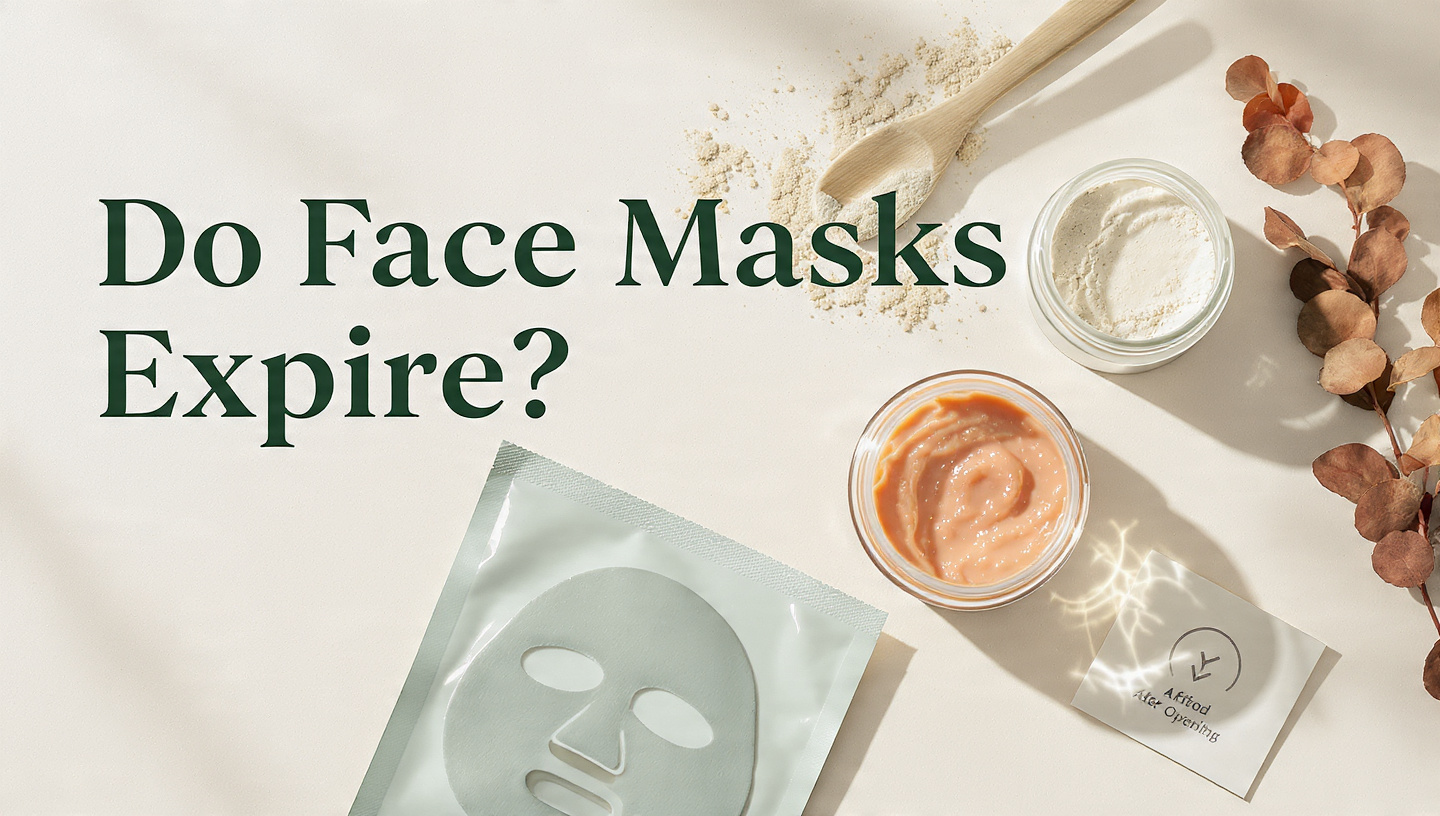
Do Face Masks Expire? Skincare Shelf Life Guide 2026
Face masks do expire, and understanding exactly when and why can save your skin from irritation, breakouts, and wasted money. The expiration date on your face mask is not a suggestion from the brand, it is a chemically meaningful marker of when the preservative system, active ingredients, or formulation stability begin to fail. This guide will teach you how to read those dates accurately, assess your own products, and know the difference between a mask that is simply past its peak and one that is genuinely unsafe.
According to the FDA, cosmetic products are not legally required to carry expiration dates, but manufacturers must ensure their products remain safe under labeled storage conditions. The period-after-opening symbol, that small open jar icon with a number and the letter M, is the closest thing skincare has to an expiration standard. Understanding how this symbol works, and what it means for different types of face masks, can help you avoid using degraded products without throwing away perfectly good skincare prematurely.
This article covers everything from unopened shelf life to mask-specific expiration timelines to a practical sensory assessment guide you can use tonight on the products sitting in your bathroom cabinet. You will learn which masks degrade fastest, which ones last longest, what spoilage actually looks and smells like, and how to protect your skincare investment through proper storage.
Do Face Masks Expire Skincare? Yes, And The Reasons Matter
Face masks expire because the chemical systems that keep them stable, preserved, and effective do not last forever. Water-containing formulations, which include most sheet masks, gel masks, and cream masks, support microbial growth once the preservative system degrades or becomes exhausted. Anhydrous formulations like dry clay powders last much longer because they contain no water to support bacteria or mold growth. Active ingredients like ascorbic acid (vitamin C) and retinol oxidize over time, losing efficacy even if the product remains microbiologically safe.
The American Academy of Dermatology (AAD) advises consumers to discard any skincare product that has changed color, texture, or smell, as these are signs the formulation has begun to break down. This is not fearmongering, it is recognition that cosmetic chemistry is not permanently stable. Preservatives like phenoxyethanol at 0.5% to 1.0% concentration work by preventing microbial growth, but they gradually lose effectiveness as they interact with oxygen, light, and the product ingredients themselves.
The distinction between safety expiration and efficacy expiration is crucial here. A preserved water-based mask past its period-after-opening date may still be microbiologically safe to use, but its active ingredients may have degraded to the point where they no longer deliver the claimed benefits. A vitamin C mask that has turned dark orange is not dangerous, but it is also not doing what you paid for it to do. Understanding this distinction helps you make smart decisions about whether to continue using a product or replace it.
| Expiration Type | What It Means | Skin Risk Level | Example |
| Safety Expiration | Preservative system can no longer prevent microbial growth | High: contamination, infection risk | Water-based gel mask left open for 12 months |
| Efficacy Expiration | Active ingredients have degraded but product remains preserved | Low: no safety issue, no benefit | Vitamin C mask that has oxidized to yellow |
| Physical Expiration | Emulsion has separated, texture has changed irreversibly | Medium: unpredictable application, potential irritation | Cream mask with visible oil separation |
Key Takeaway: A face mask can be expired in three different ways, and knowing which type of expiration you are dealing with determines whether to toss it immediately or just lower your expectations.
Do Skincare Face Masks Expire? The Answer Depends On Formulation
Skincare face masks expire at different rates depending on their formulation type. Water-based masks, which include most sheet masks, gel masks, and cream masks, have the shortest shelf life because water creates an environment where bacteria and mold can thrive once preservatives degrade. Oil-based masks and anhydrous clay powders last significantly longer because they contain no water to support microbial growth. This formulation difference is the single most important factor in determining how quickly your face mask will expire.
The International Journal of Cosmetic Science published research showing that water activity, the amount of free water available in a formulation, is the primary determinant of microbial growth risk. Products with water activity below 0.6 are generally resistant to microbial growth even without strong preservatives. Products with water activity above 0.8 require robust preservation systems to remain safe. Most sheet masks and cream masks fall into the high water activity category, which is why they carry shorter PAO dates.
Preservative systems are not permanent. Phenoxyethanol, benzyl alcohol, and potassium sorbate all degrade over time, especially when exposed to light, heat, or air. Once the preservative system falls below its effective concentration, any bacteria introduced through use, dipping fingers into the product, applying with a brush, or even just opening the container can take hold. This is why the period-after-opening date is always much shorter than the unopened shelf life.
Think of your water-based face mask like fresh produce. It has a finite lifespan once exposed to air and use, and that lifespan depends on how well it is protected from contamination. A refrigerated, untouched mask lasts longer than one sitting open on a humid bathroom counter. The formulation type sets the baseline risk, but how you handle and store the product determines how quickly it approaches that risk threshold.
Quick Tip:
- Check whether your mask contains water as the first ingredient. Water-based masks expire faster than oil-based or powder masks.
- Look for the preservatives phenoxyethanol, ethylhexylglycerin, or benzyl alcohol on the label. Their presence indicates a preserved system, but they are not permanent.
- Store all water-based masks away from direct sunlight and heat to slow preservative degradation.
Skincare Product Shelf Life: What Cosmetic Chemistry Actually Shows
Skincare product shelf life refers to the period during which a product remains safe and effective under normal storage conditions. The FDA does not require cosmetics to carry expiration dates, but it does require manufacturers to have data demonstrating their products remain safe under labeled storage conditions. This means the shelf life printed on your face mask, or the period-after-opening symbol, represents the manufacturer’s safety testing window, not a guarantee that the product will instantly become dangerous the day after.
The Journal of Cosmetic Dermatology published a review of cosmetic product stability testing that identified three primary drivers of product degradation: oxidation, hydrolysis, and microbial contamination. Oxidation primarily affects active ingredients like ascorbic acid, retinol, and tocopherol (vitamin E). Hydrolysis breaks down emulsifiers and emollients, causing texture changes and phase separation. Microbial contamination occurs when preservative systems fail and bacteria or mold take hold.
Stability testing by manufacturers typically includes accelerated aging studies at elevated temperatures, freeze-thaw cycling to test for phase separation, and preservative challenge testing. These studies generate the data behind the period-after-opening date. However, accelerated testing cannot perfectly predict how a product will age in your specific bathroom environment, which may be warmer, more humid, or more exposed to sunlight than the testing conditions assumed.
| Degradation Pathway | What It Affects | Visible Sign | Skin Impact |
| Oxidation | Active ingredients (vitamin C, retinol, oils) | Color darkening, rancid odor | Reduced efficacy, potential irritation from oxidized oil byproducts |
| Hydrolysis | Emulsifiers, emollients | Texture thinning, phase separation | Uneven application, reduced skin feel |
| Microbial Growth | Entire formulation, especially water phase | Visible mold, off odor, texture changes | Infection risk, folliculitis, contact dermatitis |
For people with sensitive skin or compromised skin barriers, the safety margin around product degradation is thinner. Irritant contact dermatitis risk increases when oxidized oils or degraded active ingredients are applied to already-reactive skin. A board-certified dermatologist can help identify whether a skin reaction is related to product degradation or a new ingredient sensitivity, but the simplest preventive step is respecting the period-after-opening date.
Key Takeaway: Shelf life is a safety window established by manufacturer testing, and pushing past it increases your risk of applying degraded actives and potentially contaminated product to your face.
Period After Opening Symbol Skincare: How To Read The PAO Date
The period-after-opening symbol, often abbreviated as PAO, is a small open jar icon printed on skincare packaging with a number followed by the letter M, such as 6M or 12M. This symbol indicates how many months the product remains safe and effective after first opening. It is not the same as the batch expiration date, which applies only to unopened products. The PAO date is the more useful number for any product you are currently using.
According to the FDA, the period-after-opening symbol is not mandatory in the United States, but it is widely used by manufacturers following European Union cosmetic regulations, which do require it. When you see a PAO symbol on a face mask, it means the manufacturer has tested the product’s safety under normal use conditions for that period. Once you open the product, the clock starts.
The position of the PAO symbol matters for visibility. It should be printed on the primary packaging, the tube, jar, or sachet, not just on an outer box that gets discarded. If you cannot find the PAO symbol on your face mask packaging, check the crimp of the tube, the bottom of the jar, or the back label near the ingredient list. Some brands print it on the outer carton only, which is not helpful once the box is thrown away.
To track your PAO dates effectively:
- When you open a new face mask, write the date you opened it on the product with a permanent marker or a small label.
- Calculate the end date based on the PAO number. A 12M mask opened on January 15, 2026 expires January 15, 2027.
- Set a reminder in your phone or write the end date directly on the packaging.
- Check the product against the visual and sensory signs of spoilage whenever you use it, not just on the expiry date.
- Discard any mask that shows signs of spoilage before the PAO date, as this indicates the preservative system has failed prematurely.
Keep in mind that the PAO date assumes you are using the product under normal conditions. If you leave your mask open for hours, store it in direct sunlight, or introduce water into the container, the effective shelf life may be much shorter than the printed PAO date suggests.
Do Face Masks Expire If Unopened Skincare? Yes, But Slower
Unopened face masks do expire, though they typically last much longer than opened products. The unopened shelf life is determined by the batch expiration date, which may be printed on the packaging or encoded in the batch number. This date reflects the manufacturer’s stability testing for the sealed product, accounting for slow chemical changes that occur even without exposure to air, light, or microbial contamination.
The FDA does not require cosmetics to carry a specific expiration date, but manufacturers must maintain stability data for their products. For most water-based skincare products, the unopened shelf life is 2 to 3 years from the date of manufacture. Anhydrous products like clay powders can last 5 years or more when kept dry and sealed. Oil-based products fall in between, typically lasting 3 to 5 years unopened.
Even in a sealed container, chemical reactions continue slowly. Ascorbic acid in a vitamin C mask will gradually oxidize, turning from clear to yellow to brown, even if the package has never been opened. Emulsions can slowly destabilize as emulsifiers degrade. Preservatives can interact with other ingredients and lose effectiveness over time. These changes are slow but irreversible, which is why the unopened shelf life is not indefinite.
A 2024 review published in the International Journal of Cosmetic Science examined long-term stability data for cosmetic emulsions and found that temperature fluctuations during storage significantly accelerate degradation, even in sealed products. Products stored in hot environments, such as a car glove compartment or a bathroom that heats up during showers, age faster than products stored at stable room temperature.
Key Takeaway: Unopened masks are not immortal, but they have a much wider safety window than opened products. If you find a sealed mask that is more than 3 years old, check the batch date, inspect the packaging for swelling or leakage, and do a small patch test before using it on your face.
How Long Do Face Masks Last Unopened? A Type-By-Type Timeline
Unopened face mask longevity varies significantly by formulation type. The table below gives realistic, chemistry-informed timelines for different mask categories when stored under proper conditions. These are general guidelines derived from manufacturer stability data and cosmetic chemistry principles, not rigid guarantees for every product.
| Mask Type | Unopened Shelf Life | Key Stability Factors | Signs of Degradation Even Sealed |
| Sheet masks (water-based) | 2 to 3 years | Preservative system integrity, pouch seal quality | Discoloration, off odor upon opening, dried-out sheet |
| Gel masks (water-based) | 2 to 3 years | Preservative concentration, pH stability | Color shift, texture thinning, off odor |
| Cream masks (emulsion) | 2 to 3 years | Emulsion stability, preservative system | Phase separation, oil slick on surface, off odor |
| Clay masks (anhydrous powder) | 5+ years | Moisture exposure prevention | Clumping, mold if moisture entered, musty smell |
| Oil-based masks (anhydrous) | 3 to 5 years | Oxidative stability of oils | Rancid odor, color darkening |
| Sleeping masks (leave-on) | 2 to 3 years | Preservative robustness, actives stability | Same as cream or gel masks plus active ingredient degradation |
Sheet masks deserve special attention because their packaging is the primary protection. A sealed foil pouch keeps out oxygen, light, and microbes, which is why sheet masks can last 3 years unopened even though they are water-based. Once the pouch is opened, the mask must be used immediately, there is no reasonable way to reseal and safely store a single-use sheet mask.
If you find an unopened face mask with no visible date and you cannot determine when you bought it, err on the side of caution for water-based products older than 3 years. The cost of a replacement mask is trivial compared to the risk of applying a product whose preservative system may have failed silently during storage.
Do Face Masks Expire Before Opening? Understanding Batch Degradation
Face masks can expire before opening if the sealed packaging has been compromised or if the product’s inherent stability limit has been exceeded. The batch expiration date exists precisely because formulations degrade even in sealed containers. The rate of degradation depends on the formulation type, the packaging quality, and the storage conditions between manufacture and use.
The International Journal of Cosmetic Science published stability data showing that water-based emulsions stored at 40°C (104°F) degrade approximately four times faster than the same products stored at 20°C (68°F). This means a mask stored in a hot warehouse, a shipping container, or a sunny retail display window may have a much shorter real-world shelf life than the batch date suggests. You cannot control the supply chain, but you can control what you buy and where you store it.
Packaging integrity is the second variable. Foil pouches are excellent barriers but can develop microscopic punctures during handling. Plastic tubes can crack at the crimp. Jars can develop gaps between the lid and the rim if the threading is damaged. Any breach in the seal allows oxygen and moisture in, accelerating oxidation and creating conditions for microbial growth even though the product has never been opened.
When you buy a face mask, check the packaging before purchasing. Squeeze the tube to make sure no product leaks from the crimp. Examine the pouch for wrinkles, punctures, or areas where the foil appears stretched or compromised. Pick up the jar and make sure the lid is tight and the seal intact. If the packaging looks damaged, choose a different unit.
Key Takeaway: Expiration is a process, not an event. A face mask can expire before you ever open it if heat exposure or packaging damage has accelerated the degradation clock beyond the manufacturer’s tested window.
Do Sheet Masks Expire? What The Preservative System Tells You
Sheet masks do expire, and because they are water-based products sealed in single-use packaging, their expiration dynamics are unique. The sheet mask itself, typically a nonwoven fabric, hydrogel, or bio-cellulose, is saturated with an aqueous serum that requires a robust preservative system to remain safe. The preservatives in sheet mask serums, typically phenoxyethanol at 0.5% to 1.0% paired with ethylhexylglycerin at 0.1% to 0.3%, are formulated to keep the serum stable inside the sealed pouch.
Once the pouch is opened, the clock runs out immediately. A sheet mask cannot be safely resealed and used later. The serum is applied directly to the face for 10 to 20 minutes, then rinsed or left on depending on the product. Introducing the mask to air, skin flora, and environmental microbes means it must be used immediately or discarded.
The primary risk with expired sheet masks is not the sheet itself but the serum. If the preservative system has degraded, the serum can harbor bacteria or mold. Applying a contaminated serum to damp, warm skin creates ideal conditions for microbial transfer. The Journal of Cosmetic Dermatology has documented cases of bacterial contamination in water-based cosmetics leading to folliculitis and other skin infections.
Signs that a sheet mask has expired or spoiled:
- The pouch appears inflated or puffy, indicating gas production from microbial activity
- The serum has changed color, particularly yellowing or browning
- The serum smells sour, musty, or alcoholic
- The sheet feels dry or the serum appears clumpy
- The pouch shows any signs of leakage or puncture
For people with sensitive skin or conditions like rosacea or atopic dermatitis, the risk profile is higher. A compromised serum applied to reactive skin can trigger contact dermatitis. If you have any doubt about a sheet mask’s integrity, the safe choice is to discard it.
Do Clay Masks Expire? Anhydrous Formulations Age Differently
Clay masks expire differently depending on whether they are formulated as dry powders or as water-based pastes. Dry clay powder masks, which contain kaolin, bentonite, and other mineral clays, contain no water and therefore do not support microbial growth. They can last for years, often 5 years or more, if kept dry and sealed. Water-based clay masks, which are pre-mixed with water, humectants, and preservatives, expire on the same timeline as other water-based products.
The primary risk for dry clay powders is moisture ingress. If water gets into the powder, either from wet fingers, a humid bathroom, or a poorly sealed container, it can create pockets where mold can grow. You will see this as dark spots, clumping, or a musty odor. Dry clay powder that has remained truly dry and free-flowing is generally safe to use even after several years.
Water-based clay masks carry the same preservative risks as any other water-containing product. The kaolin or bentonite in these formulations does not act as a preservative. It simply absorbs oil and water from the skin surface. The mask still needs a proper preservative system to prevent microbial growth in the product itself.
The Journal of Cosmetic Dermatology published stability testing on clay-based cosmetic formulations showing that water-based clay masks have a typical shelf life of 24 to 36 months from manufacture when properly preserved. The presence of clay particles does not extend this timeline and may actually shorten it slightly because the high surface area of clay can adsorb preservatives, reducing their effective concentration.
For anyone who uses clay masks regularly, the safest approach is to buy dry clay powder and mix it with water or hydrosol immediately before use. This eliminates preservative concerns entirely and gives you full control over the formulation. If you prefer pre-mixed clay masks, check the PAO date, store it in a cool dry place, and never introduce water into the jar.
Quick Tip:
- Dry clay powder can last 5+ years when kept bone-dry and sealed.
- Water-based clay masks expire like any other water-based product, typically 6 to 12 months after opening.
- If you see any dark spots, clumping, or mold in your clay powder, discard the entire container.
Do Sleeping Masks Expire? Leave-On Products Carry Higher Risk
Sleeping masks, also called overnight masks or sleeping packs, expire like other water-based leave-on products, but they carry a higher risk profile because they remain on the skin for 6 to 8 hours. This extended contact time increases the risk of irritation from degraded actives or contamination from failed preservatives. A rinse-off mask that has begun to degrade might cause a mild reaction in 10 minutes, but a leave-on mask has all night to interact with your skin.
The American Academy of Dermatology (AAD) notes that leave-on products, including sleeping masks and overnight creams, are the most likely to cause irritant contact dermatitis when they have begun to degrade. The longer the product sits on the skin, the greater the opportunity for any irritants, oxidized oils, or microbial byproducts to penetrate the stratum corneum and trigger an inflammatory response.
Sleeping masks typically contain higher concentrations of humectants like hyaluronic acid or sodium hyaluronate, emollients, and occlusives designed to trap moisture overnight. These ingredients do not pose expiration risks themselves, but the water-rich, nutrient-dense formulation is exactly the kind of environment where bacteria can thrive if preservatives fail.
Because sleeping masks are applied to clean skin and left on overnight, they should be treated as the most expiration-sensitive category of face masks. Check the PAO date carefully. If the product is past its PAO date, shows any texture or odor changes, or if you notice any separation or discoloration, discard it immediately. The cost of a replacement is modest compared to the potential for an overnight reaction.
For people with acne-prone skin, the risk is compounded. A degraded sleeping mask applied overnight can clog pores with oxidized oils and trigger inflammatory acne. Those with rosacea or atopic dermatitis face higher risks of barrier disruption from degraded leave-on products.
Key Takeaway: Treat sleeping masks with the strictest expiration discipline. They stay on your skin for hours, and any degradation or contamination has maximal time to cause irritation.
How Long Do Opened Face Masks Last? The PAO Date Is Not Optional
Opened face masks last for the period indicated by the period-after-opening symbol, typically 3M, 6M, 9M, or 12M depending on the formulation and packaging. This is not a suggestion. The PAO date is calculated from manufacturer stability testing that models preservative efficacy over time once the product is exposed to air, light, and repeated use. Using a product past its PAO date means operating outside the tested safety window.
| Packaging Type | Typical PAO | Reason |
| Sheet mask (single-use) | Use immediately | Cannot be safely resealed |
| Jar (screw-top) | 3M to 6M | Wide opening, high exposure, finger contamination |
| Tube (squeeze) | 6M to 12M | Narrow opening, less air exposure |
| Pump bottle | 12M | Minimal air exposure, no finger contact |
| Airless pump | 12M to 24M | No air ingress, preserved until fully dispensed |
| Ampoule or vial (single-use) | Use immediately | Cannot be safely resealed |
The packaging type matters because it determines how much air, light, and microbial exposure the product experiences during normal use. Jars are the worst offenders. Every time you open a jar, you expose the entire product surface to air, and every time you dip your fingers in, you introduce skin flora. Tubes and pumps are better because they limit air exposure and reduce finger contact.
The Journal of Cosmetic Dermatology published a study on in-use cosmetic contamination that found products packaged in jars were more likely to show microbial growth over time than products in tubes or pumps, even when both contained adequate preservative systems. This is not a failure of preservation, it is a function of exposure. More air, more light, and more finger contact means faster preservative depletion.
If your face mask comes in a jar, treat the PAO date as a hard limit and consider moving the product to use within 3 to 6 months regardless. If it comes in a tube or pump, you have more flexibility, but do not push past 12 months. Write the opening date on the product and respect the timeline.
How To Tell If A Face Mask Is Expired: A Sensory Assessment Guide
Determining whether a face mask is expired requires a systematic sensory assessment: look, smell, feel, and think. This four-step process can help you identify spoilage even before visible mold appears. Apply this assessment every time you use a mask that is more than a few months old, especially if you cannot remember exactly when you opened it.
Step 1: Look
Hold the product under good light and examine it closely.
- Has the color changed from when you first bought it? Yellowing or browning is a sign of oxidation, particularly in products containing ascorbic acid or other antioxidants.
- Is there visible mold on the surface? Look for fuzzy spots, black specks, or green patches.
- Has the texture changed? Cream masks that look grainy, separated, or watery may have destabilized.
- For clear gel masks, has the product become cloudy or developed floating particles?
Step 2: Smell
Bring the product close to your nose and take a small sniff.
- Does it smell the same as when you bought it? A sour, rancid, musty, or alcoholic odor is a red flag.
- Unscented products should still smell neutral. Any strong new odor indicates degradation.
- Do not inhale deeply. A light sniff is sufficient to detect most spoilage odors.
Step 3: Feel
Apply a small amount of the product to the back of your hand and feel the texture.
- Does it spread the same way it used to? Gritty, clumpy, or overly thin textures indicate changes.
- Does it feel warm when it should not? Exothermic reactions in a sealed product are rare but possible.
- For clay masks, does the product apply smoothly or does it drag and flake?
Step 4: Think
Consider the context.
- When did you open this product? Write the opening date on every product you open.
- What is the PAO date? Count forward from your opening date.
- Has the product been stored properly? Heat, humidity, and direct sunlight accelerate degradation.
- Have you introduced water or unwashed fingers into the product?
If any of these steps reveals a concern, discard the product. The risk of applying a degraded or contaminated mask to your face is not worth the cost of replacement. A board-certified dermatologist can help you identify whether any skin reaction you are experiencing is related to a specific product, but prevention is always simpler than treatment.
Key Takeaway: When in doubt, throw it out. A systematic look, smell, feel, and think assessment takes less than 30 seconds and can save you from applying spoiled product to your face.
Expired Face Mask Side Effects: What Actually Happens On Skin
Expired face masks can cause a range of skin reactions, from mild irritation to more serious complications. The specific side effects depend on whether the product has undergone efficacy expiration, physical degradation, or microbial contamination. Understanding the difference helps you know what to watch for and when to seek professional care.
Irritant contact dermatitis is the most common side effect of using an expired or degraded face mask. This occurs when oxidized oils, degraded actives, or other breakdown products irritate the skin barrier. The Journal of Cosmetic Dermatology describes irritant contact dermatitis as a non-allergic inflammatory response that typically presents as redness, stinging, burning, or dryness within minutes to hours of application. It resolves once the irritant is removed and the barrier recovers.
Allergic contact dermatitis is less common but more serious. This is a true immune-mediated allergy, typically to a specific ingredient that has formed during degradation. It presents as itchy, red, sometimes blistering skin that develops 24 to 72 hours after exposure. Once sensitized, you may react to that ingredient even in fresh products. A board-certified dermatologist or allergist can perform patch testing to identify the specific trigger.
Microbial contamination carries the highest risk profile. Applying a mask contaminated with Staphylococcus aureus, Pseudomonas aeruginosa, or mold spores can cause folliculitis, a bacterial infection of the hair follicles, or more serious skin infections. People with compromised skin barriers, including those with atopic dermatitis, rosacea, or open wounds, face elevated risk.
| Side Effect | Cause | Presentation | When To Seek Care |
| Irritant contact dermatitis | Oxidized oils, degraded actives | Redness, stinging, burning within hours | Resolves with product removal, barrier repair |
| Allergic contact dermatitis | Immune response to degraded ingredient | Itchy, red, possibly blistering, 24-72 hours after use | Patch testing by dermatologist or allergist |
| Folliculitis | Bacterial contamination | Small red bumps, sometimes with pus | Persistent or spreading infection, fever, or pain warrants medical evaluation |
| Fungal or mold infection | Fungal contamination | Red, scaly, sometimes ring-shaped patches | Antifungal treatment prescribed by dermatologist |
For people with Fitzpatrick skin types IV through VI, inflammatory reactions from expired products can trigger post-inflammatory hyperpigmentation, leaving dark spots that persist for months. This is a significant concern that makes prevention particularly important for deeper skin tones. If you fall into this category, be especially disciplined about respecting expiration dates and discarding any product that shows signs of degradation.
Can Expired Face Masks Cause Breakouts? The Microbial Connection
Expired face masks can cause breakouts through multiple pathways. The most direct mechanism is bacterial contamination. If a mask’s preservative system has failed, bacteria like Staphylococcus aureus or Cutibacterium acnes can grow in the product. Applying that product to your face introduces those bacteria directly to your pores, where they trigger an inflammatory acne response.
A second pathway is comedogenicity from degraded oils. Many cream masks and sleeping masks contain oils and emollients that can become more comedogenic as they oxidize. Oxidized oils are thicker, stickier, and more likely to clog pores than fresh oils. This is not the same as microbial contamination, but it can still cause breakouts by mechanically blocking the follicular openings.
The American Academy of Dermatology notes that using skincare products past their expiration date is a common trigger for contact dermatitis and acne-like breakouts. The AAD specifically recommends discarding any skincare product that has changed texture or smell, as these are markers that the formulation is no longer stable.
For acne-prone skin, the recommendation is stricter. If you have active acne, be especially disciplined about face mask expiration. Your skin already has an elevated microbial load, and adding more bacteria from a contaminated product will make things worse. Use single-use sheet masks promptly after opening. Use clay masks from tubes rather than jars to reduce contamination risk. Never dip wet fingers into any product, as water introduces microbes and accelerates preservative failure.
Key Takeaway: Expired face masks can cause breakouts through bacterial contamination and through the comedogenic effects of oxidized oils. Acne-prone skin should follow the strictest expiration discipline.
How To Store Face Masks Properly: Protecting Your Products
Proper storage extends the useful life of your face masks and protects the preservative systems that keep them safe. The three enemies of skincare product stability are heat, light, and air. Minimizing exposure to all three will slow degradation and keep your products safer for longer.
The ideal storage location for face masks is a cool, dark, dry place. A bathroom medicine cabinet is often not ideal because the bathroom heats up during showers and becomes humid. A bedroom drawer, a closet shelf, or a dedicated skincare organizer in a cool room is better. If you must store products in the bathroom, keep them inside a cabinet that stays closed during showers.
| Storage Variable | Ideal Condition | What To Avoid | Why It Matters |
| Temperature | 15°C to 25°C (59°F to 77°F) | Heat above 30°C (86°F) | High heat accelerates preservative degradation and oxidation |
| Light | Darkness | Direct sunlight, bright bathroom lights | UV light degrades actives and can penetrate clear packaging |
| Humidity | Low (below 50%) | Humid bathrooms | Humidity introduces water into products, supporting microbial growth |
| Air Exposure | Minimal | Jars left open, partially sealed pouches | Oxygen accelerates oxidation |
Refrigeration can extend the shelf life of some water-based masks, particularly those with heat-sensitive actives like ascorbic acid or retinol. The American Academy of Dermatology notes that refrigerating skincare products is generally safe and may extend stability. However, do not freeze water-based products, as freeze-thaw cycles can destabilize emulsions and cause irreversible phase separation.
If you travel with your face masks, keep them in their original packaging and avoid leaving them in cars, checked luggage, or anywhere they might be exposed to extreme heat. A mask that has baked in a hot car for hours has effectively been through an accelerated aging test, and its shelf life should be considered shortened.
For any product that comes in a jar, use a clean spatula or scoop rather than your fingers. This simple habit prevents introducing skin flora, oils, and moisture into the product, keeping it safer for longer. Wash the spatula after each use and store it separately.
Key Takeaway: Heat, light, and air are the three things that kill your skincare faster than anything else. Store masks in a cool, dark, dry place, use clean tools, and respect the PAO date.
Frequently Asked Questions About Face Mask Expiration
How long do face masks last after opening?
Face masks last 3 to 12 months after opening, depending on the formulation and packaging. The period-after-opening symbol on the packaging gives you the exact number. Jars have the shortest window at 3 to 6 months, while airless pumps can last up to 24 months.
Can I use a face mask that expired one month ago?
Using a face mask that expired one month ago is not recommended, especially for water-based products. The preservative system may no longer be effective, and active ingredients have likely degraded. If the product shows no signs of spoilage and is only slightly past the date, assess it carefully, but err on the side of caution.
Do clay masks expire if they have no water in them?
Dry clay powder masks do not expire in the same way water-based products do because they contain no water to support microbial growth. If kept dry and sealed, they can last 5 years or more. Water-based clay masks expire like any other water-based product, typically 6 to 12 months after opening.
What does an expired face mask smell like?
An expired face mask may smell sour, rancid, musty, or alcoholic. Any strong new odor that was not present when you purchased the product is a red flag. Unscented products should still smell neutral, so a noticeable odor change signals degradation.
Can expired face masks cause acne?
Expired face masks can cause acne through bacterial contamination and oxidized oils that clog pores. Acne-prone skin should follow strict expiration discipline and avoid using any mask past its period-after-opening date.
Do I need to refrigerate my face masks?
Refrigeration is optional for most face masks but can extend the shelf life of products with heat-sensitive actives like vitamin C or retinol. The American Academy of Dermatology notes that refrigeration is safe and may improve stability. Do not freeze water-based products, as freeze-thaw cycles can destabilize the formulation.
Face mask expiration is not a scare tactic, it is a practical reality of cosmetic chemistry. The period-after-opening symbol, the formulation type, and the storage conditions all determine how long your mask stays safe and effective. You now know how to read those dates accurately, assess your own products systematically, and distinguish between a mask that is merely past its prime and one that poses a genuine safety risk.
Start tonight by checking the masks in your current rotation. Write the opening date on any products that are missing it. Look for the PAO symbol on each one. Do the sensory assessment on anything that is more than 6 months old. If you find any products that have changed color, smell, or texture, discard them without regret.
Your skin deserves products that actually do what they promise, and your health deserves products that are safe to use. The 30 seconds you spend checking a face mask before applying it is one of the simplest, most effective self-care habits you can build.