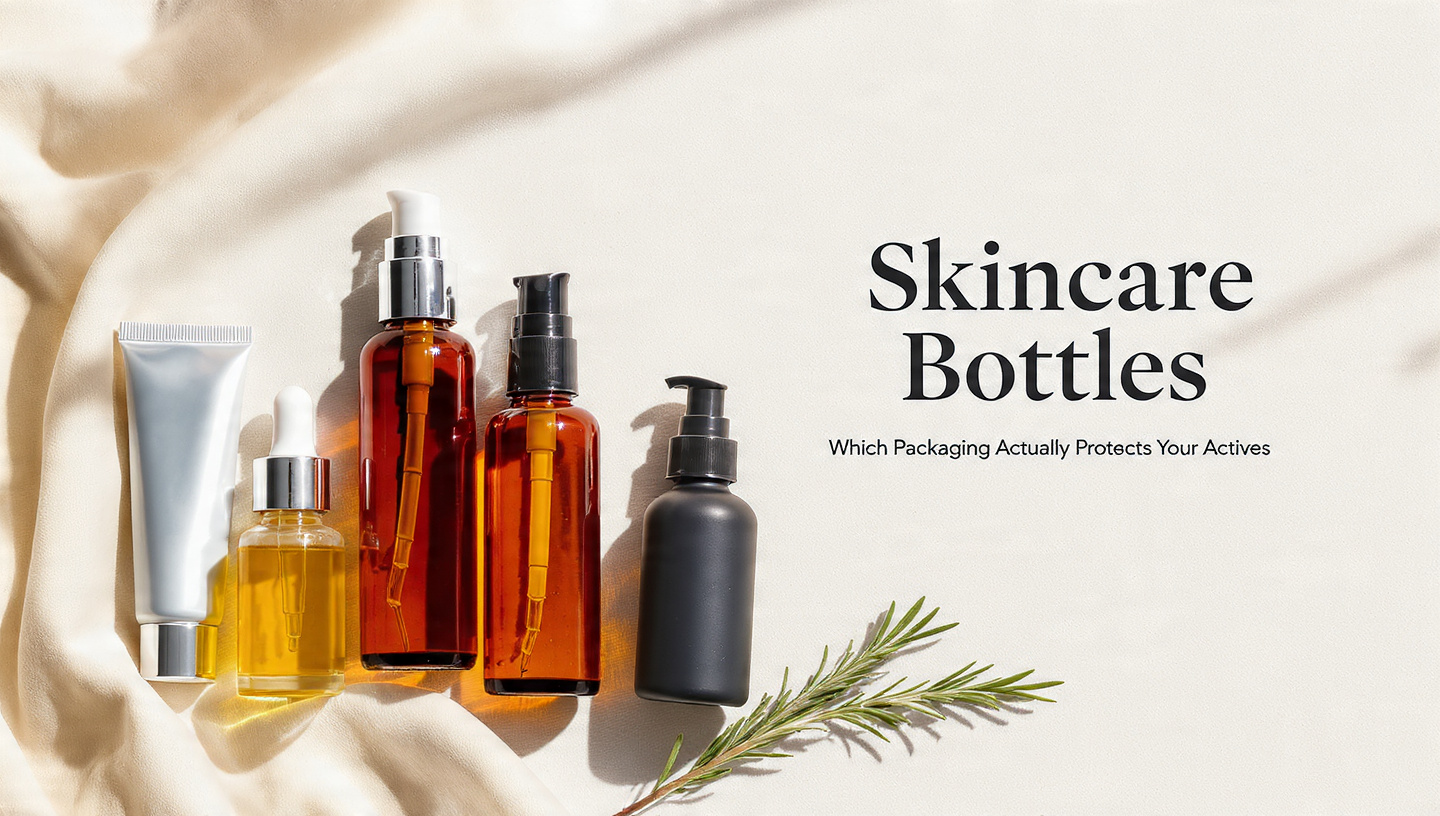
Which Skincare Bottles Actually Protect Your Products in 2026
Your skincare bottle is not just a pretty container. It is a life-support system for the active ingredients you paid for. A 2024 study published in the International Journal of Cosmetic Science found that packaging material and dispensing mechanism directly determined whether ascorbic acid remained 90% active or degraded to below 30% potency within 12 weeks under identical storage conditions.
Most of us obsess over ingredient lists and concentration percentages without ever asking whether the bottle those ingredients live in will keep them alive. That 40-dollar vitamin C serum in a clear glass dropper bottle? It started dying the moment it was filled. The retinol in a jar you dip your fingers into? Every opening introduces fresh oxygen and skin-surface bacteria that accelerate its breakdown.
This article explains exactly which skincare bottle materials, colors, and dispensing mechanisms preserve which active ingredients and why. You will learn to spot packaging that protects your products, packaging that looks premium but fails your formulations, and packaging you should never reuse no matter how pretty the bottle.
skincare bottles
Skincare bottles are the primary container-closure system that determines whether the formulation inside remains chemically stable, microbiologically safe, and functionally effective from the day you open it until you finish it. The bottle is not decorative. It is functional chemistry preservation equipment.
Every time a cosmetic chemist formulates a product, they specify a packaging type matched to that formula’s stability profile. Light-sensitive actives require opaque packaging. Air-sensitive actives require airless or vacuum dispensing. Water-based formulas with preservatives require containers that do not leach compounds that deactivate those preservatives. When a brand chooses a bottle for aesthetic reasons that contradicts the formulation’s stability requirements, the product begins degrading before it reaches your shelf.
The three variables that matter most are material composition, opacity, and dispensing mechanism. Glass blocks gas permeation but varies in light transmission. Plastic can be molded into airless pump systems but some plastics allow oxygen ingress and compound migration. Dispensing mechanisms control how much air, light, and microbial contamination reach the formula each time you use it. Understanding these three variables lets you evaluate any skincare bottle at a glance.
Key Takeaway: Your skincare bottle is a chemical stability device, not a design object. If the packaging choice contradicts what the active ingredients need, the formula inside is already degrading.
why are skincare products in dark bottles
Skincare products are packaged in dark bottles because many active ingredients, including retinol, ascorbic acid, and certain peptides, undergo photodegradation when exposed to ultraviolet and visible light wavelengths. Photodegradation is a chemical reaction where photon energy breaks molecular bonds, permanently destroying the ingredient’s functional structure.
The American Academy of Dermatology notes that retinol undergoes isomerization from its active all-trans configuration to inactive cis configurations when exposed to UV radiation between 290 and 400 nanometers. This means a retinol serum in a clear bottle sitting on your bathroom counter near a window is converting to inactive compounds every morning the sun hits it. Ascorbic acid photodegrades through a similar mechanism, oxidizing to dehydroascorbic acid and then further breaking down into compounds that provide zero antioxidant benefit.
Dark bottles work by absorbing the specific wavelengths that trigger these reactions before they reach the formulation. Amber glass absorbs light below approximately 500 nanometers, covering the entire UVA, UVB, and blue light spectrum that damages most photolabile skincare actives. Cobalt blue glass absorbs in a narrower range, effective primarily in the UV spectrum. Opaque packaging like aluminum tubes or fully pigmented plastic blocks all visible and UV wavelengths.
| Bottle Color | Light Wavelengths Blocked | Best For Ingredients Sensitive To |
| Amber Glass | UV + visible light below ~500 nm | Retinol, ascorbic acid, tocopherol |
| Cobalt Blue Glass | Primarily UV spectrum (below ~400 nm) | Less photosensitive actives, some UV filters |
| Clear Glass | None without external UV coating | Photostable ingredients only |
| Opaque White/Black Plastic | All visible and UV wavelengths | Maximum light-sensitive ingredient protection |
A common mistake is assuming all dark glass provides equal protection. Cobalt blue glass transmits more visible light than amber glass. If your product contains retinol or ascorbic acid, amber or fully opaque packaging provides measurably better photoprotection than cobalt blue alone.
glass vs plastic skincare bottles
Glass and plastic skincare bottles differ fundamentally in gas permeability, chemical inertness, light transmission control, and the risk of compound migration between container and formulation. Neither material is universally superior. Each excels for specific formulation types.
Glass bottles, particularly borosilicate glass, are nearly impermeable to oxygen and carbon dioxide. They do not leach plasticizers, stabilizers, or residual monomers into the formulation. This makes glass the preferred choice for active-ingredient serums where even trace compound migration could destabilize antioxidants or react with preservatives. Glass is also fully recyclable without material degradation. The primary limitation of glass is weight, cost, and the requirement for separate dispensing mechanisms.
Plastic bottles offer design flexibility, lower cost, and lighter shipping weight. High-density polyethylene (HDPE) and polyethylene terephthalate (PET) are the most common cosmetic-grade plastics. The issue is permeability. PET has measurable oxygen transmission rates. Over months on a shelf, oxygen slowly diffuses through the plastic walls into the formulation, oxidizing air-sensitive actives even in an unopened bottle. The Journal of Cosmetic Dermatology published a 2022 analysis showing that ascorbic acid serums in PET bottles lost antioxidant activity 30% faster than identical formulations in glass ampoules over six months of real-time aging.
Polypropylene (PP) offers slightly better barrier properties than PET but still permits gas transmission. For truly oxygen-sensitive ingredients like retinol and L-ascorbic acid, plastic packaging typically requires an additional barrier layer or internal coating, which increases cost and complexity.
| Material | Oxygen Permeability | Compound Migration Risk | Light Protection | Best For |
| Glass (Soda-Lime) | Near zero | None | Depends on colorant | Serums, active concentrates |
| PET | Low to moderate | Low (antimony catalyst residuals possible) | Depends on colorant or coating | Thick creams, cleansers |
| HDPE | Moderate | Very low | Depends on pigmentation | Body lotions, wash-off products |
| PP | Low | Very low | Depends on pigmentation | Airless pump components, jars |
Glass is the safer default for any leave-on product containing retinoids, ascorbic acid, or peptide complexes. Plastic is functionally adequate for rinse-off products, thick occlusive formulations without oxygen-sensitive actives, and body care products where packaging weight matters.
Key Takeaway: For vitamin C, retinol, and peptide serums, glass wins on oxygen barrier properties. For thick creams without oxygen-sensitive actives, quality cosmetic-grade plastic performs fine and reduces shipping weight and breakage risk.
airless pump bottles for skincare
Airless pump bottles are dispensing systems where the product is housed in a collapsible inner bag or a piston-driven chamber that expels product without allowing ambient air to enter the container after each use. Unlike traditional pumps that pull air back into the bottle to replace the dispensed volume, an airless mechanism physically collapses or advances to eliminate headspace.
This mechanism matters because headspace is where oxidation begins. In a standard pump or dropper bottle, every dispensed milliliter of product is replaced by a milliliter of room air containing approximately 21% oxygen. That oxygen immediately begins reacting with antioxidants and retinoids floating in the formulation. An airless pump removes this variable. The formulation never contacts fresh oxygen until the moment it exits the nozzle.
Airless pumps also reduce microbial contamination risk. Because ambient air never enters the container, airborne bacteria, mold spores, and skin flora transferred back through nozzle contact have no pathway into the main product reservoir. A 2021 study in the International Journal of Cosmetic Science demonstrated that preservative-free formulations in airless packaging maintained microbial limits for 12 months, while identical formulations in jar packaging exceeded yeast and mold limits within 45 days of consumer use.
The limitation of airless pumps is they are difficult to fully evacuate. A small amount of product typically remains in the mechanism at end-of-life, meaning you will not access the last 3 to 7 percent of your purchase. They are also primarily made of plastic components, which returns you to the gas permeability conversation. Not all airless pumps are created with the same barrier-layer plastics, so a retinol in an airless pump made with standard PET components may still see slow oxygen ingress through the container walls over time.
best packaging for vitamin C serum
The best packaging for a vitamin C serum containing L-ascorbic acid is an opaque, hermetically sealed, airless or vacuum-dispensing container that blocks all UV and visible light wavelengths below 500 nanometers and prevents any ambient air contact with the formulation. Single-use ampoules represent the theoretical ideal. A properly engineered airless opaque pump is the practical best for multi-use products.
L-ascorbic acid is notoriously unstable in aqueous solution. It oxidizes via a two-step pathway: first to dehydroascorbic acid, which retains some biological activity, then irreversibly to 2,3-diketogulonic acid, which is inactive. Oxygen, light, heat, and metal ions all accelerate this cascade. Packaging cannot fix a poorly formulated serum, but it can destroy a well-formulated one.
Amber glass with an airless pump mechanism addresses both the light and oxygen degradation pathways simultaneously. The amber glass blocks photodegradation-triggering wavelengths. The airless pump eliminates headspace oxygen replacement. An induction-sealed cap adds tamper evidence and prevents oxygen ingress during shelf storage before first use.
Products packaged in clear dropper bottles, regardless of how premium the brand positioning, guarantee your ascorbic acid serum will oxidize faster. Every time you unscrew the dropper, you exchange the entire headspace air volume. Every time that bottle sits on a vanity near indirect sunlight, photons hit the formulation. If your vitamin C serum is clear, pale yellow, or housed in a clear bottle, assume it is degrading faster than a well-packaged formulation and prioritize using it within 8 to 10 weeks of opening.
| Packaging Type | Oxygen Protection | Light Protection | Practical Vitamin C Viability Window After Opening |
| Amber Glass Airless Pump | Excellent | Excellent | 3 to 6 months |
| Opaque Airless Pump (Plastic) | Good to Very Good | Excellent | 2 to 5 months |
| Amber Glass Dropper Bottle | Poor (headspace air exchange) | Good | 6 to 10 weeks |
| Clear Glass Dropper Bottle | Poor | None | 3 to 6 weeks before visible oxidation |
| Single-Dose Ampoule | Perfect | Perfect | Immediately after opening only |
Key Takeaway: If your vitamin C serum comes in a clear dropper bottle, refrigerate it, close it immediately after each use, and finish it within six weeks. Oxygen and light are killing it faster than you think.
do dropper bottles contaminate serum
Dropper bottles introduce two contamination pathways into serum formulations: the repeated introduction of ambient air during every opening cycle and the direct transfer of skin-surface microorganisms from fingertips to the glass pipette tip and then into the product reservoir. Neither pathway is theoretical. Both are documented in cosmetic microbiology studies.
When you unscrew a dropper top, the entire headspace air volume above the product exchanges with room air. That room air carries oxygen, which oxidizes active ingredients, and airborne microorganisms including bacteria and fungal spores. A 2023 study published in the Journal of Cosmetic Dermatology cultured Staphylococcus aureus, Pseudomonas aeruginosa, and Candida albicans from consumer-used dropper-bottle serums at usage rates significantly above baseline sealed-product controls.
The second contamination pathway is mechanical. Fingers touch the glass dropper tip during use, even when you try to avoid it. Those fingers carry sebum, sweat, skin flora, and traces of whatever you touched before your skincare routine. The dropper then re-enters the bottle, depositing those microorganisms directly into a water-based nutrient-rich medium optimized for microbial growth.
Preservative systems in well-formulated serums are designed to handle a certain microbial load, but repeated dropper contamination overwhelms preservative capacity over time. This is why the period after opening (PAO) symbol exists. For dropper-bottle serums, the PAO is typically 6 to 12 months, but this assumes reasonable handling. Touching the dropper tip, leaving the bottle uncapped between steps, or storing it in a warm humid bathroom accelerates microbial growth beyond what the preservative system can manage.
amber glass bottles for skincare
Amber glass bottles are the cosmetic packaging standard for light-sensitive active ingredients because they absorb the entire ultraviolet spectrum plus visible light up to approximately 500 nanometers while remaining transparent enough for the user to see the product level. This specific wavelength absorption profile makes amber glass uniquely suited for protecting retinol, ascorbic acid, tocopherol, and certain unstable peptide complexes.
The amber color is achieved by adding iron, sulfur, and carbon compounds to the molten glass mixture. This is not a surface coating that can scratch off. The UV-absorbing property is integral to the glass structure itself. Soda-lime amber glass is the most common cosmetic grade, offering adequate chemical durability for water-based and oil-based formulations. Borosilicate amber glass provides superior thermal and chemical resistance but costs more and is typically reserved for high-heat-processed products or formulations with extreme pH levels.
The limitation of amber glass is that it is not fully opaque. Products stored in direct sunlight or under bright retail display lighting can still receive enough photon energy to initiate slow photodegradation over extended shelf storage. This is why the most protective packaging pairs amber glass with a secondary opaque outer carton. The outer box handles retail display light exposure. The amber bottle handles the bathroom counter after purchase. Without the outer carton, amber glass alone is good but not perfect for highly photolabile ingredients in retail environments.
| Amber Glass Type | Wavelengths Absorbed | Typical Cosmetic Applications |
| Soda-Lime Amber | UV + visible to ~500 nm | Serums, facial oils, treatment products |
| Borosilicate Amber | UV + visible to ~500 nm + thermal shock resistance | Heat-processed formulations, extreme pH products |
| Amber with Opaque Outer Carton | All wavelengths during storage | Maximum photoprotection for retinol and ascorbic acid |
retinol packaging requirements
Retinol packaging must meet three simultaneous requirements to prevent potency loss: complete opacity to ultraviolet and visible light, zero or near-zero oxygen headspace replenishment, and a dispensing mechanism that does not introduce microbial contamination. Any packaging system that fails on any one of these three axes will deliver degraded, less effective retinol to your skin within weeks of opening.
Retinol photodegradation is rapid and clinically significant. A 2022 study in the Journal of Investigative Dermatology demonstrated that retinol in simulated consumer-use clear packaging lost 40% of its active concentration within 10 days of intermittent ambient light exposure. The degradation products included inactive cis-retinol isomers and various oxidation byproducts that provide none of the collagen-stimulating or cell-turnover benefits of the parent compound.
Opaque airless packaging is the current benchmark for retinol formulations. An aluminum tube with a sealed orifice is another effective option, functioning similarly to pharmaceutical ointment packaging. Both prevent light ingress and minimize air contact. Jar packaging for retinol is functionally incompatible with ingredient stability. The wide opening exposes the entire product surface to oxygen, light, and fingertip-introduced microbes each time the jar is opened.
The FDA does not mandate specific packaging for retinol-containing cosmetic products, since retinol is regulated as a cosmetic ingredient at OTC concentrations, not as a drug. This means the packaging quality decision rests entirely with the brand’s formulation stability commitment. When you see retinol in a jar or a clear bottle, the brand has prioritized aesthetic shelf appeal or cost savings over chemical stability.
skincare bottle types and dispensing mechanisms
Skincare dispensing mechanisms fall into five functional categories, each with distinct performance characteristics for product preservation, dose control, and contamination risk. Your choice of mechanism directly impacts how long your actives stay potent.
Dropper bottles dispense product via a glass pipette with a rubber bulb. They offer precise dose control but introduce maximum air exchange and moderate contamination risk with each use. Suitable only for photostable, low-oxygen-sensitivity formulations or products formulated for rapid consumption.
Pump bottles use a spring-loaded piston mechanism to dispense product through a one-way valve. Standard pumps pull replacement air back into the bottle, creating headspace air exchange similar to droppers but without the pipette-introduced contamination risk. Airless pumps eliminate the headspace air exchange entirely by using a vacuum piston or collapsible inner pouch. Airless pumps offer the best preservation for oxygen-sensitive actives among multi-use dispensing options.
Tubes dispense product by squeezing, with either a flip-cap or a one-way valve nozzle. Aluminum tubes collapse as product is used, minimizing air ingress. Plastic tubes spring back after squeezing, pulling air inside. Aluminum tubes with lined interiors offer excellent oxygen and light protection for retinoid and antioxidant formulations.
Jars are open-mouth containers accessed by dipping fingers or a spatula into the product. Jars maximize air exposure, light exposure, and microbial contamination with each use. They are appropriate for thick, low-water-activity formulations like balms and occlusive salves where preservative systems are robust and active ingredient oxidation sensitivity is low.
| Mechanism | Air Exposure | Light Protection | Contamination Risk | Best For |
| Airless Pump | Minimal | Depends on outer container opacity | Very Low | Retinol, vitamin C, peptide serums |
| Aluminum Tube | Minimal (collapses) | Excellent (opaque) | Low (nozzle only) | Retinoid creams, antioxidant balms |
| Standard Pump | Moderate (headspace air) | Depends on container | Low | Moisturizers, body products |
| Dropper Bottle | Maximum (full headspace exchange) | Depends on glass color | Moderate | Photostable serums, short-use products |
| Jar | Maximum | Depends on container | High | Balms, heavy creams, low-water formulas |
Key Takeaway: Match your dispensing mechanism to your ingredients. Oxygen-sensitive actives demand airless pumps or aluminum tubes. Water-based formulas in jars are a stability disaster waiting to happen.
how light exposure degrades skincare ingredients
Light exposure degrades skincare ingredients through a photochemical reaction where photon energy is absorbed by molecular bonds, exciting electrons to higher energy states. When those electrons return to their ground state, the energy can break chemical bonds, create free radicals, or trigger isomerization that permanently alters the ingredient’s molecular structure and biological function.
The degradation pathway is specific to each ingredient. Retinol absorbs UVB radiation (290 to 320 nanometers) and undergoes photoisomerization from the active all-trans configuration to inactive 11-cis, 9-cis, and 13-cis isomers. These isomers cannot bind retinoic acid receptors in skin cells, rendering them biologically inactive for collagen stimulation and cell turnover regulation.
Ascorbic acid absorbs UVA radiation (320 to 400 nanometers) and visible blue light, triggering photooxidation where the ascorbic acid molecule donates electrons to dissolved oxygen, converting to dehydroascorbic acid and then to irreversible degradation products. This is functionally identical to the oxidation that occurs from air exposure but accelerated by photon energy input.
Tocopherol (vitamin E) is itself an antioxidant but photodegrades when exposed to UVB, forming tocopherol quinone and losing its radical-scavenging capacity. This creates a practical problem: formulators add tocopherol to stabilize ascorbic acid, but if the packaging is not light-protective, the tocopherol degrades alongside the ascorbic acid, accelerating overall oxidation rather than preventing it.
A 2023 International Journal of Cosmetic Science study quantified that amber glass packaging reduced ascorbic acid photodegradation by 74% compared to clear glass under simulated retail lighting conditions over 90 days. The same study found that opaque outer cartons provided an additional 18% degradation reduction beyond amber glass alone.
how to store skincare products properly
Proper skincare storage means keeping products in a cool, dark, dry environment with stable temperature, away from direct sunlight, humidity, and heat sources. The bathroom medicine cabinet is better than the counter. A bedroom drawer or closet shelf is better than either.
Temperature stability matters because heat accelerates all chemical degradation reactions, including oxidation, hydrolysis, and preservative breakdown. The Arrhenius equation, which governs reaction-rate temperature dependence, means that every 10 degrees Celsius increase roughly doubles the degradation rate for many cosmetic active ingredients. A serum stored at 30 degrees Celsius (86 degrees Fahrenheit) in a warm bathroom degrades approximately twice as fast as the same serum stored at 20 degrees Celsius (68 degrees Fahrenheit) in a climate-controlled bedroom.
Humidity affects products differently depending on packaging. Sealed airless pumps and induction-sealed bottles are minimally affected by ambient humidity. Jar products and poorly sealed dropper bottles absorb bathroom humidity, which can dilute formulations, alter pH, and create water activity conditions that favor microbial growth even in properly preserved products.
Refrigeration is appropriate for vitamin C serums (specifically L-ascorbic acid formulations), retinol products during summer months in non-air-conditioned homes, and any preservative-free or “clean” formulated products where the preservative system is weaker by design. Refrigeration slows oxidation kinetics and extends the usable window. Do not freeze skincare products. Freeze-thaw cycles can break emulsions and cause ingredient precipitation.
Products stored in direct bathroom light near a shower, on a windowsill, or in a hot car have already sustained ingredient damage that cannot be reversed by moving them to better storage.
can you reuse skincare bottles
Reusing skincare bottles is possible under specific conditions but carries real risks of microbial contamination, residual ingredient cross-reactions, and preservative system failure if the new contents differ chemically from the original formulation. Most cosmetic bottles are designed for single-fill, single-use lifecycles with one specific formula.
The primary risk is biofilm formation inside pump mechanisms and along bottle threads. Biofilms are communities of microorganisms encased in a self-produced extracellular matrix that adheres to surfaces. They are notoriously resistant to sanitizing agents. A pump mechanism that dispensed a water-based lotion for six months has almost certainly developed internal biofilms that household cleaning cannot fully remove. Filling that pump with a new water-based serum provides nutrients for the biofilm bacteria to proliferate into the fresh product.
A secondary risk is chemical incompatibility between residual product and new contents. Trace amounts of low-pH ascorbic acid serum left in a bottle can destabilize a new retinol formulation added to the same container. Surfactant residues from a cleanser bottle can emulsify and degrade a facial oil blend. Preservative concentrations in the new product are calculated for the original container volume and headspace. Changing containers alters those calculations.
If you choose to reuse a bottle, limit it to once, use only for products chemically similar to the original contents, and apply a rigorous sanitization protocol. Bottles that previously held water-based products should not be reused for oil-based products and vice versa. Any bottle with a pump mechanism or dropper assembly should be considered non-sanitizable by home methods and discarded after single use.
best travel bottles for skincare
The best travel bottles for skincare are small-volume, leak-proof, opaque containers with a dispensing mechanism that matches the oxygen sensitivity of the product being decanted. Not all travel bottles are equal, and the wrong choice can ruin an expensive serum before you reach your destination.
Silicone squeeze bottles are popular for travel because they are lightweight, collapsible, and TSA-compliant. However, silicone is oxygen-permeable. A vitamin C serum decanted into a clear silicone travel tube will oxidize faster than if left in its original amber glass airless pump. Silicone is acceptable for cleansers, shampoos, and thick creams without oxygen-sensitive actives. It is a poor choice for antioxidant serums and retinol formulations.
Airless pump travel bottles offer the best preservation for active serums during travel. Look for mini airless pumps with opaque outer barrels. The vacuum piston mechanism prevents air ingress, and the small volume (10 to 15 milliliters) means you will finish the product before significant degradation occurs even if the container material is not perfect.
For products in dropper bottles, decanting into any travel container introduces significant air exposure during the transfer process itself. If possible, bring the original dropper bottle wrapped in opaque material rather than transferring the product. If you must decant, fill the travel container as close to the brim as possible to minimize trapped headspace air. Apply a small square of plastic wrap over the opening before screwing the cap on for an additional air seal.
TSA’s 3-1-1 liquids rule limits each container to 3.4 ounces (100 milliliters). All travel bottles must fit in a single quart-sized clear bag. This makes multi-step skincare routines challenging for carry-on travel, but solid stick formulations, powder cleansers, and single-use ampoules can supplement liquid restrictions.
| Travel Bottle Type | Oxygen Protection | Leak Resistance | Best For |
| Mini Airless Pump (Opaque) | Excellent | Excellent | Retinol, vitamin C, peptide serums |
| Small Amber Glass Dropper | Poor during transfer, okay after | Good with tight cap | Short trips with photostable serums |
| Silicone Squeeze Tube | Poor | Very Good | Cleansers, shampoos, thick creams |
| PET Flip-Cap Bottle | Poor to Moderate | Good | Body lotion, hair conditioner |
| Single-Dose Ampoules | Perfect until opened | Perfect until opened | Maximum preservation for active ingredients |
Key Takeaway: Invest in one or two opaque mini airless pump bottles for your active serums. Use cheap silicone tubes for everything else. Your vitamin C deserves better than a clear plastic flip-cap.
how to clean skincare bottles for reuse
Cleaning skincare bottles for reuse requires a three-step protocol: thorough removal of residual product, sanitization with 70% isopropyl alcohol or equivalent, and complete drying before refilling. Rinsing with water alone is insufficient to remove biofilms or kill microorganisms that have colonized the container interior and dispensing mechanism.
Step one is product removal. Fill the bottle with warm water and a small amount of fragrance-free liquid soap. Shake vigorously for at least 30 seconds. If the bottle previously held an oil-based product, use a small amount of unscented dish soap to emulsify the oil residues. Pump the soapy water through the dispensing mechanism to clear product from the dip tube, spring housing, and nozzle. Repeat with clean water until no soap remains.
Step two is sanitization. Fill the bottle with 70% isopropyl alcohol. Do not use 99% isopropyl alcohol. The 70% concentration is more effective at killing microorganisms because the water content slows alcohol evaporation, increasing contact time with bacterial cell walls. Pump the alcohol through the dispensing mechanism. Let the alcohol sit in the bottle and mechanism for at least two minutes. Pour out the alcohol and allow the bottle to air-dry completely. Do not rinse after the alcohol step. Alcohol evaporates without residue.
Step three is verification. A completely dry bottle with no residual odor is ready for refilling. If the bottle retains any scent from the previous product, repeat the sanitization step. Scent retention indicates residual product compounds are still present, which can cross-react with the new formulation.
Pump mechanisms and dropper assemblies that cannot be fully disassembled should not be reused. The internal components, springs, gaskets, and narrow channels cannot be adequately cleaned or sanitized by any home method. The small volume of new product you save by reusing the bottle is not worth the contamination risk to the full product you are decanting.
period after opening skincare symbol
The period after opening symbol, printed as an open jar icon with a number followed by “M” (such as 6M, 12M, 24M), indicates the number of months a cosmetic product remains safe and stable after first opening when stored under normal conditions. This symbol is a regulatory requirement for cosmetics sold in the European Union under EC Regulation No 1223/2009 and appears voluntarily on many products sold in the United States.
The PAO is determined by the manufacturer through stability testing that evaluates preservative efficacy, physical stability, and ingredient potency over time under simulated consumer use conditions. A 12M PAO means the manufacturer’s data supports that the product will remain within specification for 12 months after the consumer first opens it. This is different from the expiration date, which applies to the sealed product on the shelf.
The PAO assumes reasonable handling. Dipping unwashed fingers into a jar invalidates the PAO. Storing the product in a hot, humid bathroom invalidates the PAO. Leaving the cap off between application steps invalidates the PAO. The symbol reflects the product’s capability, not a guarantee that overrides misuse.
Products without a PAO symbol are not necessarily less stable. The PAO is not mandatory in the US market. Some brands include both a PAO and an expiration date. Others include only an expiration date or a batch code you can check against a manufacturer database. If your product has neither, a reasonable default is 12 months for water-based formulations in pump or dropper packaging, 6 months for jar packaging, and 24 months for oil-based anhydrous formulations.
signs your skincare packaging is failing your product
Skincare packaging failure announces itself through changes in the product’s color, smell, texture, or performance that occur before the stated PAO or expiration date. These changes indicate that the container-closure system has allowed oxygen, light, moisture, or microorganisms to compromise the formulation.
Color change is the most immediately visible sign. Ascorbic acid serums shifting from clear or pale yellow to deep orange or brown indicate oxidation has progressed past the point of ingredient functionality. The serum is not just discolored. The ascorbic acid has converted to degradation products that provide no antioxidant benefit and may be pro-oxidant. A retinol cream shifting from white or pale yellow to a darker, amber tone similarly indicates photoisomerization and oxidation.
Separation of phases in an emulsion product signals that the packaging has allowed water loss or that the emulsifier system has destabilized, possibly due to temperature cycling or preservative failure. An oil and water phase that no longer mix means the product is not delivering ingredients uniformly and may harbor microbial growth at the water-oil interface.
Off odors that were not present when the product was new indicate microbial metabolism or chemical degradation. A sour or fermented smell in a water-based product suggests bacterial or yeast overgrowth. A rancid, crayon-like smell in an oil-based product indicates lipid oxidation. Either means the product should be discarded regardless of the PAO date.
Changes in texture, thinning, clumping, or grittiness indicate that the formulation matrix is breaking down. This can result from preservative failure, water evaporation through compromised packaging, or ingredient precipitation caused by pH drift that the container material could not buffer against.
preservative systems and packaging compatibility
Preservative systems in skincare formulations are chemically selected to function within a specific packaging environment. Change the packaging and you may inadvertently deactivate the preservatives, leaving your product unprotected against microbial contamination.
This compatibility problem works through several mechanisms. Some preservatives, including certain parabens and phenoxyethanol, can adsorb onto plastic container walls over time, reducing the effective concentration in the formulation itself. This phenomenon, called preservative sorption, is accelerated by small container sizes with high surface-area-to-volume ratios, high storage temperatures, and certain plastic types including low-density polyethylene.
Plastic additives can also migrate into the product and react with preservatives. Phthalates, slip agents, and antioxidant stabilizers added to plastic during manufacturing can leach into the formulation and chemically bind to preservative molecules, rendering them inactive. This is why formulators specify exact packaging plastics for each formulation and why you cannot assume a preservative system that worked in the original glass bottle will function identically in a different plastic container you bought for travel.
Water-based formulations are particularly vulnerable to packaging-preservative interactions. Water extracts more compounds from container walls than oil-based formulations do. If you decant a water-based serum into a new container, the preservative system may fail not because the preservatives are weak but because the container material is deactivating them faster than anticipated.
Key Takeaway: Preservatives and packaging are a matched system. Decanting a product into a different container type changes the preservative dynamic in ways that can leave your product unprotected, even if the new container looks clean and well-sealed.
sustainable skincare packaging options
Sustainable skincare packaging in 2026 increasingly means refillable systems, post-consumer recycled content, mono-material designs that are actually recyclable in municipal streams, and reduced component counts that eliminate unrecyclable mixed-material pumps and droppers. This is genuine progress, but sustainable packaging and active ingredient preservation sometimes conflict.
Refillable packaging, where you purchase a durable outer container once and replace an inner product cartridge, can reduce total packaging material by up to 70% according to lifecycle analyses from the Personal Care Products Council. The risk is that refill cartridges must independently provide the same light and oxygen protection as the original single-use packaging. A refill pouch for a vitamin C serum that replaces an amber glass airless pump with a thin plastic pouch provides inferior ingredient protection during shelf storage and use.
Post-consumer recycled plastic, PCR PET and PCR HDPE specifically, introduces variability in container barrier properties because recycled resin blends can have inconsistent crystallinity and additive content compared to virgin resin. For products without oxygen-sensitive actives, PCR content is a sustainability win with low functional risk. For retinol and ascorbic acid formulations, the barrier property variability in PCR plastics remains a technical challenge that some brands address with internal coatings.
Mono-material packaging, where the bottle, cap, and dispensing mechanism are all the same plastic type, solves the recycling sorting problem. Mixed-material pumps with metal springs, glass ball bearings, and multiple plastic types are functionally unrecyclable in standard municipal streams even if each component material is technically recyclable. Brands are developing mono-material polypropylene airless pumps that match the preservation performance of mixed-material pumps while being fully PP-stream recyclable. These are emerging in 2025 and 2026 as the genuine innovation in this space.
Sustainability and active ingredient preservation are not inherently opposed, but they require engineering investment that not every brand makes. A clear, lightweight, recyclable plastic bottle for a retinol serum might win on sustainability metrics while failing completely on product preservation. The most sustainable packaging is the one that prevents product waste by keeping the formulation stable until the last drop.
Frequently Asked Questions About Skincare Bottles
Do airless pump bottles really keep skincare fresh longer?
Yes, airless pump bottles extend the usable life of oxygen-sensitive formulations by preventing ambient air from entering the container after each use, eliminating the headspace air exchange that drives oxidation in standard pumps and dropper bottles. A 2021 International Journal of Cosmetic Science study confirmed that ascorbic acid formulations in airless pumps retained active concentration longer than identical formulations in standard pumps. The effect is most significant for products containing retinol, L-ascorbic acid, tocopherol, and unstable peptide complexes.
Why did my vitamin C serum turn brown in the bottle?
Your vitamin C serum turned brown because the ascorbic acid oxidized, converting from active L-ascorbic acid to dehydroascorbic acid and then to inactive brown-colored degradation products. This oxidation is triggered by light exposure, air contact in the bottle headspace, heat, and metal ion contamination. If your serum arrived clear and turned brown before the expiration date, the packaging allowed too much light or oxygen to reach the formulation.
Can I put my retinol serum in a different bottle for travel?
You can decant retinol serum into an opaque, air-tight travel container if the original packaging is too large, but the transfer process itself exposes the serum to significant oxygen and the new container may have inferior barrier properties compared to the original packaging. Use an opaque mini airless pump. Fill it to the absolute brim to minimize trapped air. Understand that even with the best travel container, the product will degrade faster than if left undisturbed in its original packaging.
Are plastic skincare bottles safe for long-term product storage?
Plastic skincare bottles are safe for long-term storage of products without oxygen-sensitive actives, provided the plastic is cosmetic-grade PET, HDPE, or PP that has been stability-tested with the specific formulation. For retinol, ascorbic acid, and unstable peptide serums, the measurable oxygen permeability of even high-quality plastics means glass or aluminum provides superior long-term preservation over months of daily use.
What does the open jar symbol on my moisturizer mean?
The open jar symbol with a number followed by “M” indicates the period after opening, the number of months the product remains safe and stable after you first open it when stored under normal conditions. A 12M symbol means the manufacturer’s stability data supports 12 months of safe use after opening. This symbol does not guarantee safety if the product is stored in heat, exposed to direct light, or contaminated by unwashed fingers in jar packaging.
How can I tell if my skincare product has gone bad from bad packaging?
Bad packaging announces itself through changes in the product that occur before the expiration date: color darkening or shifting, phase separation in emulsions, off or rancid odors, texture changes like thinning or grittiness, and reduced efficacy. If your serum is darker, smells different, or feels different than when you opened it and the PAO or expiration date has not passed, the packaging has likely failed to protect the formulation.
You do not need to memorize every material science variable to protect your skincare investments. The rule is straightforward: opaque, airtight, and touch-free dispensing wins for anything with active ingredients you care about. Amber glass airless pumps and aluminum tubes are the gold standard for retinoids and antioxidants. Dropper bottles are fine for photostable, low-oxygen-sensitivity formulas you will finish quickly. Jars are for thick balms and occlusives that do not contain fragile actives.
Look at your shelf tonight. If your vitamin C serum lives in a clear glass dropper bottle on your bathroom counter, move it to the refrigerator or a dark drawer immediately and commit to finishing it within six weeks. If you see color changes that mean oxidation has already progressed, replace the product and choose a brand whose packaging demonstrates they understand chemistry, not just aesthetics. The bottle is part of the formula whether the brand admits it or not.
Your skincare works when its chemistry works. The bottle is what keeps that chemistry intact.