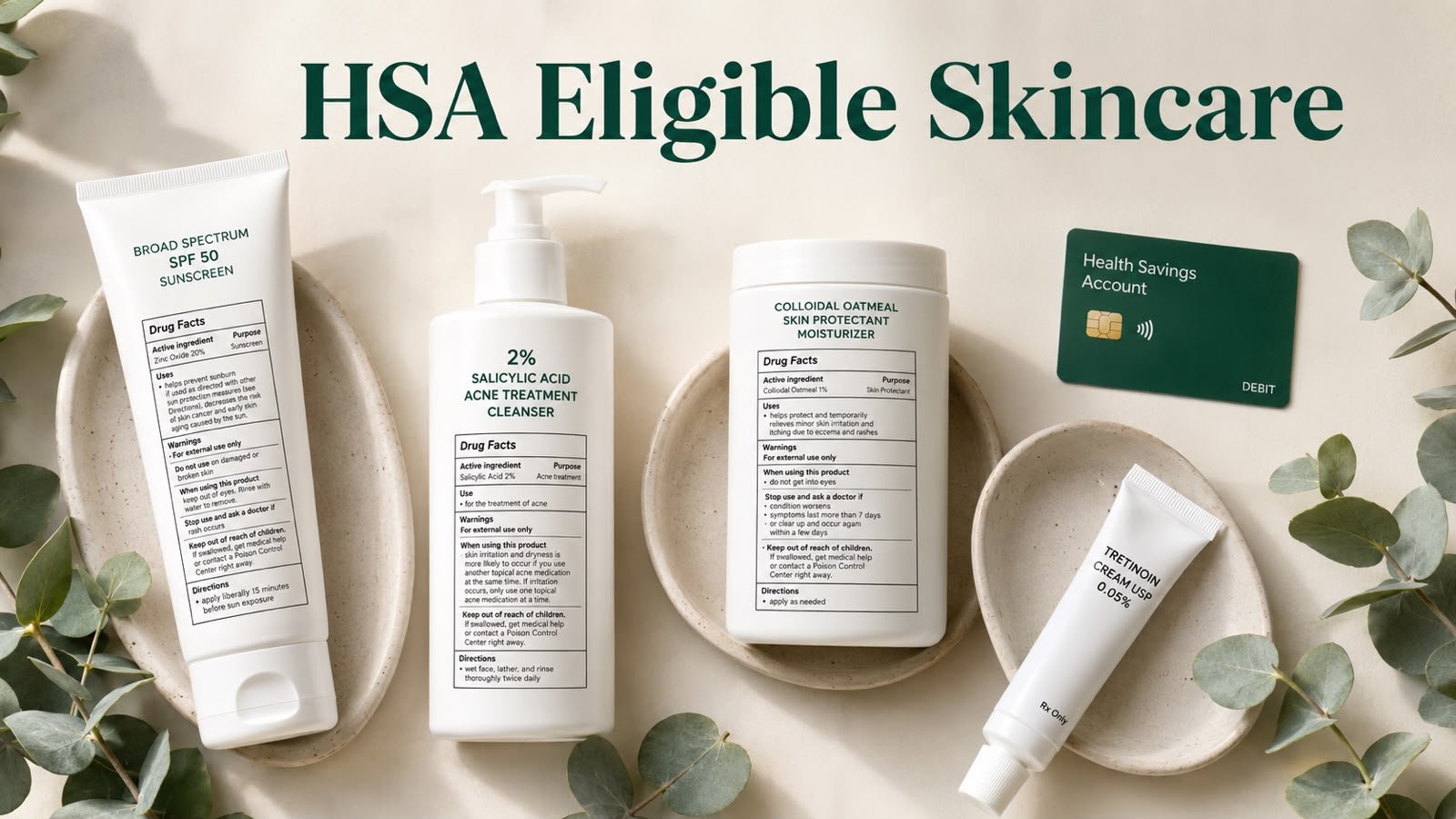
HSA Eligible Skincare Rules 2026: What Your Health Savings Account Actually Covers
Your health savings account can legally pay for specific skincare products, but only when those products treat a diagnosed medical condition and meet IRS definitions for medical care. The line between an HSA-eligible acne treatment and a non-eligible cosmetic exfoliant often comes down to a single word on the label and the concentration of active ingredients inside.
The IRS does not recognize “skincare” as a medical expense category. It recognizes treatments for specific medical conditions. According to IRS Publication 502, a qualified medical expense must diagnose, cure, mitigate, treat, or prevent disease. For skincare products, this means the product must address a diagnosed dermatological condition, not a cosmetic preference. The American Academy of Dermatology maintains clinical guidelines for conditions like acne vulgaris, atopic dermatitis, and rosacea that define what constitutes medical treatment. When your skincare product aligns with those treatment standards for a condition you have been diagnosed with, the HSA eligibility pathway opens.
This article walks through the IRS rules that govern HSA skincare spending in 2026, names the specific skin conditions that create eligibility, explains how active ingredient concentrations determine whether a product qualifies, and provides the exact documentation you need to submit a claim that survives administrator review. You will finish with a clear understanding of which products in your routine genuinely qualify and how to document them correctly.
HSA Eligible Skincare Rules 2026: The Regulatory Framework
HSA eligible skincare rules in 2026 remain governed by Internal Revenue Code Section 213(d), which defines qualified medical expenses as amounts paid for the diagnosis, cure, mitigation, treatment, or prevention of disease. A skincare product qualifies when it is purchased primarily to treat a specific diagnosed medical condition affecting the skin, not for general skincare maintenance or cosmetic improvement. The IRS does not maintain a master list of eligible products. Eligibility depends on the medical purpose of the purchase and, in many cases, the documentation supporting it.
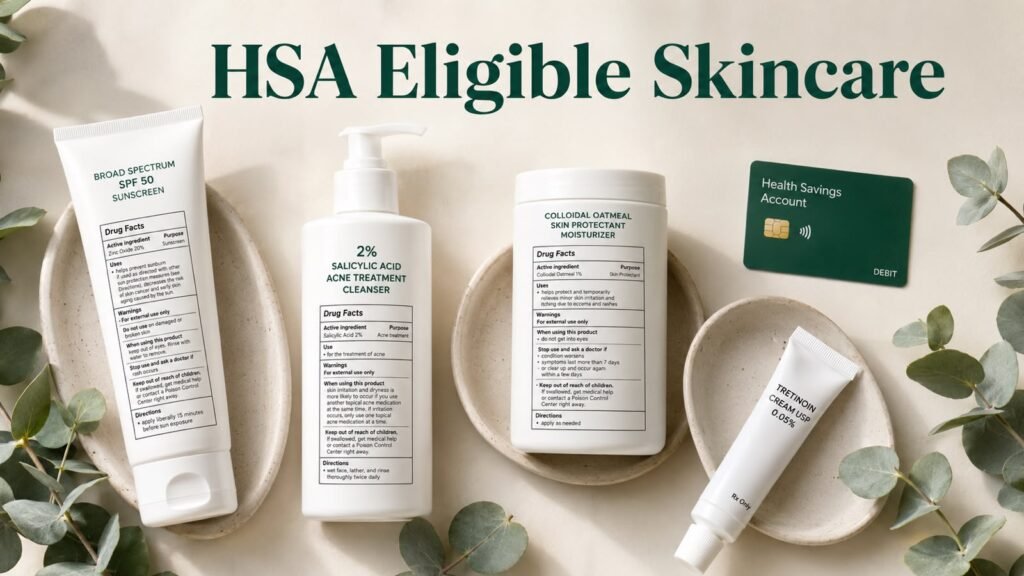
The CARES Act, enacted in 2020 and permanently codified, expanded HSA eligibility to include over-the-counter drugs without a prescription requirement. Before the CARES Act, OTC skincare treatments required a prescription for HSA eligibility. Now, OTC acne treatments containing 2% salicylic acid or 10% benzoyl peroxide, OTC adapalene gel at 0.1%, and broad spectrum sunscreens with SPF 30 or higher can be purchased with HSA funds without any prescription. This change significantly simplified access to first-line acne treatments and sun protection. The CARES Act also added menstrual care products to eligibility, but that provision does not extend to non-drug skincare.
The IRS applies a “primary purpose” test to determine eligibility. If a product is purchased primarily to treat a medical condition, it qualifies even if it also provides cosmetic benefits. A moisturizer formulated for atopic dermatitis that contains colloidal oatmeal as its active ingredient and is labeled with Drug Facts can qualify because its primary purpose is treating the skin condition. The exact same base formula sold as a cosmetic moisturizer without a Drug Facts label does not qualify, even if a person with eczema uses it. The product’s regulatory classification and labeling matter more than the user’s intent. The FDA determines whether a product is a drug or cosmetic based on intended use claims, and the IRS defers to that classification.
Key Distinction Table:
| Classification | FDA Definition | HSA Eligibility | Example |
|---|---|---|---|
| OTC Drug | Treats or prevents disease; has Drug Facts label | Eligible without prescription (CARES Act) | 2% salicylic acid acne cleanser |
| Cosmetic | Cleanses, beautifies, or alters appearance | Not eligible | Hydrating facial cleanser without drug claims |
| Prescription Drug | Requires prescriber authorization | Eligible with prescription | Tretinoin 0.05% cream |
| Combination Product | Drug + cosmetic functions in one product | Partially eligible; drug portion qualifies | Moisturizer with SPF 30 broad spectrum sunscreen |
IRS Publication 502 Skincare Medical Expenses Explained
IRS Publication 502, titled Medical and Dental Expenses, provides the official IRS guidance on what counts as a qualified medical expense for tax purposes and HSA distributions. The publication does not contain a “skincare” section. It contains categories of medical conditions and treatments that create eligibility when skincare products serve as the treatment vehicle. Publication 502 lists “acne” under deductible medical expenses when treatment is prescribed or provided as an OTC drug. It does not list “dry skin” or “anti-aging” anywhere.
The publication specifically includes amounts paid for prescription drugs and insulin as qualified medical expenses. Over-the-counter drugs purchased after January 1, 2020, qualify under the CARES Act permanent provisions without a prescription. The key term is “drug.” For a skincare product to qualify as an OTC drug, it must contain an FDA-recognized active ingredient at a monograph-specified concentration and display a Drug Facts label. Products without a Drug Facts label are legally cosmetics, not drugs, regardless of what they claim to do. IRS Publication 502 defers to FDA drug classification when determining eligibility.
A 2023 update to IRS guidance clarified that “medicated” claims on product packaging do not automatically confer eligibility. The product must meet FDA OTC drug monograph standards for its active ingredient. Some products labeled “medicated” contain active ingredients at concentrations below the monograph threshold or contain ingredients not recognized by any FDA monograph. These products remain cosmetics in the eyes of both the FDA and the IRS. Checking for the Drug Facts panel on the packaging is the single most reliable indicator of OTC drug status. Products with only a “Supplement Facts” or ingredient list are not OTC drugs.
Publication 502 also addresses the treatment of capital expenses for medical purposes, which can apply to certain skincare devices when prescribed. Light therapy devices for psoriasis or acne, when prescribed by a dermatologist and supported by a Letter of Medical Necessity, may qualify as durable medical equipment expenses. The cost of such devices, including maintenance and batteries, can be HSA-eligible when the primary purpose is treating a diagnosed condition. A 2022 IRS private letter ruling, while not precedent-setting for other taxpayers, confirmed HSA eligibility for a prescribed blue light therapy device for acne treatment when supported by adequate medical documentation.
Key Takeaway: HSA eligibility for skincare follows FDA drug classification, not marketing language. If the product has a Drug Facts label and treats a condition recognized by the IRS as a medical expense, it generally qualifies.
Medical vs Cosmetic Skincare: The HSA Distinction That Matters
Medical skincare treats a diagnosed disease or disorder affecting the structure or function of the skin. Cosmetic skincare alters appearance without treating an underlying pathology. The FDA makes this determination based on a product’s intended use as demonstrated by its labeling, active ingredients, and marketing claims. The IRS then uses that FDA classification to determine HSA eligibility. This is the single most important distinction in understanding which skincare products your HSA can cover.
The FDA classifies a product as a drug when it is intended to treat or prevent disease or to affect the structure or function of the body. For skincare, this means products that treat acne, eczema, psoriasis, rosacea, seborrheic dermatitis, actinic keratosis, and other diagnosed skin conditions fall into the drug category when they contain recognized active ingredients at therapeutic concentrations. Products intended to moisturize, smooth fine lines, brighten skin tone, or reduce the appearance of pores are cosmetics. Even if a cosmetic product contains an ingredient that is also an active drug ingredient, it remains a cosmetic if it is not marketed with drug claims and does not display a Drug Facts label.
Consider salicylic acid as the clearest example. At 2% concentration in a product labeled “acne treatment” with a Drug Facts panel, it is an OTC drug. The same manufacturer might sell a 0.5% salicylic acid “clarifying toner” in a cosmetic line. The toner contains the same ingredient but at a lower, non-therapeutic concentration and without drug claims. The acne treatment is HSA-eligible. The clarifying toner is not. The distinction has nothing to do with the ingredient itself and everything to do with how the product is classified and labeled for its intended medical purpose.
The “cosmeceutical” marketing category deserves specific attention here because it causes persistent confusion. Cosmeceutical is not an FDA-recognized classification. It is a marketing term used by skincare brands to suggest that a cosmetic product has drug-like effects. No matter how many clinical studies a cosmeceutical brand funds, if the product does not have a Drug Facts label and is not classified as an OTC drug by the FDA, it remains a cosmetic for HSA purposes. A cosmeceutical vitamin C serum with “clinically proven” anti-aging claims is still a cosmetic. It will not qualify for HSA reimbursement regardless of the evidence behind it. The IRS and FDA care about regulatory classification, not marketing language or internal efficacy studies.
OTC Drug vs Cosmetic Identification Table:
| Feature | OTC Drug (Potentially HSA Eligible) | Cosmetic (Not HSA Eligible) |
|---|---|---|
| Label | Drug Facts panel required | Ingredient list only |
| Active Ingredient | Listed with concentration percentage | Not listed as active; part of full ingredient list |
| Claims | Treats, prevents, cures, or mitigates disease | Improves appearance, hydrates, smooths, brightens |
| FDA Monograph | Meets specific active ingredient and concentration requirements | Not subject to drug monograph |
| Example | “Acne Treatment: Salicylic Acid 2%” | “Clarifying Toner with Salicylic Acid” |
| HSA Status | Eligible without prescription (CARES Act) | Not eligible without LMN and prescription |
Skin Conditions That Qualify for HSA Skincare Purchases
The IRS recognizes skincare products as qualified medical expenses when they treat a diagnosed medical condition. Not every skin concern qualifies. Dry skin from low humidity is a comfort issue. Xerosis associated with atopic dermatitis is a medical condition. The distinction matters for HSA eligibility. A board-certified dermatologist’s diagnosis creates the medical context that transforms a skincare product from a cosmetic purchase into a qualified medical expense.
Acne vulgaris is the most common condition creating HSA eligibility for skincare products. The American Academy of Dermatology classifies acne as a chronic inflammatory skin condition affecting the pilosebaceous unit. OTC acne treatments containing FDA-monographed active ingredients (salicylic acid 0.5% to 2%, benzoyl peroxide 2.5% to 10%, adapalene 0.1%) qualify without a prescription. Prescription acne treatments including tretinoin, higher-concentration adapalene, topical antibiotics, and oral medications all qualify with a valid prescription. Acne is explicitly recognized in IRS Publication 502 as a deductible medical expense when treated with drugs.
Atopic dermatitis, the most common form of eczema, creates HSA eligibility for therapeutic moisturizers, barrier repair creams, and medicated cleansers when these products are prescribed or recommended as part of a medical treatment plan. The National Eczema Association recognizes colloidal oatmeal, ceramides, and petrolatum-based occlusives as therapeutic agents for atopic dermatitis management. Products containing these ingredients as active drug components with Drug Facts labeling (such as colloidal oatmeal skin protectants) qualify as OTC drugs. Prescription treatments including topical corticosteroids, calcineurin inhibitors, and PDE4 inhibitors are eligible with a prescription. A moisturizer without drug labeling, even one recommended by a dermatologist for eczema-prone skin, generally requires a Letter of Medical Necessity to establish HSA eligibility.
Rosacea qualifies when treated with FDA-recognized therapies. Prescription treatments including topical metronidazole, azelaic acid 15%, ivermectin, and oral doxycycline are eligible with a prescription. OTC azelaic acid at 10% concentration, while available without a prescription, exists in a regulatory gray area. The FDA recognizes azelaic acid as a prescription drug for rosacea at 15% concentration. The 10% OTC formulation is not FDA-monographed for rosacea treatment. A Letter of Medical Necessity from a dermatologist can establish HSA eligibility for OTC azelaic acid 10% when it is part of a documented rosacea treatment plan. Broad spectrum SPF 30+ sunscreens are also qualifying medical expenses for rosacea because UV exposure is a well-established trigger for rosacea flares.
Psoriasis and seborrheic dermatitis create eligibility for medicated shampoos, topical steroids, vitamin D analogs, coal tar preparations, and salicylic acid preparations when these products are recognized as FDA OTC drugs or prescribed treatments. The National Psoriasis Foundation recognizes coal tar and salicylic acid as OTC active ingredients for psoriasis management. Actinic keratosis treatments, including prescription fluorouracil, imiquimod, and diclofenac, are eligible with a prescription. The underlying principle is consistent. A diagnosed medical condition plus an FDA-recognized drug treatment equals potential HSA eligibility.
Key Takeaway: A dermatologist’s diagnosis of a specific skin condition is the foundation of HSA eligibility for skincare. Without a diagnosed condition, skincare products remain personal care expenses regardless of their ingredient quality.
HSA Eligible Skincare for Acne: What Counts and Why
Acne treatments represent the most straightforward HSA eligible skincare category because the FDA maintains clear OTC drug monographs for acne active ingredients and the IRS explicitly recognizes acne treatment as a medical expense. Three OTC active ingredients are FDA-monographed for acne treatment at specific concentrations: salicylic acid at 0.5% to 2%, benzoyl peroxide at 2.5% to 10%, and adapalene 0.1%. Any product containing one of these active ingredients at its monograph-specified concentration and displaying a Drug Facts label qualifies as an HSA eligible OTC drug under the CARES Act.
Salicylic acid works as a beta-hydroxy acid that penetrates sebaceous follicles and promotes desquamation of keratinocytes lining the follicle wall. At 2% concentration, it is clinically effective for comedonal acne. Products containing 0.5% salicylic acid fall within the OTC monograph range but may be labeled for “mild acne” treatment. Both concentrations qualify as OTC drugs when labeled with Drug Facts. The critical verification step is checking that the Drug Facts panel lists salicylic acid as the active ingredient with its percentage, not as an inactive ingredient in a cosmetic formulation. Many “acne” or “blemish” products marketed by cosmetic brands lack the Drug Facts panel entirely and are legally cosmetics containing salicylic acid as a cosmetic ingredient, not an active drug ingredient.
Benzoyl peroxide at concentrations from 2.5% to 10% is FDA-monographed for acne treatment. A 2022 systematic review in the Journal of the American Academy of Dermatology confirmed that 2.5% benzoyl peroxide formulations are as effective as 10% formulations for inflammatory acne with significantly less irritation. Products containing benzoyl peroxide as an active ingredient with Drug Facts labeling are HSA eligible. Benzoyl peroxide cleansers, leave-on gels, and combination products with adapalene all qualify as OTC drugs. The CARES Act provision permanently allows HSA reimbursement without a prescription for these products.
Adapalene 0.1% gel became available OTC in 2016 after FDA approval of the prescription-to-OTC switch. It remains the only FDA-monographed OTC retinoid for acne treatment. Adapalene is a third-generation synthetic retinoid that normalizes follicular keratinization and has anti-inflammatory properties through retinoic acid receptor modulation. As an OTC drug with Drug Facts labeling, it is HSA eligible without a prescription. Prescription retinoids for acne, including tretinoin at various concentrations and higher-strength adapalene 0.3%, remain prescription-only and are HSA eligible when prescribed by a board-certified dermatologist. Tretinoin also treats photoaging, but HSA eligibility for tretinoin prescribed for anti-aging purposes alone is not established. The prescribing diagnosis must be acne or another recognized medical condition.
Acne Treatment HSA Eligibility Table:
| Active Ingredient | OTC Concentration | Prescription Concentration | HSA Eligible (OTC) | HSA Eligible (Rx) |
|---|---|---|---|---|
| Salicylic Acid | 0.5% to 2% | N/A | Yes, with Drug Facts label | N/A |
| Benzoyl Peroxide | 2.5% to 10% | N/A | Yes, with Drug Facts label | N/A |
| Adapalene | 0.1% | 0.3% | Yes, with Drug Facts label | Yes, with prescription |
| Tretinoin | N/A | 0.01% to 0.1% | N/A | Yes, with prescription |
| Azelaic Acid | 10% (limited OTC availability) | 15% and 20% | Requires LMN | Yes, with prescription |
| Clindamycin | N/A | 1% topical | N/A | Yes, with prescription |
HSA Eligible Sunscreen Requirements: SPF, Broad Spectrum, and Drug Classification
Sunscreen is HSA eligible when it meets the FDA definition of a sunscreen drug product: broad spectrum protection with SPF 30 or higher. The FDA classifies sunscreen as an over-the-counter drug because it prevents disease (skin cancer) and affects the structure or function of the body (protecting skin from UV radiation damage). This drug classification makes sunscreen one of the few skincare product categories where virtually every properly labeled product automatically qualifies for HSA reimbursement under the CARES Act provisions.
The FDA sunscreen monograph specifies that sunscreens must provide broad spectrum protection against both UVA and UVB radiation to make claims about skin cancer and photoaging prevention. Products labeled “broad spectrum SPF 30+” meet this standard and are classified as OTC drugs. Sunscreens with SPF below 15 or lacking broad spectrum labeling are not recognized by the FDA as providing sufficient protection for disease prevention claims. These lower-SPF products may not qualify for HSA reimbursement because they lack the disease prevention intended use that creates drug classification. The American Academy of Dermatology recommends broad spectrum SPF 30 or higher for all skin types, and this recommendation aligns precisely with the FDA standard that triggers HSA eligibility.
The active sunscreen ingredients zinc oxide and titanium dioxide are FDA Category I sunscreen agents, meaning they are generally recognized as safe and effective based on current monograph standards. Chemical sunscreen active ingredients including avobenzone, octisalate, octocrylene, homosalate, and others remain under FDA review through the monograph process but are currently marketed as OTC sunscreen drug products and remain HSA eligible. The sunscreen vehicle, whether lotion, cream, stick, spray, or powder, does not affect eligibility. The active ingredient panel and broad spectrum SPF 30+ labeling determine drug classification.
Sunscreen products with cosmetic benefits create partial eligibility situations. A tinted moisturizer with broad spectrum SPF 30 remains a sunscreen drug product. The primary intended use is sun protection, and the cosmetic tint is secondary. These combination products are generally fully HSA eligible because the FDA classifies them as sunscreen drug products with cosmetic attributes, not as cosmetics with added sunscreen. A cosmetic foundation with SPF 15 that is not labeled as broad spectrum does not qualify, even if it contains sunscreen active ingredients. The product’s primary intended use classification determines eligibility.
Quick Tip:
- Check for “Broad Spectrum SPF 30” or higher on the front label
- Verify that active ingredients (zinc oxide, titanium dioxide, or chemical UV filters) appear in a Drug Facts panel
- Lip balms with broad spectrum SPF 30+ qualify as sunscreen drug products
- SPF in cosmetic products below SPF 30 or without broad spectrum labeling generally does not qualify
Prescription Retinoid HSA Eligibility: Tretinoin, Adapalene, and Beyond
Prescription retinoids are HSA eligible when prescribed by a board-certified dermatologist or other licensed prescriber for a diagnosed medical condition. Tretinoin, the most commonly prescribed topical retinoid, is FDA-approved for acne vulgaris and photoaging. When prescribed for acne, tretinoin at any concentration (typically 0.01% to 0.1%) qualifies as an HSA eligible expense because it treats a recognized medical condition. The prescription itself, combined with the pharmacy dispensing record, serves as sufficient documentation for HSA reimbursement.
The distinction between acne treatment and anti-aging treatment matters for tretinoin HSA eligibility. The FDA has approved tretinoin for both indications, but the IRS medical expense definition applies to disease treatment, not cosmetic improvement. Tretinoin prescribed for acne (ICD-10 code L70.9) is clearly eligible. Tretinoin prescribed solely for photoaging or wrinkle reduction may not meet the IRS definition of medical care because photoaging, while biologically real, is not classified as a disease. Many dermatologists prescribe tretinoin for patients with both acne and photoaging concerns. The prescribing diagnosis code on the pharmacy record becomes the determining factor for HSA eligibility. A prescription accompanied by an acne diagnosis supports HSA eligibility. A prescription with only a cosmetic diagnosis code may not.
Adapalene 0.3% gel is a prescription-strength retinoid specifically FDA-approved for acne vulgaris. Its HSA eligibility follows the same pathway as tretinoin for acne. Prescription documentation with an acne diagnosis establishes eligibility. Other prescription retinoids including tazarotene and trifarotene are FDA-approved for acne and, in the case of tazarotene, plaque psoriasis. All qualify as HSA eligible when prescribed for their FDA-approved medical indications. The prescription record and pharmacy receipt together satisfy HSA documentation requirements for these products.
Oral retinoids deserve specific mention because isotretinoin, the oral retinoid prescribed for severe nodulocystic acne, is unequivocally HSA eligible as a prescription drug treating a serious medical condition. Isotretinoin is a potent teratogen with a mandatory FDA Risk Evaluation and Mitigation Strategy (REMS) program. Its medical necessity is well-established, and its cost is substantial. HSA funds can cover the medication cost, required monthly office visits, and associated laboratory testing. This represents one of the clearest intersections between dermatological treatment and HSA utilization.
Key Takeaway: Prescription retinoids are eligible when prescribed for an FDA-approved medical condition. The diagnosis code on the prescription matters. Acne creates eligibility. Anti-aging alone does not.
OTC Medicated Skincare: HSA Eligible Categories and Ingredient Thresholds
OTC medicated skincare products become HSA eligible when they contain FDA-monographed active ingredients at therapeutic concentrations and display Drug Facts labeling. The CARES Act eliminated the prescription requirement for OTC drugs, making these products directly purchasable with HSA funds at any retailer. The eligible categories are defined by FDA OTC drug monographs, not by brand marketing or “medicated” claims on packaging. Understanding which active ingredients appear in which monographs is the key to correctly identifying eligible products.
Skin protectant products containing colloidal oatmeal, dimethicone, petrolatum, or zinc oxide are FDA-monographed OTC drugs for the temporary protection of minor skin irritation and relief of itching associated with eczema, rashes, and other skin conditions. A moisturizer labeled “skin protectant” with a Drug Facts panel listing colloidal oatmeal as the active ingredient at the monograph-specified concentration is an OTC drug and HSA eligible. The identical base formula sold as a daily moisturizer without the Drug Facts panel is a cosmetic and is not eligible. This distinction frustrates many consumers because the products appear nearly identical and often share the same brand name. The label classification, not the ingredient list, controls eligibility.
Dandruff and seborrheic dermatitis treatments are another significant OTC medicated category. FDA-monographed active ingredients for dandruff treatment include pyrithione zinc, selenium sulfide, ketoconazole, coal tar, and salicylic acid at specified concentrations. Medicated shampoos and scalp treatments containing these active ingredients with Drug Facts labeling qualify as OTC drugs for HSA purposes. The condition being treated, seborrheic dermatitis, is a recognized medical condition. The products are formulated and labeled as treatments, not cosmetic hair care. This same category extends to face and body products formulated with these active ingredients for seborrheic dermatitis management.
Psoriasis OTC treatments containing coal tar or salicylic acid as active ingredients with Drug Facts labeling are FDA-monographed for psoriasis symptom management. The National Psoriasis Foundation recognizes coal tar preparations as effective for reducing scaling, itching, and inflammation in plaque psoriasis. These products qualify as OTC drugs for HSA purposes. Hydrocortisone at 1% concentration is an OTC drug for the temporary relief of itching associated with minor skin irritation, inflammation, and rashes, including eczema and psoriasis flares. Products containing hydrocortisone 1% as an active ingredient with Drug Facts labeling are HSA eligible without a prescription.
OTC Medicated Skincare Eligibility by Active Ingredient:
| Active Ingredient | Monograph Category | Common Concentration | Treats | HSA Eligible |
|---|---|---|---|---|
| Colloidal Oatmeal | Skin Protectant | Varies by formulation | Eczema, minor irritation | Yes, with Drug Facts |
| Dimethicone | Skin Protectant | 1% to 30% | Dry, irritated skin | Yes, with Drug Facts |
| Hydrocortisone | Topical Anti-itch | 1% | Eczema, rashes, itching | Yes, with Drug Facts |
| Pyrithione Zinc | Dandruff/Seb Derm | 1% | Seborrheic dermatitis | Yes, with Drug Facts |
| Coal Tar | Psoriasis/Dandruff | 0.5% to 5% | Psoriasis, seborrheic dermatitis | Yes, with Drug Facts |
| Salicylic Acid | Acne/Psoriasis/Dandruff | 0.5% to 2% (acne), 1.8% to 3% (psoriasis) | Acne, psoriasis | Yes, with Drug Facts |
| Ketoconazole | Dandruff | 1% | Seborrheic dermatitis | Yes, with Drug Facts |
Letter of Medical Necessity for Skincare Products: How to Get One
A Letter of Medical Necessity, abbreviated as LMN, is a document written by a licensed healthcare provider that establishes a specific product or service is medically necessary to treat a diagnosed condition. For skincare products, an LMN becomes necessary when a product falls outside the OTC drug category but remains essential to managing a diagnosed skin condition. The LMN bridges the gap between a product’s cosmetic classification and its therapeutic function for a specific patient with a specific diagnosis.
The LMN must contain specific elements to satisfy HSA administrator review. It must state the patient’s diagnosed medical condition using standard diagnostic terminology and preferably an ICD-10 code. It must name the specific product or product category being prescribed or recommended as medically necessary. It must explain why the product is medically necessary for this patient’s condition management, with reference to the mechanism by which the product addresses the condition’s pathophysiology. It must be signed and dated by a licensed healthcare provider acting within their scope of practice. It should include the provider’s name, license number, practice address, and contact information. A generic note stating “patient needs moisturizer” will not survive administrator review. The LMN must connect the clinical dots.
Board-certified dermatologists are the most appropriate providers to write LMNs for skincare products because they have the specialty training to diagnose skin conditions and prescribe therapeutic skincare regimens. Nurse practitioners and physician assistants working in dermatology practices can also write valid LMNs when acting within their state’s scope of practice regulations. A primary care physician can write an LMN for atopic dermatitis or acne treatment if they have diagnosed the condition and are managing the treatment plan. The key is that the provider must have diagnosed the condition and be able to articulate the medical necessity of the specific product.
Request an LMN at your dermatology appointment. Explain that your HSA requires documentation of medical necessity for reimbursement of therapeutic skincare products. Bring the specific product names or categories you need documented. Your dermatologist is familiar with this process and likely writes LMNs regularly. Some practices have template letters for common situations like barrier repair moisturizers for eczema patients or mineral sunscreens for rosacea patients. Ask for an updated LMN annually because HSA administrators may require current documentation for ongoing purchases. An LMN from 2023 may not support a 2026 reimbursement claim if the administrator requires annual recertification of medical necessity.
The LMN does not guarantee HSA administrator approval, but it significantly improves the likelihood of reimbursement and creates a documented basis for appeal if a claim is denied. Keep a copy of the LMN with your tax records and HSA documentation. The IRS may request substantiation of HSA distributions, and the LMN serves as contemporaneous documentation that the expense was for medical care as defined in Section 213(d). This is the same documentation standard that applies to all HSA expenditures, not a special requirement for skincare.
How to Submit HSA Skincare Claims Without Rejection
HSA skincare claims follow the same reimbursement process as any other HSA-qualified medical expense, but the documentation requirements demand more attention because skincare products trigger additional scrutiny from administrators. The IRS does not pre-approve HSA expenses. The taxpayer is responsible for determining eligibility and maintaining documentation. When an administrator requests substantiation, you must provide evidence that the purchase meets the IRS medical expense definition. Proper documentation submitted correctly prevents denials.
Purchase the product and retain the receipt. The receipt must show the product name, the purchase date, and the amount paid. A credit card statement showing a pharmacy purchase without itemization is not sufficient. The product name on the receipt must match the product for which you are claiming eligibility. If the receipt shows only a SKU or abbreviated description, request an itemized receipt at the point of sale. Pharmacies routinely provide itemized receipts for HSA purposes. Online retailers like Amazon provide downloadable invoices with full product descriptions.
Package the receipt with the supporting documentation. For OTC drugs, the Drug Facts label serves as proof of drug classification. Take a photo of the Drug Facts panel showing the active ingredient and concentration. For prescription products, the pharmacy receipt showing the prescription number and prescriber name is sufficient. For products requiring an LMN, include the dated LMN along with the receipt. The complete documentation packet demonstrates that a medical condition exists, the product is recognized as a treatment for that condition, and you incurred the expense during the tax year in question.
Submit the claim through your HSA administrator’s portal or reimbursement process. Most administrators provide online submission with document upload. Some provide HSA debit cards that can be used directly at pharmacies and retailers with inventory information approval systems (IIAS) that automatically identify eligible OTC drug purchases. When using the HSA debit card, the IIAS system at the point of sale filters eligible items from ineligible ones and approves only the eligible portion of the transaction. Using the card does not eliminate documentation requirements. Keep all receipts even for card transactions because the IRS can request substantiation of any HSA distribution during an audit.
If a claim is denied, request the denial reason in writing. Administrators must provide the specific basis for denial. Common denial reasons for skincare claims include insufficient documentation of medical necessity, product not classified as a drug, or LMN lacking required elements. Address the specific deficiency and resubmit. An appeal with a more detailed LMN from your dermatologist often resolves denials for products that genuinely treat a diagnosed condition.
Key Takeaway: Documentation is everything. Receipt plus Drug Facts label or LMN. Submit complete packages. Keep records for seven years after the tax return filing date.
Documentation Needed for HSA Skincare Reimbursement
The documentation required for HSA skincare reimbursement depends on the product’s regulatory classification and the eligibility pathway. An OTC acne treatment with a Drug Facts label requires different documentation than a therapeutic moisturizer that qualifies only through a Letter of Medical Necessity. Preparing the correct documentation before submitting a claim prevents back-and-forth with your administrator and reduces the likelihood of denial. Every HSA skincare purchase should generate three categories of records: proof of purchase, proof of product classification, and proof of medical necessity.
For OTC drug products with Drug Facts labeling, the required documentation includes a detailed receipt showing the product name and purchase date plus a photo or scan of the product’s Drug Facts panel. The receipt establishes the expense. The Drug Facts panel establishes that the product is an FDA-recognized OTC drug. Together, they demonstrate that you purchased an OTC drug for a condition the IRS recognizes as a medical expense. You do not need a prescription or LMN for OTC drugs. The CARES Act permanently eliminated that requirement. You do not need a formal diagnosis letter for common OTC drug purchases like acne treatments or broad spectrum sunscreen because these are self-treatable conditions with recognized OTC drug treatments.
For prescription skincare products, the documentation standard is simpler. The pharmacy receipt showing the prescription number, medication name, prescribing provider, and date of fill is sufficient. The prescription itself establishes medical necessity. The pharmacy dispensing record proves the purchase. No additional documentation is required because the prescription and dispensing process satisfies both the medical necessity and expense verification requirements. Keep the pharmacy receipt. Do not discard the prescription label or information sheet that comes with the medication.
For products requiring a Letter of Medical Necessity, the documentation packet expands to include all three categories. The receipt proves the purchase. A photo of the product label shows what you bought. The LMN proves medical necessity. The LMN must be current, generally within 12 months of the purchase date. Some administrators require annual LMN renewal for ongoing purchases of the same product category. Check your plan’s specific LMN renewal requirements. Store LMNs digitally with your HSA records so they are accessible during tax preparation or if substantiation is requested.
For combination products where only a portion is medically necessary, documentation should clearly separate the qualifying and non-qualifying portions. A moisturizer with SPF 30 broad spectrum sunscreen is generally fully eligible because the FDA classifies the entire product as a sunscreen drug. But if you purchase a cosmetic set that includes one OTC drug product and several cosmetic products, only the drug product qualifies. Request an itemized receipt showing individual product prices. Do not submit a claim for the full set price when only one item qualifies. This is one of the most common HSA audit triggers for skincare purchases.
HSA Eligible Moisturizer With Sunscreen: When Combination Products Qualify
Moisturizers that contain sunscreen active ingredients and are labeled as broad spectrum SPF 30 or higher are classified by the FDA as sunscreen drug products and are generally HSA eligible in their entirety. The FDA considers the primary intended use of such products to be sun protection, which is a disease prevention function. The cosmetic moisturizing benefits are secondary to the drug function of UV protection. This classification means the entire product, not just the sunscreen component, qualifies for HSA reimbursement.
The FDA sunscreen monograph requires that products making sun protection claims meet specific standards for active ingredient concentrations, broad spectrum testing, and water resistance labeling where applicable. When a moisturizer meets these drug monograph requirements, it is regulated as both a drug (for sun protection) and a cosmetic (for moisturizing). The FDA’s position on combination drug-cosmetic products is that the drug classification governs the product’s regulatory status. The IRS defers to this FDA classification. A moisturizer with SPF 30 broad spectrum protection is a sunscreen drug product that also moisturizes. It is not a cosmetic moisturizer with incidental SPF.
Tinted moisturizers with SPF follow the same principle. If the product is labeled with broad spectrum SPF 30 or higher and contains FDA-monographed sunscreen active ingredients, it is a sunscreen drug product regardless of the tint. Many dermatologists specifically recommend tinted mineral sunscreens for patients with melasma or post-inflammatory hyperpigmentation because the iron oxides in the tint provide additional protection against visible light, which contributes to hyperpigmentation in Fitzpatrick skin types IV through VI. This medical rationale further supports HSA eligibility when documented through an LMN for a specific diagnosed condition.
Products where sunscreen appears to be an afterthought do not qualify. A foundation with SPF 15 that is not labeled “broad spectrum” and is marketed primarily as a cosmetic product is not a sunscreen drug product. The FDA requires broad spectrum SPF 15 or higher for any sun protection claims, but the AAD recommends SPF 30 or higher for adequate protection. Products at the lower threshold may not satisfy the medical purpose test because they provide insufficient disease prevention benefit. When purchasing a combination moisturizer-sunscreen product for HSA reimbursement, the threshold is clear: broad spectrum SPF 30 or higher with sunscreen active ingredients listed in a Drug Facts panel.
Key Takeaway: Broad spectrum SPF 30+ labeled as sunscreen, even when combined with moisturizing or tinted cosmetic benefits, is fully HSA eligible as an OTC drug under the CARES Act.
Therapeutic Skincare Products: What HSA Rules Actually Cover
Therapeutic skincare products occupy the middle ground between prescription medications and cosmetic moisturizers. These are products formulated to support skin barrier repair, reduce transepidermal water loss, and manage chronic skin conditions through mechanisms that are biologically therapeutic rather than purely cosmetic. The HSA eligibility of these products depends on whether they are classified as OTC drugs or whether a Letter of Medical Necessity establishes their medical purpose for a specific patient.
Barrier repair moisturizers containing ceramides, fatty acids, and cholesterol in specific ratios are widely recommended by dermatologists for managing atopic dermatitis, post-procedure skin, and compromised skin barriers resulting from prescription retinoid use. The physiological rationale is well-established. The stratum corneum’s lipid matrix consists of ceramides, cholesterol, and free fatty acids in an approximately 3:1:1 molar ratio. Products that supply these lipids in bioavailable forms support barrier restoration. A 2021 study in the Journal of Investigative Dermatology demonstrated that a ceramide-dominant moisturizer reduced transepidermal water loss in atopic dermatitis patients by 34% compared to vehicle control over four weeks. Despite this evidence, most barrier repair moisturizers are marketed as cosmetics without Drug Facts labeling. They require an LMN for HSA eligibility.
Colloidal oatmeal preparations represent a clearer case because the FDA recognizes colloidal oatmeal as a skin protectant active ingredient. Products labeled with Drug Facts listing colloidal oatmeal as the active ingredient are OTC drugs for the temporary protection and relief of itching associated with eczema and minor skin irritation. These products are directly HSA eligible without a prescription or LMN. This illustrates a broader principle worth understanding. When a therapeutic ingredient like colloidal oatmeal, dimethicone, or petrolatum appears in a product with Drug Facts labeling as a skin protectant, it qualifies automatically. When the same ingredient appears in a cosmetic formulation without drug labeling, it requires an LMN.
Products formulated for post-procedure skin following dermatological treatments like chemical peels, laser resurfacing, or microneedling sit in a complex regulatory space. These products are often recommended by the treating dermatologist as part of the post-procedure recovery protocol. When the procedure itself is a medical treatment (such as laser treatment for acne scarring or actinic keratosis removal), the post-procedure skincare can be included as part of the treatment expense. An LMN from the treating dermatologist specifying that the product is medically necessary for proper healing following a covered procedure strengthens the eligibility case.
HSA Eligible Skincare Brands and Product Types 2026
HSA eligible skincare products are identified by their regulatory classification and labeling, not by brand name. No skincare brand is universally HSA eligible. Every brand sells both drug and cosmetic products. CeraVe sells an acne foaming cream cleanser with 4% benzoyl peroxide that is an OTC drug and HSA eligible. CeraVe also sells a hydrating facial cleanser that is a cosmetic and is not HSA eligible. The brand name on the bottle tells you nothing about HSA eligibility. The Drug Facts panel tells you everything.
Product types that are commonly HSA eligible when properly labeled include acne treatment cleansers, spot treatments, and leave-on gels containing salicylic acid 0.5% to 2% or benzoyl peroxide 2.5% to 10%. Broad spectrum sunscreens with SPF 30 or higher, including mineral and chemical formulations, regardless of brand. Skin protectant moisturizers containing colloidal oatmeal, dimethicone, or petrolatum as active ingredients with Drug Facts labeling. Dandruff and seborrheic dermatitis shampoos containing pyrithione zinc, ketoconazole, selenium sulfide, or salicylic acid. Psoriasis treatments containing coal tar or salicylic acid at monograph concentrations. OTC adapalene 0.1% gel. Hydrocortisone 1% cream for itching and inflammation.
Prescription skincare products, regardless of brand, are eligible when prescribed for a diagnosed medical condition. This category includes tretinoin cream or gel at any concentration, prescription-strength azelaic acid formulations, topical antibiotics for acne or rosacea, topical immunomodulators for atopic dermatitis, and prescription barrier repair devices or wound care products. The pharmacy dispensing the prescription determines the specific brand dispensed, but HSA eligibility follows the prescription, not the brand.
Store brands and private-label pharmacy products are just as eligible as national brands when they contain the same active ingredients at FDA-monographed concentrations. The CVS Health or Walgreens brand acne treatment with 2% salicylic acid and a Drug Facts panel is HSA eligible on the same terms as the name-brand equivalent. In many cases, the active ingredient and concentration are identical while the price is lower. HSA funds used on store-brand eligible products go further, preserving tax-advantaged dollars for other medical expenses.
Common Product Type Eligibility Reference:
| Product Type | Active Ingredient Example | Classification | HSA Eligible? |
|---|---|---|---|
| Acne face wash | Salicylic Acid 2% | OTC Drug (Drug Facts) | Yes |
| Daily face wash | No active ingredient | Cosmetic | No |
| Acne spot treatment | Benzoyl Peroxide 10% | OTC Drug (Drug Facts) | Yes |
| Hydrating serum | Hyaluronic Acid | Cosmetic | No |
| Daily SPF moisturizer | Zinc Oxide, Broad Spectrum SPF 30 | OTC Drug (Drug Facts) | Yes |
| Night moisturizer | Ceramides | Cosmetic | Requires LMN |
| Dandruff shampoo | Pyrithione Zinc 1% | OTC Drug (Drug Facts) | Yes |
| Gentle skin cleanser | No active ingredient | Cosmetic | No |
| Eczema cream | Colloidal Oatmeal (active) | OTC Drug (Drug Facts) | Yes |
| Anti-aging cream | Retinol | Cosmetic | No |
Key Takeaway: Ignore the brand. Check for the Drug Facts panel and an active ingredient at monograph concentration. That single distinction answers the eligibility question for most OTC skincare products.
Non-Eligible Skincare Products: What Your HSA Cannot Cover
Non-eligible skincare products are those classified as cosmetics by the FDA, regardless of their ingredient quality, price point, or the skin condition of the person using them. The IRS medical expense definition requires that an expense treat or prevent disease. Cosmetic products, by FDA definition, do not treat or prevent disease. They cleanse, beautify, or alter appearance. This classification makes them ineligible for HSA reimbursement, and no amount of dermatologist recommendation or personal medical need changes that classification without a Letter of Medical Necessity.
General moisturizers without drug labeling are the most commonly confused category. Moisturizers that hydrate and smooth skin are cosmetics. Even when a person with diagnosed eczema uses a cosmetic moisturizer as part of their daily skin management, the product itself remains a cosmetic unless it is labeled as an OTC skin protectant or accompanied by an LMN. The moisturizer’s function for the individual does not change its regulatory classification. This is frustrating for eczema patients who go through large quantities of moisturizer as part of their medical management. The solution is to use a moisturizer labeled as an OTC skin protectant with colloidal oatmeal or to obtain an LMN from a dermatologist for the specific product.
Anti-aging products including retinol serums, vitamin C serums, peptide creams, and growth factor formulations are cosmetics. Retinol is a cosmetic ingredient that converts to retinoic acid in the skin at very low efficiency. It is not an FDA-recognized OTC drug active ingredient. Even when retinol products cite clinical studies showing wrinkle reduction, they remain cosmetics because they are not FDA-monographed as drugs for any disease treatment indication. Tretinoin, the prescription retinoid, is a drug. Retinol, the cosmetic ingredient, is not. This distinction between retinol (cosmetic, ineligible) and tretinoin (drug, eligible with acne prescription) causes persistent confusion.
Cleansers, toners, and exfoliants without drug claims are cosmetics. A gentle skin cleanser recommended by a dermatologist for sensitive skin is still a cosmetic unless it contains an FDA-monographed active ingredient and a Drug Facts panel. Exfoliating toners containing alpha-hydroxy acids like glycolic acid or lactic acid are cosmetics. These ingredients are not FDA-monographed as OTC drug active ingredients for any indication, despite their well-documented effects on skin texture and appearance. The FDA classifies them as cosmetic ingredients. The IRS follows that classification.
Cosmetic procedures including facials, microdermabrasion performed by an esthetician for cosmetic purposes, and cosmetic laser treatments are not HSA eligible. The IRS specifically excludes cosmetic procedures from the medical expense definition unless they are necessary to correct a deformity arising from a congenital abnormality, personal injury, or disfiguring disease. A chemical peel performed to treat acne may qualify with proper documentation. The same chemical peel performed for cosmetic rejuvenation does not. The medical purpose of the procedure determines eligibility.
HSA Skincare Spending Limits and Rules for 2026
HSA skincare spending is governed by the same rules that apply to all HSA distributions. There is no separate spending limit for skincare products. The annual HSA contribution limit for 2026 sets the ceiling on how much you can contribute to your HSA, and all qualified medical expenses up to your available balance are eligible for tax-free distribution. The IRS announces contribution limits annually. For reference, the 2025 limits are $4,150 for individual coverage and $8,300 for family coverage, with a $1,000 catch-up contribution for individuals age 55 and older. Expect 2026 limits to reflect inflation adjustments.
You can spend HSA funds on qualified skincare products up to your available account balance. There is no per-product limit. A $75 sunscreen and a $200 prescription retinoid are both eligible in full when they meet the classification requirements. You can spend your entire annual HSA balance on eligible skincare and other qualified medical expenses if your medical needs warrant it. The only limit is the total balance available in your HSA. Funds roll over year to year without expiration, unlike Flexible Spending Arrangements, which have use-it-or-lose-it provisions.
HSA funds can be used for eligible skincare products for yourself, your spouse, and any dependents claimed on your tax return. This is a significant benefit. If your child has eczema and their dermatologist recommends a specific colloidal oatmeal skin protectant, you can use your HSA to pay for it even though the HSA is in your name. If your spouse uses prescription tretinoin for acne, that expense is also covered. The family coverage extends the utility of HSA funds across household members with dermatological needs.
All HSA distributions must be supported by documentation, but there is no requirement to submit documentation with your tax return. You self-certify on Form 8889 that distributions were used for qualified medical expenses. The documentation is retained in case of IRS inquiry. The IRS recommends keeping records for at least three years from the date you file your tax return, though longer retention is prudent given that IRS audit periods can extend to six years in some circumstances. Maintain a digital folder with receipts, Drug Facts panel photos, LMNs, and pharmacy records organized by tax year.
Key Takeaway: HSA funds for skincare follow the same rules as all HSA spending. No special limits. Full family coverage. Documentation retained for potential IRS review.
Dermatologist HSA Skincare Prescription Process: What to Ask For
The dermatologist HSA skincare prescription process begins with an accurate diagnosis and a treatment plan that includes specific products or product categories. Your dermatologist does not need to prescribe products that are already available as OTC drugs. The CARES Act makes OTC drugs HSA eligible without a prescription. What you may need from your dermatologist is a prescription for prescription-only products, a Letter of Medical Necessity for products that are therapeutically necessary but not classified as OTC drugs, and documentation of your diagnosis with the appropriate ICD-10 code for your records.
At your dermatology appointment, state clearly that you have an HSA and need documentation to support HSA reimbursement for your prescribed skincare regimen. Ask your dermatologist to specify which of their recommended products are available as OTC drugs and which will require a prescription or LMN. For prescription products, confirm that the diagnosis code on the prescription reflects the medical condition being treated. For products requiring an LMN, ask directly if the practice can provide one. Most dermatology practices have experience with this request and can generate an LMN during your visit or within a few business days.
A complete dermatology visit for HSA documentation purposes should produce the visit summary with diagnosis codes, any prescriptions written with the associated diagnosis, and any Letters of Medical Necessity requested for non-drug therapeutic products. Keep all of these documents with your HSA records. The visit summary establishes the medical context for your skincare purchases. If you are ever asked to substantiate HSA skincare distributions, the combination of the visit record, product receipts, and Drug Facts labels or LMNs creates a complete documentation trail that satisfies administrator and IRS requirements.
For ongoing care, request an updated LMN annually. HSA administrators may question an LMN that is more than 12 months old for recurring purchases. Annual LMN renewal aligns with the typical dermatology follow-up schedule. At your annual skin check or condition management appointment, request a new LMN that covers the upcoming year’s anticipated therapeutic skincare needs. This approach integrates HSA documentation into your routine dermatological care rather than treating it as a separate administrative burden.
Frequently Asked Questions About HSA Eligible Skincare
Can I use my HSA for CeraVe moisturizer?
Only if the specific CeraVe product contains an FDA-recognized active ingredient and displays a Drug Facts label, or if you have a Letter of Medical Necessity from your dermatologist for that product.
The CeraVe Acne Foaming Cream Cleanser with 4% benzoyl peroxide has a Drug Facts panel and is an OTC drug, making it HSA eligible.
The CeraVe Hydrating Facial Cleanser and CeraVe Moisturizing Cream do not have Drug Facts labels and are classified as cosmetics, requiring an LMN to establish HSA eligibility for a diagnosed condition like eczema.
Is retinol HSA eligible?
Retinol is a cosmetic ingredient and is not recognized by the FDA as an OTC drug active ingredient for any medical condition.
Retinol products are classified as cosmetics and are not HSA eligible, even when marketed with “clinical strength” or anti-aging claims.
Tretinoin, the prescription retinoid, is an FDA-approved drug for acne and is HSA eligible when prescribed by a dermatologist with an acne diagnosis.
What skin conditions make skincare products HSA eligible?
Diagnosed skin conditions that have FDA-recognized treatments create HSA eligibility, including acne vulgaris, atopic dermatitis, rosacea, psoriasis, seborrheic dermatitis, and actinic keratosis.
The skin condition must be diagnosed by a licensed healthcare provider, and the skincare product must treat that specific condition as either an OTC drug or a prescribed therapeutic agent.
Cosmetic concerns like dry skin without an underlying diagnosis, fine lines, uneven tone, or enlarged pores do not qualify as conditions that make skincare products HSA eligible.
Can I buy sunscreen with my HSA card?
Yes, sunscreen labeled as broad spectrum SPF 30 or higher is an FDA-regulated OTC drug and is HSA eligible without a prescription under the CARES Act.
Most HSA debit cards work at pharmacies and retailers with IIAS systems that automatically recognize sunscreen as an eligible OTC drug purchase.
Sunscreens below SPF 30 or without broad spectrum labeling may not qualify because they lack the disease prevention claim that establishes drug classification.
How do I get a Letter of Medical Necessity for my skincare products?
Request a Letter of Medical Necessity from your board-certified dermatologist during an office visit, specifying the product or product category you need documented for HSA purposes.
The LMN must include your specific diagnosis, the product name or category, an explanation of why the product is medically necessary for your condition, and the provider’s signature, license information, and date.
Most dermatology practices can provide an LMN during your visit or within a few business days, and you should request an updated LMN annually.
What happens if I use HSA funds for non-eligible skincare?
If you use HSA funds for a non-eligible skincare purchase, you must report the distribution as taxable income on your tax return and pay a 20% penalty on the non-qualified amount.
The 20% penalty applies unless you are age 65 or older, disabled, or the distribution qualifies for another exception.
Retaining receipts and Drug Facts panel documentation for all HSA skincare purchases allows you to exclude eligible expenses and identify any non-eligible amounts that need to be reported.
Your HSA is a powerful tool for managing the cost of medically necessary skincare, but its power depends entirely on your understanding of the rules that govern it. The IRS does not recognize “skincare” as a category. It recognizes medical conditions and the products classified as drugs to treat them. When you learn to see your skincare products through this lens, checking for Drug Facts labels, confirming active ingredients at therapeutic concentrations, and requesting LMNs when needed, you unlock the full value of your health savings account.
Start with your dermatologist. A clear diagnosis and a documented treatment plan transform your skincare routine from a personal care expense into a documented medical expense. Bring the specific product names you want to purchase. Ask for the documentation your HSA requires. Integrate this conversation into your routine dermatology visits so it becomes a standard part of your care.
The line between cosmetic skincare and medical skincare is real, and it matters for your HSA. But it is also a line you can learn to navigate with confidence. Check the label. Know your diagnosis. Keep your documentation. Those three habits are the difference between leaving HSA dollars unused and putting them to work for the skin you are already treating.