2026 Cradle Cap Self-Care Guide for New Parents
If you see yellow, greasy scales on your newborn’s head, you are likely looking at cradle cap, a condition that requires specific self-care techniques rather than medical treatment. Cradle cap self-care focuses on gentle softening and mechanical removal of scales without irritation.
Seeing those thick, crusty patches on your baby’s soft head can be startling for any parent. However, according to the American Academy of Pediatrics, up to 70% of three-month-old infants will develop this condition at some point . It is the most common benign skin condition of the newborn period.
This guide provides the complete 2026 approach to managing cradle cap. You will learn exactly why this happens, the specific oils and shampoos that work without causing harm, the step-by-step washing routine, and exactly when those scales signal a need to call the pediatrician.
What Is Cradle Cap? (Infantile Seborrheic Dermatitis Explained)
Cradle cap is the common name for infantile seborrheic dermatitis, a non-inflammatory skin condition localized primarily to the sebum-rich areas of a newborn’s scalp.
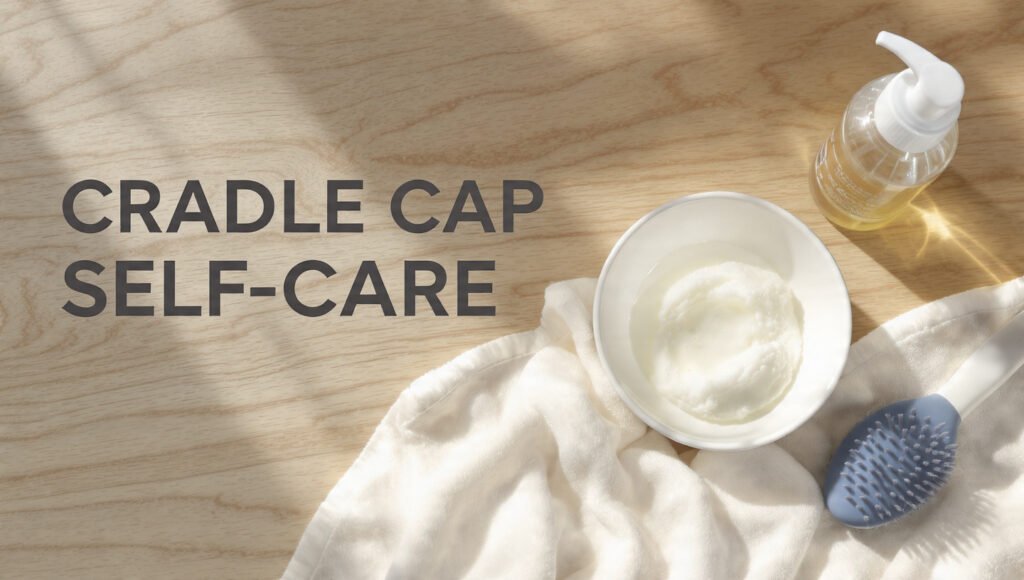
The condition presents as thick, yellowish, greasy scales or crusts that adhere to the vertex of the scalp. Unlike dry skin or eczema, cradle cap scales feel waxy to the touch because they are saturated with sebum (skin oil). In some cases, you might see a mild pinkish rash underneath the scales, but generally, the surrounding skin looks normal.
Key Takeaway: Cradle cap is a buildup of oil and dead skin cells, not a sign of an allergy or infection. It is a self-limiting condition, meaning it usually resolves on its own, but self-care techniques can speed up the process significantly.
Is Cradle Cap Dangerous for My Newborn?
Cradle cap is completely harmless to your baby’s health and development, and it does not cause pain or itching.
Health authorities like the Cleveland Clinic explicitly state that cradle cap has no negative effects on a baby’s eating or sleeping habits . Because the scales are essentially dried oil and shed skin, they do not represent an open wound or an active infection. Your baby cannot “catch” cradle cap from another baby, and it does not mean you are failing at hygiene.
However, if the condition is ignored to the point where the scales become very thick and matted, it can create a trap for moisture and bacteria. This is rare. For most infants, cradle cap is purely a cosmetic nuisance for the parents, not a medical issue for the child.
Why Do Babies Get Cradle Cap? The Yeast and Oil Connection
Babies develop cradle cap due to a perfect storm of maternal hormones and a specific skin fungus called Malassezia.
Before birth, babies receive a surge of maternal androgens (hormones). After birth, these hormones stimulate the infant’s sebaceous glands to go into overdrive, producing too much sebum. At the same time, a yeast called Malassezia globosa, which lives naturally on everyone’s skin, feeds on this excess oil. The yeast breaks down triglycerides in the sebum, leaving behind irritating fatty acids. This metabolic byproduct causes the skin cells to clump together into the greasy scales you see.
According to a 2023 review in the Journal of the American Academy of Dermatology, this reaction is a normal part of infant skin maturation and not an immune deficiency.
Key Takeaway: You cannot prevent the hormone surge or remove Malassezia permanently. Your self-care goal is to remove the “food source” (oil buildup) and the “waste product” (scales).
The First Rule of Cradle Cap Self-Care: Do Not Pick the Scales
The single most important rule in cradle cap self-care is to never pick or scratch the scales off with your fingernails.
Picking at the scales creates micro-tears in the stratum corneum (the top protective layer of the skin). While a scale is inert, the skin underneath is often slightly damp or sensitive. If you forcibly rip the scale off, you break the skin barrier. This opens a pathway for bacteria to enter, potentially turning a benign cosmetic issue into a case of secondary cellulitis or impetigo.
If you pick the scales and cause bleeding or weeping, stop home care and consult your pediatrician. Gentle removal is the goal. If a scale does not come off with a soft brush or a light touch, it is not ready to come off. Leave it and try the softening process again tomorrow.
Softening the Scales: Choosing the Right Oil for Overnight Treatment
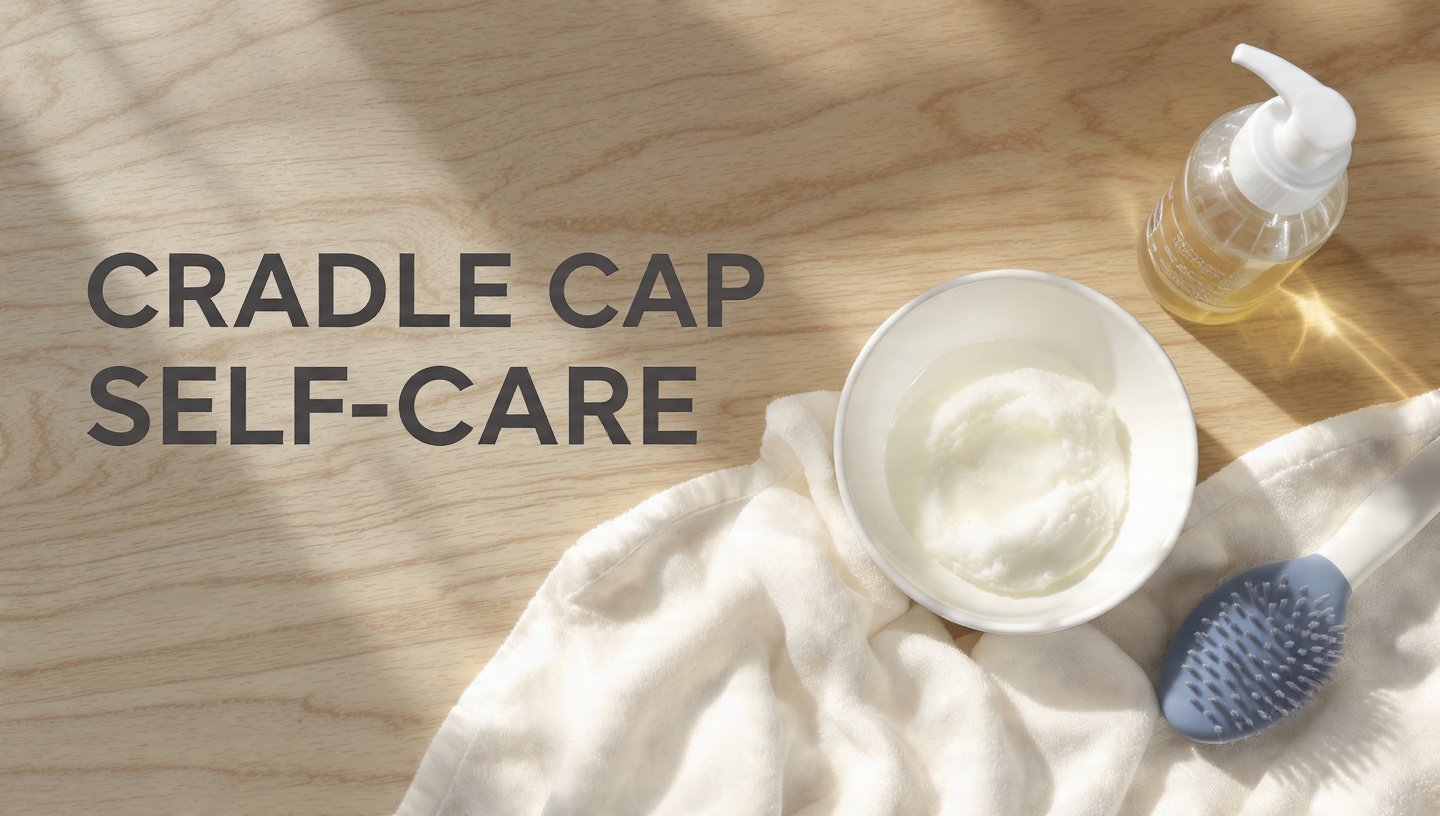
To remove scales without injury, you must first dissolve the glue holding them down using an occlusive oil.
You should apply a thin layer of oil to the scalp about one hour before bathing, or you can leave it on overnight. The oil works by penetrating between the scale and the scalp, loosening the adhesion.
Choosing your oil:
- Mineral Oil (Paraffinum Liquidum) or Baby Oil: This is the gold standard recommended by dermatologists, including the AAD . It is hypoallergenic, non-comedogenic (does not clog pores), and cannot spoil.
- Petroleum Jelly: An excellent occlusive, but thick and hard to wash out without multiple shampoo cycles.
- Coconut Oil: A popular natural alternative. It has antimicrobial properties, but it is comedogenic and can trigger allergic reactions in infants sensitive to tree nuts. The American Academy of Pediatrics suggests caution, though it is generally safe if no allergy exists .
- Olive Oil: Avoid. A 2020 study suggested that olive oil can damage the skin barrier in infants because it is high in oleic acid, which can disrupt the stratum corneum.
Key Takeaway: Mineral oil is the safest, most effective, and most research-backed choice for softening cradle cap scales.
Step-by-Step: How to Wash Your Baby’s Scalp Correctly
Once the scales are softened, washing mechanically lifts them away. Here is the precise 2026 washing protocol.
Step 1: Apply Oil
Massage a teaspoon of mineral oil into the scalp. Leave for 60 minutes or overnight.
Step 2: Wet the Scalp
Use lukewarm water. Do not submerge the baby if the oil makes them slippery; lean them back over the sink or use a reclining bath seat.
Step 3: Shampoo Application
Apply a drop of mild, fragrance-free baby shampoo directly to the wet scalp. Use the pads of your fingers (not nails) to rub in circular motions. Do this for 2 minutes to emulsify the oil.
Step 4: Rinse Thoroughly
Rinse completely. Leftover oil can actually make cradle cap worse by feeding the yeast. Rinse until the water runs clear and the hair no longer feels slick.
Step 5: Gently Brush
With the hair still wet and soapy, use a soft brush to lift the now-loosened scales. They should lift easily.
Step 6: Final Rinse and Dry
Rinse one last time and pat dry with a soft towel.
The Best Tools for Removing Cradle Cap Scales (Brush vs. Comb)
Using the correct tool prevents scalp damage. You have three main options, each with a specific use case.
| Tool Type | Best For | Usage Tip |
|---|---|---|
| Soft Bristle Brush | Daily maintenance & mild scales | Use while shampooing. Circular motions. |
| Silicone Finger Brush | Moderate scales & massage | Gentle on fontanelles; easy to sanitize. |
| Fine-Toothed Plastic Comb | Stubborn, thick plaques | Use AFTER oiling. Comb gently from root to tip. Never force. |
| Metal Combs | Do Not Use | Too sharp for an infant’s thin scalp skin. |
If you use a comb, hold it at a 45-degree angle. If you meet resistance, stop. Do not saw back and forth. The goal is to catch scales that are already floating free, not to scrape them off the living skin.
Choosing the Right Shampoo: Why Fragrance-Free Matters
The shampoo you choose is critical for treatment success and safety. You must avoid irritating the scalp.
Standard “adult” shampoos are too harsh. They have a pH of 5.5, whereas infant scalp pH is closer to neutral (6.5 to 7). Using high-pH or heavily fragranced shampoos can strip the natural lipids, worsening the irritation.
Look for:
- Fragrance-Free/Unscented: Fragrance is the number one cause of allergic contact dermatitis in infants.
- Tear-Free Surfactants: Look for ingredients like Decyl Glucoside or Lauryl Glucoside (mild glucosides) rather than Sodium Lauryl Sulfate (SLS).
- No Medicated Ingredients (yet): Do not use ketoconazole or selenium sulfide shampoos unless a doctor tells you to.
If basic baby shampoo isn’t working after 2 weeks, the AAD suggests looking for a shampoo specifically labeled “for cradle cap” containing salicylic acid or sulfur, but only use these as directed .
Key Takeaway: Fragrance-free, SLS-free baby shampoo used daily is the most effective non-medicated treatment.
How Long Does Cradle Cap Last? A Realistic Timeline
If you start active self-care, you will see results in days, but the condition can last for months.
- With Daily Treatment: You will likely see a 70% reduction in visible scales within 5 to 7 days. However, the scales may return until the underlying oil production slows down.
- Without Treatment: The condition typically clears up completely on its own between 6 and 12 months of age .
- Recurrence: Even after a clear scalp, cradle cap can flare up again at 2 or 3 months old. Do not be discouraged. Resume the washing and oil routine for a few days.
For a small percentage of toddlers, mild seborrheic dermatitis persists until age 2 or 3. If your child is over 2 and still has thick plaques, you should consult a dermatologist to rule out other conditions like psoriasis.
When Cradle Cap Spreads: Seborrheic Dermatitis on the Face and Body
Cradle cap often does not stay on the scalp. You may find similar yellow scales behind the ears, on the eyebrows, or in the diaper area.
When this rash appears off the scalp, it is clinically referred to as seborrheic dermatitis. The treatment is similar but requires more caution on delicate facial skin.
- Behind the Ears: This area cracks easily. Apply mineral oil on a cotton ball to soften, then wipe away.
- Eyebrows: Be extremely careful. Do not get oil or soap in the eyes. Use a wet, soft washcloth to gently wipe outward.
- Diaper Area: If a red rash with yellow scales appears in the groin, it may be mixed with yeast diaper rash. You usually need an antifungal cream (like clotrimazole) for this specific area, prescribed by your pediatrician.
When to See a Doctor for Cradle Cap (Signs of Infection)
While cradle cap is harmless, complications are not. You need to stop self-care and see a pediatrician immediately if specific signs appear.
The Red Flags:
- Weeping or Oozing: If the scalp is wet, sticky, or has honey-colored crusts, this is likely a bacterial infection (impetigo).
- Spreading Redness: If the redness extends beyond the scale edges and feels warm to the touch.
- Swollen Lymph Nodes: If you feel a lump behind the baby’s ear (posterior auricular lymph node).
- Hair Loss in Patches: While hair comes off with the scale, if there are round, bald spots without scales, that suggests tinea capitis (ringworm), not cradle cap.
- Fever or Irritability: A fever with a scalp rash is never cradle cap.
According to Drugs.com, if you see these signs, do not apply over-the-counter hydrocortisone or antifungals without a doctor’s order, as these can mask the infection or worsen fungal overgrowth .
Key Takeaway: Crusting + oozing = Doctor visit. Dry scales = Home care.
Can Older Kids Get Cradle Cap? (Seborrheic Dermatitis in Toddlers)
Most sources say cradle cap ends at age 1, but in reality, seborrheic dermatitis can persist or appear in children aged 2 to 5.
Toddler seborrheic dermatitis looks different than infant cradle cap. It is less greasy and more flaky, resembling severe dandruff. It often appears in the “scalp line” (the hair margin at the forehead) and behind the ears.
For a toddler:
- Continue using gentle, fragrance-free baby shampoo.
- If it persists, a pediatric dermatologist may approve a low-strength ketoconazole 2% shampoo once a week.
- You must rule out atopic dermatitis (eczema) , which is itchy, versus seborrheic dermatitis, which is usually not itchy.
Preventing Cradle Cap Recurrence: Maintenance Routines
Once the scalp is clear, you can stop the intensive oil treatments, but you must adjust your routine to prevent relapse.
The Prevention Protocol:
- Frequency: Wash your baby’s hair 3 times a week. Waiting longer than 3 days allows oil to build up again.
- Brushing: Give the scalp a 60-second dry brush massage every morning. This stimulates circulation and mechanically disrupts any early scale formation.
- Watch the Diet: For older babies starting solids, cradle cap is not triggered by food. Do not eliminate foods to treat the scalp.
If you see the first sign of a yellow flake returning, do one overnight oil treatment immediately. Nipping it in the bud prevents the thick crust from reforming.
The Parental Mindset: Self-Care for You, Not Just the Baby
Cradle cap self-care is as much about managing your own anxiety as it is about the baby’s scalp.
It is easy to feel guilty when you look at your newborn and see a messy, scaly head. You might feel like you aren’t cleaning them well enough. This is false. Cradle cap is hormonal, and you cannot scrub away a hormone imbalance.
Recognize that performing this gentle washing ritual is a form of self-care for you. It gives you a structured, safe way to bond with your baby and “fix” a problem that bothers you. If the process stresses you out (if the baby cries during washing, or you are afraid of the fontanelle), stop. Give yourself permission to leave the cradle cap alone. It will not hurt the baby, and waiting a week to try again is perfectly fine.
Key Takeaway: Your mental health matters. If treating the cradle cap increases your stress, stop treating it. The baby is fine either way.
Frequently Asked Questions About Cradle Cap
Can I use coconut oil on my baby’s cradle cap?
Yes, you can use coconut oil, but mineral oil is safer and more effective. Coconut oil has a higher risk of triggering a contact allergy (especially in babies with eczema) and is comedogenic, meaning it can clog pores. If you use it, patch test on the inner arm first and rinse it out thoroughly.
Does cradle cap cause hair loss in babies?
Cradle cap does not cause permanent hair loss. The hair shaft is attached to the scale, not the root. When the scale falls off, the hair comes with it. The hair follicle remains intact under the skin, and healthy hair will grow back in that spot within a few weeks.
Can I use Selsun Blue or Head and Shoulders on my baby?
Do not use adult dandruff shampoos on an infant unless directed by a healthcare provider. These contain high concentrations of selenium sulfide or zinc pyrithione that are too strong for a baby’s thin skin and can be absorbed systemically. If your doctor prescribes a medicated shampoo, they will give you a specific infant-safe dosage schedule.
Is cradle cap related to eczema or allergies?
No. Cradle cap is a condition of the sebaceous glands and Malassezia yeast. Eczema (atopic dermatitis) is an immune barrier dysfunction. Having cradle cap does not increase the risk of developing food allergies or asthma. They are separate pathways, though a baby can have both conditions simultaneously.
How often should I wash my baby’s hair if they have cradle cap?
The American Academy of Dermatology recommends washing as frequently as every other day to soften the scale . If your baby has very sensitive skin or eczema, follow your dermatologist’s advice, but for standard cradle cap, daily washing during active flare-ups is considered safe and effective.
My baby is 2 years old and still has scales, is this normal?
While 80% of cases resolve by 12 months, some toddlers continue to have mild seborrheic dermatitis until age 2 or 3. If your child is otherwise healthy and the scale is not itchy or infected, continue gentle washing. However, if the scale is thick, silver, and itchy, see a dermatologist to rule out psoriasis or tinea capitis.
You now know exactly how to handle cradle cap safely. Start with the oil softening tonight, wash gently tomorrow morning, and watch those scales lift away without stress. Your baby’s skin will clear up, but for now, focus on the gentle routine, not the perfection of the result.