Image Skincare VITAL C: Complete 2026 Ingredient Review
Vitamin C remains one of the most researched ingredients in dermatology, but not all vitamin C serums work the same way. The Image Skincare VITAL C line uses stabilized vitamin C derivatives instead of traditional L-ascorbic acid, which changes how the product interacts with your skin.
The difference between effective vitamin C skincare and wasted money comes down to formulation science. According to a 2025 review published in the Journal of Skin and Stem Cell, L-ascorbic acid demonstrates the most potent direct biological activity but suffers from poor stability and limited skin penetration, while stabilized derivatives offer enhanced stability and lower irritation potential .
This article breaks down exactly what is in the Image Skincare VITAL C serum, how each derivative works at the skin biology level, what the 2026 clinical evidence supports, and whether this formulation makes sense for your specific skin type and concerns.
What Is Image Skincare VITAL C?
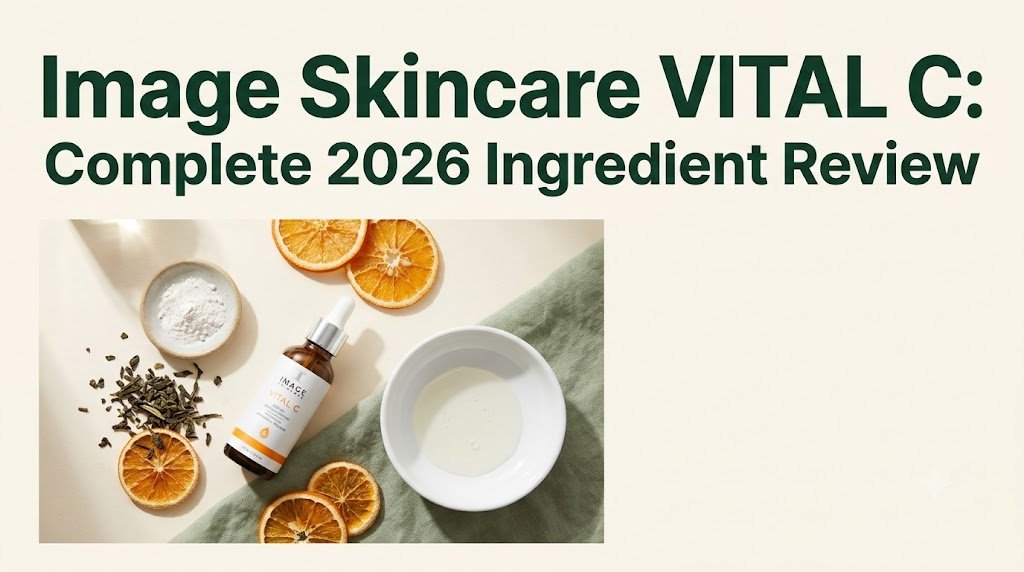
Image Skincare VITAL C is a collection of vitamin C skincare products built around stabilized vitamin C derivatives rather than traditional L-ascorbic acid. The hero product is the VITAL C Hydrating Antioxidant A C E Serum, a multi-vitamin formula that combines two different vitamin C derivatives with vitamin E, green tea extract, and sodium hyaluronate .
The VITAL C line launched over 20 years ago and has undergone multiple formulation updates to improve stability and efficacy . Unlike many vitamin C serums that use L-ascorbic acid at a low pH of 2.0 to 3.5, VITAL C derivatives work at a higher pH closer to skin’s natural level of 5.5. This pH difference makes the product less likely to cause stinging or irritation.
The serum contains three primary antioxidant components: tetrahexyldecyl ascorbate (an oil-soluble vitamin C ester), sodium ascorbyl phosphate (a water-soluble phosphate salt of vitamin C), and tocopheryl acetate (vitamin E) . The formula also includes palmitoyl tripeptide-38 for collagen signaling and centella asiatica extract for soothing properties.
Key Takeaway: The VITAL C serum uses two distinct vitamin C derivatives that penetrate skin through different pathways, potentially offering broader antioxidant coverage than single-derivative formulas.
How Does Vitamin C Work on Skin?
Vitamin C functions as a potent antioxidant that neutralizes reactive oxygen species before they can damage skin cells. When UV radiation or pollution hits your skin, it creates unstable molecules called free radicals that rip electrons from healthy cell structures, starting a chain reaction of damage.
The L-ascorbic acid form of vitamin C donates electrons to these free radicals without becoming destabilized itself. This neutralization process stops oxidative chain reactions that would otherwise damage lipids in cell membranes, proteins like collagen, and DNA within skin cells .
Vitamin C also serves as an essential cofactor for two enzymes your skin needs to build collagen: prolyl hydroxylase and lysyl hydroxylase. These enzymes modify collagen proteins after they are assembled, a step required for proper collagen fiber structure. Without adequate vitamin C, collagen synthesis slows dramatically, leading to weaker skin structure over time.
For hyperpigmentation concerns, vitamin C inhibits the enzyme tyrosinase, which is the first and rate-limiting step in melanin production. By reducing tyrosinase activity, vitamin C slows the formation of new pigment, helping existing dark spots fade as skin naturally turns over.
Key Takeaway: Vitamin C protects skin from environmental damage through free radical neutralization, supports collagen construction through enzyme cofactor functions, and reduces new pigment formation through tyrosinase inhibition.
L-Ascorbic Acid vs Stabilized Vitamin C Derivatives
L-ascorbic acid is the pure, biologically active form of vitamin C that your skin cells can use directly without any conversion. A pivotal 2025 review comparing vitamin C derivatives found that L-AA demonstrates the most potent direct biological activity, but its effectiveness comes with major formulation challenges .
The main problem is stability. L-ascorbic acid oxidizes rapidly when exposed to light, air, or temperatures above room temperature. Once oxidized, the molecule turns yellow or brown and loses all antioxidant activity. L-ascorbic acid also requires a low pH below 3.5 to penetrate the stratum corneum effectively, which causes stinging and irritation for many users.
Stabilized derivatives modify the vitamin C molecule by adding chemical groups that protect it from oxidation. These modifications make the derivatives more stable on the shelf and gentler on skin, but they also mean the derivative must be converted back to L-ascorbic acid by enzymes in your skin to become active .
| Derivative Type | Stability | Skin Penetration | Irritation Potential | Requires Enzymatic Conversion |
|---|---|---|---|---|
| L-Ascorbic Acid | Poor | Good at pH below 3.5 | High | No |
| Tetrahexyldecyl Ascorbate | High | Excellent (oil-soluble) | Low | Yes |
| Sodium Ascorbyl Phosphate | High | Moderate (water-soluble) | Very low | Yes |
| Magnesium Ascorbyl Phosphate | High | Moderate | Very low | Yes |
The tradeoff is immediate potency versus long-term stability. L-ascorbic acid works faster and more directly but degrades quickly and irritates sensitive skin. Derivatives last longer on the shelf and cause fewer reactions but rely on your skin’s enzyme activity to become active.
Key Takeaway: L-ascorbic acid offers the most direct biological activity but degrades easily and causes irritation, while stabilized derivatives trade some immediate potency for better stability and gentler application.
Tetrahexyldecyl Ascorbate: The Oil-Soluble Derivative
Tetrahexyldecyl ascorbate (THD ascorbate) is an oil-soluble ester of vitamin C created by attaching a fatty acid chain to the L-ascorbic acid molecule. This structural modification transforms the water-soluble L-AA into a lipophilic compound that dissolves easily in oils and can penetrate the lipid-rich stratum corneum more effectively .
The fatty acid tail on THD ascorbate allows the molecule to slip between the lipid bilayers that form your skin’s barrier. Water-soluble L-ascorbic acid at low pH relies on creating microscopic channels through the barrier, which can disrupt barrier function. THD ascorbate moves through existing lipid pathways without forcing the barrier open.
Once THD ascorbate reaches the living layers of the epidermis, skin enzymes called esterases cleave off the fatty acid tail, releasing free L-ascorbic acid that cells can use. This two-step process (penetration then conversion) means THD ascorbate can deliver more total vitamin C to living skin cells than L-AA applied at low pH.
For formulation benefits, THD ascorbate remains stable at neutral pH around 5.0 to 7.0, matching skin’s natural pH. It does not oxidize quickly when exposed to air, so the serum stays active longer. The 2025 derivative review notes that lipophilic derivatives including ascorbyl tetraisopalmitate (a similar compound) provide superior skin permeability and sustained antioxidant activity .
Key Takeaway: THD ascorbate penetrates skin through existing lipid pathways at neutral pH, then converts to active vitamin C inside skin cells, offering better delivery with less barrier disruption than L-ascorbic acid.
Sodium Ascorbyl Phosphate: The Water-Soluble Option
Sodium ascorbyl phosphate (SAP) is a water-soluble vitamin C derivative created by attaching a phosphate group to the L-ascorbic acid molecule at the carbon-2 position. This phosphate group protects the active site of the molecule from oxidation, making SAP significantly more stable than L-ascorbic acid .
The phosphate group also changes how SAP interacts with skin. Unlike THD ascorbate which penetrates through lipid pathways, SAP as a water-soluble molecule remains primarily on the skin surface and in the upper layers of the stratum corneum. Research summarized in the 2025 derivative review indicates that SAP shows limited direct antioxidant activity in vitro until it is enzymatically converted to L-ascorbic acid upon skin absorption .
Skin contains phosphatase enzymes that cleave phosphate groups from molecules. When SAP reaches these enzymes in the epidermis, the phosphate group is removed, releasing active L-ascorbic acid. This conversion takes time, which means SAP provides a delayed-release effect rather than immediate antioxidant activity.
For sensitive skin, SAP offers distinct advantages. It remains stable at neutral pH around 7.0, so formulations do not need the low pH that causes L-ascorbic acid stinging. According to the 2025 review, SAP is recognized as a less irritating alternative to L-AA, making it suitable for formulations intended for sensitive skin . The tradeoff is that delayed conversion may result in reduced immediate clinical effects compared to direct L-AA application.
Key Takeaway: SAP provides excellent stability and very low irritation potential by remaining inactive until skin enzymes convert it to L-ascorbic acid, but this delayed activation means results build more slowly.
Full Ingredient Breakdown of VITAL C Serum
The Image Skincare VITAL C Hydrating Antioxidant A C E Serum combines multiple active ingredients beyond just vitamin C derivatives. According to the professional product page, the formula contains the following key components :
Primary vitamin C derivatives:
Tetrahexyldecyl ascorbate (oil-soluble, penetrates lipid layers)
Sodium ascorbyl phosphate (water-soluble, works on surface and upper epidermis)
Supporting antioxidants:
Tocopheryl acetate (vitamin E, stabilizes vitamin C and provides separate antioxidant activity)
Camellia sinensis (green tea) leaf extract (polyphenol antioxidants including epigallocatechin gallate)
Centella asiatica extract (soothes inflammation, supports collagen production)
Hydration and peptide components:
Sodium hyaluronate (humectant that holds 1000 times its weight in water)
Palmitoyl tripeptide-38 (signal peptide that stimulates collagen production)
Glycosaminoglycans (structural molecules that support skin matrix)
Presence of potential irritants:
Citrus aurantium dulcis (orange) peel oil (fragrance component, contains limonene and linalool)
Phenoxyethanol (preservative, safe up to 1% in finished products)
The formula does not disclose exact percentage concentrations for any active ingredient. This lack of transparency is common among professional skincare lines that market to spas and dermatology offices rather than direct-to-consumer channels.
Key Takeaway: The VITAL C serum combines two vitamin C derivatives with vitamin E, green tea polyphenols, peptides, and hyaluronic acid in a fragrance-containing base that may trigger reactions in citrus-sensitive individuals.
How Stabilized Vitamin C Improves Skin Penetration
Stabilized vitamin C derivatives overcome the penetration problems that limit L-ascorbic acid efficacy. The 2025 review on topical vitamin C derivatives explains that L-ascorbic acid carries a negative charge at physiological pH, which repels the negatively charged skin surface, limiting absorption .
Derivatives solve this charge problem through chemical modification. Adding a fatty acid chain (as in THD ascorbate) creates a neutral or positively charged molecule at skin pH, allowing it to move through the stratum corneum’s lipid bilayers without electrical repulsion. The 2025 review notes that lipophilic derivatives provide superior skin permeability compared to water-soluble forms .
The oil solubility of THD ascorbate means it can penetrate through sebum-rich areas that block water-soluble ingredients. The surface of human skin is coated in sebum, a mixture of oils, waxes, and lipids. Water-based serums bead up on this oily surface, limiting contact time and absorption. Oil-soluble derivatives dissolve into the sebum layer and travel with it into the stratum corneum.
Water-soluble derivatives like SAP take a different route. They remain on the skin surface and in the upper stratum corneum, where phosphatase enzymes are present. The conversion to L-ascorbic acid happens in place, and the released L-AA then diffuses downward. This two-compartment model (surface conversion followed by diffusion) explains why SAP takes longer to show effects but eventually delivers active vitamin C to living skin cells .
For consumers who have tried L-ascorbic acid serums that felt sticky or never fully absorbed, stabilized derivatives offer a distinctly different experience. Oil-soluble derivatives feel like lightweight oils, not water, and absorb without the tacky residue common with high-concentration L-AA serums.
Key Takeaway: Stabilized derivatives penetrate skin better than L-ascorbic acid by either dissolving into the sebum layer (oil-soluble forms) or converting to active vitamin C directly on the skin surface (water-soluble forms).
Should You Use Vitamin C Serum in the Morning or at Night?
Morning application is the evidence-supported choice for vitamin C serums, including the VITAL C line. The primary function of topical vitamin C is to neutralize reactive oxygen species generated by UV exposure, which occurs during daytime hours.
A 2026 clinical trial presented at the American Academy of Dermatology Annual Meeting demonstrated that antioxidant formulations containing vitamin C reduced lipid peroxidation markers by over 70% in keratinocytes exposed to UV radiation . This protective effect matters most during daylight when UV exposure happens.
Applying vitamin C in the morning allows the antioxidant to accumulate in the stratum corneum and upper epidermis before UV exposure begins. Research on L-ascorbic acid penetration found that skin concentrations reach saturation after three days of daily application, with a half-life of approximately four days . This means consistent daily morning use builds and maintains skin protection.
Nighttime application is not harmful, but it misses the timing advantage. Vitamin C does provide separate benefits that support overnight repair, including collagen synthesis support and tyrosinase inhibition. However, these processes happen regardless of application timing as long as consistent daily use is maintained.
For the VITAL C serum specifically, morning application makes even more sense because the product contains multiple antioxidants (vitamin C derivatives plus vitamin E and green tea polyphenols) that work synergistically to neutralize daytime environmental stressors. Layering SPF over a morning vitamin C application provides the evidence-based combination for photoprotection.
| Application Time | Primary Benefit | Supporting Evidence |
|---|---|---|
| Morning | UV protection, pollution defense, free radical neutralization | AAD 2026 study showed 70% reduction in lipid peroxidation markers |
| Night | Collagen synthesis support, pigment inhibition | Theoretical benefit without timing-specific research |
| Both | Maximum antioxidant coverage | May increase irritation risk with some formulations |
Key Takeaway: Apply VITAL C serum in the morning before SPF to take advantage of its free radical neutralization during daytime UV exposure, following the evidence-based approach supported by dermatological research.
Layering VITAL C With Vitamin E and Other Antioxidants
Vitamin C and vitamin E work as a team, not just as separate ingredients. When vitamin C neutralizes a free radical, it becomes oxidized and temporarily inactive. Vitamin E can restore oxidized vitamin C back to its active form, creating a recycling loop that extends antioxidant protection .
The VITAL C serum already contains tocopheryl acetate (vitamin E) in the same formula, so the recycling pair is built into the product. You do not need to layer a separate vitamin E product to get this synergistic effect. The formulation places both vitamins in the same delivery vehicle, ensuring they reach the skin together.
Research presented in a 2026 split-face clinical trial published in Clinical, Cosmetic and Investigational Dermatology showed that combining vitamin C with vitamin E and ferulic acid produced significantly greater improvements in photoaging than microneedling alone . The antioxidant serum used in that trial contained 15% L-ascorbic acid, 1% vitamin E, and 0.5% ferulic acid.
For layering order with the VITAL C serum:
Apply to clean, dry skin after cleansing and before any water-based toners or essences have fully dried
Allow the serum to absorb for 60 to 90 seconds before applying moisturizer
Finish with broad-spectrum SPF 30 or higher in the morning
Do not layer VITAL C with high-concentration L-ascorbic acid serums. The pH difference between the stabilized derivatives (neutral pH) and L-AA (pH 2.0 to 3.5) can cause instability when products mix on the skin. Choose one form and use it consistently rather than combining.
Quick Tip:
The antioxidant synergy pyramid works from lowest to highest pH: Apply low-pH L-ascorbic acid first if using it, then wait 3-5 minutes. Apply neutral-pH stabilized derivatives like VITAL C next. Finish with vitamin E-rich moisturizers and SPF. For VITAL C alone, it applies at step two after any exfoliating acids and before moisturizer.
Key Takeaway: VITAL C already contains the vitamin C and vitamin E pairing needed for antioxidant recycling, so you do not need additional layering beyond the serum itself followed by moisturizer and SPF.
Can Sensitive Skin Tolerate Vitamin C Derivatives?
Sensitive skin often cannot tolerate traditional L-ascorbic acid serums because the low pH required for penetration (2.0 to 3.5) directly irritates the stratum corneum and triggers stinging, redness, and peeling. Stabilized vitamin C derivatives solve this problem by working effectively at neutral pH.
According to the 2025 derivative review, magnesium ascorbyl phosphate and sodium ascorbyl phosphate are recognized as less irritating alternatives to L-ascorbic acid, suitable for formulations intended for sensitive skin . Both are phosphate salts that remain stable at pH 7.0, matching skin’s natural pH.
The VITAL C serum contains sodium ascorbyl phosphate, which has a very low irritation profile, but it also contains fragrance components that may trigger sensitivity. The ingredient list shows citrus aurantium dulcis (orange) peel oil, which contains limonene and linalool . These are known contact allergens that cause reactions in sensitized individuals.
For truly sensitive skin or diagnosed contact dermatitis, the fragrance in VITAL C presents a higher risk than the vitamin C derivatives. The National Eczema Association has approved some vitamin C serums specifically because they are fragrance-free, such as the Skinfix Brighten + Firm 15% Vitamin C Serum launched in late 2025 . VITAL C does not carry this approval.
| Skin Sensitivity Level | Can Use VITAL C? | Precautions Needed |
|---|---|---|
| Mildly sensitive (occasional stinging) | Yes | Patch test for 7 days on inner arm |
| Reactive to fragrance or citrus oils | No | Seek fragrance-free vitamin C alternatives |
| Compromised barrier (active eczema flare) | No | Repair barrier first with ceramides and occlusives |
| Diagnosed contact dermatitis | No | Require patch testing by dermatologist |
Key Takeaway: The vitamin C derivatives in VITAL C are gentle, but the added fragrance oils (limonene, linalool from orange peel) make this product unsuitable for fragrance-sensitive individuals or anyone with diagnosed contact dermatitis.
What Clinical Evidence Supports Vitamin C Derivatives in 2026?
The 2025 peer-reviewed article in the Journal of Skin and Stem Cell provides the most comprehensive recent comparison of vitamin C derivatives for cosmetic use. The review systematically evaluated stability profiles, solubility, dermal absorption, and biological activity across multiple derivative types .
Key findings from the 2025 review:
L-ascorbic acid shows the most potent direct biological activity but is constrained by poor stability and limited skin penetration
Water-soluble derivatives (MAP, SAP) offer enhanced stability and lower irritation potential but require enzymatic activation
Lipophilic derivatives (ascorbyl tetraisopalmitate, THD ascorbate) provide superior skin permeability and sustained antioxidant activity
No single derivative is universally superior; optimal selection depends on formulation objectives
A 2026 double-blinded split-face clinical trial published in Dove Medical Press evaluated a topical antioxidant serum containing vitamins C, E, and ferulic acid combined with microneedling for facial photoaging . Results showed significant improvements in skin elasticity (39.0% vs 6.8% with placebo), melanin index reduction (21.3% vs 3.4%), and global aesthetic improvement (89.3% achieving marked improvement vs 7.1% with placebo).
A 2026 study presented at the American Academy of Dermatology Annual Meeting examined an antioxidant serum containing vitamin C, feverfew, and epigallocatechin gallate . Results showed:
Lipid peroxidation decreased by over 70% in keratinocytes and nearly 90% in fibroblasts
Transepithelial electrical resistance increased by 45.2% following UV exposure, indicating improved barrier function
The serum preserved filaggrin expression, a key protein for barrier integrity
Key Takeaway: 2025 and 2026 research confirms that vitamin C derivatives provide genuine antioxidant protection, with lipophilic forms showing superior skin penetration and combination formulas with vitamin E producing enhanced results.
Who Should Choose Stabilized Vitamin C Over L-Ascorbic Acid?
Stabilized vitamin C derivatives make sense for specific skin types and situations where traditional L-ascorbic acid creates problems. The choice depends on your skin’s tolerance, your storage conditions, and your expectations for visible results.
Choose stabilized derivatives (THD ascorbate, SAP, MAP) if:
You have sensitive skin that stings or reddens with L-ascorbic acid serums
You cannot store products in a cool, dark place away from bathroom heat and humidity
You want a serum you can use once daily without worrying about oxidation within 3 months
You have dry or dehydrated skin that does not tolerate low-pH products
You prefer a serum that layers smoothly under makeup without tackiness
Choose L-ascorbic acid if:
You have tolerant, oilier skin that handles low pH without irritation
You are willing to replace the serum every 3 months or store it in the refrigerator
You want the fastest possible visible results for brightening
You are using the serum primarily for collagen support with tolerance established
The 2025 review notes that L-AA demonstrates the most potent direct biological activity but requires careful formulation with low pH and opaque packaging to maintain stability . For most consumers who do not want to refrigerate their skincare or monitor for oxidation color changes, stabilized derivatives offer a more user-friendly option.
Evidence quality for stabilized derivatives: Supported by clinical studies showing conversion to active L-ascorbic acid in skin and antioxidant effects in human trials. However, fewer direct comparison trials exist between THD ascorbate and L-AA at equivalent concentrations.
Key Takeaway: Choose stabilized vitamin C derivatives if you have sensitive skin, cannot refrigerate your products, or want a low-maintenance routine. Choose L-ascorbic acid if your skin tolerates low pH and you prioritize maximum immediate potency.
How to Choose a Vitamin C Serum by Derivative Type
Reading a vitamin C serum ingredient list requires knowing what each derivative name means and what it delivers. The INCI name tells you the derivative type, which predicts stability, penetration, and irritation potential.
Look for these ingredients on labels:
Tetrahexyldecyl ascorbate (THD ascorbate): Oil-soluble, excellent penetration, stable at neutral pH, converts to L-AA after absorption. Best for dry or mature skin that needs deep antioxidant delivery.
Sodium ascorbyl phosphate (SAP): Water-soluble, very stable, requires enzymatic conversion, works well for sensitive skin and acne-prone skin (some evidence for antibacterial effects). Best for normal to combination skin.
Magnesium ascorbyl phosphate (MAP): Water-soluble, stable, converts to L-AA in skin, supports collagen synthesis. Best for sensitive skin, similar to SAP.
3-O-Ethyl ascorbic acid: Water-soluble, more stable than L-AA, directly active without conversion, penetrates well. Best for those who want L-AA-like activity with better stability.
Ascorbyl tetraisopalmitate: Oil-soluble, very stable, excellent penetration. Best for very dry or barrier-compromised skin.
Red flags on labels:
L-ascorbic acid listed in a clear bottle (will oxidize rapidly)
L-ascorbic acid with water as the first ingredient but no stabilizers like ferulic acid or vitamin E
No pH disclosure on packaging (effective L-AA requires pH below 3.5)
Vitamin C serum that has turned yellow or brown (already oxidized, discard)
For the VITAL C serum specifically, the label lists two derivatives: tetrahexyldecyl ascorbate and sodium ascorbyl phosphate . This combination provides both oil-soluble deep penetration (THD) and water-soluble surface activity (SAP), a formulation strategy that may offer broader antioxidant coverage than either derivative alone.
Key Takeaway: Match the derivative type to your skin type: THD ascorbate for dry/mature skin, SAP for sensitive or acne-prone skin, and L-ascorbic acid only if your skin tolerates low pH and you can store it properly.
Vitamin C Antioxidant Protection and Collagen Support
The two primary evidence-supported benefits of topical vitamin C are antioxidant protection against environmental damage and collagen synthesis support. Each benefit operates through distinct biological mechanisms.
For antioxidant protection, vitamin C neutralizes reactive oxygen species (ROS) generated by UV exposure before they can damage cellular structures. A 2026 AAD study found that a vitamin C-containing antioxidant serum reduced lipid peroxidation by over 70% in keratinocytes, meaning significantly less oxidative damage to skin cell membranes . This protection is dose-dependent and requires consistent daily application.
For collagen support, vitamin C serves as an essential cofactor for prolyl hydroxylase and lysyl hydroxylase, the enzymes that stabilize collagen molecules after they are assembled. Without adequate vitamin C, these enzymes cannot function, and newly synthesized collagen collapses into unusable forms. The 2025 derivative review confirms that in vitro studies on human dermal fibroblasts show L-AA enhances collagen synthesis, promotes fibroblast proliferation, and inhibits melanogenesis .
The concentration needed for each benefit differs. A pivotal in vivo study by Pinnell et al. demonstrated that the greatest increase in skin concentration of L-AA occurs with a 15% to 20% solution applied at pH 2.0 to 3.5, with decreasing absorption above 20% . For stabilized derivatives, conversion efficiency affects the final L-AA concentration delivered to living skin cells.
For the VITAL C serum, the exact concentration of each derivative is not disclosed. Based on industry formulation standards for THD ascorbate and SAP in professional skincare lines, estimated total vitamin C derivative concentration is likely between 5% and 10%. This is lower than the 15-20% effective range for L-AA but may achieve comparable delivered L-AA through better penetration efficiency.
Key Takeaway: Vitamin C provides two distinct evidence-backed benefits: antioxidant protection against UV and pollution damage, plus enzymatic support for collagen synthesis. Both require consistent daily use.
Frequently Asked Questions About Image Skincare VITAL C
Can you use Image Skincare VITAL C with retinol?
Yes, but use them at different times of day. Apply VITAL C serum in the morning for antioxidant protection, then use retinol products in the evening. The VITAL C line is formulated to be compatible with Image Skincare’s AGELESS+ retinol products when used in separate routines .
Is VITAL C safe for acne-prone skin?
Sodium ascorbyl phosphate, one of the derivatives in VITAL C, has shown some evidence of antibacterial effects against Cutibacterium acnes. However, the formula also contains multiple oils and fragrance components that may clog pores or irritate acne-prone skin. Patch test before full-face application.
How long does it take to see results from VITAL C serum?
According to Image Skincare’s published claims, 100% of participants in their internal study agreed the serum hydrates and smooths skin, with 89% reporting brighter skin after four weeks . For collagen-related results like fine line reduction, allow 8 to 12 weeks of consistent daily use.
Can you use VITAL C while pregnant or nursing?
The FDA classifies topical vitamin C as Generally Recognized as Safe, but consult your obstetrician before adding any new active skincare products during pregnancy. The fragrance components (limonene, linalool) are not known to pose pregnancy-specific risks, but some clinicians recommend fragrance-free products during pregnancy due to heightened skin sensitivity.
Does VITAL C need to be refrigerated?
No. The stabilized vitamin C derivatives in VITAL C are significantly more stable than L-ascorbic acid and do not require refrigeration. Store at room temperature away from direct sunlight and keep the bottle tightly closed when not in use.
What is the difference between VITAL C and traditional L-ascorbic acid serums?
VITAL C uses oil-soluble tetrahexyldecyl ascorbate and water-soluble sodium ascorbyl phosphate instead of L-ascorbic acid. This means the serum works at neutral pH (less stinging), remains stable without refrigeration, and penetrates skin through lipid pathways rather than forcing the barrier open. The tradeoff is that the derivatives require enzymatic conversion to become active, so results may build more slowly than with high-concentration L-AA.
The choice between stabilized vitamin C derivatives and traditional L-ascorbic acid comes down to your skin’s tolerance and your willingness to manage storage and oxidation concerns. Image Skincare VITAL C offers a well-formulated derivative-based option that solves the stability and irritation problems of L-AA, but the added fragrance means it is not for everyone.
If your skin reacts to low-pH L-ascorbic acid serums with stinging or redness, VITAL C is worth trying. Apply it every morning to clean, dry skin, let it absorb for 60 seconds, then follow with moisturizer and SPF. Give it a full 12 weeks of consistent use before deciding whether the brightening and hydrating effects meet your expectations.
For fragrance-sensitive individuals or anyone with diagnosed contact dermatitis, look for a stabilized vitamin C serum without citrus oils or limonene. The vitamin C derivatives themselves are gentle. The fragrance is not.
What matters most is consistent daily use of some form of topical vitamin C, whether derivative-based or pure L-ascorbic acid. Your skin’s collagen production and antioxidant defenses depend on it.