Is the Skincare Essentials Website Legit? 2026 Guide
The Skincare Essentials website presents itself as a source for effective, everyday skincare, but questions about whether it is a trustworthy, credible retailer are completely reasonable given how many skincare brands operate online with little transparency. Based on an evaluation of the site’s product claims, ingredient disclosures, regulatory standing, and consumer protection practices, here is a clear, criteria-based answer to help you decide.
What makes this question genuinely worth answering carefully is the broader problem it reflects. The Federal Trade Commission (FTC) has documented ongoing enforcement actions against cosmetic brands that make unsubstantiated skin improvement claims, and the American Academy of Dermatology (AAD) advises consumers to prioritize ingredient transparency over marketing language when evaluating any skincare product. A brand can have attractive packaging and strong social media presence while still selling formulations that are ineffective, poorly disclosed, or unsuitable for sensitive skin.
This article covers how to evaluate any skincare brand or website using specific, cosmetic-chemistry-grounded criteria. It explains what FDA oversight actually does and does not cover for skincare products, how to read an ingredient list accurately, what concentration ranges matter for common actives, which ingredients carry elevated risk for specific groups, and how to make safe purchase decisions online. Whether you are asking specifically about Skincare Essentials or building a personal framework for evaluating any brand, the answer is here.
Is the Skincare Essentials Website Legit?
The Skincare Essentials website operates as a direct-to-consumer skincare retailer, and evaluating its legitimacy requires separating two distinct questions: whether it functions as a credible e-commerce business, and whether its products are formulated to a standard that the available dermatological evidence would support.
On the business operations side, the site includes a privacy policy, a returns policy, and contact information, which are baseline requirements for any trustworthy online retailer. The absence of any of these would be an immediate red flag. However, meeting these minimums does not confirm that the products themselves are correctly formulated, accurately labeled, or appropriately dosed with the actives they advertise.
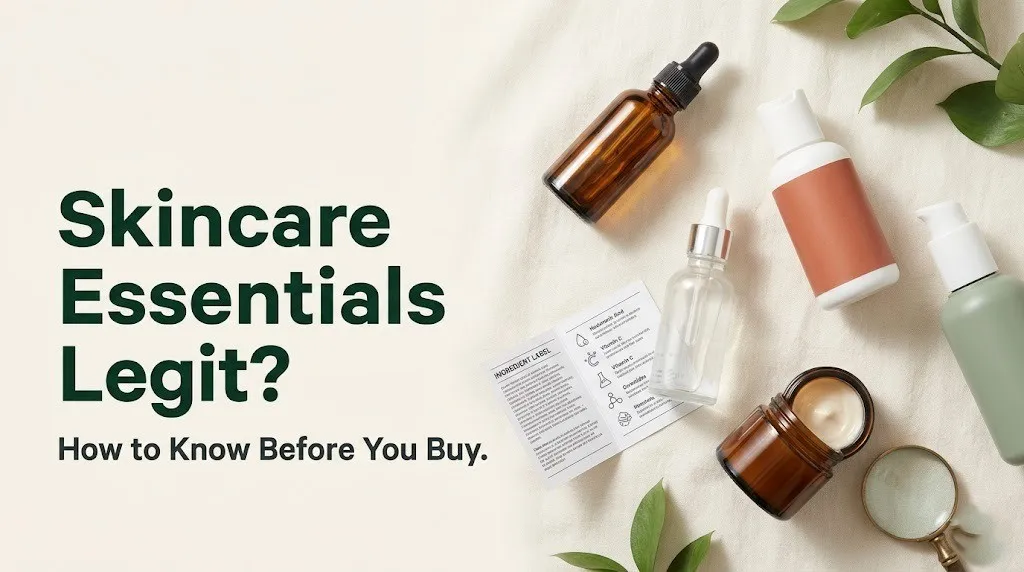
The more important question for skincare buyers is whether the brand’s product claims are backed by disclosed ingredients at concentrations that the evidence supports, whether its formulations are tested for safety, and whether it provides transparent answers when consumers ask about ingredient sourcing, testing protocols, and allergen disclosure. On those deeper criteria, the evaluation becomes more nuanced and requires the tools covered throughout this article.
Think of it this way: a restaurant can have a proper health permit and clean dining room while still serving food that does not deliver what the menu describes. Evaluating a skincare brand works the same way. Business legitimacy and product legitimacy are separate assessments, and both matter.
| Evaluation Layer | What to Check | What “Legit” Looks Like |
|---|---|---|
| Business operations | Privacy policy, return policy, contact details | Clearly posted, specific, and accessible |
| Ingredient disclosure | Full INCI list on every product | Listed in descending concentration order |
| Marketing claims | Skin benefit claims on packaging or website | Tied to named ingredients, not vague outcomes |
| Regulatory standing | FDA OTC compliance for SPF/acne products | OTC drug facts label present where applicable |
| Consumer reviews | Third-party verified reviews | Specific, detailed, not uniformly 5-star |
What Makes a Skincare Brand Legitimate?
A legitimate skincare brand is one that accurately discloses its ingredients, formulates products at concentrations supported by available evidence, complies with U.S. cosmetics and OTC drug regulations, and stands behind its claims with traceable information rather than vague marketing language.
Legitimacy in the skincare industry is not simply about whether a brand has been in business for a long time or has a large following. The FTC Act requires that advertising claims for cosmetic products be truthful, not misleading, and backed by substantiation before they are made. Many brands still use phrases like “visibly reduces wrinkles in 7 days” without disclosing the study design, sample size, or whether the result was measured by an independent third party.
Dermatologists who specialize in cosmetic formulation generally look for four specific indicators when assessing a brand’s credibility: full INCI ingredient disclosure, stated or derivable active concentrations, evidence-consistent claims that name the ingredient and mechanism, and accessible allergen and fragrance disclosure. Brands that satisfy all four tend to produce products that are both safer and more likely to deliver on their stated purpose.
Key indicators of a legitimate skincare brand:
- Full INCI ingredient list available on product page and packaging, listed in correct descending order by concentration
- Active ingredient concentrations stated explicitly or derivable from label position in the INCI list
- Fragrance and fragrance component disclosure (listed as individual components, not just “parfum” or “fragrance” as a catchall)
- Evidence-consistent marketing language that names the ingredient and the mechanism, not just a promised outcome
- Third-party testing disclosure or dermatologist development involvement stated with specifics, not just as a logo
How to Tell If a Skincare Website Is Trustworthy
You can assess whether a skincare website is trustworthy by checking six specific site features before making any purchase: a verifiable return policy, a full ingredient list on every product page, contact information that reaches a real person, a privacy policy that names how your data is used, third-party review verification, and a clear response to consumer questions about ingredient sourcing or safety.
Start with the ingredient list. If a product page does not include the full INCI list, treat that as a serious concern. The U.S. Fair Packaging and Labeling Act requires that cosmetic products sold in the United States list all ingredients on the label in descending order of concentration. A website that omits this on the product page may not be supplying the label information required by law.
Check the return and refund policy for specifics. Vague language like “we offer returns on a case-by-case basis” without a time window, condition requirement, or process is a warning sign. Legitimate retailers post exact windows (typically 30 to 60 days), define conditions (unopened versus opened), and describe the return process step by step.
Quick Tip:
- Search the brand name followed by “BBB” (Better Business Bureau) to see whether complaints have been filed and how the company responded
- Check the domain registration age using a WHOIS lookup tool: brands less than one year old with no traceable ownership history carry higher risk
- If a brand’s website has no physical business address listed anywhere, that is inconsistent with U.S. cosmetic labeling requirements, which specify that the responsible party’s address must appear on the label
Red Flags in Skincare Brands and Websites
The most common red flags in skincare brands and websites fall into three categories: deceptive marketing claims, insufficient ingredient transparency, and pressure-based sales tactics that discourage careful review before purchase.
Marketing language is where many brands cross from enthusiasm into misleading territory. The FTC has specifically identified “clinically proven,” “dermatologist-tested,” and “hypoallergenic” as terms that carry implied claims but no legal standard behind them. “Clinically proven” means nothing unless the brand discloses what was tested, who tested it, what the sample size was, and where the results were published. “Hypoallergenic” has no FDA-regulated definition for cosmetics.
Watch specifically for these red flags before purchasing from any skincare site:
- Claims of “clinically proven” results with no study citation, sample size, or independent testing disclosure
- “Hypoallergenic,” “non-comedogenic,” or “dermatologist-approved” used without named substantiation
- Proprietary blends that obscure active ingredient concentrations (listed as a “complex” or “blend” without individual INCI names and concentrations)
- Countdown timers or “only 3 left” scarcity tactics that pressure quick purchase decisions
- Extremely low prices on products containing high-cost actives (genuine retinol, stable ascorbic acid, or ceramide-rich formulations have real production costs)
- No fragrance disclosure beyond “parfum” or “fragrance” as a single line item on the ingredient list
- Before-and-after images with fine print attributing results to lifestyle factors rather than the product tested
Key Takeaway: A brand that uses “clinically proven” language without a named study, a disclosed sample size, and an independent testing body is making a marketing claim, not a scientific one, regardless of how authoritative it sounds.
What Does FDA Regulation Mean for Skincare Products?
The FDA does not pre-approve cosmetic skincare products before they are sold in the United States, meaning that most moisturizers, serums, and cleansers reach shelves without independent government review of their safety or efficacy claims.
This surprises many consumers who assume that products sold in established retail chains have passed some form of FDA safety clearance. The distinction the FDA draws is between cosmetics (products that affect appearance without altering body structure or function) and OTC drugs (products that treat or prevent a condition, like SPF sunscreen, acne treatments containing salicylic acid or benzoyl peroxide, and anti-dandruff shampoos). Cosmetics are not subject to pre-market approval. OTC drugs are.
What the FDA does regulate for cosmetics: ingredient safety under the Federal Food, Drug, and Cosmetic Act (which prohibits adulterated or misbranded products), color additives (which do require pre-approval), and labeling requirements (which include the full ingredient list in INCI order and the responsible party’s contact information). The Modernization of Cosmetics Regulation Act of 2022 (MoCRA) expanded FDA authority to require facility registration, product listing, safety substantiation records, and serious adverse event reporting, which represents the most significant update to cosmetics oversight in decades.
| Product Category | FDA Pre-Market Review | Labeling Requirements | Safety Substantiation Required |
|---|---|---|---|
| Cosmetic moisturizer or serum | No | Yes (INCI list, responsible party) | Yes, under MoCRA 2022 |
| SPF sunscreen (OTC drug) | Yes (drug monograph) | Yes (Drug Facts label) | Yes |
| Acne treatment with salicylic acid (OTC) | Yes (drug monograph) | Yes (Drug Facts label) | Yes |
| Prescription retinoid (tretinoin) | Yes (NDA) | Yes | Yes |
For people with sensitive skin, atopic dermatitis, or compromised barriers, the absence of pre-market review makes independent ingredient evaluation especially important because the regulatory system does not screen out irritants before a product reaches the consumer.
How to Read an INCI Ingredient List
The INCI (International Nomenclature of Cosmetic Ingredients) list on a skincare product tells you every ingredient in the formula, listed in descending order by concentration from highest to lowest, with one critical exception: ingredients present at or below 1% can be listed in any order after the higher-concentration ingredients.
Reading the INCI list correctly gives you more actionable information than any marketing claim on the front of the packaging. The first five ingredients typically make up the majority of the formula by weight. If the first ingredient is water (aqua), the second is a humectant like glycerin, and the third is an emollient like dimethicone, you are looking at a standard hydration-focused formulation. Where the active ingredients appear in that list tells you approximately how concentrated they are.
To read an INCI list accurately:
- Identify the first five ingredients: these form the base of the formula and represent the largest concentrations
- Locate your active ingredient (niacinamide, ascorbic acid, retinol, salicylic acid, azelaic acid): its position in the list gives you a concentration estimate
- Note where “fragrance” or “parfum” appears: if it is in the top 10, fragrance is a primary ingredient, not just a trace component
- Identify preservatives (phenoxyethanol, benzyl alcohol, ethylhexylglycerin): these typically appear near the end and confirm the formula is stabilized
- Check for known sensitizers: common ones include cinnamal, geraniol, limonene, linalool, eugenol, and isoeugenol, which must be individually listed in the EU and are increasingly disclosed voluntarily by transparent brands in the U.S.
- Cross-reference unfamiliar names using the EWG Skin Deep database or INCI Decoder for plain-language identification
People with fragrance allergies or contact dermatitis should pay particular attention to step 5. According to a systematic review published in Contact Dermatitis, fragrance is consistently one of the most common causes of allergic contact dermatitis from cosmetic products, affecting an estimated 1% to 3% of the general population with higher rates among individuals with pre-existing atopic dermatitis.
Key Takeaway: Where an active ingredient sits in the INCI list is your best available proxy for its concentration when the brand does not disclose the exact percentage, and that position is the difference between a product that can work and one that cannot.
Skincare Ingredient Concentration and Efficacy
An ingredient’s effectiveness in a skincare product depends directly on its concentration in the formula: too low and it produces no measurable effect on skin; at the correct range, it can deliver outcomes the evidence supports; too high and it may cause irritation without additional benefit.
This is where the gap between ingredient marketing and ingredient science becomes most visible. A serum can list niacinamide (INCI: niacinamide) prominently on its label while containing it at a concentration below 2%, which the available clinical evidence indicates is insufficient for meaningful changes in sebum production or melanin transfer. A 2002 study published in the International Journal of Cosmetic Science found that 5% niacinamide applied twice daily over four weeks produced a statistically meaningful reduction in sebum excretion rate compared to vehicle control. Products listing niacinamide as the 15th ingredient likely contain less than 1%, which would not replicate that outcome.
| Active Ingredient | Minimum Effective Concentration | Common Clinical Range | Evidence Source |
|---|---|---|---|
| Niacinamide | 2% | 4% to 10% | International Journal of Cosmetic Science, 2002 |
| Ascorbic acid (vitamin C) | 8% | 10% to 20% | Journal of Investigative Dermatology |
| Salicylic acid (acne treatment) | 0.5% | 1% to 2% | FDA OTC drug monograph |
| Retinol | 0.025% | 0.1% to 1% | Journal of the American Academy of Dermatology |
| Azelaic acid (OTC) | 10% | 10% to 20% | British Journal of Dermatology |
| Glycolic acid (AHA) | 5% | 8% to 15% | Journal of Cosmetic Dermatology |
For people new to active ingredients, starting at the lower end of these ranges allows the skin barrier to adapt before moving to higher concentrations. This matters especially for those with atopic dermatitis or rosacea, where barrier function is already compromised and high-concentration actives can worsen inflammation rather than resolve it.
Ingredients to Avoid in Skincare Products
There is no single universal list of ingredients that are “bad” for all skin. Whether a specific ingredient poses a risk depends on its concentration, the formulation context, the frequency of application, and the individual’s skin type, health status, and sensitivity profile.
That said, certain ingredient categories carry documented elevated risk for specific groups and warrant careful attention on any INCI list. Fragrance/parfum listed as a single catch-all term (rather than individual fragrance components) is consistently identified by the Contact Dermatitis journal literature as the most common source of cosmetic-related allergic contact dermatitis. Skin already sensitized by atopic dermatitis or perioral dermatitis is at higher baseline risk.
Ingredients with specific population-level concerns:
- Hydroquinone at concentrations above 2%: effective for hyperpigmentation but classified as a Category C substance during pregnancy by the FDA; associated with ochronosis (bluish-black skin discoloration) with long-term unsupervised use, particularly relevant to darker phototypes
- Retinoids including retinol and tretinoin: contraindicated during pregnancy based on teratogenicity data; safe and well-evidenced for most non-pregnant adults at appropriate concentrations
- Essential oils (eucalyptus oil, peppermint oil, lemon oil): high sensitization potential, particularly for rosacea-prone and reactive skin; commonly listed by INCI name in transparency-focused brands but often obscured under “fragrance” by less transparent ones
- Denatured alcohol (alcohol denat.) as a primary solvent: in high concentrations (typically positions 2 through 5 in the INCI list), it accelerates transepidermal water loss (TEWL) and disrupts barrier lipid organization in susceptible individuals
- Methylisothiazolinone (MI) and methylchloroisothiazolinone (MCI): preservatives associated with a high rate of contact sensitization; the European Commission banned MI as a leave-on cosmetic ingredient in 2016 due to sensitization prevalence data
Children under two years old require particular attention. The American Academy of Dermatology advises that products for infants and toddlers should be fragrance-free, dye-free, and formulated specifically for pediatric use, as their skin barrier is structurally thinner and more permeable than adult skin.
How to Verify Skincare Brand Claims
You can verify skincare brand claims by cross-referencing the stated ingredient against published clinical evidence, checking whether the claimed concentration is disclosed or inferable from the INCI list, and confirming that the benefit claim is consistent with what the research evidence at that concentration actually demonstrates.
The gap between what a skincare brand claims and what the science shows is often significant. A brand claiming its serum “reduces the appearance of dark spots” can be making that claim honestly if it contains a pigmentation-modulating ingredient like niacinamide, azelaic acid, ascorbic acid, or kojic acid at a concentration the literature supports. The same claim becomes misleading if the product contains only a trace amount of one of these ingredients, listed near the bottom of a long INCI list.
To verify a specific brand claim:
- Identify the ingredient the brand credits for the claimed benefit
- Locate that ingredient in the INCI list and note its position
- Check the clinically established minimum effective concentration for that benefit (see the table in the concentration section above)
- If the ingredient appears after the 12th to 15th position without a stated concentration, it is very likely below 1%, which falls below the clinical minimum for most actives
- Search the brand’s claim plus the ingredient name in Google Scholar or PubMed to find whether human clinical trials support the specific claim at the disclosed or estimated concentration
The FTC’s guidance on health claims in advertising specifies that when a brand implies a clinical or scientific basis for a claim, it must have “competent and reliable scientific evidence” to support it. Consumers who find brands making strong clinical language claims without disclosed study references can file a report directly with the FTC at ftc.gov.
Key Takeaway: If a brand credits an ingredient for a specific skin benefit, that ingredient must appear in the top half of the INCI list at a concentration the evidence supports. An ingredient listed as position 18 of 20 cannot deliver the outcome the marketing promises.
Safe Skincare for Sensitive and Reactive Skin
Safe skincare for sensitive or reactive skin prioritizes minimal formulations, fragrance-free ingredients, and active concentrations low enough to support barrier recovery without adding additional chemical stress to already-compromised skin.
Sensitive skin is not a single clinical entity. The term covers a range of presentations including easily flushed skin (often associated with rosacea subtypes), skin with impaired barrier function leading to increased TEWL, skin prone to allergic contact dermatitis, and skin reactive to physical or environmental triggers. Each of these has a distinct underlying mechanism and responds differently to specific ingredients. A formulation appropriate for barrier-impaired skin (high in ceramide NP, ceramide AP, ceramide EOP, cholesterol, and fatty acids) may still trigger flushing in someone with erythematotelangiectatic rosacea if it also contains warming agents or high-strength actives.
For people with reactive skin purchasing from any skincare retailer, the following criteria matter most:
- Fragrance-free formulation (not just “unscented,” which can still contain masking fragrances)
- No methylisothiazolinone or methylchloroisothiazolinone as preservatives
- Active ingredient concentration at or below the minimum effective range to allow gradual tolerance building
- Emollient and occlusive base ingredients that support barrier repair: petrolatum, mineral oil, shea butter, and ceramide-containing formulations
- pH-balanced formulations between 4.5 and 5.5, which is closest to the skin’s natural acid mantle
According to the American Academy of Dermatology, people with a history of eczema or atopic dermatitis should avoid skincare products containing fragrances, botanical extracts with high sensitization potential, and formulations with more than 15 to 20 total ingredients, which increase the risk of encountering a trigger.
Skincare for Fitzpatrick Skin Types IV Through VI
People with Fitzpatrick phototypes IV through VI face specific risks from certain skincare ingredients that are not always disclosed in brand marketing, particularly those ingredients used in brightening or pigmentation-focused formulations.
The Fitzpatrick scale classifies skin by its melanin content and UV response. Types IV through VI describe skin that tans easily, rarely burns, and has higher baseline melanin density. This is a clinically meaningful distinction for skincare because higher melanin content does not mean skin is less reactive: in fact, post-inflammatory hyperpigmentation (PIH) is significantly more prevalent in deeper skin tones because melanocytes in these phototypes produce more melanin in response to inflammation, injury, or irritation.
A skincare ingredient or formulation that causes irritation or inflammation in any phototype creates a higher risk of visible PIH in people with Fitzpatrick types IV through VI. This means that high-strength actives like glycolic acid at 15% or above, or retinol at concentrations above 0.5% introduced too quickly, carry a higher secondary risk profile for darker skin tones even when they are considered standard practice for lighter phototypes.
Ingredients with a good evidence base and favorable tolerability profile for Fitzpatrick types IV through VI:
- Niacinamide at 4% to 5%: inhibits melanosome transfer from melanocytes to keratinocytes without the irritation risk of stronger depigmenting agents
- Tranexamic acid (INCI: tranexamic acid): emerging evidence for PIH and melasma in darker phototypes with a favorable tolerability profile; a 2020 study in the Journal of Cosmetic Dermatology reported measurable improvement in melasma with 3% topical tranexamic acid over 12 weeks
- Azelaic acid at 10% to 20%: anti-inflammatory and melanin-synthesis inhibiting properties; FDA-approved as an OTC and prescription formulation; well-documented in clinical trials for post-inflammatory hyperpigmentation across phototype ranges
People with darker skin tones evaluating any skincare brand should specifically check whether the brand’s brightening or pigmentation products contain hydroquinone above 2%, high-strength exfoliating acids without pH disclosure, or retinoids without low-concentration starter options, all of which warrant extra caution.
Pregnancy-Safe Skincare Ingredient Guidelines
During pregnancy, the standard approach is to avoid skincare ingredients with documented teratogenicity or insufficient human safety data, specifically retinoids in all forms and hydroquinone above 2%, while continuing the use of well-tolerated, evidence-supported ingredients that pose no known fetal risk at topical concentrations.
The FDA pregnancy category system, while no longer used for new drug approvals, provides historical context: oral vitamin A derivatives (retinoids) are categorized as teratogenic at high systemic doses. Topical retinol and retinoids are absorbed transdermally at lower rates than oral forms, but due to the absence of large-scale human controlled trials confirming safety during pregnancy, most board-certified dermatologists and obstetric dermatologists advise avoiding all topical retinoids during pregnancy and while nursing.
Ingredients generally considered compatible with pregnancy at standard topical concentrations:
- Niacinamide: no known fetal risk at topical concentrations; no restriction in pregnancy dermatology guidelines
- Azelaic acid: considered pregnancy-compatible; widely recommended as an alternative to retinoids for acne management during pregnancy by obstetric dermatologists
- Zinc oxide: physical sunscreen ingredient; minimal systemic absorption; considered safe during pregnancy per FDA OTC monograph data
- Glycolic acid at low concentrations (under 10%): generally considered low-risk during pregnancy but should be used infrequently
- Vitamin C (ascorbic acid) in serum form: topical application at concentrations of 10% to 20% is not associated with fetal risk; systemically, the tolerable upper intake level for vitamin C is 2,000 mg/day per the National Institutes of Health Office of Dietary Supplements
People who are pregnant or nursing and are evaluating a skincare brand should check specifically for retinol, retinal, retinaldehyde, retinoic acid, and tretinoin in any formulation. Any of these should be paused during pregnancy pending discussion with an obstetric dermatologist or OB-GYN who is familiar with cosmetic ingredient safety.
Key Takeaway: Pregnancy-safe skincare is not about switching to all-natural or minimal products across the board; it is specifically about removing retinoids and high-concentration hydroquinone and continuing everything else that the individual’s skin genuinely needs.
Buying Skincare Products Online Safely
Buying skincare products online safely requires verifying five things before checkout: that the seller is the authorized retailer or manufacturer, that the product’s full INCI list is disclosed on the product page, that the packaging shown matches what is described in consumer reviews, that the price is consistent with the ingredient quality, and that the return policy covers products that arrive damaged, expired, or different from what was advertised.
Gray-market and counterfeit skincare products are a documented problem in online retail. The FDA has issued multiple alerts about counterfeit skincare products sold through third-party online marketplaces that contain unlisted ingredients, including in some cases mercury compounds (calomel, mercurous chloride, mercuric iodide) in purported skin-brightening products. Counterfeit products often show up at prices significantly below the manufacturer’s listed retail.
To buy skincare online with confidence:
- Purchase directly from the brand’s official website or from authorized retailers listed on the brand’s official site
- Check that the INCI list on the product page matches what is shown on the packaging in user-submitted photos in the review section
- Verify the batch code on delivered products using batch decoder tools to confirm the product is within its documented shelf life
- Examine the packaging on arrival: misspellings, off-color fonts, unusually thin or warped packaging are all associated with counterfeit product detection
- Report any suspected counterfeit skincare products to the FDA MedWatch reporting system
Gray-market products, meaning genuine brand products sold by unauthorized resellers, carry a different risk: they may be authentic but improperly stored, expired, or missing the regulatory labeling required for U.S. sale. This matters most for products containing actives that degrade quickly, including ascorbic acid (vitamin C), which oxidizes with heat and light exposure and becomes ineffective and potentially irritating once degraded.
How to Patch Test a New Skincare Product
A patch test is a 24 to 48 hour application trial of a new skincare product on a small area of skin before full-face or body application, used to identify potential irritant or allergic reactions before they affect a larger surface area.
The American Academy of Dermatology recommends patch testing any new skincare product, particularly those containing active ingredients, fragrances, or botanical extracts, for people with sensitive skin, a history of contact dermatitis, or known ingredient allergies. For people with atopic dermatitis, the AAD recommends a Repeated Open Application Test (ROAT) protocol, where the product is applied twice daily to the inner forearm for 7 to 10 days to detect reactions that may not appear after a single application.
To patch test a new skincare product correctly:
- Select a small test area with skin similar to your intended application zone: the inner forearm is commonly used for face products because the skin is accessible but not the most reactive area
- Apply a pea-sized amount of the product to the test area and leave it in place without rinsing for 24 hours (or follow the product’s intended rinse-off timing for rinse-off products)
- Do not apply any other new products to the test area during the test period
- Check at 24 hours and again at 48 hours for redness, itching, swelling, scaling, or papules (small raised bumps)
- If no reaction appears after 48 hours, introduce the product to its intended area at the lowest recommended frequency
A reaction during a patch test is informative but not diagnostic. Redness and warmth may indicate irritant contact dermatitis (a concentration or frequency issue). Itching, raised bumps, or delayed redness appearing after 24 to 48 hours are more consistent with allergic contact dermatitis. If a severe reaction occurs or a reaction spreads beyond the test area, consult a board-certified dermatologist or allergist who can conduct formal patch testing with individual ingredient allergens to identify the specific sensitizer.
Skincare Essentials Alternatives Worth Considering
If you are evaluating alternatives to the Skincare Essentials brand, the most useful comparison is not brand versus brand but rather formulation criteria versus formulation criteria: active concentration, full INCI disclosure, fragrance-free options, evidence-consistent claims, and price-to-ingredient-quality ratio.
Several widely available brands meet all five of these criteria across a range of price points. The evaluation below is based solely on publicly available INCI lists, stated concentrations, and alignment of marketing claims with published ingredient evidence. This is not a paid or sponsored evaluation.
| Brand Tier | What It Does Well | Best Suited For | Key Consideration |
|---|---|---|---|
| Drugstore (e.g., CeraVe, La Roche-Posay) | Full INCI disclosure, ceramide-containing formulas, fragrance-free options, dermatologist co-development | Sensitive, dry, barrier-compromised, atopic skin | Lower active concentrations in some products; fewer high-strength options |
| Mid-range (e.g., Paula’s Choice, The Ordinary) | Stated concentrations, single-ingredient focus, evidence-consistent claims | Those targeting specific concerns with actives like retinol, niacinamide, or AHAs | Requires user knowledge to build a compatible routine |
| Professional-grade (prescription or dermatologist-dispensed) | Highest regulated concentrations, formal clinical trial evidence, physician-oversight | Acne, melasma, severe photoaging, clinical skin conditions | Requires a prescription or professional consultation for strongest formulations |
For people with reactive or sensitive skin who want the highest possible formulation transparency, brands that publish full formulations online, state exact active percentages, and offer fragrance-free versions across their entire line provide the clearest ingredient audit trail. The Ordinary (DECIEM) and Paula’s Choice are two examples of brands that disclose exact concentrations on their product pages, which allows direct comparison against published efficacy thresholds.
Key Takeaway: The most practical alternative to any skincare brand is not necessarily the most popular replacement; it is the brand whose INCI list, stated concentrations, and marketing claims all align with what the published evidence actually shows the ingredients can do.
Questions to Ask Before Trusting Any Skincare Brand
Before committing to any skincare brand, including Skincare Essentials, the most protective questions to ask focus on three areas: ingredient transparency, evidence substantiation, and consumer safety policies.
Most consumers ask “does this work?” The better question is “how do I know whether this works?” A brand that provides a clear, traceable answer to that question, naming the ingredient, the concentration, the study type, and the independent or peer-reviewed source, is operating at a higher standard of transparency than one that relies on before-and-after photography and social media endorsements.
Questions worth asking of any skincare brand before purchasing:
- Can you tell me the exact percentage of [the active ingredient] in this product?
- Is this formulation fragrance-free, and does the fragrance-free claim apply to masking fragrances as well as functional ones?
- Has this product been independently dermatologically tested, and can you share the study design and results?
- What preservative system does this product use, and does it contain methylisothiazolinone or methylchloroisothiazolinone?
- Is this product appropriate for use during pregnancy, and which ingredients should a pregnant consumer be aware of?
- What is your return policy if I have a skin reaction, and does it require a dermatologist’s documentation?
Brands that answer these questions readily, with specifics rather than deflection, are operating with the consumer’s safety in mind. Brands that respond with generic reassurance (“our products are formulated for all skin types”) without engaging the specific question are telling you something important about how they manage consumer risk.
A final check: search the brand name alongside “FDA warning letter” on the FDA’s official site. Brands that have received warning letters for drug claim violations, misbranding, or unapproved ingredients have a documented compliance record that informs the legitimacy question directly.
Frequently Asked Questions About Skincare Essentials and Online Skincare Safety
Is the Skincare Essentials website legit or a scam?
The Skincare Essentials website shows baseline e-commerce legitimacy indicators including a posted return policy and contact information, but its product legitimacy, meaning whether formulations contain active ingredients at evidence-supported concentrations, requires independent ingredient verification.
Use the INCI list evaluation and concentration cross-referencing methods described in this article to assess any specific product before purchasing.
If the site does not post full INCI lists on product pages, treat that as a material disclosure gap under U.S. Fair Packaging and Labeling Act requirements.
How can I tell if a skincare website is safe to buy from?
A trustworthy skincare website posts the full INCI ingredient list on every product page, has a clearly stated return policy with specific terms, and provides verifiable contact information tied to a registered business.
Additional trust signals include third-party verified reviews, transparent fragrance and allergen disclosure, and no use of unsupported claims like “clinically proven” without named study references.
If a site lacks any of these, purchase directly from the brand’s own site or an authorized major retailer rather than a third-party seller.
Does the FDA approve skincare products before they are sold?
The FDA does not pre-approve cosmetic skincare products before sale in the United States, meaning most moisturizers, serums, and cleansers reach consumers without government safety review.
The exception is OTC drug products like SPF sunscreens, acne treatments containing salicylic acid or benzoyl peroxide, and anti-dandruff formulations, which must comply with FDA OTC drug monographs.
The Modernization of Cosmetics Regulation Act of 2022 (MoCRA) added new requirements for facility registration, product listing, and adverse event reporting, which strengthens but does not replace independent consumer ingredient evaluation.
What ingredients should I avoid when buying skincare online?
There is no single universal list of avoided ingredients because risk depends on concentration, formulation, frequency, and individual health status, but specific groups face documented elevated risk from retinoids (contraindicated in pregnancy), high-concentration hydroquinone (above 2%, with risks for darker phototypes and pregnant consumers), and fragrance components including cinnamal, geraniol, limonene, and linalool (common allergic contact sensitizers).
Preservatives methylisothiazolinone (MI) and methylchloroisothiazolinone (MCI) are associated with high sensitization rates and are banned from leave-on products in the EU.
People with reactive skin, atopic dermatitis, or rosacea should specifically scrutinize the fragrance disclosure and avoid any product listing “fragrance” or “parfum” without individual component breakdown.
How do I read a skincare ingredient list to check product quality?
The INCI ingredient list on a skincare product is ordered by concentration from highest to lowest, with ingredients present at or below 1% listed in any order after the higher-concentration items.
An active ingredient like niacinamide, ascorbic acid, or retinol that appears in position 12 or lower in a list of 20 ingredients is very likely present below 1%, which is below the minimum effective concentration for most documented skin benefits.
Cross-reference ingredient names you do not recognize using a free database like INCI Decoder or EWG Skin Deep, and compare the active ingredient’s position against the established clinical concentration thresholds in the table included in this article.
What is a safe way to test a new skincare product on my skin?
Apply a small amount of the product to a discrete patch of skin, typically the inner forearm, and leave it undisturbed for 24 to 48 hours before applying it to the intended area.
Check for redness, itching, swelling, or raised papules at both the 24-hour and 48-hour marks, as some allergic contact reactions do not appear until the second day.
If a reaction occurs, discontinue use and consult a board-certified dermatologist or allergist who can perform formal patch testing with individual ingredient panels to identify the specific compound causing the reaction.
The clearest takeaway from evaluating any skincare brand, including Skincare Essentials, is that legitimacy has two separate layers: whether the business operates honestly as a retailer, and whether the products are formulated and labeled in a way that the evidence supports. Most consumer complaints about skincare sites involve the second layer, not the first.
Start with the INCI list. Cross-reference your active of interest against its established clinical concentration range. Check the fragrance disclosure, the return policy specifics, and the brand’s response to direct questions about ingredient percentages. These steps take five minutes and tell you more about a brand than any marketing claim ever will.
You have the tools now. Use the ingredient list, not the packaging copy, as your primary source of truth.