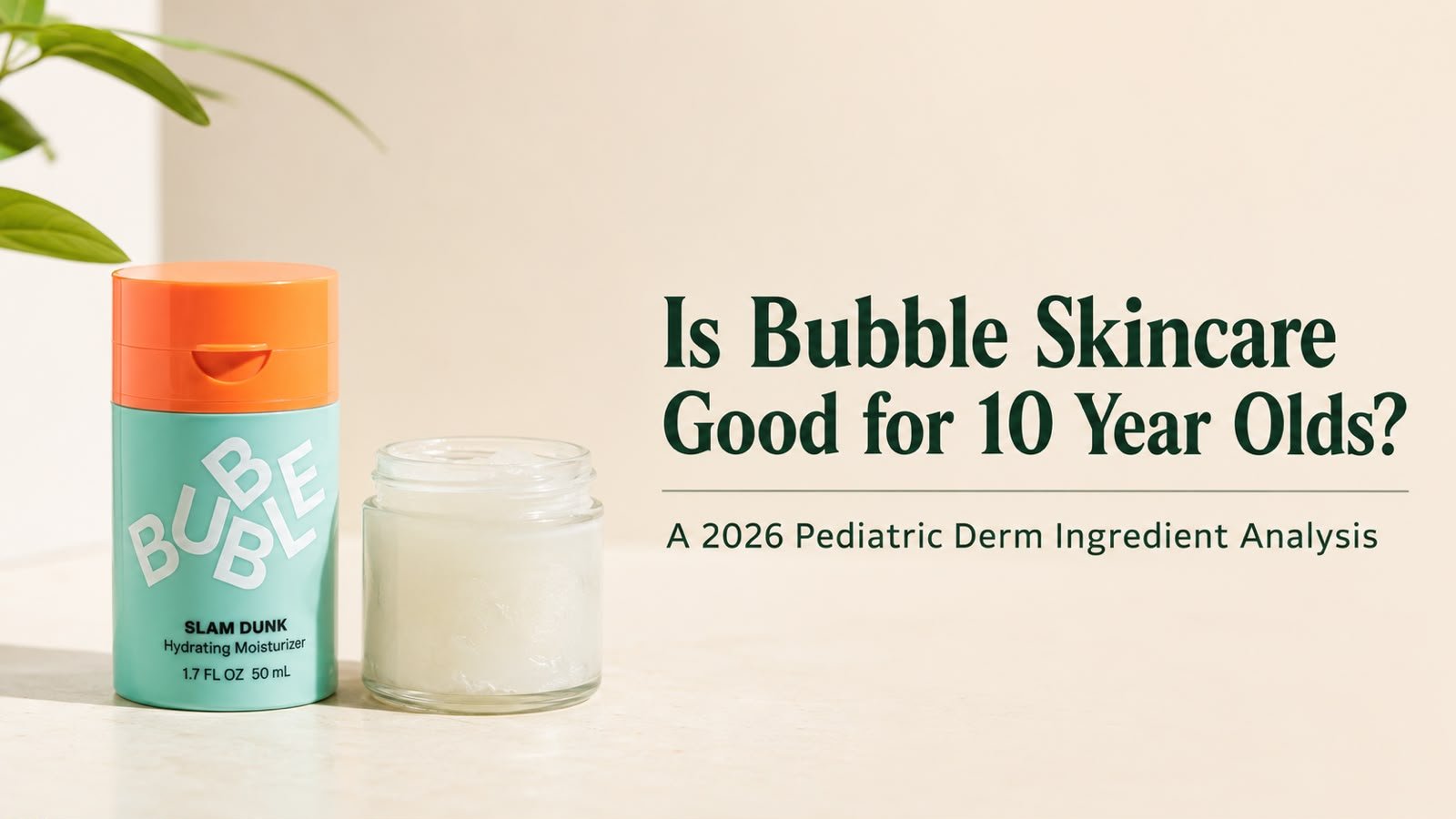
Is Bubble Skincare Good for 10 Year Olds? 2026 Safety Guide
For most 10-year-olds, the answer is a qualified no: Bubble skincare is not the optimal choice, but a few specific, fragrance-free products are genuinely acceptable if your child is insistent and you select carefully. The brand’s marketing positions it for “young skin,” yet several of its formulations contain fragrance components and botanical extracts that the Society for Pediatric Dermatology consistently flags as unnecessary sources of irritant contact dermatitis for this precise age group. Your 10-year-old’s skin barrier is structurally different from a teenager’s, making it more permeable and reactive to ingredients an older adolescent might tolerate without issue.
A 2024 clinical review published in the Journal of the American Academy of Dermatology noted a sharp rise in pediatric contact dermatitis cases correlating with the use of multi-step skincare routines purchased through social media influence. The study found that pre-pubertal skin, aged roughly 8 to 11, has a thinner stratum corneum and a higher rate of transepidermal water loss (TEWL), meaning ingredients penetrate more easily, for better or worse. This is not a trivial distinction. The product that causes a slight tingle in a 15-year-old can trigger visible dermatitis in a 10-year-old.
What follows is a direct, evidence-based guide to every Bubble product a 10-year-old might encounter, which ingredients pass the pediatric dermatology safety bar, and how to build a routine that respects both your child’s skin physiology and their psychological need to participate in a trend. No marketing fluff. Just what the research on young skin actually supports.
Is Bubble Skincare Good for 10 Year Olds?
Bubble skincare is a mixed bag for 10-year-olds: a handful of products like the Slam Dunk hydrating moisturizer and Plus One SPF are safe and well-formulated for this age, while the Fresh Start gel cleanser and any product containing fragrance or fragrant plant extracts introduce an unnecessary risk of irritation that a 10-year-old’s skin does not need. The brand’s core safety claim, that it is formulated “for young skin,” refers more to marketing positioning and the exclusion of harsh acne actives like benzoyl peroxide than to the stringent standards a pediatric dermatologist would apply when evaluating products for pre-pubertal skin. The real risk with Bubble is less about one catastrophic ingredient and more about the cumulative effect of low-grade irritants on a skin barrier that is not yet fully mature.
| Bubble Product | Key Concern for a 10-Year-Old | Pediatric Dermatology-Safe? |
|---|---|---|
| Fresh Start Gel Cleanser | Contains fragrance (parfum) and potentially stripping surfactants for dry, pre-pubertal skin. | Caution |
| Bounce Back Serum | Contains fragrance, plant extracts. Serums are generally unnecessary for age 10 skin. | No |
| Slam Dunk Hydrating Moisturizer | Fragrance-free, contains barrier-supportive ceramide NP and niacinamide. | Yes |
| Plus One SPF 40 | Fragrance-free mineral SPF with zinc oxide. Excellent choice for this age. | Yes |
| Day Dream Vitamin C Serum | Contains fragrance, unnecessary active for this age, potential for irritation. | No |
Key Takeaway: Choose only Bubble’s explicitly fragrance-free products like Slam Dunk moisturizer and Plus One SPF. Skip any Bubble product with “parfum” or fragrant plant oils on the INCI list.
What Age Is Bubble Skincare For?
Bubble skincare is optimally formulated and marketed for ages 14 and up, when the sebaceous glands become fully active, the skin barrier matures, and mild acne-fighting ingredients like 2% salicylic acid can be introduced safely. The brand’s own language often references “teens and young adults,” a demographic whose skin biology is fundamentally different from a 10-year-old’s. A teenager’s skin contends with increased sebum production driven by androgen hormones; this is why cleansers like Bubble’s Fresh Start, which uses surfactants to degrease, exist. A 10-year-old’s sebum production is minimal by comparison, making degreasing formulations a solution to a problem that does not yet exist for most children.
Applying products designed for oily, acne-prone teen skin to a child’s thinner, drier, more reactive skin is like using a heavy-duty degreaser on a surface that needs only a gentle wipe. You risk stripping away the small amount of sebum and natural moisturizing factors the skin is producing, which leads to a compromised barrier. A statement from the American Academy of Dermatology on pediatric skincare stresses that the only universally necessary skincare product before puberty is a broad-spectrum sunscreen. Everything else, particularly cleansers with active ingredients or fragrance, should be introduced only to address a specific, diagnosed skin condition.
Bubble Skincare for Tweens: A Better Framework
Bubble skincare for tweens, defined as ages 9 through 12, should be approached not as an all-or-nothing brand embrace but as a careful curation of two to three specific products that meet the criteria of being fragrance-free, essential oil-free, and free of active ingredients like salicylic acid. The better framework is this: a parent’s role is not to ban Bubble outright, which can make it forbidden fruit and elevate its social cachet, but to become the educated gatekeeper who knows exactly which products are dermatologically benign. This approach validates your tween’s desire to participate in a peer-driven trend while enforcing non-negotiable safety boundaries grounded in skin science.
Think of your child’s skincare interest as a learner’s permit for a car. You don’t hand over the keys to a high-speed sports car. You start with a slow, safe vehicle, and you sit in the passenger seat. The Slam Dunk moisturizer or the Plus One SPF are the safe vehicles. The Bubble serums and exfoliating cleansers are the sports cars. A 2023 report from the Society for Pediatric Dermatology highlighted a concerning trend of tweens developing contact dermatitis from multi-step routines involving fragranced serums, noting that the irritation often manifests subtly at first, as dryness or tightness, then escalates to visible redness and scaling. A parent’s cautious, ingredient-focused selection prevents this entirely.
Key Takeaway: You control the product selection, but you validate your tween’s interest in self-care. That psychological piece is discussed later in this article.
Can Kids Use Bubble Skincare?
Kids can use a very limited selection of fragrance-free Bubble skincare products, but the term “kids” must be broken down: a 15-year-old with acne is a kid, and a 9-year-old with dry skin is a kid, and their product needs are worlds apart. The American Academy of Dermatology does not endorse any single over-the-counter brand for children under 12 without a specific, board-certified pediatric dermatologist’s recommendation tailored to that child’s skin type and history. The reason is simple: there is no regulatory definition of “safe for kids” in cosmetics. A company can claim their product is for “young skin” because their marketing department decided it, not because a pediatric dermatology panel set a safety standard they then met.
This means the burden of ingredient analysis falls entirely on you. For a child under 12, the guiding rule is therapeutic minimalism. If the skin is healthy, which most 10-year-old skin is, the goal is to protect it, not to “treat” it or “improve” it with actives. A child’s healthy skin does not need niacinamide for brightening, antioxidants for anti-aging, or hyaluronic acid for hydration beyond what a basic moisturizer provides. Those ingredients are not dangerous. They are simply unnecessary, and the more products a child applies, the higher the probability of an interaction or cumulative irritation. The foundational question is: is this product solving a real skin problem my child has, or is it solving a marketing problem created by social media?
Bubble Skincare Ingredients Safe for Young Skin
Bubble skincare ingredients that are both safe and beneficial for 10-year-old skin include dimethicone, ceramide NP, glycerin, squalane, and zinc oxide. These compounds share a common profile: they are synthetic or highly purified, have a long track record of use in pediatric dermatology, have a low or zero allergenicity rate, and function solely as protectants or barrier-repairing agents. They do not exfoliate. They do not alter cell turnover. They simply sit on top of the skin or integrate into the lipid bilayer of the stratum corneum to perform a protective, moisturizing function.
Dimethicone, a silicone-based polymer, is one of the safest, most inert ingredients in cosmetic chemistry. The FDA includes it in its OTC skin protectant monograph, meaning it is officially recognized as a safe and effective ingredient to protect and soothe skin. Ceramide NP is a lipid identical to one found naturally in human skin and is critical for barrier function. Zinc oxide, the active ingredient in Bubble’s Plus One SPF, is a mineral, not a chemical, sunscreen filter. According to the FDA’s proposed 2019 sunscreen rule, which remains the relevant regulatory framework in 2026 for mineral sunscreens, zinc oxide is classified as GRASE (Generally Recognized as Safe and Effective) for use in children over 6 months of age. It sits on the skin’s surface, reflecting UV radiation, and does not absorb systemically in any significant amount, a key concern for young skin.
What Bubble Products Are Safe for 10 Year Olds?
The Bubble products that meet the pediatric dermatology safety threshold for a 10-year-old are limited to the Plus One SPF 40 and the Slam Dunk Hydrating Moisturizer. These two products are fragrance-free and formulated around barrier-supportive ingredients without any chemical exfoliants or high concentrations of fragrant botanical extracts. The Plus One SPF 40 uses zinc oxide as its sole active ingredient, suspended in a gentle base. This makes it an excellent everyday sunscreen for a child this age. The Slam Dunk moisturizer contains ceramide NP, niacinamide at a low, non-irritating concentration, and squalane, all of which support the skin barrier without over-delivering actives.
| Safe Bubble Product | Key Supportive Ingredients | Reason for Pediatric Safety Rating |
|---|---|---|
| Plus One SPF 40 | Zinc Oxide (20%) | Mineral filter, no chemical UV absorbers, GRASE by FDA for pediatric use. |
| Slam Dunk Moisturizer | Ceramide NP, Niacinamide, Squalane | Fragrance-free, barrier-repairing lipids, no exfoliants or irritants. |
Conversely, Bubble products like the Fresh Start Gel Cleanser, Bounce Back Serum, and Day Dream Vitamin C Serum should be avoided for this age group. The cleanser contains fragrance and surfactants that can strip the minimal protective lipid layer on pre-pubertal skin. The serums introduce not only fragrance but also active compounds like vitamin C (ascorbic acid) and plant extracts. For a 10-year-old with no photoaging to reverse and no collagen loss to stimulate, the irritation risk of these serums outweighs any theoretical benefit. The absence of a skin problem to treat makes the risk-benefit analysis a straightforward “no.”
Key Takeaway: The safe list has two products on it. A moisturizer and an SPF. That is the complete list.
Bubble Skincare Ingredients to Avoid for Tweens
For tweens, the Bubble skincare ingredients to avoid categorically are fragrance (listed as parfum on the INCI label), essential oils like citrus-derived limonene and linalool, and sodium lauryl sulfate (SLS), a surfactant that is too harsh for the pre-pubertal lipid barrier. These are not ingredients that signal a defective product. They are ingredients that carry an accepted level of risk for adult skin which is simply not acceptable for a 10-year-old’s thinner, more reactive skin barrier. A 2019 study in the Journal of Clinical and Aesthetic Dermatology identified fragrance as the single most common cause of cosmetic-related contact dermatitis in children.
The physiological mechanism is clear. Fragrance compounds, including essential oils, are small, volatile molecules that penetrate the stratum corneum readily. Once in the viable epidermis, they can bind to skin proteins, forming a hapten-protein complex that triggers an immune response. This is allergic contact dermatitis. Even before an allergy develops, these compounds can cause irritant contact dermatitis by directly damaging keratinocytes and stripping the intercellular lipid matrix. SLS does this through a different mechanism: it is a potent surfactant that denatures skin proteins and solubilizes barrier lipids, leading to a sharp increase in transepidermal water loss. For a tween, avoiding these three ingredient categories—parfum, fragrant essential oil compounds, and SLS—eliminates the majority of contact dermatitis triggers.
How to Build a Basic Skincare Routine for a 10 Year Old
A basic skincare routine for a 10-year-old has exactly three steps in the morning and one to two at night, and its primary goal is protection, not treatment. The routine is: morning cleanse (gentle), moisturize (if skin is dry), and protect with SPF. Evening: cleanse (to remove SPF and dirt), and moisturize. There is no step for a serum, an exfoliant, a toner, or an eye cream. This is not a simplified adult routine. This is the entire dermatologically necessary routine for healthy, pre-pubertal skin. The American Academy of Dermatology’s basic skincare guidance for children mirrors this minimal approach.
- Step 1: Gentle Water-Soluble Cleanser (AM and PM). For a 10-year-old, this is often a fragrance-free, creamy, non-foaming cleanser. Foam is a cosmetic property produced by surfactants; it has no cleaning benefit and often means a more stripping formula.
- Step 2: Basic Fragrance-Free Moisturizer (AM only if dry, PM always). At night, the skin’s permeability and TEWL increase. Applying a simple moisturizer with ingredients like dimethicone, glycerin, or ceramides before bed supports the skin’s overnight repair cycle.
- Step 3: Broad-Spectrum SPF 30 or Higher, Mineral-Based (AM only, every single day). This is the only “anti-aging” product a child needs. UVA rays, which penetrate glass and cloud cover, cause cumulative collagen damage starting in childhood. A zinc oxide or titanium dioxide sunscreen applied to the face every morning is a non-negotiable health habit, like brushing teeth.
Best Gentle Cleansers for Kids: What to Look For
The best gentle cleanser for a 10-year-old is one that is water-soluble, has a low foam profile, is fragrance-free, and has a pH close to the skin’s natural range of roughly 4.5 to 5.5. In practice, this means looking for cream or milk cleansers rather than gels or foaming washes. The ingredient list should be short and dominated by water (aqua), gentle emollients like glycerin, and mild non-ionic surfactants like decyl glucoside. You want to avoid the anionic surfactant sodium lauryl sulfate (SLS) and, for very sensitive skin, even sodium laureth sulfate (SLES), though the latter is less irritating than SLS due to a chemical process called ethoxylation.
Bubble’s Fresh Start gel cleanser, because it contains fragrance and is formulated for degreasing oily teenage skin, falls outside this safe category for a 10-year-old. A better approach is to ignore brand hype and read the INCI list for the criteria above. Your goal with cleansing is to remove the day’s dirt and SPF without leaving the skin feeling “squeaky clean.” That squeaky feeling is a subjective sensation of a stripped lipid barrier. It is a sign of damage, not cleanliness. For a child, the skin after washing should feel soft and hydrated, as if a thin layer of moisturizer has already been applied. This is the sensation of an intact acid mantle and a healthy lipid bilayer.
Best Moisturizers for 10 Year Olds with Sensitive Skin
The best moisturizer for a 10-year-old with sensitive skin contains three categories of ingredients—humectants, emollients, and occlusives—in a fragrance-free, minimal-ingredient formula. Humectants like glycerin and sodium hyaluronate pull water into the stratum corneum. Emollients like squalane and fatty alcohols (cetyl alcohol, stearyl alcohol) fill in the spaces between skin cells, smoothing the surface. Occlusives like dimethicone and petrolatum create a breathable seal that prevents water loss. Bubble’s Slam Dunk moisturizer fits this profile well, which is why it is one of the only two Bubble products endorsed in this guide.
For sensitivity-prone skin, the occlusive step is especially important at night. TEWL rates increase during sleep. A thin layer of a petrolatum-based product, sometimes called “slugging” by skincare enthusiasts, can be a highly effective, non-irritating, and dirt-cheap solution for a child’s dry patches. Plain petrolatum is the gold-standard occlusive in pediatric dermatology and is often recommended for eczema management. It’s less cosmetically elegant than a branded moisturizer, but it is superior at preventing water loss. For a 10-year-old’s nighttime routine, a basic moisturizer followed by a whisper-thin layer of petrolatum on any rough or dry areas is a clinically sound, inexpensive practice.
Key Takeaway: A good moisturizer has humectants, emollients, and occlusives. The Slam Dunk meets this standard. Plain petrolatum is an underrated, dermatologist-loved backup.
SPF Recommendations for Children Age 10
The SPF recommendation for a 10-year-old is a broad-spectrum, water-resistant, mineral sunscreen with an SPF of at least 30, using zinc oxide or titanium dioxide as the active ingredient, applied daily to all exposed skin. The Society for Pediatric Dermatology and the FDA’s GRASE findings on sunscreen ingredients both favor mineral filters over chemical ones for this age group. Chemical sunscreens like oxybenzone and octinoxate have been under FDA scrutiny since a 2019 pilot study showed they are absorbed through the skin into the bloodstream at levels that exceed the agency’s threshold for waiving further safety studies. While this does not mean they are proven dangerous, it does mean we have more safety data gaps for chemical filters than we do for zinc oxide, which has a centuries-long track record of topical use.
Bubble’s Plus One SPF 40 is a strong choice because it uses 20% zinc oxide, is fragrance-free, and has a relatively elegant texture for a mineral sunscreen. Application mechanics matter as much as the product. A 10-year-old needs to apply about a nickel-sized amount to the entire face. The most common error is under-application, which linearly reduces the delivered SPF. Teaching a child to apply their own sunscreen is a hand-eye coordination exercise. You may need to supervise or apply it yourself for a few years. The sunscreen must also be reapplied every two hours of direct sun exposure, or immediately after swimming or sweating. This is a habit that, if solidified now, is one of the single most powerful health interventions you can give your child for long-term skin health.
How to Spot a Damaged Skin Barrier in a Child
A damaged skin barrier in a child typically presents as skin that feels rough or tight after cleansing, appears dull or slightly scaly, has patches of persistent dryness that don’t improve with lotion, and reacts with stinging or redness to the application of a product that never bothered them before. A healthy stratum corneum is an organized lattice of flattened, lipid-surrounded cells. When the lipid bilayer is disrupted by harsh surfactants, over-exfoliation, or irritants, the “mortar” between the “bricks” dissolves. This creates microscopic cracks in the barrier. Clinically, this is visible as increased transepidermal water loss (TEWL), which can be measured with a device in a dermatologist’s office but is easily observed by a parent as skin that simply cannot hold onto moisture.
- The skin looks tight and shiny, almost like plastic wrap, not dewy.
- There are patches of fine, dry flakes, particularly around the mouth, nose, or eyes.
- Your child reports that their “moisturizer stings,” a classic sign of a breached barrier.
- The skin may look redder than usual in areas, especially after washing.
If you spot these signs, the intervention is not to add more products but to immediately strip the routine down to a gentle cleanser, a basic moisturizer, and an occlusive at night. All fragrances, all actives, all Bubble serums must stop. The skin barrier needs roughly two weeks of this “zero-therapy” approach to begin self-repairing. The keratinocytes need time to produce new lipids and natural moisturizing factor without constant chemical interference.
Irritant Contact Dermatitis vs Allergic Reaction in Kids
Irritant contact dermatitis is a direct, dose-dependent chemical injury to the skin barrier that can happen to anyone and appears as a red, dry, rough, or scaly patch that burns or stings, usually within minutes to hours of product application. An allergic contact dermatitis reaction is an immune system response to a specific allergen (like a fragrance component or a preservative) and appears as an intensely itchy, red, swollen rash that may blister or weep, developing 24 to 48 hours after the second or subsequent exposure. This is a critical clinical distinction for parents because the “treatment” and the culprit identification process are different.
Think of it like the difference between a sunburn and poison ivy. The sunburn is the irritant, the burn is direct, immediate, and dose-dependent. The poison ivy is the allergen, the rash is delayed and immune-mediated. If your child’s skin stings and turns red within an hour of applying a Bubble product, you are likely seeing irritant dermatitis. Remove the product immediately, wash with cool water, and apply a simple occlusive like petrolatum. The reaction should calm down within a day. If, however, a raised, incredibly itchy rash appears on the cheeks 36 hours after using a new scented moisturizer for the second time, that is more suspicious for a true allergy. A board-certified pediatric dermatologist can perform a patch test to identify the specific allergen.
Key Takeaway: Irritant dermatitis burns and looks angry fast. Allergic dermatitis itches intensely and appears on a delay. Any blistering, swelling, or spreading rash warrants an immediate call to your pediatrician.
How to Talk to Kids About Skincare and Self-Esteem
The conversation about skincare with a 10-year-old must actively decouple skincare products from self-worth and recouple them with health and hygiene, using language that mirrors brushing teeth or wearing a bike helmet. Your child’s interest is not superficial. It is developmentally normal. They are navigating early social identity formation, and peer trends are a huge part of that. The psychological risk is not that they want a moisturizer. The risk is that the narrative embedded in skincare marketing, the idea that skin must be “fixed” or “perfected,” becomes internalized. Your job is to talk openly about this narrative, not ignore it.
Ask your child why they want the product. A question like “What do you like about it?” will get you a much more honest answer than a lecture. They might say the packaging is cute, their friend has it, or they think it will make their skin “look better.” Cute packaging is a benign aesthetic preference you can probably indulge safely. “Make my skin look better” is a signpost for a self-critical thought that needs a gentle, science-based reframe. You can explain, “Your skin’s job right now is to grow with you and protect your body. Skincare isn’t for fixing anything, because nothing is broken. The right products, like sunscreen, are about keeping your skin healthy and strong for your whole life, just like eating vegetables keeps your body strong.” This shifts the frame from cosmetic correction to lifelong health.
Skincare Red Flags for Tweens: Social Media Influence
The most serious skincare red flag for tweens on social media is the algorithmic promotion of 10-step routines and potent active ingredients like retinol and chemical exfoliants as aspirational, a trend driven by “skinfluencers” who are not medical professionals and often have undisclosed financial partnerships with the brands they promote. A child’s prefrontal cortex, the part of the brain that handles critical foresight and consequence evaluation, is not fully developed. They are being marketed to by a system designed to bypass that undeveloped function. This makes them uniquely vulnerable to the parasocial trust they place in a 19-year-old influencer with perfect lighting and a filter.
- Watch for language that frames skin as “gross,” “needs fixing,” or requires a “glow up.”
- Any influencer recommending retinol or strong chemical exfoliants to an audience of tweens is a massive red flag and a sign of no dermatological oversight.
- Haul videos where tweens display a large quantity of products normalize overconsumption and multiple-step routines that are actively harmful to young skin.
A practical family policy is to make a rule that no product gets purchased or applied until you and your child have read the full ingredient list together. This transforms the purchase from a passive, influenced act into an active, educational one. It teaches INCI literacy, label skepticism, and the idea that safety is checkable. It slows the process down. Anything with “parfum,” a long list of fruit extracts, or an active ingredient name like salicylic acid is an automatic “no” that you can explain with calm, skin-science reasoning, not parental arbitrariness.
Key Takeaway: The “Sephora tween” trend is a consumer behavior phenomenon, not a skincare guideline. Your family’s skincare policy is built on ingredient lists, not influencer shelfies.
When to See a Pediatric Dermatologist for Skincare Concerns
You should seek a consultation with a board-certified pediatric dermatologist when your child’s skin reaction to any product—Bubble or otherwise—persists for more than a week after stopping all products, involves blistering or swelling, spreads beyond the original point of contact, is intensely itchy and disrupting sleep, or when your child develops persistent acne that is causing psychological distress. A pediatric dermatologist has completed specialized fellowship training on the unique physiological and disease states of infant, child, and adolescent skin. They are not the same as a general dermatologist and are equipped to perform pediatric patch testing for specific allergen identification.
You do not need to wait for a crisis. A proactive, one-time consultation to establish a safe routine for a child with early signs of acne or a strong family history of eczema or psoriasis is a wise use of specialized medical care. When booking the appointment, ask specifically if the practice offers pediatric patch testing. Bring all the product bottles your child has used, including cleansers, moisturizers, and sunscreens. The INCI list on the back is the dermatologist’s diagnostic data. This turns a generic office visit into a specific, personalized safety audit for your child’s routine, which is exactly what your 10-year-old deserves before adopting any heavily marketed skincare brand.
Frequently Asked Questions About Bubble Skincare for Kids
Is Bubble skincare safe for 10 year olds?
Only Bubble’s fragrance-free products, the Slam Dunk moisturizer and Plus One SPF, are considered safe choices for a 10-year-old by pediatric dermatology standards.
Any Bubble product containing fragrance (parfum), essential oils, or active ingredients like salicylic acid is not recommended for this age group due to an elevated risk of irritant contact dermatitis.
What ingredients should 10 year olds avoid in skincare?
Ten-year-olds should avoid skincare products containing fragrance (parfum), essential oils like limonene and linalool, the harsh surfactant sodium lauryl sulfate (SLS), and any active ingredient meant for acne or anti-aging, such as salicylic acid and retinol.
These ingredients are common causes of contact dermatitis in pre-pubertal skin, which has a thinner barrier and is more permeable to irritants.
Can a 10 year old use Bubble moisturizer?
A 10-year-old can use the Bubble Slam Dunk Hydrating Moisturizer because it is fragrance-free and formulated with barrier-supporting ingredients like ceramide NP and niacinamide.
Other Bubble moisturizers should be checked individually on their INCI list for “parfum” or fragrant plant extracts, and avoided if present.
Does Bubble skincare cause breakouts in tweens?
Bubble skincare is not inherently comedogenic but can cause red, bumpy, acne-like rashes in tweens, which are often irritant contact dermatitis rather than true acne.
This occurs when fragranced or active-laden products inflame the skin, and the best fix is stopping all products immediately and reverting to a gentle, fragrance-free cleanser and moisturizer.
What is a safe skincare routine for a 10 year old?
A safe skincare routine for a 10-year-old is a gentle, fragrance-free cleanser in the morning and evening, a basic fragrance-free moisturizer only if the skin is dry, and a mineral SPF 30 or higher every single morning without exception.
There is no dermatological need for a serum, toner, exfoliant, or eye cream in healthy 10-year-old skin.
When should I take my child to a dermatologist for a skin reaction?
Take your child to a board-certified pediatric dermatologist if a product-related rash is intensely itchy, blistering, swelling, spreading, or persists for more than a week after stopping all suspect products.
A pediatric dermatologist can perform specialized patch testing to identify the exact allergen and build a safe, personalized routine.
The overwhelming majority of 10-year-old skin needs almost nothing from a bottle. It needs a gentle cleanser, a simple moisturizer if it feels dry, and a really good mineral sunscreen every morning. That is it. The rest of what the skincare industry sells, and what social media promotes, is a solution in search of a problem that does not exist yet on a child’s face.
Your child’s curiosity about self-care is not the problem. The problem is a market that exploits that curiosity to sell $30 serums to an audience whose skin will thrive best with a $10 sunscreen and basic petrolatum. You are the informed filter between that market and your child’s health. Keep the routine fiercely minimal. Read every INCI list out loud. Give an enthusiastic “yes” to the one or two truly safe products that let your child participate in a trend without harm, and a calm, confident, science-backed “no” to everything else.
You are not the mean parent blocking the cool skincare. You are the smart parent who just taught a masterclass in label literacy, self-worth, and the long game of lifelong skin health, and your child will absorb those lessons long after the Bubble hype fades.