Ichetucknee Springs State Park Camping Guide for 2026
Ichetucknee Springs State Park camping delivers a genuine North Florida spring experience unlike any other in the state park system. You camp minutes from a first-magnitude spring with water visibility exceeding 100 feet on clear days.
The Ichetucknee River flows six miles from the head spring to the Santa Fe River, and campers who book smart can tube from near their campsite. That combination of car camping convenience and spring-fed recreation is what makes this destination worth planning around.
This guide covers specific campsite recommendations, reservation timing, seasonal strategy, nearby alternatives, and what most campers get wrong about Ichetucknee. Read through all 16 sections before booking anything.
Ichetucknee Springs State Park Camping Overview
Ichetucknee Springs State Park camping centers on a 23-site campground located off the South Entrance near the river. The campground sits in a sandhill and hardwood hammock ecosystem with Spanish moss draping live oaks.
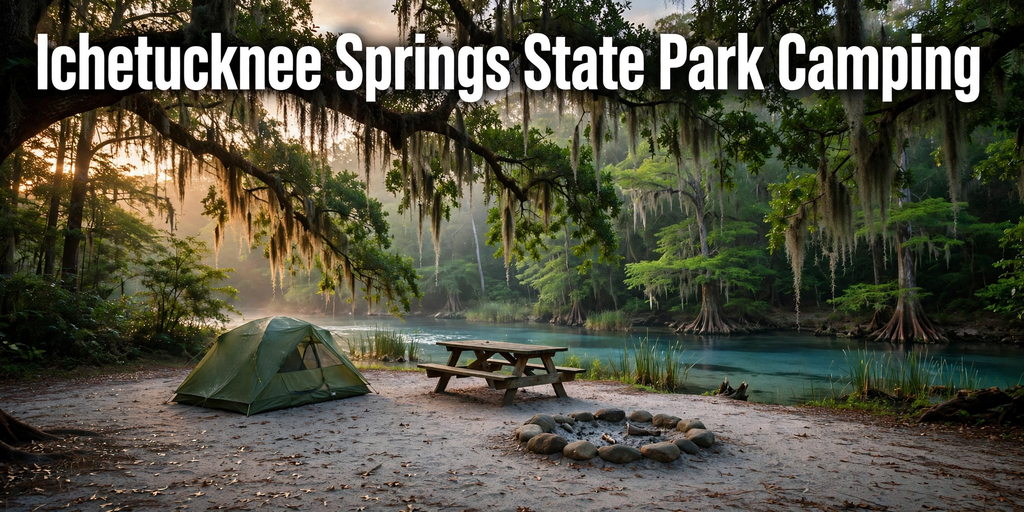
The park protects nine named springs along the Ichetucknee River, with the head spring being the largest and most visited. Blue Hole Spring, the other major spring, is a short walk from the campground.
The single most important fact: camping at Ichetucknee is a completely different experience during tubing season versus the rest of the year. Tubing season runs from late May through early September, and everything from booking difficulty to noise levels changes.
First-time campers will find Ichetucknee approachable, with flush toilets, hot showers, and clearly marked sites. Experienced campers seeking solitude should look elsewhere or book off-season weekdays.
According to the Florida Department of Environmental Protection, Ichetucknee Springs is one of the most visited state parks in North Florida. That popularity directly affects campground demand, especially on summer weekends.
Ichetucknee Springs Campground Map and Loops
The Ichetucknee Springs campground is compact, with all 23 sites arranged in two loops near the river. Site numbers and loop names may change, so verify the current campground map before booking.
The campground has a single entrance road off the South Entrance, and most sites are back-in on packed sand. RVs and trailers can navigate the loops, but tight turns require careful maneuvering for longer rigs.
Sites near the river side of the campground tend to stay cooler in summer because of the water and tree canopy. Sites on the interior of the loops get more afternoon sun and are warmer.
Campers who want easy walk-to-tubing access should look for sites closest to the river path. Those who want quieter mornings should consider sites away from the main foot traffic.
The best campsite at Ichetucknee Springs State Park depends entirely on your season and equipment. Spring and fall favor river-side sites; summer favors any site with maximum shade.
The Dyrt’s campground reviews for Ichetucknee consistently mention that campsite privacy is limited because of the open understory. Expect to see and hear your neighbors more than in a densely forested campground.
Best Campsites at Ichetucknee Springs State Park
The best campsites at Ichetucknee Springs for tent campers are those with live oak canopy and the most distance from the bathhouse. Sites near the river side also benefit from a light breeze that keeps mosquitoes down.
RV campers should prioritize sites with the straightest back-in angle and the least tree root intrusion on the pad. Some sites have roots that make leveling a trailer more work than it should be.
Sites near the bathhouse get more foot traffic and late-night light spill. Sites at the far ends of each loop tend to be quieter, with less pass-through noise.
Families with young children should choose sites closest to the bathhouse, even if they are slightly noisier. The convenience of a short walk for a toddler at 2 a.m. outweighs the privacy tradeoff.
Couples seeking a romantic weekend should book a river-side site in the fall, when crowds drop and temperatures moderate. The same site in July will feel like a parking lot at a water park.
Insider Tip:
The best Ichetucknee campsite for morning light is on the east side of the campground.
The best for afternoon shade is on the west side under the largest oaks.
First-time campers should call the park directly and ask which sites have the fewest roots for tent staking.
Ichetucknee Tent Camping Sites and RV Hookups
Ichetucknee Springs campground offers tent-only sites, RV sites with electric hookups, and no full hookup sites. There is a dump station near the campground entrance for RV waste.
Tent-only sites at Ichetucknee have packed sand pads, picnic tables, and fire rings with grill grates. You will need to bring your own firewood or purchase it locally, as gathering wood is prohibited.
RV sites include 30-amp or 50-amp electric service, but water and sewer hookups are not available at individual sites. A central potable water spigot and a dump station serve the entire campground.
Campers with trailers or motorhomes should verify maximum RV length before booking, as some sites cannot accommodate rigs over 30 feet. The access road is paved, but site pads are packed sand and can settle after rain.
Budget campers will find Ichetucknee tent sites a strong value compared to private campgrounds near Ginnie Springs. The cost difference becomes significant over a multi-night stay.
RV travelers who want full hookups should look at private campgrounds near High Springs or Lake City instead of Ichetucknee. The state park’s lack of sewer hookups is a genuine limitation for some rigs.
| Campsite Type | Hookups | Facilities | Best For | Honest Note |
|---|---|---|---|---|
| Tent-only site | None | Shared bathhouse, fire ring, picnic table | Budget campers, beginners | Sand pad can get muddy after heavy rain |
| RV electric site | 30/50 amp electric | Shared bathhouse, dump station, no water at site | RV travelers wanting basic electric | No sewer or water hookup at site |
| Cabin | Climate controlled | Private bath, kitchenette | Families wanting comfort | Limited availability, books far ahead |
| Group site | None | Shared facilities | Scouts, large family groups | Verify group site availability before planning |
Ichetucknee Springs Cabin Rentals and Alternatives
Ichetucknee Springs State Park does not have cabin rentals inside the park, despite what some outdated listings claim. The nearest state park cabins are at O’Leno State Park, approximately 20 miles away.
O’Leno State Park cabins sleep up to six people and include climate control, kitchens, and private bathrooms. They are a legitimate alternative for families who want the springs experience without tent camping.
Private cabin rentals around High Springs and Fort White offer more amenities but at higher cost and with less direct river access. Many sit along the Santa Fe River and provide private spring access.
Couples seeking a romantic weekend should compare O’Leno cabins against private glamping options near Ginnie Springs. The O’Leno cabins are more basic but significantly quieter in summer.
Budget travelers should know that cabins anywhere near Ichetucknee are dramatically more expensive than campsites. A single cabin night often costs more than three nights at the Ichetucknee campground.
Verify current cabin availability and pricing directly with O’Leno State Park or private operators before booking anything. Cabin inventory in this region changes seasonally and books out far in advance.
Ichetucknee Springs Campground Reservations
Ichetucknee Springs campground reservations are made through ReserveAmerica or the Florida State Parks reservation system, not Recreation.gov. Do not search Recreation.gov for this park; you will not find it there.
The reservation window opens 11 months in advance for Florida State Parks, and peak tubing season weekends book within hours of opening. Weekday dates during summer also fill quickly, though not as fast.
First-time campers should create a ReserveAmerica account before the booking window opens and practice navigating to the Ichetucknee page. The interface is straightforward, but practice saves valuable minutes when dates drop.
Reservation fees are added to the nightly camping rate, and cancellation policies vary by season and notice period. Always verify the current fee structure and cancellation window before booking.
Experienced campers know to book the maximum stay allowed for a summer weekend and then adjust later if plans change. This locks in the hard-to-get date while leaving flexibility.
According to ReserveAmerica data, Ichetucknee Springs campground has a higher booking fill rate than most other Florida State Parks campgrounds. Only the beach parks and Blue Spring State Park near Orlando compete for demand.
Florida State Parks Booking Window for Ichetucknee
The Florida State Parks booking window for Ichetucknee Springs is 11 months to the day before your arrival date. The window opens at 8:00 a.m. Eastern Time on ReserveAmerica.
To book a summer weekend at Ichetucknee, you must be online at exactly 8:00 a.m. 11 months before your planned date. Waiting even 24 hours often means missing the site entirely.
Weekday bookings are easier but still require planning, especially for sites with the most shade or river access. Spring break and holiday weekends operate on the same scarcity model as summer weekends.
RV travelers should be flexible on site number and take whatever is available with electric hookups during peak season. Holding out for a specific site usually means getting no site at all.
Experienced campers use two browser windows: one for the campsite page and one for the reservation calendar. This reduces the time lost navigating between pages during the opening rush.
The state park system periodically adjusts booking windows and platform details, so verify the current system before your trip. Sign up for the park’s email alerts if available to catch policy changes early.
Best Time to Camp at Ichetucknee Springs
The best time to camp at Ichetucknee Springs is late October through early November, when temperatures drop and crowds disappear. Water remains a steady 72 degrees Fahrenheit year-round, so swimming is still comfortable.
Late March through April offers the second-best window, with cooler nights, fewer insects, and moderate weekend crowds. Wildflowers bloom in the sandhill areas, adding color to the campground.
May through September brings extreme heat, humidity, daily thunderstorms, and peak tubing crowds. The campground becomes an extension of the tubing operation, with all the noise and traffic that implies.
December through February is quiet and cool but can feel damp, with occasional frost and limited tubing access. The park operates on reduced staffing during this period.
Families with school-age children often have no choice but summer, and should book shaded sites far from the bathhouse. Those sites stay cooler and avoid the worst of the pass-through traffic.
Couples without children should absolutely target November weekdays for the quietest possible experience. You will have the river to yourself on a Tuesday morning.
| Month | Conditions | Crowd Level | Reservation Lead Time | Verdict |
|---|---|---|---|---|
| January | Cool, damp, possible frost | Very low | Usually available | Quiet but limited activities |
| February | Mild days, cool nights | Low | Usually available | Good for solitude |
| March | Pleasant, wildflowers | Moderate | Book 2-3 months ahead | Excellent for camping |
| April | Warm, low humidity | Moderate | Book 3-4 months ahead | Excellent for camping |
| May | Hot, humid, thunderstorms | High | Book 11 months for weekends | Only if tubing is the goal |
| June-August | Extreme heat, daily storms | Very high | Book 11 months exactly | Poor unless tubing is essential |
| September | Hot, humid, storms | High | Book 3-4 months ahead | Transitional month |
| October | Warm days, cool nights | Moderate | Book 2-3 months ahead | Very good |
| November | Pleasant, dry | Low | Usually available | Best overall month |
| December | Cool, damp | Low | Usually available | Quiet but limited |
Ichetucknee Tubing Season and Camping Demand
Ichetucknee tubing season runs from the Saturday before Memorial Day through Labor Day, and it fundamentally changes the camping experience. If you camp during this window, you are camping at the center of a major commercial tubing operation.
The South Entrance, where the campground is located, becomes the busiest entrance because it hosts the tube rental and tram service. Campers must deal with day-use traffic, tram noise, and the constant movement of tubers.
If your goal is quiet camping, do not book during tubing season. The campground is not a refuge from the tubing crowds; it is part of the same infrastructure.
If your goal is convenient tubing access, camping at Ichetucknee during tubing season is genuinely convenient. You can walk to the tube launch and avoid parking hassles that day visitors face.
The tubing operation uses trams that run from the South Entrance to the launch points throughout the day. The tram route passes near some campsites, creating a distinctive mechanical noise that repeats every few minutes.
Families with young children who want to tube should consider camping during the shoulder weeks right before or after tubing season. The river is still swimmable, and you can bring your own tubes without the commercial operation running.
Ichetucknee Springs Bugs, Heat, and Humidity Management
Ichetucknee Springs State Park camping in summer means managing mosquitoes, no-see-ums, yellow flies, and extreme humidity. These are not minor annoyances; they are the defining feature of summer camping here.
The most effective mosquito strategy is a combination of permethrin-treated clothing, DEET or picaridin on exposed skin, and a Thermacell or similar device at the picnic table. No single product solves the problem alone.
Yellow flies are active during daylight in summer and deliver a painful bite. They are attracted to movement and carbon dioxide, and they are persistent.
Heat and humidity mean you should plan afternoon activities in or on the water, not at the campsite. A tent sitting in direct sun becomes an oven by 10 a.m.
Experienced campers use a battery-powered fan inside the tent for sleeping in summer. It makes the difference between sleeping and merely enduring the night.
Campers from northern or western states often underestimate Florida summer camping conditions. The humidity is the issue, not just the temperature.
The Leave No Trace Center for Outdoor Ethics recommends using insect repellent sparingly and following product instructions to minimize environmental impact. Apply repellent away from springs and rinse before entering the water.
Ichetucknee Tubing and Kayaking From the Campground
Campers at Ichetucknee Springs can tube or kayak directly from the campground area by walking to the South Take-Out or the tram pickup point during tubing season. Off-season, you can launch your own tube or kayak at Dampier’s Landing or the South Take-Out.
The full river float from the head spring to the South Take-Out takes approximately three to four hours during normal flow. Shorter floats from Dampier’s Landing or Midpoint Tube Launch take one to two hours.
Kayaking upstream from the South Take-Out is not permitted because the current is strong and the river is narrow in sections. Paddlecraft must launch at designated points and follow the downstream flow.
Tubing is not a physically demanding activity, but it does require basic water safety awareness. The water is cold, the current is steady, and submerged logs exist.
Families with children should use life jackets, even if the rules do not require them for all ages. The current can be stronger than it looks from the surface.
During tubing season, campers can purchase tube rentals and tram passes at the South Entrance, which is walking distance from the campground. This is the single biggest convenience advantage of camping at Ichetucknee.
Ichetucknee Springs Hiking Trails and Blue Hole Spring
Ichetucknee Springs State Park has three named hiking trails: the Pine Ridge Trail, the Trestle Point Trail, and the Blue Hole Trail. None are long or strenuous, but each offers a different perspective on the park’s ecosystems.
The Blue Hole Trail is a short, accessible boardwalk loop from the Blue Hole parking area to the spring overlook. Blue Hole Spring is a second-magnitude spring with a deep blue color and a swim area.
The Pine Ridge Trail runs through sandhill habitat and passes through areas with longleaf pine and wiregrass. It is a good trail for bird watching and seeing wildflowers in spring.
The Trestle Point Trail leads to the river and passes through cypress swamp and hardwood hammock. Expect wet conditions and mosquitoes on this trail year-round.
Hikers seeking a challenging trail will not find it at Ichetucknee. The trails are short, flat, and more about nature observation than physical exertion.
According to the American Hiking Society, trails in Florida state parks are best hiked in the morning during warm months to avoid heat and afternoon thunderstorms. Start early and carry more water than you think you need.
| Trail Name | Distance | Difficulty | Surface | Best Season | Honest Note |
|---|---|---|---|---|---|
| Blue Hole Trail | 0.25 miles loop | Easy | Boardwalk, accessible | Year-round | Crowded during tubing season |
| Pine Ridge Trail | 2 miles loop | Easy | Sand, uneven | Fall-Spring | Exposed, hot in summer |
| Trestle Point Trail | 1.5 miles out-and-back | Moderate due to mud | Dirt, roots | Winter | Wet and buggy in summer |
Ichetucknee Camping With Dogs and Pet Policies
Ichetucknee Springs State Park allows dogs in the campground and on designated trails but not in the springs or river. Pets must be on a six-foot leash at all times.
Dogs are not permitted on the tubing tram or in the tube rental area during tubing season. This means you cannot tube with your dog at Ichetucknee.
The Blue Hole Trail and the boardwalk to Blue Hole Spring are closed to pets. The Pine Ridge Trail and Trestle Point Trail generally allow leashed dogs, but verify current rules before your visit.
Camping with a dog at Ichetucknee requires special attention to heat, as sand surfaces become dangerously hot in summer. Test the ground with your hand before walking a dog.
Alligators are present in the Ichetucknee River, and dogs near the water’s edge are at risk. Do not allow dogs to swim or drink at the river edge.
Verify current pet policies directly with the park before booking, as restrictions can change. Some areas of the campground may have different pet rules depending on wildlife activity.
Campgrounds Near Ichetucknee Springs State Park
Several named campgrounds near Ichetucknee Springs offer alternatives when the state park is full or when you need different amenities. The closest significant options are O’Leno State Park, Ginnie Springs Outdoors, and various private campgrounds near High Springs.
O’Leno State Park is approximately 20 miles southeast of Ichetucknee and offers a larger campground with more sites, full hookups, and cabin rentals. It sits along the Santa Fe River and has its own spring-fed swimming area.
Ginnie Springs Outdoors is a private campground near High Springs, approximately 15 miles southwest, known for multiple springs and scuba diving. It is more expensive and far more party-oriented than the state park.
Private campgrounds near High Springs along the Santa Fe River offer full hookups, wi-fi, and direct river access. They cater to RV travelers and families who want more amenities than state parks provide.
Budget campers should compare total costs, not just nightly rates. Some private campgrounds charge additional per-person fees and tubing fees that make them significantly more expensive than Ichetucknee.
Campers who want quiet should avoid private campgrounds near springs on summer weekends. They are often louder than the state park because of alcohol policies and party culture.
The nearest free camping is dispersed camping in the Osceola National Forest, approximately 45 minutes northeast. That is a genuine option for budget travelers with a high-clearance vehicle.
O’Leno State Park Camping vs Ichetucknee Comparison
O’Leno State Park is the single best alternative to Ichetucknee Springs for campers who want a quieter, more spacious campground within 30 minutes of the springs. It has more sites, more hookup options, and more separation between campsites.
Ichetucknee wins on direct spring access, tubing convenience, and proximity to Blue Hole Spring. O’Leno wins on campsite privacy, camping infrastructure, and crowd management.
O’Leno has a dedicated swimming area at a natural sink on the Santa Fe River, but it is not comparable to tubing the Ichetucknee. It is more of a swimming hole than a river float.
RV travelers will find O’Leno more accommodating, with full hookup sites and more space for larger rigs. Ichetucknee’s electric-only sites feel more limiting by comparison.
Families with young children may prefer O’Leno for the playground and the larger, flatter campsites. Ichetucknee’s compact campground works fine but lacks the open space for kids to roam.
Experienced campers who want to tube the Ichetucknee without camping in the middle of the tubing operation should book O’Leno and drive to Ichetucknee for a day trip. That strategy delivers the best of both.
| Campground | Sites | Hookups | Cost Tier | Best For | Honest Note |
|---|---|---|---|---|---|
| Ichetucknee Springs | 23 | Electric only | Low | Tubing access, spring swimming | Crowded and noisy in summer |
| O’Leno State Park | 61 | Full, electric, tent | Low | Quieter camping, families | No tubing, limited spring swimming |
| Ginnie Springs Outdoors | 200+ | Full, electric, tent | High | Scuba diving, party scene | Loud, expensive, party culture |
| High Springs private CG | Varies | Full | Mid | RV comfort, amenities | Less nature, more resort feel |
Getting to Ichetucknee Springs and Campground Access
Ichetucknee Springs State Park is located at 12087 SW US Highway 27, Fort White, Florida, approximately 45 miles northwest of Gainesville. The park has two entrances: the North Entrance for day use and the South Entrance for the campground and tubing.
From Gainesville, take I-75 north to exit 423, then follow SR-47 west to US-27 north. The drive takes approximately 50 minutes without traffic.
From Jacksonville, take I-10 west to US-441 south, then SR-47 west to US-27 north. The drive takes approximately 90 minutes.
The South Entrance is the correct entrance for campers, and you will check in at the ranger station before proceeding to your site. The campground is clearly marked after the entrance gate.
Cell service at Ichetucknee is unreliable, with some carriers having no signal in the campground. Download offline maps and reservation confirmations before arrival.
Fuel and groceries are available in Fort White, approximately 10 minutes from the park entrance, but options are limited. Stock up in Gainesville or Lake City for better selection and prices.
Key Takeaway: Book 11 months to the day at 8:00 a.m. Eastern Time for summer weekends.
Frequently Asked Questions About Ichetucknee Springs State Park Camping
Do you need reservations for Ichetucknee Springs State Park camping?
Yes, Ichetucknee Springs State Park requires reservations for all campsites through ReserveAmerica or the Florida State Parks reservation system.
Walk-in camping is not available, and arriving without a reservation means you will be turned away.
Always verify the current booking platform directly with the park before your trip.
How far in advance can you book Ichetucknee Springs campground?
The Florida State Parks booking window opens 11 months in advance to the day.
Reservations open at 8:00 a.m. Eastern Time on ReserveAmerica.
Summer weekends book within hours, so set an alarm and book immediately.
Is there RV camping at Ichetucknee Springs State Park?
Yes, Ichetucknee Springs offers RV sites with 30-amp or 50-amp electric hookups.
There are no full hookup sites, and no water or sewer at individual sites.
A dump station and potable water spigot serve the entire campground.
Can you tube from the Ichetucknee Springs campground?
Yes, during tubing season you can walk from the campground to the South Entrance for tube rentals and tram service.
Off-season, you can launch your own tube or kayak at designated points along the river.
Tubing from the campground to the South Take-Out takes roughly three to four hours.
What is the best campsite at Ichetucknee Springs State Park?
The best campsite depends on your season and equipment, but river-side sites with live oak canopy are consistently preferred.
Sites near the bathhouse are convenient for families but get more foot traffic.
Call the park directly and ask which sites have the fewest roots and best shade.
Are dogs allowed at Ichetucknee Springs campground?
Yes, dogs are allowed in the campground on a six-foot leash.
Dogs are not permitted in the springs, river, or on the Blue Hole boardwalk.
Dogs are not allowed on the tubing tram, so you cannot tube with your dog.
Ichetucknee Springs State Park camping works best for families, beginners, and couples who want convenient spring access without backcountry effort.
The single most important action is booking exactly 11 months in advance for summer dates, and being flexible on site number.
Campground fees, reservation windows, pet policies, and tubing season dates change without notice, so verify directly with Florida State Parks before booking.
Book the first available acceptable site, then check back for cancellations if you want a specific site.
That one booking discipline changes everything about your trip.