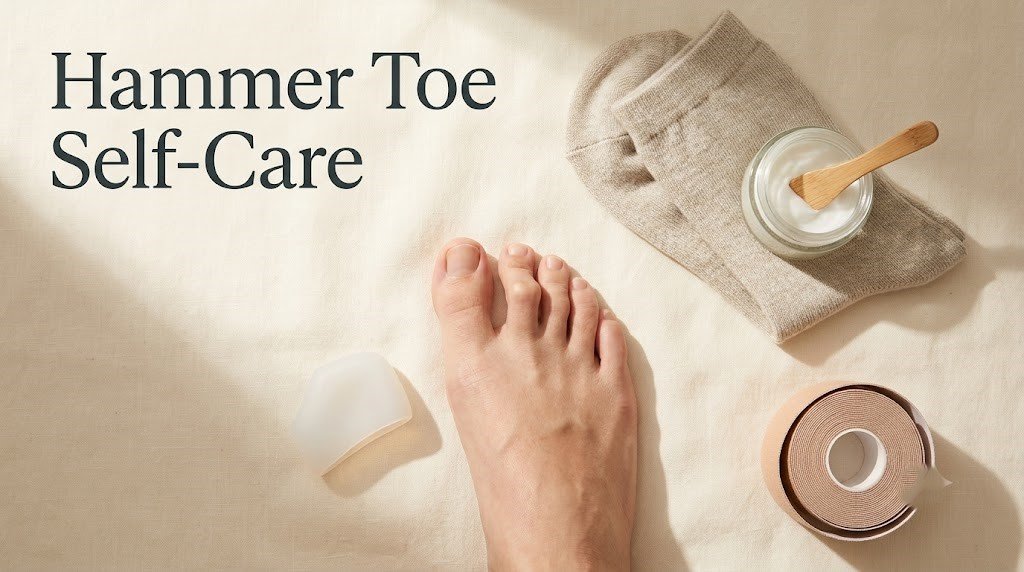
Hammer Toe Self-Care
Hammer toe self-care is the set of daily practices that protect your skin, reduce friction, manage discomfort, and slow the progression of a toe that bends upward at the middle joint. The goal is not necessarily to straighten the toe completely but to keep the skin intact, the joint mobile, and the foot comfortable enough to walk without pain. Most people can manage flexible hammer toes effectively at home for years when they understand exactly which interventions address the skin damage and which address the structural problem beneath it.
According to the American Podiatric Medical Association, hammer toe is one of the most common lesser toe deformities seen in podiatric practice, and conservative management remains the first-line approach for the majority of flexible cases. What most online guides fail to address, however, is that the skin overlying the raised proximal interphalangeal joint is the primary source of daily discomfort, not the bent joint itself. Corns, calluses, friction blisters, and skin fissures develop where the toe rubs against footwear, and managing these skin complications is what makes hammer toe livable day to day.
This article is built around that practical reality. You will learn exactly what causes hammer toe, how to tell if yours is still flexible enough to respond to self-care, and the specific skin management techniques that prevent the corns, maceration, and breakdown that generic foot care advice misses entirely. Every recommendation here reflects published podiatric and dermatological guidance, not wellness trends, and every section draws a clear line between what you can safely manage at home and what requires a board-certified podiatrist.
Key Takeaway: Hammer toe self-care works best when you treat the skin complications and the joint alignment together. Addressing one without the other is why most home care fails.
What Is Hammer Toe and What Causes It
A hammer toe is a deformity of the second, third, or fourth toe where the proximal interphalangeal joint bends downward while the metatarsophalangeal joint bends upward, creating a raised knuckle that rubs against the top of footwear. The toe essentially gets stuck in a contracted, clawing position. Unlike a mallet toe, which affects only the distal joint nearest the toenail, or a claw toe, which involves both toe joints and the metatarsophalangeal joint together, a hammer toe primarily involves that middle knuckle.
The root cause is a muscle imbalance between the intrinsic foot muscles on the bottom of the foot and the extrinsic extensor tendons on top. When the small lumbrical and interossei muscles that stabilize the toe weaken or lose mechanical advantage, the extensor digitorum longus tendon overpowers them. The metatarsophalangeal joint hyperextends upward, and the proximal interphalangeal joint compensates by flexing downward. Over time, the joint capsule tightens, soft tissue contracts, and the deformity becomes structural.
Several factors contribute to this muscle imbalance. Footwear with a narrow toe box forces toes into a cramped position, shortening the intrinsic muscles over years. High heels shift body weight forward onto the forefoot, increasing pressure on the metatarsophalangeal joints. A high-arch foot type creates inherent tendon imbalance. Trauma, arthritis, and certain neurological conditions like Charcot-Marie-Tooth disease also predispose people to hammer toe development. According to the National Institute of Arthritis and Musculoskeletal and Skin Diseases, women develop hammer toe more frequently than men, largely attributable to long-term narrow footwear use.
What matters for self-care is understanding that the skin damage happens because the raised joint becomes the highest point of contact inside your shoe. Every step creates friction and pressure directly over that bony prominence. The thicker plantar skin on the bottom of the foot is built for weight-bearing. The thinner dorsal skin on top of the toes is not. This mismatch between skin durability and pressure load is what drives every skin complication of hammer toe.
Key Takeaway: Hammer toe starts as a muscle problem but becomes a skin problem. The bend creates a pressure point where dorsal toe skin, never designed to bear weight, gets compressed against footwear with every step.
Flexible vs Rigid Hammer Toe Difference
A flexible hammer toe can be manually straightened by pulling the toe back into a neutral position using your fingers. The joint still moves, the soft tissues have not permanently contracted, and conservative self-care measures have a genuine chance of slowing progression and reducing symptoms. A rigid hammer toe cannot be straightened manually. The joint capsule has tightened, the tendons have shortened permanently, and the deformity is fixed. This distinction determines everything about what self-care can achieve.
The American Orthopaedic Foot and Ankle Society classifies hammer toe into two stages. In the flexible stage, the deformity is reducible, meaning passive manipulation can restore neutral alignment. The toe curls when standing or walking but can be straightened when non-weight-bearing. Pain is usually mild and activity-dependent. In the rigid stage, the deformity is non-reducible. The toe remains curled at rest, passive straightening is impossible, and pain is often constant. Radiographic changes including joint space narrowing and bone spur formation become visible.
Testing whether your hammer toe is flexible or rigid takes ten seconds. Sit down with your foot resting on the opposite knee. Grasp the affected toe gently. Pull it straight. If the toe moves into a neutral position without significant resistance or pain, it is flexible. If you meet firm resistance and the toe will not straighten past a certain point regardless of gentle pressure, it is rigid. Never force the toe. Pain is a hard stop signal.
This distinction guides treatment decisions. Flexible hammer toes respond to toe exercises, taping, toe spacers, and footwear changes because the soft tissues can still be retrained and repositioned. Rigid hammer toes require accommodative management only. Padding, wide toe box shoes, and silicone caps protect the skin but will not change the toe position. The Journal of Foot and Ankle Research published a 2019 systematic review confirming that conservative interventions including exercises and splinting show measurable improvement in flexible hammer toe symptoms but offer minimal structural benefit once rigidity develops.
| Feature | Flexible Hammer Toe | Rigid Hammer Toe |
|---|---|---|
| Manual straightening | Possible | Not possible |
| Joint mobility | Preserved | Fixed |
| Pain pattern | Activity-dependent | Often constant |
| Exercise benefit | High | Low |
| Taping effective | Yes | No for straightening, yes for skin protection |
| Splinting benefit | May slow progression | Provides cushioning only |
| Self-care goal | Maintain flexibility, reduce symptoms | Protect skin, accommodate deformity |
Key Takeaway: Test your toe. If it straightens with gentle manual traction, exercises and taping can help. If it does not budge, shift your self-care focus entirely to skin protection and pressure redistribution.
Hammer Toe Skin Complications Corns Calluses Blisters
Skin complications are not side effects of hammer toe. They are the primary source of daily pain. The raised proximal interphalangeal joint becomes a pressure point where dorsal toe skin, which is thin and poorly adapted to friction, rubs against the shoe upper with every step. Three distinct skin problems develop at this site, and each requires a different management approach.
A digital corn is a focal, cone-shaped plug of compact keratin that forms directly over the bony prominence of the bent joint. Podiatrists call this a heloma durum, meaning a hard corn. The keratin core points inward like a small stone pressing into the dermis, which is why corns hurt disproportionately to their size. The American Academy of Dermatology explains that corns develop when pressure concentrates on a single point, triggering the skin to thicken rapidly in that exact spot as a protective response. Unlike the diffuse callus that forms under a metatarsal head from weight-bearing pressure, a digital corn is sharply circumscribed and exquisitely tender to direct pressure.
A friction blister forms when shear forces separate the epidermis from the dermis, creating a fluid-filled pocket. On a hammer toe, this happens at the dorsal joint where the shoe upper rubs with each step. Blisters indicate acute friction exceeding what the skin can tolerate, usually from a specific footwear change or an extended walking session. Left unprotected, blisters rupture, creating an open wound directly over a bony prominence where healing is slow.
Skin splitting or fissuring occurs when the stretched skin over the bent joint becomes so dry and inelastic that it cracks under tension. The dorsal toe skin already has fewer sebaceous glands than facial skin, and the constant bending stress depletes its natural moisture barrier. Fissures can extend into the dermis, bleed, and create an entry point for bacteria. This is particularly dangerous for people with diabetes or peripheral neuropathy, where even a small fissure can progress to a non-healing ulcer.
Between the toes, a different problem arises. The contracted toe position often crowds adjacent toes, creating moist, warm interdigital spaces where soft corns can develop. A soft corn is a rubbery, macerated keratin buildup caused by pressure and moisture between toes. These are prone to secondary fungal and bacterial overgrowth.
Key Takeaway: Corns, blisters, and fissures each have a different mechanism. Corns come from sustained point pressure, blisters from acute shear friction, and fissures from skin dryness combined with mechanical tension. Treating them interchangeably makes everything worse.
How to Treat Hammer Toe Corns at Home
Treating a hammer toe corn at home requires a keratolytic agent that dissolves keratin protein bonds, not a moisturizer that only softens the surface. Salicylic acid at 17 to 40 percent concentration is the standard over-the-counter keratolytic for digital corns, available as medicated plasters, liquid drops, or gel formulations. It works by breaking disulfide bonds in the keratin structure of the corn, allowing the hardened tissue to be gradually sloughed away over several days.
Apply salicylic acid corn treatment only to the corn itself, never to the surrounding healthy skin. Before application, soak the foot in warm water for ten to fifteen minutes to soften the keratin. Dry the toe thoroughly. Protect the healthy skin around the corn with a thin layer of petroleum jelly applied with a cotton swab. Then apply the salicylic acid preparation directly to the corn surface. Cover with a bandage if the product is not already on a medicated plaster. Repeat daily for up to five days, then gently file the softened corn with a pumice stone or emery board after soaking. Never cut or shave a corn with a blade. That turns a manageable skin lesion into an open wound with infection risk.
A 2020 clinical review in the Journal of the American Podiatric Medical Association confirmed that salicylic acid preparations are effective for digital corn debridement when used correctly but emphasized that the underlying pressure source must be addressed simultaneously. You can dissolve a corn completely, but if the hammer toe joint continues pressing against the same shoe, the corn will recur within two to four weeks. This is why padding and footwear modification are non-negotiable even during corn treatment.
Urea 40 percent cream is the non-acid alternative for people who cannot tolerate salicylic acid due to skin sensitivity, aspirin allergy, or pregnancy. Urea is a humectant and keratolytic that denatures keratin proteins more gently than salicylic acid. Apply urea 40 percent cream to the corn, cover with a bandage, and leave overnight. The occlusive environment enhances penetration. Results take longer than salicylic acid, typically one to two weeks for visible softening, but the irritation risk is substantially lower.
Critical Safety Note: Salicylic acid corn treatments are absolutely contraindicated if you have diabetes, peripheral neuropathy, or peripheral arterial disease. The Journal of Foot and Ankle Research reports that chemical corn removers are a leading cause of preventable foot ulcers in diabetic populations. If you have any condition that reduces sensation or circulation in your feet, corn treatment belongs exclusively in a podiatrist’s office.
| Treatment | Active Ingredient | How It Works | Timeline | Safety Notes |
|---|---|---|---|---|
| Medicated corn plaster | Salicylic acid 17-40% | Keratolytic; breaks keratin bonds | 3-7 days | Not for diabetic/neuropathic feet |
| Urea 40% cream | Urea 40% | Keratolytic and humectant | 7-14 days | Gentler alternative to salicylic acid |
| Ammonium lactate 12% | Lactic acid derivative | Exfoliates and moisturizes | 10-21 days | Best for combined corn and surrounding dryness |
| Pumice stone filing | Mechanical abrasion | Physical keratin removal | After soaking only | Never on unsoftened skin; never cut |
Key Takeaway: Salicylic acid treats the corn you have. Footwear modification and padding prevent the corn from coming back. You must do both or neither works long-term.
Preventing Skin Breakdown on Hammer Toes
Preventing skin breakdown means stopping friction and pressure from reaching the vulnerable dorsal skin over the proximal interphalangeal joint before damage begins. This is the most important daily self-care action you can take, more important than any cream or exercise, because once the skin breaks open, everything stops. You cannot exercise a toe with an open fissure. You cannot tape over a blister. Prevention is the foundation.
The friction force that damages hammer toe skin is called shear stress. It occurs when the shoe upper slides across the toe skin with each step rather than moving with it. Reducing shear requires a friction barrier between the toe and the shoe. Silicone toe caps, gel sleeves, and properly selected socks are the three primary barriers. Each works differently. A silicone toe cap encases the entire toe in a smooth, low-friction surface that absorbs shear and distributes pressure across a wider area. The shoe upper rubs against the silicone, not the skin. A gel sleeve lined with mineral oil provides similar protection with less bulk, useful in tighter shoes. A friction-reducing sock fabric like merino wool or Coolmax polyester creates a low-shear interface and wicks moisture away from the skin, because wet skin has a higher coefficient of friction than dry skin. Friction against damp skin causes more damage with less force.
Pressure redistribution matters just as much as friction reduction. A metatarsal pad placed just behind the metatarsal heads, not under them, shifts weight away from the forefoot and reduces the upward force driving the hammer toe joint into the shoe upper. The correct placement is critical. A pad positioned too far forward under the metatarsal heads actually increases pressure on the toes. A pad too far back does nothing. The sweet spot is immediately proximal to the metatarsal heads, where it slightly lifts the metatarsal shafts and allows the toes to relax.
Daily skin inspection is the habit that catches problems before they become wounds. Check the dorsal surface of every hammer toe every evening when you remove your socks. Look for redness, shiny skin indicating early friction damage, small fluid-filled bumps, or the first white ring of a developing corn. Early intervention at the redness stage with a silicone cap takes two seconds and costs nothing in recovery time. Waiting until a blister forms means days of healing. The American Academy of Dermatology recommends this daily foot inspection as a core self-care practice for anyone with a foot deformity that creates pressure points, and it becomes medically critical for people over 50 when skin thinning and slower healing compound the risk.
Key Takeaway: Shear stress causes the damage, not just pressure alone. A silicone toe cap that lets the shoe glide over it without grabbing the skin prevents more breakdown than any cream applied after the fact.
Moisturizing Hammer Toes Without Causing Maceration
Moisturizing hammer toes requires a strategy that addresses dry dorsal skin without trapping moisture in the deep skin crease on the underside of the bent joint. This is where generic “moisturize your feet” advice fails for hammer toe specifically. The contracted proximal interphalangeal joint creates a skin fold on the plantar aspect of the toe that remains closed and dark and moist. Apply a heavy cream everywhere and that fold becomes a maceration chamber where keratin breaks down, skin turns white and soggy, and fungal organisms thrive.
The correct technique is differential moisturizing. Apply an emollient cream containing urea 10 to 20 percent or ammonium lactate 12 percent to the dorsal surface of the hammer toe only, where the skin is dry, stretched, and prone to fissuring. Use a small amount, roughly a pea-sized dab per toe. Massage it in thoroughly until no residue remains on the surface. For the interdigital spaces and the underside skin crease, apply nothing. These areas need to stay dry. After showering or bathing, dry between the toes with a separate towel or a cotton swab before applying any product anywhere on the foot. This single habit prevents more interdigital maceration than any antifungal powder.
Cream formulation matters. Occlusive petrolatum-based products like petroleum jelly or thick shea butter balms create a water-impermeable film that is excellent for heel calluses but problematic for toe creases where ventilation is already poor. A lotion or cream with a humectant base absorbs more completely and leaves less residue to migrate into creases. Look for glycerin, urea, sodium PCA, or hyaluronic acid as the primary humectants rather than petrolatum as the primary occlusive. The International Journal of Cosmetic Science notes that humectant-dominant formulations are preferred for intertriginous areas like toe webs and skin folds because they improve stratum corneum hydration without blocking transepidermal water vapor transmission enough to trigger maceration.
If you notice white, soggy skin between your hammer toe and the adjacent toe, stop all moisturizing in that area immediately. Dry the space thoroughly. Apply an over-the-counter antifungal powder containing miconazole or clotrimazole if redness or itching suggests fungal involvement. Allow the area to air-dry for fifteen minutes twice daily. Once the maceration resolves, resume differential moisturizing with the strict rule that only the dorsal toe surface receives product. The American Academy of Dermatology specifically recommends this separation of moisturizing zones for anyone with overlapping or contracted toes where skin-on-skin contact creates moisture traps.
Key Takeaway: Moisturize the top of the hammer toe where the skin is dry and stretched. Leave the underside crease and between-toe spaces completely dry. Different zones, different rules.
Best Socks and Footwear for Hammer Toe Friction Reduction
Socks are the most overlooked variable in hammer toe self-care. The sock is the direct interface between your skin and your shoe, and its fiber type, thickness, seam construction, and moisture management determine how much friction reaches your toe with every step. A shoe with adequate toe box depth is useless if the sock inside it has a thick abrasive seam sitting directly over your proximal interphalangeal joint.
The ideal hammer toe sock has four characteristics. First, seamless toe construction. Most socks have a seam running across the top of the toes that creates a raised ridge. On a normal foot, this is a minor annoyance. On a hammer toe, that ridge sits exactly over the most pressure-sensitive spot and functions like a miniature saw with each step. Seamless socks, sometimes labeled as “diabetic socks” or “sensitive foot socks,” eliminate this ridge entirely. Second, moisture-wicking fiber. Merino wool transports water vapor away from the skin and has a naturally low coefficient of friction against skin compared to cotton. Cotton absorbs moisture, loses its structure when wet, and increases friction. A 2021 study in the Journal of Foot and Ankle Research found that synthetic moisture-wicking socks reduced dorsal foot blister incidence by 47 percent compared to cotton socks during prolonged walking. Third, adequate cushioning without bulk. A sock that is too thick reduces the functional toe box space inside the shoe, paradoxically increasing pressure on the hammer toe. Fourth, a non-binding cuff that does not restrict circulation at the ankle or compress the forefoot.
For footwear, the critical measurement is toe box depth, not shoe length. A hammer toe joint sits higher than a normal toe joint. A shoe that is long enough but shallow will still crush the dorsal prominence. The American Podiatric Medical Association recommends shoes with an extra-depth toe box that provides at least one-half inch of clearance above the highest point of the hammer toe when standing. This means trying shoes on at the end of the day when feet are slightly swollen, wearing the exact sock thickness you will use daily, and physically checking clearance by pressing on the shoe upper over the hammer toe. If you feel the joint immediately under the material, the shoe is too shallow regardless of how the length feels at the heel.
Shoe upper material also matters. A soft, flexible upper like unlined leather or stretch mesh conforms to the toe rather than resisting it. A stiff patent leather or synthetic upper that does not yield creates a rigid wall the toe presses against. Lacing systems can be adjusted to reduce forefoot pressure. Skip the lowest eyelet near the toes and use a parallel lacing pattern rather than a crisscross pattern over the forefoot. This reduces downward pressure from the shoe tongue onto the dorsum of the foot and toes.
| Sock Feature | Why It Matters for Hammer Toe | What to Look For |
|---|---|---|
| Seamless toe | Eliminates abrasive ridge over the joint | “Seamless toe” or “hand-linked toe” on packaging |
| Fiber type | Controls friction and moisture | Merino wool, Coolmax, or bamboo blends; avoid 100% cotton |
| Thickness | Too thick reduces toe box space | Medium cushion; test in your actual shoes |
| Fit | Compression worsens deformity | Non-binding top; wide toe box shape |
| Moisture management | Wet skin friction is higher than dry | Wick-dry rated; change if damp mid-day |
Key Takeaway: The right sock costs fifteen dollars and prevents more hammer toe skin damage than any fifty-dollar cream. Seamless toe, merino wool or moisture-wicking synthetic, and medium cushion. Cotton socks actively worsen friction on a hammer toe.
Silicone Toe Caps vs Gel Sleeves for Hammer Toe
Silicone toe caps and gel toe sleeves both create a protective barrier between the hammer toe and the shoe, but they work through different mechanisms and suit different situations. Choosing the wrong one wastes money and may worsen the problem you are trying to solve.
A silicone toe cap is a thick, molded sleeve that covers the entire toe from tip to base, often with a slight anatomical curve to match toe shape. It works by absorbing pressure, distributing it across a wider surface area, and providing a smooth low-friction surface for the shoe to glide over. The silicone material, typically medical-grade silicone polymer, is dense enough to cushion the bony prominence while flexible enough to move with the toe during walking. Silicone caps work best for rigid hammer toes where the joint is fixed and the primary need is protection rather than alignment correction. They add meaningful volume inside the shoe, so they require adequate toe box depth. Using a silicone cap in a shoe that is already shallow will increase pressure, not reduce it.
A gel toe sleeve is thinner, usually lined with mineral oil or vitamin E gel, and stretches to fit over the toe like a fabric tube coated in gel. It provides less bulk and less pressure redistribution than a silicone cap but conforms better to irregular toe shapes. Gel sleeves work best for flexible hammer toes where you need protection but still want some ability to feel the ground and maintain proprioceptive feedback. They are also better for shoes with limited extra depth where a full silicone cap would crowd the toe box. The mineral oil lining provides continuous low-level moisturization, which helps prevent fissuring on the dorsal surface but requires careful monitoring of the skin crease underneath for maceration.
The key difference in practice is this. If your hammer toe hurts most from direct pressure when wearing shoes, choose a silicone toe cap for its superior cushioning. If your hammer toe hurts most from friction and rubbing, a gel sleeve may be sufficient and will fit in more shoes. Some people use both, a gel sleeve for daily wear and a silicone cap for extended walking or exercise.
Material durability differs. Silicone caps last several months with daily washing. Gel sleeves lose their gel coating more quickly, typically needing replacement every four to six weeks. Both should be washed daily with mild soap and water and dried completely before reuse to prevent bacterial colonization. The American Podiatric Medical Association notes that any toe device that traps moisture against the skin for extended periods increases maceration risk, so removing and drying the toe and the device at midday is recommended for full-day wear.
Key Takeaway: Silicone toe caps are thicker, more protective, and better for rigid hammer toes, but they need roomy shoes. Gel sleeves are thinner, fit in more shoes, and work for flexible toes where friction is the main issue.
Hammer Toe Padding and Splinting Options
Padding and splinting serve different goals. Padding protects the skin and reduces pressure. Splinting attempts to hold the toe in a corrected or neutral position to slow deformity progression. Using a splint when you need a pad will be uncomfortable and ineffective. Using a pad when a splint might help misses an opportunity to preserve toe alignment.
Padding options for hammer toe start with simple adhesive felt or moleskin pads cut to size and applied directly over the dorsal corn or pressure point. These are the most basic, least expensive, and most universally available option. The key is cutting a donut shape or U-shape that surrounds the pressure point without sitting directly on top of it. Placing a flat pad over the corn increases pressure on the prominence because the pad adds height. A donut pad redistributes pressure to the surrounding skin. Replace adhesive pads daily. They lose adhesion, shift position, and the accumulated moisture underneath can macerate skin if left for multiple days.
Metatarsal pads represent a different padding strategy. Instead of protecting the toe, they alter foot mechanics to reduce the force driving the hammer toe upward. A metatarsal pad placed just proximal to the metatarsal heads reduces metatarsophalangeal joint hyperextension, which in turn reduces the compensatory flexion at the proximal interphalangeal joint. This is biomechanical padding rather than protective padding. The Journal of the American Podiatric Medical Association describes metatarsal pad placement as the single most technique-sensitive conservative hammer toe intervention. Two millimeters too far forward and it worsens symptoms. Two millimeters too far back and it does nothing.
Splinting options include the toe crutch splint, which has a cushioned pad under the plantar toe surface and a strap that pulls the toe downward into a more neutral position, and the Budin splint, which similarly applies a corrective force. These splints aim to stretch the tightened dorsal joint capsule and extensor tendons. Splinting works only for flexible hammer toes. Applying a corrective splint to a rigid toe creates pressure ulcers without changing alignment. Night splinting while sleeping allows prolonged low-load stretching without the competing forces of weight-bearing, making it potentially more effective than daytime splinting for flexible deformities. A 2018 study in the Journal of Foot and Ankle Research found that night splinting for eight weeks improved flexible hammer toe alignment in approximately 60 percent of participants, though long-term maintenance required ongoing use.
| Device | Function | Best For | Not For |
|---|---|---|---|
| Felt donut pad | Offloads pressure from corn | Flexible or rigid hammer toe with painful corn | Wet environments; replace daily |
| Metatarsal pad | Reduces MTP joint hyperextension | Flexible hammer toe; forefoot pain | Rigid deformity; incorrect placement worsens symptoms |
| Toe crutch splint | Holds toe in corrected position | Flexible hammer toe; night use | Rigid deformity; ill-fitting splints cause ulcers |
| Gel toe spreader | Separates adjacent toes | Interdigital soft corns; overlapping toes | Does not address dorsal pressure |
| Silicone toe cap | Cushions dorsal prominence | Rigid hammer toe; skin protection during activity | Shoes with inadequate depth |
Key Takeaway: Padding protects skin. Splinting attempts to preserve alignment. Know which problem you are solving before you choose. A donut pad placed over a corn with the hole directly over the pressure point protects more effectively than a flat pad that adds height.
Hammer Toe Taping Technique Step by Step
Taping a hammer toe correctly pulls the proximal interphalangeal joint downward into a more neutral position while anchoring the toe to an adjacent stable toe. This is called buddy taping with a plantar flexion component, and it serves two purposes simultaneously. It reduces the dorsal prominence rubbing against the shoe, and it provides a sustained gentle stretch to the tightened joint capsule and extensor tendons. Taping works only for flexible hammer toes. Taping a rigid toe is ineffective and painful.
To tape a hammer toe:
- Start with clean, completely dry skin. Any moisture under the tape causes maceration within hours. Wipe the toe and the adjacent toe with alcohol, let dry fully.
- Place a small piece of cotton, gauze, or a silicone toe separator between the hammer toe and the adjacent toe. This prevents skin-on-skin maceration and provides a cushion for the tape pressure. The interdigital spacer should be thin enough not to splay the toes apart unnaturally.
- Use one-half inch medical tape, paper tape, or kinesiology tape. Zinc oxide athletic tape works but is more occlusive and increases maceration risk with prolonged wear. Kinesiology tape is preferred because it is breathable, flexible, and designed for multi-day wear on moving joints.
- Start the tape on the dorsal surface of the hammer toe just below the proximal interphalangeal joint, wrap under the toe with gentle downward traction pulling the joint into a slightly flexed or neutral position, then bring the tape across the interdigital space and anchor it on the adjacent stable toe.
- Apply a second piece of tape in a figure-eight pattern for additional stabilization if needed. The tape should feel supportive, not constrictive. If the toe turns white or blue, the tape is too tight and must be removed immediately.
- Wear tape during the day for support inside shoes. Remove tape at night to allow skin to breathe and to inspect for any tape-related skin damage. Some people benefit from night taping with the toe in a corrected position without shoe pressure, using a lighter tape tension.
Remove tape immediately if you feel tingling, numbness, color change, or increasing pain. Never sleep in daytime tape tension. The skin under tape cannot shed normally, so keep tape off for at least eight hours daily to allow epithelial turnover. People with fragile skin, those on blood thinners, or those with peripheral vascular disease should not tape without first consulting a podiatrist. Tape removal can shear fragile skin and create wounds that are more problematic than the hammer toe itself.
Key Takeaway: Tape pulls the flexible hammer toe down and anchors it to a neighbor. Kinesiology tape is the best material choice for breathability. Always use an interdigital spacer between the toes and never tape so tight that skin color changes.
Hammer Toe Exercises and Stretches That Help
Hammer toe exercises target the small intrinsic foot muscles that stabilize the toe in a neutral position. Strengthening these muscles helps counteract the overpull of the extensor tendons on top of the foot. The exercises that actually work focus on toe grasping, toe spreading, and manual passive stretching of the tightened structures. Consistency matters more than intensity. Five minutes daily produces better results than thirty minutes once weekly.
The towel scrunch exercise strengthens the flexor digitorum brevis and the small interossei and lumbrical muscles. Sit with your foot flat on a towel placed on a smooth floor. Keeping your heel planted, use only your toes to scrunch the towel toward you. Repeat until the towel is fully gathered, then smooth it out and repeat. Do this for three sets. The muscles will fatigue quickly at first. That is normal and expected. Intrinsic foot muscles atrophy rapidly with disuse and rebuild slowly over weeks.
The toe spread or toe abduction exercise targets the dorsal and plantar interossei. Sit with your foot flat. Attempt to spread all toes apart from each other as wide as they will go, hold for five seconds, release. Many people find they cannot consciously activate toe abduction at first. The neurological connection weakens from years of toes being compressed in shoes. Place your finger between two toes and try to squeeze it, then relax. This biofeedback helps retrain the brain-toe connection. Progress to unassisted spreading over one to two weeks.
Manual passive stretching addresses the tightened dorsal joint capsule and extensor tendons. Sit with your foot crossed over the opposite knee. Grasp the hammer toe with one hand stabilizing the metatarsophalangeal joint and the other hand holding the toe. Gently pull the toe into a straightened position, then add slight plantar flexion. Hold for thirty seconds without bouncing. Repeat five times. Perform this stretch after a warm foot soak when tissues are more pliable. Never stretch into pain. The goal is a gentle pull that feels like a stretch, not a sharp sensation that feels like tearing.
The Journal of Foot and Ankle Research published a 2020 randomized controlled trial demonstrating that a daily eight-week intrinsic foot muscle exercise program improved toe alignment and reduced pain scores in participants with flexible hammer toes compared to a control group receiving footwear advice alone. The study used a protocol of towel scrunches, marble pickups with toes, and passive stretching, performed for ten minutes daily. The marble pickup exercise, placing marbles on the floor and picking them up one by one with the toes to drop into a cup, was particularly effective for intrinsic muscle recruitment.
Key Takeaway: Towel scrunches, toe spreading, marble pickups, and passive stretching done for five to ten minutes daily strengthen the muscles that oppose the deforming forces. Results build over eight weeks, not eight days.
Toe Separators and Spacers for Hammer Toe Alignment
Toe separators and spacers address the crowding component of hammer toe that develops when the bent toe presses against its neighbors, creating interdigital soft corns and worsening the rotational deformity. A toe separator is a device placed between two toes to maintain separation and prevent skin-on-skin contact. A toe spacer or toe spreader is slightly broader and attempts to restore more natural toe spacing across multiple toes. Neither device directly straightens a hammer toe, but both reduce the secondary damage that crowding causes.
Gel toe separators are the most common and comfortable option. The single-toe loop design fits around the hammer toe or the adjacent toe with a small gel cushion that sits in the interdigital space. They prevent soft corns, reduce friction between toes, and can be worn inside socks during the day. Silicone toe spreaders that fit between multiple toes simultaneously are bulkier and typically limited to barefoot or loose slipper use at home. Their value is in passive stretching of contracted intermetatarsal ligaments and in giving the toes time in a more anatomically spaced position after hours of shoe compression.
Toe separators are not corrective devices for the proximal interphalangeal joint deformity of hammer toe. They do not pull the bent joint straight. What they do is prevent the hammer toe from rotating and drifting toward or under the adjacent toe, which is a common progression pattern. A hammer toe that begins as an isolated sagittal plane deformity can develop a transverse plane rotational component when shoe pressure forces it laterally into the neighboring toe. A toe separator prevents this lateral pressure transmission.
For people who experience burning pain between toes or notice macerated skin and soft corns in the interdigital spaces, toe separators are often the single most immediately effective intervention. The relief comes from eliminating skin-on-skin friction and allowing ventilation. Gel separators with an antimicrobial coating claim to reduce bacterial and fungal colonization, though the primary mechanism of benefit is mechanical separation rather than antimicrobial activity. Wash separators daily and dry them completely. Replace when the gel loses elasticity, typically every two to three months with daily use.
Key Takeaway: Toe separators do not straighten hammer toes. They prevent the secondary crowding damage and interdigital soft corns that make hammer toe more painful and harder to manage.
Hammer Toe Pain Relief Methods at Home
Hammer toe pain has two distinct sources, and effective relief depends on treating the right one. Pressure pain comes from the dorsal corn or the inflamed bursa over the proximal interphalangeal joint being compressed against footwear. Joint pain comes from the synovitis and capsulitis inside the bent joint itself. The first responds to offloading and protection. The second responds to anti-inflammatory measures and temporary rest from aggravating activity.
For pressure pain, the immediate intervention is removing the shoe and applying a silicone toe cap or donut pad before putting the shoe back on. If you are at home, simply being barefoot or in open-toed slippers eliminates the pressure source entirely. Pressure pain should resolve within minutes to an hour once offloading is achieved. Pain that persists hours after removing shoes suggests joint inflammation rather than or in addition to pressure pain.
For joint inflammation, a cold pack applied to the dorsal toe for ten to fifteen minutes reduces synovial swelling and provides temporary analgesia. Wrap the cold pack in a thin cloth. Never apply ice directly to toe skin, which is thin and vulnerable to cold injury. Oral nonsteroidal anti-inflammatory drugs like ibuprofen or naproxen can reduce joint inflammation when taken as directed on the label, but they treat the symptom, not the cause. If you need NSAIDs more than twice weekly for hammer toe pain, the underlying mechanical problem needs a podiatrist’s evaluation.
Warm foot soaks with Epsom salt provide symptomatic relief through two mechanisms. The warmth increases blood flow and relaxes soft tissues, temporarily improving toe flexibility, and the magnesium sulfate in Epsom salt may provide mild anti-inflammatory effects through transdermal magnesium absorption, though the clinical evidence for transdermal magnesium efficacy remains limited. A fifteen-minute soak in warm water, not hot, before exercises or stretching improves tissue compliance and reduces stretching discomfort. Dry thoroughly, especially between toes, after every soak.
Topical analgesic creams containing menthol or camphor provide temporary pain relief through counterirritation. They create a cooling or warming sensation that distracts the nervous system from pain signals. These do not treat the underlying condition. Menthol-based creams should never be applied to broken skin or open fissures. Topical diclofenac gel, an NSAID available over the counter in some formulations, can reduce localized joint inflammation when applied over the painful proximal interphalangeal joint, but absorption through dorsal toe skin is limited. The clinical benefit is modest and best reserved for inflammatory flares rather than daily use.
Key Takeaway: Figure out whether the pain is pressure pain or joint inflammation. Pressure pain resolves with offloading. Joint inflammation needs cold therapy and temporary rest. Using the wrong approach for the wrong pain source wastes time.
Daily Foot Care Routine for Hammer Toes
A daily hammer toe foot care routine combines skin protection, joint maintenance, and pressure redistribution into a sequence that takes under ten minutes. Consistency transforms hammer toe from a daily source of discomfort into a managed condition that stays in the background. The routine has morning and evening components that address different needs.
Morning routine focuses on preparing the foot for the day’s pressure. Wash feet with lukewarm water and a gentle syndet cleanser rather than traditional soap, which is alkaline and strips the stratum corneum lipids that protect dorsal toe skin. Dry completely, paying specific attention to the interdigital spaces and the deep skin crease on the underside of the hammer toe. Apply a humectant-based lotion with urea or ammonium lactate to the dorsal surface of the hammer toe only, massaging it in thoroughly. Insert a gel toe separator between the hammer toe and the adjacent toe if you are prone to interdigital maceration. Apply a silicone toe cap or donut pad over the dorsal joint. Put on seamless moisture-wicking socks. Check shoe toe box clearance by pressing on the upper over the hammer toe before lacing.
Evening routine focuses on recovery and inspection. Remove socks and any toe devices. Visually inspect the dorsal hammer toe skin for redness, blister formation, or early corn development. Check the interdigital spaces for maceration. If skin is intact, perform passive toe stretches. Do two to three minutes of towel scrunches or marble pickups while sitting and watching television. Apply urea-based cream to the dorsal toe surface only, leaving the creases dry. Consider night splinting if you have a flexible hammer toe and have discussed it with a podiatrist.
Weekly additions include soaking the foot in warm water for ten minutes before gently filing any developing callus or corn with a pumice stone after the soak softens the keratin. Never file dry skin. Never use a blade. Apply salicylic acid corn treatment if a corn is actively present, following the protection and application protocol outlined earlier. Replace adhesive felt padding. Wash all silicone and gel devices with mild soap and water and allow them to air dry overnight.
The American Podiatric Medical Association emphasizes that daily foot inspection becomes non-negotiable for anyone over 50, anyone with diabetes or prediabetes, and anyone with reduced foot sensation from any cause. What begins as a minor corn or fissure can progress to a wound requiring months of offloading to heal when healing capacity is diminished. The evening skin check is the single highest-yield habit in the entire self-care routine.
Key Takeaway: Morning protects. Evening recovers and inspects. The evening skin check catches problems when they are still redness you can fix with a silicone cap, not a wound that stops you from walking.
When Hammer Toe Self-Care Is Not Enough
Self-care has clear limits, and recognizing them prevents a manageable condition from becoming a surgical one. The threshold where self-care must transition to professional podiatric care is defined by pain that limits function, skin that will not heal, or a deformity that has become rigid and progressive.
A board-certified podiatrist should evaluate your hammer toe when any of these conditions are met. Pain that consistently limits your walking distance or causes you to alter your gait to avoid pressure on the toe indicates that the deformity has progressed beyond what padding and footwear can manage. An altered gait from toe pain eventually causes secondary problems in the ankle, knee, hip, and lower back as the body compensates. A corn or callus that repeatedly breaks down, bleeds, drains fluid, or shows surrounding redness and warmth may be ulcerated or infected. What looks like a stubborn corn may be an impending ulcer, especially over a bony prominence where soft tissue coverage is thin. An open wound on a hammer toe must be evaluated by a podiatrist within twenty-four hours if you have diabetes or peripheral neuropathy. The risk of rapid deterioration into a limb-threatening infection is too high for watchful waiting.
If the hammer toe has become rigid and you can no longer passively straighten it, self-care’s structural benefit ends here. Rigid hammer toes do not respond to exercises, taping, or splinting because the joint capsule and tendons are permanently shortened and bony changes have occurred. Continuing to force these interventions on a rigid toe can cause ligament tears, capsular damage, and skin breakdown. A rigid hammer toe still benefits from accommodative self-care, proper footwear, silicone caps, and skin protection, but the goal shifts entirely to comfort and skin integrity rather than alignment improvement.
If the toe is beginning to overlap or underlap the adjacent toe, the deformity is progressing. This progression changes the pressure dynamics and creates new skin breakdown risks in the interdigital spaces. A podiatrist can assess whether custom orthotics with specific posting and metatarsal support can slow the progression or whether surgical intervention should be considered before the deformity becomes more complex to repair. The Journal of Foot and Ankle Research notes that hammer toe surgery outcomes are better and recovery is faster when the deformity is corrected in the flexible to early rigid stage compared to the fully rigid stage with secondary contractures.
Key Takeaway: Pain that changes how you walk, skin that will not stay healed, and a toe that has become rigid and is drifting toward its neighbor are the three hard stops for self-care. A board-certified podiatrist needs to evaluate at that point.
Preventing Hammer Toe From Getting Worse
Preventing hammer toe progression requires removing the mechanical forces that drive the deformity forward while maintaining the muscle strength that resists it. Every step taken in a shoe with inadequate toe box depth applies a dorsiflexion force to the metatarsophalangeal joint and a compressive force to the proximal interphalangeal joint. Over thousands of steps daily, these forces gradually tighten the joint capsule and shorten the extensor tendons. Prevention is daily force reduction, not a one-time footwear purchase.
The single highest-impact prevention measure is ensuring every shoe you own has adequate toe box depth and width for your hammer toe with whatever sock and toe device you wear inside it. This often means replacing multiple pairs of shoes, not just buying one pair of orthopedic shoes and wearing the old damaging ones three days a week. The cumulative exposure matters. Even two hours in a shallow dress shoe once weekly applies enough repetitive dorsiflexion stress to counteract the benefit of the other five days in proper footwear. The American Podiatric Medical Association recommends that people with existing hammer toes evaluate every pair of shoes against the same depth and width criteria, not just their walking shoes.
Maintaining intrinsic foot muscle strength through daily exercises prevents the muscle atrophy that allows the deformity to accelerate. Intrinsic foot muscles weaken with age and disuse regardless of footwear, but the combination of aging plus compressive footwear accelerates atrophy significantly. A 2022 study in the Journal of Foot and Ankle Research found that adults over 50 with hammer toes who performed daily intrinsic foot exercises maintained toe alignment and reported less pain progression over a two-year follow-up compared to those who relied on footwear modification alone. The exercises do not need to be intensive. Five minutes of towel scrunches and toe spreading while watching television is sufficient for maintenance.
Weight management reduces the load transmitted through the forefoot with every step. The metatarsophalangeal joints bear approximately 60 percent of body weight during the push-off phase of gait. Every pound of body weight multiplies through these small joints. Weight loss cannot reverse an existing hammer toe, but it demonstrably reduces the rate of progression and the severity of pressure-related skin complications. This is particularly relevant for the second metatarsophalangeal joint, which is the most common site of hammer toe development and the joint most sensitive to increased forefoot loading.
Key Takeaway: Prevention is daily. Every shoe counts. Five minutes of toe exercises daily maintains the muscles that resist deformity progression. A single damaging shoe worn once a week can undo the benefit of proper footwear the other six days.
Frequently Asked Questions About Hammer Toe
Can hammer toe be corrected without surgery?
Flexible hammer toes can often be managed and their progression slowed without surgery using exercises, proper footwear, taping, and splinting.
Once a hammer toe becomes rigid and cannot be manually straightened, surgery is the only option for structural correction.
Self-care can still protect the skin and reduce discomfort in rigid toes even when straightening is no longer possible.
What is the best cream for hammer toe corns?
A cream containing 17 to 40 percent salicylic acid, available as medicated corn plasters or liquid, is the standard over-the-counter treatment for hammer toe corns.
Urea 40 percent cream is the non-acid alternative for people who cannot tolerate salicylic acid due to sensitivity or pregnancy.
Salicylic acid corn treatments must never be used by people with diabetes, peripheral neuropathy, or poor circulation without podiatrist supervision.
How do you tape a hammer toe properly?
Use half-inch kinesiology tape to pull the flexible hammer toe downward into a neutral position and anchor it to an adjacent stable toe.
Place a small cotton or gel spacer between the toes before taping to prevent skin maceration.
The tape should be supportive but never tight enough to change skin color, and it must be removed for at least eight hours daily to allow skin recovery.
What socks are best for hammer toes?
Seamless toe socks made from merino wool or moisture-wicking synthetic fibers like Coolmax reduce friction over the dorsal hammer toe joint.
Cotton socks increase friction when damp and should be avoided for hammer toe management.
The sock should have medium cushioning, adequate toe box width, and a non-binding cuff that does not compress the forefoot.
Can hammer toe cause skin problems between toes?
Yes, the bent position of a hammer toe forces it against neighboring toes, creating warm, moist interdigital spaces where soft corns, maceration, and fungal infections develop.
Daily drying between toes and using gel toe separators prevents skin-on-skin contact and reduces interdigital breakdown.
Interdigital skin that becomes white, soggy, or painful requires stopping all moisturizing in that area and allowing it to dry completely.
When should I see a podiatrist for hammer toe?
See a board-certified podiatrist when hammer toe pain consistently limits your walking, when a corn repeatedly breaks down or shows signs of infection, or when the toe becomes rigid and cannot be manually straightened.
Anyone with diabetes, peripheral neuropathy, or poor circulation should have a podiatrist manage all hammer toe skin complications rather than attempting self-treatment.
A toe that is beginning to overlap the adjacent toe also warrants podiatric evaluation before the deformity progresses further.
Hammer toe self-care succeeds when it addresses both halves of the problem: the skin that suffers and the joint that bends. Protecting dorsal toe skin with silicone caps, proper socks, and correctly placed padding keeps you comfortable and mobile while the slower work of exercises and footwear correction addresses the underlying mechanics. The single habit that prevents the most misery is the daily evening skin check. Catch redness before it becomes a blister, a developing corn before it becomes a wound, and maceration before it becomes an infection.
If your hammer toe is still flexible, start tonight with passive stretching and tomorrow morning with a silicone toe cap and seamless socks. Give exercises eight weeks of daily consistency before deciding whether they help. If your toe is rigid, accept that structural correction is no longer the goal and commit fully to skin protection and accommodative footwear. Both paths are valid. Both can keep you walking comfortably for years.
The line between self-care and professional care is real and important. Pain that changes your gait, skin that will not heal, and a toe that has stopped moving are your signals to bring a podiatrist onto your team. There is no prize for managing a condition alone that needs a second set of trained eyes.