Korean Skincare Advent Calendar 2026: A Buyer’s Guide
A Korean skincare advent calendar can be a brilliant way to try multiple K-beauty formulations at a fraction of their individual retail cost, but only if the ingredients inside actually match your skin type and the value holds up to scrutiny. These sets are not just holiday novelties. They are, in practical terms, a fast-tracked product testing kit, and how you approach them determines whether your skin ends up happier or seriously irritated by January.
According to the American Academy of Dermatology, introducing even a single new skincare product correctly requires a patch test and a two-week observation window, a timeline that directly conflicts with the daily-unboxing format of an advent calendar. A 24-product set opened one door per day introduces more variables in three weeks than most board-certified dermatologists would recommend across six months. That tension between novelty and skin safety defines every decision worth making here.
This guide walks you through exactly what to look for in a 2026 Korean skincare advent calendar, which ingredients justify the purchase and which serve only as decorative filler, how to match a calendar to your specific skin type, what the real dollar value of these sets looks like when you strip away marketing math, and the safe, methodical approach to introducing these products without disrupting your skin barrier. You will finish knowing whether a K-beauty advent calendar belongs in your holiday plan and, if so, which one.
What Is a Korean Skincare Advent Calendar?
A Korean skincare advent calendar is a holiday-season product set, typically containing 12 to 24 individually packaged skincare items hidden behind numbered doors, designed to be opened one per day in December leading up to Christmas or New Year. These sets originated in the beauty industry as a marketing evolution of traditional chocolate advent calendars, but Korean beauty brands have transformed them into compact product discovery experiences that often include miniatures, deluxe samples, and occasional full-size products from a brand’s range.
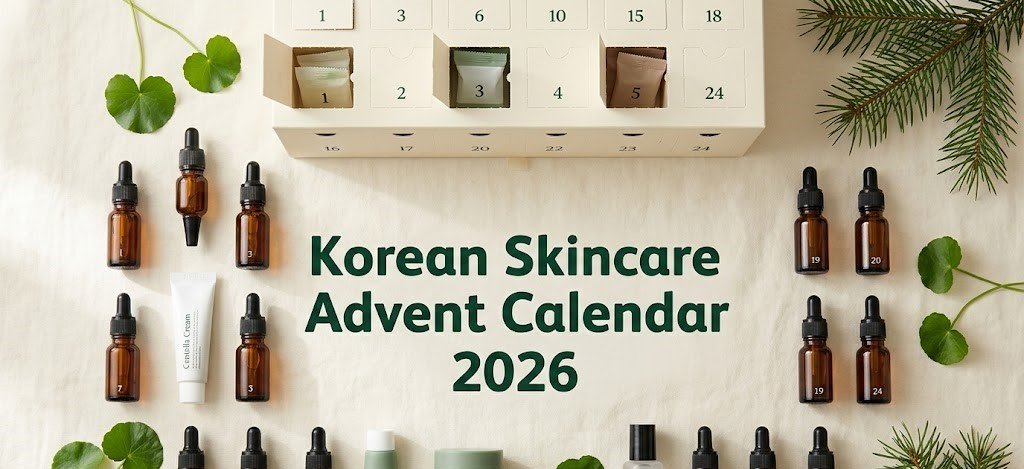
The contents of a K-beauty advent calendar usually span multiple categories within a single brand or retailer’s collection. You might find a cleansing balm behind door four, a toner behind door eight, a serum behind door fifteen, and a sleeping mask behind door twenty-two. Retailers like Olive Young and Stylevana, along with brand names like Sulwhasoo, Laneige, and COSRX, have all released calendar formats. Some are curated by K-beauty retailers who pull products across multiple brands into one set, while others represent a single brand’s entire line in miniature form.
What separates these from a standard holiday gift set is the ritualized discovery format and the marketing story that accompanies it. The packaging is designed for social media visibility, and the “one day, one product” structure creates a gamified unboxing experience that drives engagement. From a skincare perspective, however, this format is neutral at best. The calendar structure does nothing to improve product efficacy or the quality of your routine. What matters is the contents, not the doors.
Korean Skincare Advent Calendar 2026: What’s New This Year
The 2026 Korean skincare advent calendar market is shaped by two shifts that were already visible in late 2025 purchasing data and brand release patterns. First, several major K-beauty brands are moving away from fragrance-forward formulations in their calendar offerings, responding to consumer demand for sensitive skin compatibility. Second, the retailer-curated multi-brand calendar has become more common than the single-brand set, offering broader ingredient diversity but also greater formulation inconsistency across the included products.
Brands are emphasizing ingredient transparency more than in previous years. Where 2024 and 2025 calendars often relied on packaging allure and brand prestige, the 2026 releases are more likely to feature the ingredient hero upfront. You will see “niacinamide 5%” or “centella asiatica extract 80%” printed on the outer box or included in the ingredient pamphlet, a notable shift from the “mystery ingredient” marketing of earlier editions. The American Academy of Dermatology has not issued specific guidance on advent calendars, but the broader skincare transparency trend is influencing the K-beauty holiday market.
Retailer calendars from Olive Young, YesStyle, and Stylevana for 2026 are expected to feature more products from brands that have gained traction in Western markets for their minimal-ingredient, fragrance-free formulations. Brands like Beauty of Joseon, Purito, and Isntree are appearing more frequently in these curated sets than they did in 2024. The practical implication for you is that 2026 offers a better chance of finding a calendar without a long list of potential irritants than previous years did, though you will still need to check the ingredient list for every product inside.
Key Takeaway: Korean skincare advent calendars in 2026 are trending toward greater ingredient transparency and more fragrance-free options than previous years, but the burden of verifying each product’s compatibility with your skin still rests entirely on you.
How to Evaluate a Korean Skincare Advent Calendar
Evaluating a Korean skincare advent calendar requires a different lens than the one most reviews provide. Do not count the number of items first. Do not assess the packaging first. Start with the ingredient list of every product in the set, and if a calendar does not publish those lists openly on the retailer or brand website, treat that absence as a disqualifier. A legitimate skincare purchase in 2026 should not require you to buy the product to learn what is inside it.
The first filter is formulation quality. Look for products that name active ingredients with concentration percentages: “5% niacinamide,” “0.5% salicylic acid,” “80% centella asiatica extract.” A calendar that lists 12 serums but names no concentration for any of them is selling mystery liquids in attractive bottles. The second filter is ingredient compatibility across the set. If seven of twelve products contain fragrance, essential oils, or alcohol denat., and you have reactive skin, that calendar is not for you, regardless of the brand prestige or the packaging beauty. The third filter is product category diversity. A genuinely useful calendar includes at least one cleanser, one treatment product with a named active ingredient, one moisturizer, and one sun protection product. A set that is entirely sheet masks and hand creams is a novelty, not a skincare investment.
Check the volume of each product against your ability to evaluate it meaningfully. A 5ml serum sample allows roughly three to five applications, which is enough to observe a negative reaction but not enough to judge efficacy. That is fine if your goal is ingredient screening. It is deceptive if the marketing implies you are receiving enough product to see results. The table below breaks down the evaluation criteria in order of priority.
| Evaluation Criterion | What to Look For | Red Flag |
|---|---|---|
| Ingredient list availability | Full INCI lists published on the product page | Lists only available after purchase |
| Active concentration disclosure | Specific percentages (e.g., “5% niacinamide”) | “Contains niacinamide” with no concentration |
| Fragrance and essential oil content | Fragrance-free; essential oil-free if sensitive | “Natural fragrance” or multiple essential oils |
| Product category diversity | Cleanser, treatment, moisturizer, SPF represented | All sheet masks or all creams |
| Usable volume per product | Minimum 5ml for serums; 10ml for moisturizers | 1ml sachets that provide one incomplete application |
Common Korean Skincare Ingredients and What They Do
Korean skincare product labels can feel overwhelming if you have not learned to parse the recurring ingredient names that appear across essences, serums, ampoules, and creams. Understanding the five or six most frequently used compounds transforms the shopping experience from guesswork into informed selection.
Niacinamide (INCI: niacinamide) is the most common active in K-beauty formulations. It functions by increasing ceramide synthesis in the stratum corneum, reducing transepidermal water loss, and modulating sebum production at the sebaceous gland level. Concentrations between 2% and 5% are standard for barrier support and hydration. At 5% to 10%, niacinamide addresses oil regulation and pore appearance. According to a review published in the Journal of the American Academy of Dermatology, niacinamide is well tolerated across skin types and Fitzpatrick phototypes, and it carries particular value for Fitzpatrick skin types IV through VI because it inhibits melanosome transfer, reducing post-inflammatory hyperpigmentation risk without the irritation profile of stronger tyrosinase inhibitors.
Snail secretion filtrate is a humectant-rich ingredient containing naturally occurring allantoin, glycolic acid, glycoproteins, and antimicrobial peptides. It functions primarily as a hydration layer that supports barrier repair and provides mild surface exfoliation through its endogenous glycolic acid content. Most K-beauty snail products use concentrations between 70% and 96% snail secretion filtrate. People with dust mite allergies or known mollusk allergies should approach snail mucin with caution due to potential cross-reactivity, though clinical reports of allergic contact dermatitis to snail secretion filtrate remain low.
Centella asiatica extract (INCI: centella asiatica extract), along with its purified triterpenoid compounds madecassoside, asiaticoside, asiatic acid, and madecassic acid, functions as an anti-inflammatory agent through inhibition of the NF-kB signaling pathway. It also stimulates collagen type I synthesis in dermal fibroblasts, a mechanism supported by both in vitro and animal wound-healing studies. Products labeled simply “cica” or “centella” without specifying which compound or extraction method vary dramatically in potency. A product containing 0.1% purified madecassoside is chemically different from one containing 50% crude centella extract, and the label does not always clarify which you are getting.
| Ingredient (INCI) | Primary Function | Typical Effective Concentration | Caution Group |
|---|---|---|---|
| Niacinamide | Barrier support, sebum regulation, melanosome transfer inhibition | 2% to 10% | Rare niacin allergy |
| Snail secretion filtrate | Humectant, mild exfoliant, barrier hydration | 70% to 96% | Dust mite or mollusk allergy |
| Centella asiatica extract / madecassoside | Anti-inflammatory, wound healing, collagen synthesis stimulation | 0.1% to 2% (purified); 5% to 100% (extract) | Rare allergy |
| Galactomyces ferment filtrate | Fermented yeast filtrate; humectant, potential brightening | 50% to 95% (as base) | Fungal acne-prone skin |
| Sodium hyaluronate | Humectant; holds water in stratum corneum | 0.1% to 2% | None; universal humectant |
Skincare Advent Calendar Value Guide: Calculate What You Really Get
The standard value calculation used in most advent calendar reviews takes the retail price of each full-size product, multiplies it by the fraction of the full size the sample represents, and sums those numbers to produce a “total value” figure that dramatically exceeds the calendar’s purchase price. This math is technically correct and practically meaningless. You are not buying full-size products. You are buying samples. And a 5ml sample of a serum that retails at $48 for 50ml is worth $4.80 in raw volume terms, not $48 in value terms, unless you would genuinely have purchased that exact full-size product anyway.
Calculate value differently. First, identify how many products in the calendar you would consider purchasing full-size after testing, based on their ingredient profile matching your skin type and routine gaps. If only four of twelve products meet that bar, the practical value of the calendar is the cost of testing those four versus what you would have paid for their deluxe samples individually. Second, calculate the total volume of active products received. A calendar with ten 5ml serums gives you 50ml of serum total, roughly equivalent to one full-size product. If the calendar costs $80 and a single full-size K-beauty serum of comparable ingredient quality costs $30 to $45, you are paying roughly double for the discovery and variety, not getting a bargain.
Third, subtract the cost of any product you cannot use safely due to skin type incompatibility, fragrance sensitivity, or ingredient conflict. If a $90 calendar contains six products you cannot put on your face because they contain bergamot oil, lavender oil, or alcohol denat., you are effectively paying $90 for six usable products, not twelve. The per-product cost just doubled, and the value proposition collapsed. The table below shows how to reframe the calculation.
| Value Factor | Standard Marketing Calculation | Honest Skincare Calculation |
|---|---|---|
| Basis of product value | Full-size retail price, prorated | Would you buy the full-size? If yes, sample value is discovery cost. If no, sample value is zero. |
| Unusable products | Counted at full value in “total worth” | Subtracted from usable product count; increases effective price per usable item |
| Product volume received | Not differentiated from full-size value | Assessed against how many applications each sample provides; is it enough to decide? |
| Ingredient quality | Assumed equivalent across all products | Evaluated product by product; one star ingredient does not validate the rest |
Key Takeaway: A Korean skincare advent calendar’s real value equals the number of products you can actually use safely multiplied by the discovery value of finding a new routine staple, not the inflated “total worth” printed on the retailer’s product page.
Korean Skincare Advent Calendar for Sensitive Skin
Sensitive skin, defined by the American Academy of Dermatology as skin that is more prone to stinging, burning, redness, or irritation in response to topical products, requires a specific filtering approach when evaluating any multi-product skincare set. An advent calendar is a high-risk purchase format for sensitive skin because it introduces multiple new formulations with no run-in period between them, the opposite of the slow, single-product introduction that dermatologists recommend for reactive skin.
The first rule for sensitive skin is to eliminate any calendar where the full ingredient list for every product is not published and accessible before purchase. You must be able to scan for known triggers. The second rule is to prioritize calendars composed entirely, or almost entirely, of fragrance-free and essential-oil-free products. Fragrance, whether synthetic “parfum” or natural essential oil constituents like limonene, linalool, citral, and geraniol, is among the most common causes of allergic contact dermatitis from cosmetics, a finding documented extensively in the Journal of the American Academy of Dermatology’s contact dermatitis research. A calendar that lists “fragrance” or multiple essential oils across its products is a calendar designed for people with non-reactive skin.
Look for calendars where the ingredient lists are dominated by barrier-supporting, low-irritation compounds: ceramide NP, ceramide AP, ceramide EOP, panthenol (provitamin B5), allantoin, squalane, and beta-glucan. Avoid calendars where the first five ingredients of multiple products include alcohol denat., which strips the stratum corneum and elevates transepidermal water loss, or PEG-40 hydrogenated castor oil, which can be a penetration enhancer that increases irritant access in already-reactive skin. The National Eczema Association’s ingredient guidance, while not K-beauty specific, provides a useful framework: fewer ingredients, lower botanical complexity, and no fragrance represent the safer path for reactive skin.
If you have sensitive skin, do not follow the one-product-per-day advent format. Instead, open the calendar on day one, photograph or scan every ingredient list, identify the three to four products that appear safest, and test one per week with a full patch test protocol. The calendar becomes a December purchase and a January-through-March testing project. That is not the marketing story. It is the skin-safe one.
Korean Skincare for Dry Skin Advent Calendar Picks
Dry skin is characterized by insufficient sebaceous gland lipid production and a compromised stratum corneum lipid matrix, leading to elevated transepidermal water loss, flaking, tightness, and a rough surface texture. A Korean skincare advent calendar that serves dry skin well will prioritize humectant-rich essences, emollient creams, and occlusive sleeping masks over astringent toners, strong exfoliants, or products that dry down to a matte finish.
The ingredient markers to seek out are specific and identifiable. Sodium hyaluronate and hyaluronic acid at 0.5% to 2% draw water into the upper stratum corneum. Ceramide NP, ceramide AP, and ceramide EOP at a 3:1:1 ratio replenish the lipid mortar between keratinocytes. Squalane, a hydrocarbon structurally similar to human sebum, provides emollient slip without comedogenicity risk for most dry skin types. Shea butter (INCI: butyrospermum parkii butter) delivers occlusive fatty acids that slow overnight water loss. Panthenol at 1% to 5% improves barrier hydration and reduces irritation.
A calendar where the majority of products are watery toners, gel-textured moisturizers, or clay masks is unlikely to satisfy dry skin, regardless of how elegant the packaging looks. Dry skin benefits from product categories that the K-beauty routine structure already emphasizes: essence, serum, emulsion, and sleeping mask steps that layer hydration progressively. A well-chosen calendar for dry skin will be heavy on those categories and light on foaming cleansers, which tend to use harsher surfactants that strip already-scarce lipids.
One brand-specific formulation note: Sulwhasoo calendars, which frequently appear in premium K-beauty holiday sets, rely heavily on ginseng extract and hanbang (traditional Korean herbal medicine) ingredients that provide emollient richness but also introduce complex botanical fragrance profiles. For dry skin that is not reactive, this richness is a benefit. For dry skin that is also sensitive, the botanical complexity may trigger irritation despite the emollient function. Check the ingredient list rather than assuming that rich texture equals safe formulation.
Korean Skincare Advent Calendar for Acne-Prone Skin
Acne-prone skin requires an advent calendar strategy that prioritizes non-comedogenic formulations, identified active ingredients with a documented mechanism for reducing acne lesions, and an absence of ingredients that can trigger or worsen acne mechanistically. This is more specific than “look for oil-free labels,” which mean little under K-beauty formulation conventions where lightweight oils like squalane are frequently used in products designed for oily skin.
The active ingredients to look for in a 2026 K-beauty advent calendar for acne-prone skin include niacinamide at 4% to 10% for sebum regulation, salicylic acid (INCI: salicylic acid) at 0.5% to 2% for comedolytic activity within the pore lining, and centella asiatica extract or its purified triterpenes for anti-inflammatory support that reduces the erythema surrounding active lesions. Azelaic acid, though less common in K-beauty than in Western formulations, appears in some 2026 Korean product lines at 10% to 15% and provides both antibacterial activity against Cutibacterium acnes and tyrosinase inhibition to fade post-inflammatory hyperpigmentation.
Ingredients to actively avoid in a calendar for acne-prone skin include coconut oil (INCI: cocos nucifera oil), which is comedogenic for a significant portion of acne-prone individuals, isopropyl myristate and isopropyl palmitate, which can occlude pores, and ethylhexyl palmitate, which has been associated with comedogenicity in rabbit ear model testing. The term “non-comedogenic” is not regulated by the FDA, so a product labeled non-comedogenic that contains these ingredients still warrants caution.
Fermented ingredients, a K-beauty staple, occupy a complicated position for acne-prone skin. Galactomyces ferment filtrate and saccharomyces ferment filtrate are used for their humectant and potential brightening properties, but yeast ferments can exacerbate fungal acne (malassezia folliculitis) in susceptible individuals. If your acne features small, uniform, itchy bumps that do not respond to standard acne treatments, you may be dealing with fungal acne rather than acne vulgaris. In that case, a calendar heavy on fermented essences and galactomyces-first products is the wrong purchase entirely.
| For Acne-Prone Skin: Seek | For Acne-Prone Skin: Avoid |
|---|---|
| Niacinamide 4% to 10% | Coconut oil (cocos nucifera oil) |
| Salicylic acid 0.5% to 2% | Isopropyl myristate, isopropyl palmitate |
| Centella asiatica / madecassoside | Ethylhexyl palmitate |
| Azelaic acid 10% to 15% | Galactomyces ferment (if fungal acne suspected) |
| Lightweight gel and emulsion textures | Heavy occlusive creams with unidentified oils |
Key Takeaway: An acne-safe Korean skincare advent calendar is one where you can verify the active acne-fighting ingredients, confirm the absence of known comedogenic carriers, and eliminate any yeast-ferment products if your acne pattern suggests fungal involvement.
How to Safely Introduce Multiple New Skincare Products
The dermatological standard for introducing a new skincare product is one product at a time, with a patch test first and a two-week observation period before adding another variable. The format of an advent calendar, where you are presented with a new product every single day, directly contradicts this standard. This is not a minor friction point. It is the central safety tension of the entire product category, and how you resolve it determines your outcome.
The American Academy of Dermatology recommends introducing one new product every two to four weeks to accurately identify the cause of any reaction. When you introduce three products simultaneously and experience stinging, redness, or breakouts, you cannot determine which product caused the issue. You must stop all three, let your skin recover, and reintroduce them one at a time anyway. The calendar’s daily format, followed literally, simply delays this process by a few weeks and adds skin irritation to the timeline.
The solution is to treat the advent calendar as a December acquisition and a January-through-April testing protocol. Open the entire calendar on the day you receive it, or open it as intended through December but do not apply anything to your face. Photograph or scan every ingredient list. Sort products into three categories: low risk based on your known ingredient tolerances, moderate risk with one or two unfamiliar ingredients, and high risk with multiple unknown actives or known personal irritants. Begin with one low-risk product. Use it for two weeks. If no reaction occurs, rotate in one moderate-risk product. Continue this staggered introduction over several months.
This protocol strips the holiday novelty from the format. That is the trade-off. The calendar’s value is the curated product discovery at a reduced per-sample cost. The calendar’s risk is the social-media-driven expectation that you will put twelve new formulations on your face in twelve days. You cannot have the discovery safely without abandoning the daily application ritual. Choose the skin health path.
Patch Testing New Skincare Products Correctly
A patch test is the single most reliable at-home method for predicting whether a new skincare product will irritate your skin, and it is the step most frequently skipped when advent calendar excitement overrides cautious protocol. The standard patch test recommended by the American Academy of Dermatology involves applying a small amount of the product to a discreet skin area twice daily for five to seven days and observing for any reaction before moving the product to the face.
To patch test correctly:
- Select a test area: the skin behind one ear, the side of the neck, or the inner forearm. The test site should be clean, dry, and free of other active products.
- Apply a pea-sized amount of the product to the test area and leave it on as you would on your face. Do not occlude or cover it unless the product instructions specify occlusion.
- Reapply to the same spot twice daily for five consecutive days. Reactions can take multiple exposures to develop, particularly for allergic contact dermatitis, which is a delayed-type hypersensitivity response. A single application patch test misses most allergic reactions.
- Observe the site for redness, itching, swelling, stinging, or any textural change. Photograph the area on day one and day five to track subtle changes.
- If no reaction occurs within seven days, the product can be introduced to the face, starting every third day before moving to daily use if the formula includes active ingredients.
For an advent calendar with twelve to twenty-four products, this protocol means it takes roughly six to twelve months to fully test every product if you test one at a time. That timeline is not a flaw in the protocol. It is an honest reflection of how long safe product introduction takes. If you are unwilling to wait that long, reduce your testing period to a minimum five-day patch test per product and accept the elevated risk of delayed reactions.
Over-Exfoliation Signs and How to Recover
Over-exfoliation is a specific clinical state of stratum corneum compromise caused by the cumulative effect of multiple exfoliating products applied too frequently or at too high a concentration. Advent calendars increase over-exfoliation risk because K-beauty formulations frequently include mild exfoliating acids, enzymes, or physical exfoliants across multiple products in the same set, often without clear labeling that signals “this product exfoliates.”
The signs of over-exfoliation are recognizable and progressive. The first signal is a persistent tight, glassy, or “smooth in the wrong way” texture that appears after cleansing and does not resolve with moisturizer. This reflects ceramide depletion and lipid matrix disruption. The second signal is increased stinging or burning when applying products that previously caused no sensation. The third signal is visible erythema, surface shininess without oiliness, and fine, crinkled dehydration lines that resemble aging but are actually barrier failure. The fourth and most advanced signal is breakout-like texture that is not acne but rather perioral dermatitis or irritant contact dermatitis secondary to barrier loss.
If you recognize these signs after working through an advent calendar, stop all active products immediately. Strip your routine to three steps: a non-foaming, sulfate-free cleanser, a moisturizer containing ceramide NP, ceramide AP, ceramide EOP, cholesterol, and fatty acids in a barrier-identical ratio, and a mineral-only sunscreen (zinc oxide or titanium dioxide) during the day. Continue this minimal routine for two to four weeks, or until the stinging resolves and normal skin texture returns.
Do not reintroduce the advent calendar products until your barrier is fully healed. When you do, test each one using the patch test protocol described above, paying specific attention to whether any individual product caused stinging that you dismissed as normal during your initial use. Products that sting on a healed barrier should not be used again.
Key Takeaway: Over-exfoliation from rapid advent calendar product introduction is fully reversible with barrier-repair protocol, but pushing through the stinging and adding more products on top of a compromised stratum corneum can trigger a cycle of irritation that requires dermatologist intervention.
Korean Skincare Fragrance and Essential Oil Risks
Fragrance, whether listed as “parfum,” “fragrance,” or as individual essential oil constituents, is the most common cause of allergic contact dermatitis attributable to cosmetic products. The European Commission’s Scientific Committee on Consumer Safety (SCCS) has identified 26 fragrance allergens that must be individually labeled on cosmetic products sold in the European Union, a regulation that has influenced how many global K-beauty brands format their ingredient disclosures. The list includes well-known sensitizers like limonene, linalool, citral, geraniol, eugenol, and coumarin, all of which appear routinely in fragranced K-beauty formulations.
The skin safety concern with fragrance in an advent calendar context is amplified by the number of exposures. If you use twelve products, and eight contain fragrance compounds, your skin is encountering fragrance allergens from eight different sources, potentially multiple times per day, layered under occlusive moisturizers that increase penetration. This cumulative exposure is what converts a one-time non-reaction into a sensitized immune response over time. Allergic contact dermatitis is a delayed-type hypersensitivity that can develop after repeated exposure, not just on first contact.
Essential oils are not safer than synthetic fragrance. Bergamot oil, lavender oil, peppermint oil, eucalyptus oil, and citrus oils (lemon, orange, grapefruit) are among the most frequently cited botanical sensitizers in contact dermatitis literature. A 2022 review in the Journal of the American Academy of Dermatology identified lavender oil as a common cause of allergic contact dermatitis from “natural” skincare products. A K-beauty advent calendar that markets “natural botanical fragrance” is not inherently safer than one that lists “parfum.” Both require the same scrutiny if you have sensitive or reactive skin.
The pragmatic filter: if a calendar product’s ingredient list includes fragrance, parfum, limonene, linalool, citral, geraniol, bergamot oil, lavender oil, or any citrus-derived oil, and you have a history of skin reactivity, set that product aside. Treat it as a hand cream or body product where the skin is thicker and less reactive, not as a facial product.
Snail Mucin in Korean Skincare Advent Calendars
Snail mucin, listed on ingredient labels as snail secretion filtrate, is a frequent centerpiece ingredient in Korean skincare advent calendars. It appears in essences, serums, ampoules, and moisturizers, often at high concentrations between 70% and 96%. The ingredient functions as a humectant, providing hydration through its naturally occurring glycoproteins and hyaluronic acid content, and as a mild surface exfoliant through its endogenous glycolic acid. The allantoin in snail secretion filtrate contributes a soothing, wound-healing supportive effect.
The clinical evidence supporting snail mucin for human skin is real but not as extensive as the marketing suggests. The majority of research on snail secretion filtrate involves in vitro studies examining its fibroblast stimulation, antimicrobial peptide activity, and glycoprotein hydration capacity. Controlled human clinical trials remain limited. What is clear from formulation science is that snail mucin works primarily as an effective hydrator and barrier supporter, not as the deep wrinkle treatment or scar eraser that some product claims imply.
A calendar that features snail mucin prominently will often include it in an essence or serum position, which means it sits under your moisturizer and any occlusive product. This placement maximizes its humectant function because humectants draw water into the skin and need an occlusive layer on top to prevent that water from evaporating. Snail mucin products that contain no occlusive ingredients should be followed by a moisturizer to lock in the hydration.
The safety profile is generally strong, with low rates of reported allergic contact dermatitis. The notable caution is for people with dust mite allergies or known mollusk allergy. The protein structures in snail secretion filtrate can cross-react with dust mite allergens in sensitized individuals. A patch test on the inner arm for a full five days, not just a single application, is appropriate before applying a high-concentration snail mucin product to your face.
Centella Asiatica Skincare Formulations
Centella asiatica, known colloquially in K-beauty as “cica” and listed on ingredient labels as centella asiatica extract or by its individual triterpenoid names madecassoside, asiaticoside, asiatic acid, and madecassic acid, appears in a large portion of 2026 Korean skincare advent calendars across multiple product categories. Its inclusion is not decorative. The ingredient has genuine skin-calming and wound-healing bioactivity that makes it useful for barrier support, redness reduction, and post-procedure skincare.
The mechanism of action operates through several pathways. Madecassoside, the most studied centella triterpenoid, inhibits the NF-kB inflammatory signaling pathway, reducing the production of pro-inflammatory cytokines in the skin. It also stimulates collagen type I synthesis in dermal fibroblasts, a mechanism demonstrated in both in vitro and animal models. Asiaticoside has shown angiogenesis-promoting and wound-closure-accelerating effects in wound-healing models. Together, these compounds create an anti-inflammatory, pro-repair profile that aligns well with skin in need of calming.
The complexity for an advent calendar buyer is that centella products vary dramatically in their chemical composition. A product labeled “Centella Asiatica Extract” may contain a water-based extract standardized to an unspecified triterpenoid content. A product labeled “Madecassoside 0.1%” is a chemically defined, potency-specific formulation. The two are not interchangeable, and K-beauty brands do not always clarify the extraction standard or the triterpenoid concentration. A calendar that features centella across multiple products is beneficial only if those products deliver the bioactive compounds at a concentration the research supports, which is why transparency about triterpenoid content matters more than the presence of the ingredient name on the front of the bottle.
For Fitzpatrick skin types IV through VI, centella’s anti-inflammatory activity provides a genuine benefit: by calming redness and inflammation quickly, it may reduce the inflammatory cascade that leads to post-inflammatory hyperpigmentation. The ingredient does not directly inhibit melanin production the way that niacinamide, azelaic acid, or tranexamic acid do, but it reduces the upstream inflammatory trigger that initiates PIH in the first place.
Fermented Ingredients in K-Beauty Advent Calendars
Fermented ingredients are a category-defining feature of Korean skincare and a near-guaranteed inclusion in any K-beauty advent calendar. The most common ferment filtrates are galactomyces ferment filtrate, bifida ferment lysate, and saccharomyces ferment filtrate. These are produced through the controlled fermentation of yeast or bacterial cultures, a process that breaks down larger molecules into smaller, potentially more skin-penetrable compounds and generates a byproduct mixture that includes vitamins, amino acids, organic acids, and peptides.
The theoretical rationale behind fermented skincare is grounded in the observation that fermentation increases the concentration of certain bioactive molecules. Galactomyces ferment filtrate, for example, contains kojic acid as a fermentation byproduct, which provides a mild tyrosinase-inhibiting brightening effect. Bifida ferment lysate has been studied for its potential to support the skin’s microbiome and strengthen barrier function, though the human clinical trial data remains limited relative to the marketing claims.
The practical consideration for your advent calendar evaluation is that fermented ingredients are, by their nature, complex mixtures rather than single purified compounds. This complexity makes them unpredictable for sensitive or reactive skin. The fermentation byproducts can include organic acids that lower the product’s pH and provide mild exfoliation, which is not always disclosed clearly on the packaging. If multiple products in a calendar contain different ferments, you are introducing several complex biological mixtures to your skin simultaneously, each with its own profile of fermentation-derived compounds.
Fungal acne (malassezia folliculitis) is a specific concern with galactomyces and saccharomyces ferments. The yeast-based ferments can feed malassezia yeast on the skin surface, triggering or worsening the small, uniform, itchy bumps that characterize this condition. If you have experienced treatment-resistant “acne” that consists of tiny, uniform bumps along the forehead, temples, or jawline, a calendar built around fermented essences is likely to worsen, not help, that condition. A board-certified dermatologist can diagnose malassezia folliculitis and help distinguish it from acne vulgaris.
Key Takeaway: Fermented skincare ingredients offer genuine humectant and potential brightening benefits, but their biochemical complexity makes them a higher-variable choice in an advent calendar, and they are a specific risk factor for people with malassezia folliculitis.
Korean Skincare Advent Calendar Where to Buy 2026
The primary purchasing channels for Korean skincare advent calendars in 2026 remain the major K-beauty retailers that ship internationally, the direct-to-consumer brand websites that have expanded their global shipping, and the Western beauty retailers that now carry curated K-beauty holiday exclusives. Each channel has different advantages for ingredient transparency, return policy, and pricing.
Olive Young, South Korea’s largest health and beauty retailer, offers global shipping and typically releases its own curated advent calendar in October, featuring products from multiple brands sold in its stores. Olive Young’s product pages generally include full ingredient lists, making pre-purchase ingredient verification possible. YesStyle and Stylevana are Hong Kong-based retailers that carry multiple brand calendars and often release their own multi-brand holiday sets. Ingredient list availability on these platforms varies by product and brand. You may need to cross-reference the brand’s own website for a complete INCI list.
Direct brand purchases from Sulwhasoo, Laneige, COSRX, Beauty of Joseon, and Dr. Jart+ offer the most reliable access to full ingredient disclosure. These brands publish complete INCI lists on their own e-commerce platforms, and their 2026 advent calendars will include ingredient pamphlets inside the physical box. Purchasing directly from the brand also provides the strongest customer service path if a product arrives damaged or you need to verify a formulation detail.
US-based K-beauty curators including Soko Glam and Peach & Lily typically release their own holiday sets rather than traditional numbered advent calendars, but their 2026 offerings may include calendar-format sets with ingredient vetting done by the curation team. These retailers have built their brand identity around ingredient-conscious K-beauty selection, which means their holiday sets are more likely to be fragrance-free, essential-oil-free, and documented with concentration information than the mass-market retailer calendars.
Pre-ordering opens in September for most 2026 releases. The calendars with the strongest ingredient profiles and most transparent disclosures tend to sell out by mid-November. If ingredient quality and skin type compatibility are your filters rather than packaging novelty, plan to purchase early rather than waiting for December discounts, which tend to apply to the calendars that are not selling due to weaker formulations.
Frequently Asked Questions About Korean Skincare Advent Calendars
Are Korean skincare advent calendars worth the money?
A Korean skincare advent calendar is worth the money if at least half the products inside match your skin type, feature ingredient transparency with named actives and concentrations, and would genuinely cost more to purchase individually as deluxe samples for testing purposes. The calendars that are not worth the money are those where the packaging and branding account for most of the price, the ingredient lists are inaccessible before purchase, or multiple products contain fragrance, essential oils, or alcohol denat. that make them unusable on your face.
How do I know if a Korean skincare advent calendar is right for my skin type?
You know a calendar is right for your skin type by reading the full ingredient list of every product before purchase and confirming that the actives, carrier ingredients, fragrance status, and exfoliant load match what your skin tolerates. A calendar that does not publish full ingredient lists for every product is not verifiably right for any skin type because the information required to make the determination is hidden from you.
Can I use all the products from an advent calendar in December?
You should not use all the products from an advent calendar in December if you want to follow the dermatological standard for safe product introduction. The American Academy of Dermatology recommends introducing one new skincare product every two to four weeks. A 12-product calendar would take 24 to 48 weeks to test safely. Using one new product daily for 12 or 24 days eliminates your ability to identify which product caused any reaction and increases the risk of cumulative irritation, barrier disruption, and allergic contact sensitization.
What Korean skincare ingredients should I avoid if I have sensitive skin?
If you have sensitive skin, avoid products containing fragrance (parfum), essential oils (lavender oil, bergamot oil, citrus oils, peppermint oil, eucalyptus oil), alcohol denat., sodium lauryl sulfate, and high concentrations of exfoliating acids including glycolic acid and lactic acid above 5%. Individual fragrance allergens to scan for on INCI lists include limonene, linalool, citral, geraniol, eugenol, and coumarin, which must be listed individually in products sold in the European Union and are often listed on globally distributed K-beauty products as well.
Do Korean skincare advent calendars expire?
Korean skincare advent calendars contain products subject to the same expiration dating as any cosmetic product, and the calendar format does nothing to extend shelf life. Each product inside should carry a manufacturing date or expiration date printed on the individual packaging, not just the outer box. Products in sample sizes may have a shorter practical shelf life once opened because the small volumes provide less preservative coverage per surface area, but the unopened products remain stable through the expiration date if stored in a cool, dry environment away from direct light.
What should I do if a product from my advent calendar causes a reaction?
If a product from your advent calendar causes stinging, redness, itching, swelling, or breakout-like texture, stop using that product immediately and strip your routine to a gentle cleanser, a barrier-supporting moisturizer containing ceramides, and a mineral sunscreen during the day. Do not apply other advent calendar products to the affected area until the reaction has fully resolved. Document the product’s ingredient list and note any actives, fragrances, or preservatives that may be new to your skin. If the reaction persists beyond five days, worsens, or involves blistering or significant swelling, see a board-certified dermatologist and bring the product and its ingredient list with you.
Your Skin Deserves a Calendar That Deserves Your Skin
The single most useful shift you can make when evaluating a Korean skincare advent calendar in 2026 is to stop seeing it as a holiday countdown and start seeing it as a product testing kit with seasonal packaging. The value is not in the doors. It is in the formulations behind them, and those formulations either serve your skin or they do not, based on chemistry, not on brand prestige or unboxing aesthetic.
Open the calendar, read every ingredient list, identify what matches your skin type, set aside what does not, and introduce the products that pass your filter one at a time, slowly, with a patch test and a waiting period between each one. That approach stretches the calendar’s usable timeline across months rather than weeks. It also protects your skin barrier from the cumulative irritation that the daily-advent format invites.
You are not missing out by skipping the one-a-day ritual. You are doing what any board-certified dermatologist would advise: treating new skincare products as variables to be tested, not gifts to be applied without scrutiny. A well-chosen calendar, used this way, can genuinely expand your routine with products you understand and trust. That is a better outcome than twelve days of novelty followed by weeks of skin recovery.