Skincare Coloring Pages Guide: Self-Care in 2026
Skincare coloring pages are thematically designed adult coloring sheets that merge the relaxing, evidence-backed practice of focused coloring with the aesthetic and educational world of skincare. You are not just filling in cartoon bottles. You are engaging with scientifically accurate illustrations of ingredients, skin anatomy, and self-care rituals designed to anchor a mindfulness practice that genuinely benefits your skin by lowering your body’s stress response. Coloring a detailed illustration of a hyaluronic acid molecule or a well-composed morning routine vignette for 25 minutes can shift your nervous system out of a fight-or-flight state in ways that directly impact your skin’s barrier function and clarity.
According to the American Academy of Dermatology (AAD), stress is a well-documented trigger for skin conditions including acne, eczema, and psoriasis flares. The biological pathway is not mysterious. When your brain perceives stress, your hypothalamus signals your pituitary gland, which signals your adrenal glands to release cortisol. Elevated cortisol ramps up sebum production and weakens your skin’s barrier. A 2020 review in the Journal of the American Academy of Dermatology confirms that mind-body practices capable of reducing perceived stress, including mindfulness-based activities, are a legitimate, dermatologist-recognized adjunct to topical skincare.
This guide is for you if you love skincare, value your self-care practice, and want a new 2026 ritual that feels genuinely restorative rather than performative. You will learn exactly why coloring works on a neurological level to quiet your stress response, how to select or design pages that teach you real cosmetic chemistry while you color, which tools create the most satisfying sensory experience, and how to sequence this practice into your existing wellness routine. This is the practical, evidence-grounded guide to skincare coloring that does not exist anywhere else.
skincare coloring pages
Skincare coloring pages are printable or digital line-art illustrations featuring skincare-themed imagery specifically designed for adults to color as a focused, self-directed relaxation practice. Think of them as the opposite of a mindless scroll through social media. They are a structured creative task that demands just enough attention to pull your brain out of its worry loops without feeling like a chore. The subject matter ranges from botanically accurate illustrations of centella asiatica leaves to cross-sections of the epidermis and whimsical flat-lays of a complete morning routine.
The modern concept of adult coloring as a wellness tool gained traction around 2015, but the 2026 iteration is more intentional and niche. Instead of generic mandalas, you will find targeted themes that reflect real adult interests. For a skincare enthusiast, this means coloring pages that accurately depict a stratum corneum layer with ceramide lipids, or a dropper bottle labeled with the correct INCI name for ascorbic acid. This thematic specificity is what separates a “skincare coloring page” from a generic “pretty bottle” coloring page. It provides a visual anchor for your thoughts. When your mind wanders to a stressful email while you shade a niacinamide serum illustration, the image itself gently redirects your focus back to your self-care intention.
Choosing pages with subject matter you genuinely care about makes the practice stick. This is not a clinical prescription. It is a behavioral design trick. People repeat activities that feel personally relevant. If you already spend time researching ingredients like azelaic acid or tranexamic acid, coloring an illustration of that same compound’s molecular structure creates a novel sensory layer to your existing interest. The practice becomes a tactile extension of your skincare hobby, a 25-minute pause where you are still engaging with what you love, just through a different sensory channel that happens to lower your cortisol.
Key Takeaway: Skincare coloring pages are a stress-reducing tool that leverages your existing interest in skincare to make a clinically informed mindfulness practice feel effortless and personally meaningful.
skincare coloring pages printable
Skincare coloring pages printable refers to downloadable, usually PDF-format, files that you can print at home on standard A4 or US Letter paper. This format gives you immediate access to the activity without shipping costs, packaging waste, or waiting. In a 2026 context, where many wellness tools are locked behind subscription apps, a printable page represents a deliberately low-tech, high-agency choice. You own the file. You control the printing quality. You select the paper texture.
Most free printable skincare coloring pages available online in 2026 will be the generic, child-oriented sheets still dominating search results. You will recognize them instantly: smiling cartoon sunscreen bottles, anthropomorphic cucumbers, sheets clearly designed for an elementary school health class. These can still be relaxing to color. The stress-reducing mechanism of focused coloring does not depend entirely on sophisticated design. However, the engagement factor, the pull that makes you actually reach for the page, drops significantly if the imagery feels infantilizing.
For an adult seeking a genuine self-care experience, high-quality printable options will feature clean, detailed line art with a modern aesthetic. Look for pages formatted with adequate margins for a hole punch if you want to store them in a binder. The file should be a high-resolution 300 DPI PDF, not a compressed JPEG pulled from a screenshot. Printing on paper with a weight above 120 GSM prevents bleed-through if you plan to use alcohol markers. A 2017 study on adult coloring and anxiety published in The Arts in Psychotherapy did not find that image complexity alone predicted stress reduction. The key variable was the participant’s personal engagement with the image. A thoughtfully designed, aesthetically aligned page you actually want to color will outperform a generically “complex” one every time.
| Paper Weight (GSM) | Best For | Bleed-Through Risk | Texture Note |
|---|---|---|---|
| 80 to 100 GSM | Standard printer paper, colored pencils | High with markers | Smooth |
| 120 to 160 GSM | Gel pens, light marker application | Moderate | Slightly textured |
| 180 to 250 GSM | Alcohol markers, heavy blending | Low | Heavy cardstock feel |
self care coloring pages for adults
Self care coloring pages for adults are illustrations intentionally designed to facilitate a relaxation response through themes of wellness, nature, personal ritual, and mental health affirmations. The defining feature is not the subject matter alone. It is the cognitive load the page demands. The design needs to occupy your brain’s verbal, ruminating network with a non-verbal, patterned task. This is the neurological mechanism that separates coloring a detailed illustration of a skincare ritual from, say, absentmindedly doodling on a sticky note.
Your brain operates on different networks. The default mode network (DMN) is active when you are daydreaming, worrying, or mentally replaying a conversation. This network is where stress lives. When you engage in a structured, focused task like coloring a precise botanical illustration of a calendula flower, you activate the task-positive network (TPN). Activating the TPN quiets the DMN. This is the same neural mechanism that makes activities like knitting, woodworking, or playing a musical instrument feel restorative. The coloring page functions as a simple, accessible toggle switch for your brain’s stress circuitry.
An effective adult self-care coloring page for 2026 often incorporates elements of biophilic design. Images of leaves, water droplets, and natural textures engage your visual cortex in ways that have a measurable calming effect, a concept supported by research in environmental psychology. A page that depicts a neat arrangement of skincare tools (a jade roller, a soft headband, a glass serum bottle with a dropper) next to a bundle of dried lavender or an aloe vera plant taps into two calming cues simultaneously: the ritual of personal care and the presence of natural forms. This combination is more potent than a generic geometric pattern because it connects the relaxation exercise directly to your existing sensory memories of a pleasant skincare routine.
Key Takeaway: Adult self-care coloring works by demanding just enough non-verbal focus to silence your brain’s stress-producing default mode network, turning your attention fully to a calming, structured pattern.
mindfulness coloring for stress relief
Mindfulness coloring for stress relief uses the act of coloring as an anchor for present-moment attention. The goal is not to create a frame-worthy piece of art. The goal is to notice the sensation of the pencil tip on the paper, the sound it makes, the gradient of color forming in a small petal, and to gently return your attention to those sensations whenever your mind inevitably drifts. This is applied mindfulness, a secular, evidence-backed cognitive skill, not a spiritual bypass.
A foundational 2017 study by Curry and Kasser, published in the journal Art Therapy, tested the effect of coloring mandalas, plaid patterns, and blank pages on anxiety levels in college students. The mandala and plaid pattern groups showed statistically significant reductions in state anxiety compared to the free-drawing group. The structure of the pattern mattered. The boundaries provided by the pre-drawn lines created a “containing” psychological effect. The coloring page held the space, reducing the minor cognitive burden of deciding what to draw, which allowed the full cognitive benefit of the focused task to land.
To use a skincare coloring page specifically for mindfulness practice, do not put on a podcast in the background. Do not do it while half-watching a show. Sit at a table with good light. Select one color at a time with intention. Feel the weight of the pencil or marker in your hand. If your thoughts spiral toward a stressful conversation or your to-do list, notice that without judgment, and redirect your focus to the single circle you are currently shading on a sunscreen bottle illustration. This is a mental bicep curl. You are not failing at mindfulness when your mind wanders. You are successfully performing the exercise every time you notice the wandering and choose to return your attention to the page. The skincare theme simply makes the visual anchor more pleasant and personally resonant than a random geometric shape.
does coloring help with stress
Coloring demonstrably helps with acute stress by reducing physiological arousal markers like elevated heart rate and reported anxiety levels. The mechanism is a combination of low-stakes focused attention, repetitive fine motor movement, and structured cognitive engagement that together trigger the relaxation response, a measurable physiological state first characterized by Dr. Herbert Benson at Harvard Medical School. You shift your autonomic nervous system out of sympathetic (fight-or-flight) dominance and into parasympathetic (rest-and-digest) dominance.
A 2018 randomized controlled trial published in The Arts in Psychotherapy assigned participants to either a structured coloring condition (a pre-drawn mandala) or an open art-making condition. The structured coloring group reported significantly greater reductions in negative mood states and anxiety. The researchers theorized that the predictable, rule-bound nature of coloring, staying inside the lines, selecting a color palette for a defined space, provides a sense of psychological control that open-ended creative tasks do not offer. For someone experiencing stress, the gentle, predictable constraint of a coloring page is a feature, not a limitation.
It is essential to state clearly what coloring cannot do. Coloring is not a treatment for clinical generalized anxiety disorder (GAD), major depressive disorder, or chronic post-traumatic stress. If you experience intrusive thoughts, panic attacks, persistent low mood lasting more than two weeks, or find that stress is significantly impairing your ability to work or maintain relationships, a licensed professional counselor (LPC) or psychologist can provide evidence-based treatments like cognitive behavioral therapy (CBT). Coloring is a wellness tool for managing day-to-day stress. It is an adjunct, not an alternative, to professional mental healthcare. The distinction matters, and claiming otherwise would be a disservice.
Key Takeaway: Structured coloring reliably lowers situational anxiety and activates your body’s relaxation response, functioning as a healthy, accessible stress-management habit, not a clinical anxiety treatment.
skincare coloring page designs
Skincare coloring page designs in 2026 can be grouped into four distinct visual categories, each serving a slightly different psychological or educational purpose. The design you pick should match your intention for the session. Selecting the right type of page is part of the self-care ritual itself, a small act of intentionality before you even pick up a pencil.
The first category is Routine Ritual Scenes. These pages depict flat-lay compositions of a morning or evening routine. They might show a sink with a cleanser, a toner bottle, a serum with a dropper, a moisturizer jar, and a sunscreen tube arranged among fresh flowers or a cup of tea. Coloring this scene is a visual meditation on the habit you already practice. It reinforces your commitment to your routine by rendering it as a beautiful, deliberate still life. The second category is Botanical Ingredient Illustrations. These are scientifically accurate line drawings of plants commonly used in skincare: aloe vera, gotu kola (centella asiatica), chamomile, green tea leaves, and calendula. They satisfy the biophilic need for nature connection while subtly educating you on the plant origin of your favorite extracts.
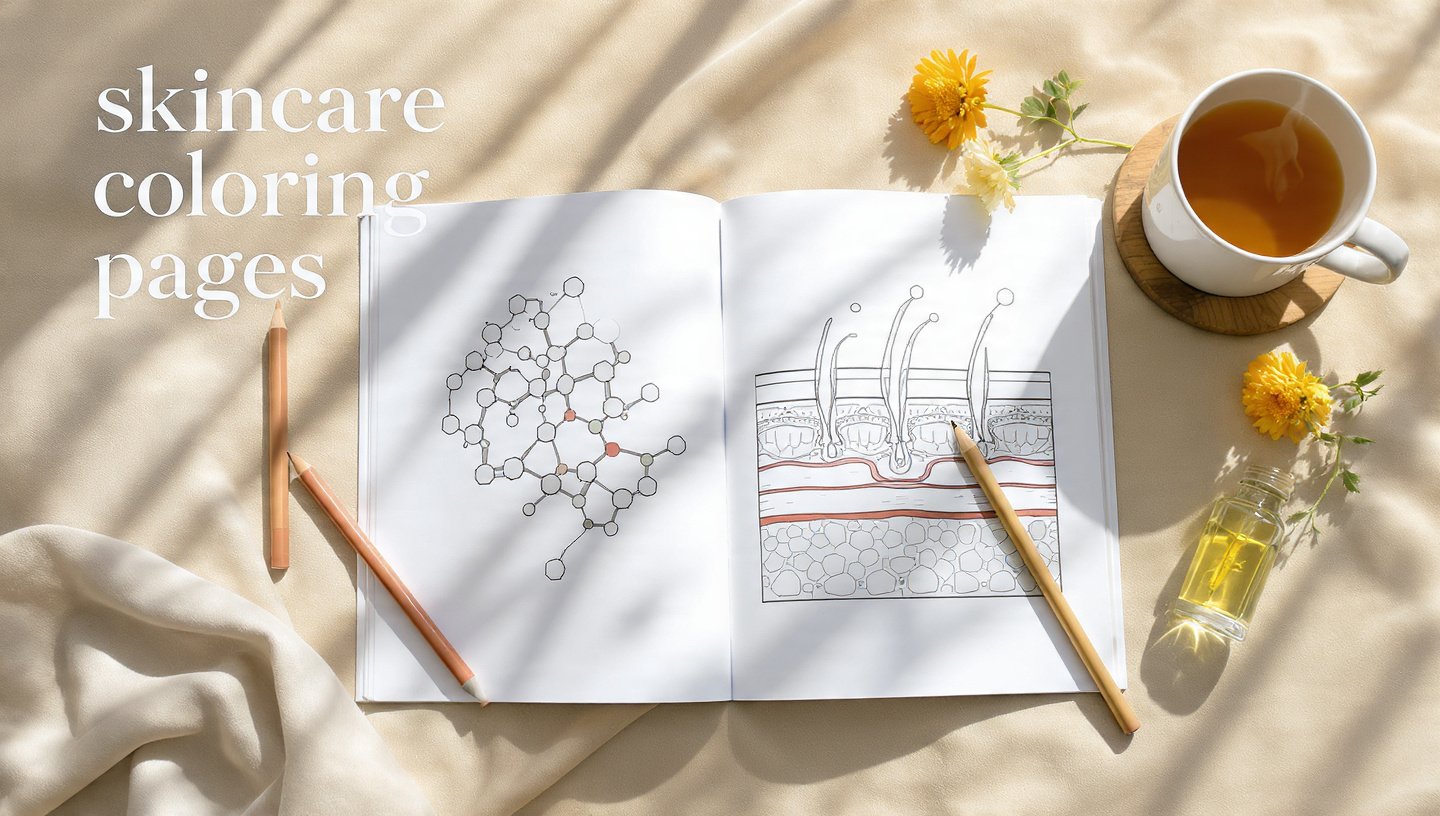
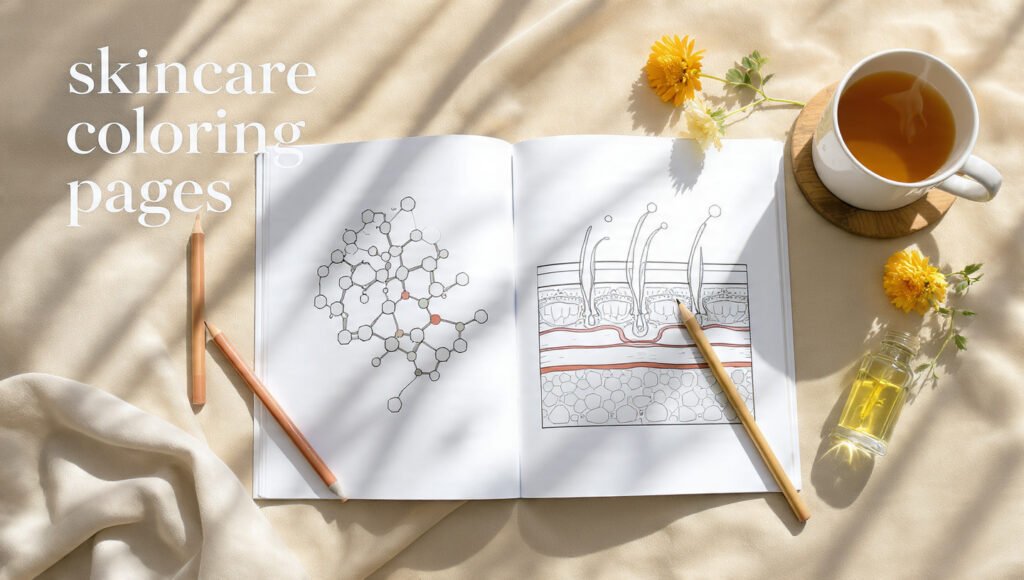
The third category is Cosmetic Chemistry Abstracts. These are technical, almost diagrammatic, illustrations of ingredient molecules (hyaluronic acid, niacinamide, ceramide NP), skin cross-sections (stratum corneum layers, a sebaceous gland), or a stylized INCI ingredient list. They appeal to the skincare enthusiast who finds beauty in the science. Coloring a molecular diagram requires fine focus and offers a uniquely modern, knowledge-based mindfulness anchor. The fourth category is Affirmation and Typography Pages. These blend skincare-related phrases (“Protect your barrier,” “SPF is self-care,” “Patch test and peace”) with decorative borders and illustrative elements. They function as a gentle, visual mantra, embedding the self-care message deeper through the repetitive act of coloring each letterform.
psychodermatology and the stress-skin connection
Psychodermatology is the clinical and research field that studies the bidirectional communication between your central nervous system, your endocrine system, and your skin. Your skin is not just a passive wrapper. It is a fully innervated, hormone-responsive organ. The connection is direct and biochemical. When your brain perceives a threat, your hypothalamus releases corticotropin-releasing hormone (CRH). This triggers the pituitary gland, which signals your adrenal glands to pump out cortisol. Mast cells in your skin have receptors for CRH. Peripheral nerve endings in your dermis release substance P, a neuropeptide that drives inflammation.
A 2022 review published in the Journal of the American Academy of Dermatology detailed the clinical implications of this pathway for common skin conditions. In acne, psychological stress correlates with increased severity, and the mechanism appears to be cortisol-driven upregulation of sebaceous gland activity. In atopic dermatitis, stress impairs the skin barrier’s recovery rate. A classic experiment published in the Archives of Dermatology demonstrated that tape-stripped skin on stressed students recovered significantly slower than the same model on the same students during a low-stress vacation period. The stress literally slowed down how quickly their skin barrier repaired itself.
Coloring a skincare-themed page directly intervenes on the “brain” side of the brain-skin axis. By lowering your perceived stress, you lower your circulating cortisol. By lowering cortisol, you reduce the inappropriate signal your sebaceous glands receive to overproduce sebum. You are not applying anything to your skin. You are changing the chemical environment your skin cells are bathing in from the inside. This is not a replacement for your topical routine. A board-certified dermatologist would, and should, tell you that your azelaic acid and your moisturizer are doing the heavy lifting at the tissue level. The coloring practice is a preventative, systems-level support for the environment in which your skin operates. Think of it as reducing the background noise so your well-formulated topicals can do their job without constant cortisol-driven interference.
Key Takeaway: Psychodermatology provides the clinical framework proving your brain’s stress state directly and measurably affects your skin’s barrier function and inflammation levels, making a 25-minute stress-lowering coloring session a legitimate skin health support practice.
printable self-care routine coloring sheets
Printable self-care routine coloring sheets are downloadable pages that illustrate the sequential steps of a wellness or skincare ritual. These are not single-object images. They are visual storyboards of a practice. You might color a sheet that walks through six steps: cleansing, toning, applying a serum, moisturizing, applying SPF, and finishing with a calming tea. Each step is a framed illustration panel, like a comic strip of your morning.
The act of coloring this sequence serves two functions. First, the focused coloring process itself is relaxing, as established. Second, you are visually rehearsing a positive health behavior. A concept in behavioral psychology called “implementation intentions” suggests that mentally visualizing the steps of a desired behavior, including the context and order, increases the likelihood of performing the behavior when the context arises. By coloring the panels of a PM routine, you are not just relaxing. You are embedding the sequence of double cleansing, applying your retinoid, waiting, and then applying your moisturizer into your procedural memory through a multisensory pathway.
Use these sheets as a mindful planning session. Print one on a Sunday evening. Select a color palette that feels calm, maybe soft sage greens, warm terracottas, and creams. As you color the “cleanse” panel, reflect on the sensory feeling of your cleanser. As you color the “moisturize” panel, think about the texture of your favorite barrier cream. This bridges the gap between a static wellness plan and an embodied, anticipated ritual. This practice is not an evidence-based treatment for any skin condition. It is a behavioral support for adherence and mindfulness. It makes your routine feel like a treat you are looking forward to, not a task you need to remember.
how to use coloring for skincare-inspired self-care
Integrating coloring into a skincare-inspired self-care practice requires framing the activity as a pre-routine relaxation anchor, not as a replacement for any part of your topical skincare. You are adding a nervous system regulation step before the cleansing step. The sequence matters because your skin benefits most from your products when you are not flooded with cortisol. Your barrier is more receptive. The sensory experience of the products will feel more luxurious because you are present.
Start with a specific, time-bound commitment. Remove decision fatigue entirely. You will color for exactly 20 minutes, three times this week, on Monday, Wednesday, and Saturday evenings before your PM routine. Print those three sheets in advance. Pick your coloring tools and set them in a dedicated spot. When the time comes, set a timer for 20 minutes on your phone, place it face down, and color. When the timer chimes, stop. Move into your double cleanse. This tight, ritualized structure is far more effective for habit formation than a vague intention to “color sometimes to relax.” According to research on habit formation published in the European Journal of Social Psychology, a clear context cue (time of day, preceding action) and a simple, repeatable behavior dramatically increase the likelihood of a practice sticking.
Choose your page theme to match your emotional need that evening, not your aesthetic mood board. If you feel scattered and anxious, pick a highly structured, symmetrical botanical or molecular illustration. The clean order of a hyaluronic acid molecular structure on the page will help cognitively organize your frazzled state. If you feel emotionally flat or disconnected from your body, pick a routine ritual scene. Coloring the warm, familiar objects of your bathroom counter will gently resurface feelings of comfort and safety. This is not pseudoscience. This is a deliberate use of environmental cueing and thematic priming. The content you focus on colors your emotional state in return.
skincare ingredient coloring activity
A skincare ingredient coloring activity uses scientifically accurate line drawings of active compounds, their source plants, or their skin biology target site as educational coloring templates. You are not coloring a generic flower labeled “moisture.” You are coloring the large, spiraling polysaccharide structure of sodium hyaluronate. You are shading the small, water-soluble amide molecule of niacinamide. You are filling in the lipid bilayer of the stratum corneum, with tiny ceramide molecules bridging the gaps between keratinocytes.
This approach transforms passive relaxation into active learning. A 2019 study in the journal Anatomical Sciences Education found that psychology students who colored detailed anatomical illustrations of the brain scored significantly higher on subsequent neuroanatomy recall tests than students who only read the text or viewed the images. The combination of focused visual search, color-coding decisions, and sustained attention on a single structure deeply encodes the information. Applying this to your skincare hobby, you will remember that niacinamide increases ceramide synthesis by keratinocytes more firmly if you have spent 20 minutes carefully selecting a shade for the keratinocyte cell and a different shade for the newly synthesized ceramide it is releasing into the intercellular space.
This is the practice that completely bypasses the shallow “cartoon bottle” issue of generic printable pages. The illustration itself must be accurate. The molecular structure of ascorbic acid must have the correct bond angles. The cross-section of the skin must label the dermis, epidermis, and stratum corneum in the correct anatomical relationship. The coloring key should use accurate terms. If you find a page that labels an ingredient correctly in both its common and INCI name, and depicts its documented mechanism of action visually, you have found a truly valuable self-care tool that marries the stress-reduction science of coloring with the educational curiosity of a skincare enthusiast.
Key Takeaway: Coloring scientifically accurate skincare ingredient illustrations deepens your cosmetic chemistry knowledge through the same sensory encoding mechanism that helps medical students master complex anatomy.
creative stress management techniques for skin health
Creative stress management for skin health encompasses any structured, hands-on, non-digital creative practice that reduces cortisol levels and serves as a buffer against the documented negative effects of stress on the skin. Coloring is an exemplary practice within this category due to its low barrier to entry, but it is not the only one. A full 2026 self-care toolkit for skin health acknowledges the family of practices that share the same mechanism.
The mechanism across all these practices is the induction of a flow state and the subsequent suppression of the sympathetic nervous system. Activities that meet the criteria are structured (have clear rules or boundaries), involve repetitive fine motor movement, and are just challenging enough to demand focus without causing frustration. Knitting, particularly simple repetitive patterns like a stockinette stitch scarf, meets all these criteria and has been studied for its anxiety-reducing effects. A 2013 survey published in the British Journal of Occupational Therapy found that knitting was associated with feelings of calm, happiness, and improved cognitive functioning. The rhythmic, bilateral motion is profoundly soothing to an overactive amygdala.
For skin health, knitting while listening to an audiobook on a Sunday afternoon functions as a sustained cortisol-lowering session. Other analogous practices include simple, pattern-based watercolor painting, assembling jigsaw puzzles with a pleasing image, or working with polymer clay to make small beads or charms. The principle is always the same: occupy your hands with a structured, non-screen-based task that quiets the brain’s verbal worry networks. Do not slot this into the ten minutes between meetings where you are also scrolling your phone. Schedule at least one continuous hour per week, ideally on a lower-stakes day like Sunday, of focused creative engagement. This is not a frivolous hobby. This is a neuroendocrine intervention for your skin, delivered via your own hands and a chosen medium.
best coloring tools for adult coloring pages
The “best” coloring tool for adult skincare coloring pages is the one you will actually use consistently, but the sensory and visual quality of your tools directly impacts the relaxing experience. The texture of the stroke, the saturation of the color, the sound of the utensil on the paper, all of this feeds into the mindfulness of the practice. Choosing the right tool is part of the ritual. Your tool choice should match the paper and the level of detail in your chosen design.
Colored pencils offer the most control and are the most forgiving medium for beginners. A soft-core, wax-based pencil like the Prismacolor Premier line lays down rich pigment that blends smoothly. The repetitive, light-pressure motion of building up layers of colored pencil is inherently meditative. Oil-based pencils, such as the Faber-Castell Polychromos, are slightly harder but hold a sharper point for the fine details in a molecular structure or a botanical illustration. The tactile feedback of a quality pencil on a paper with a slight tooth is a grounding sensory experience. Alcohol markers, including the popular Copic or Ohuhu lines, provide a completely different sensory experience. The ink flows smoothly with zero resistance, creating a slick, almost painting-like finish. The blending capabilities are unmatched for creating gradients on a serum bottle illustration. The sensation is more fluid and faster-paced. The smell of the alcohol ink can be pleasant for some and overwhelming for others. Use alcohol markers only on thick, 180 GSM or higher, smooth paper to prevent bleeding through to the surface below.
Gel pens are the tool of choice for adding small, precise, and intensely pigmented details. A white Sakura Gelly Roll pen can add tiny highlights to a glass dropper bottle. A metallic gold gel pen can add elegant details to an affirmation typography page. The fine motor precision required to use a gel pen on a small detail is a powerful cognitive focus anchor. For digital coloring on a tablet using an Apple Pencil and the Procreate app, the sensory experience is undeniably different, lacking the tactile feedback of physical tools. However, for individuals with hand pain, arthritis, or fine motor challenges, the digital option with an “undo” button and pressure sensitivity allows full participation in the self-care practice. A board-certified art therapist would likely recommend starting with whatever medium you find least intimidating.
| Tool Type | Best For | Sensory Experience | Paper Requirement |
|---|---|---|---|
| Soft-core Colored Pencil (Prismacolor) | Blending, shading botanical illustrations | Smooth, waxy, slow | 120+ GSM, light tooth |
| Oil-based Colored Pencil (Faber-Castell) | Fine detail, molecular structures | Harder, precise, slow | 120+ GSM, smooth |
| Alcohol Markers (Copic/Ohuhu) | Vibrant flat-lays, gradient fills | Fluid, zero resistance, fast | 180+ GSM, very smooth |
| Gel Pens (Sakura Gelly Roll) | Highlights, metallic details, typography | Precise, precise, tiny feedback | 120+ GSM, any texture |
| Digital (iPad/Procreate) | Unlimited undo, accessible, portable | Smooth glass, no physical texture | N/A |
relaxation techniques coloring vs meditation for skin health
Coloring and seated meditation are both effective, evidence-backed relaxation techniques that improve skin health indirectly by lowering cortisol, but they achieve this through different cognitive pathways and suit different mental states. Neither is a universally superior practice. Each is a tool. The skill is matching the tool to your current nervous system state. The primary difference is in cognitive demand. Seated mindfulness meditation, the practice of focusing on the breath, is cognitively deceptively difficult. You are asking your brain to attend to a very subtle, constantly present sensation.
For someone in an acutely stressed, highly anxious, or ruminative state, trying to sit quietly and focus on the breath can feel like wrestling an angry cat. The brain’s stress networks are screaming. The quiet of meditation provides no buffer. Structured coloring, by contrast, provides a focal task with a clear boundary. It occupies the brain’s perceptual and motor networks just enough to drown out the stress noise without being taxing. A 2017 study in the Creativity Research Journal found that structured coloring was more effective than open mandala drawing at reducing anxiety in a non-clinical sample. The structure itself was the active ingredient.
Meditation, however, builds a deeper meta-cognitive skill over time: the ability to observe thoughts without getting hooked by them. A regular, long-term meditation practice changes the brain structurally, thickening the prefrontal cortex and shrinking the amygdala, as documented in neuroimaging studies led by researchers at Massachusetts General Hospital. This is a profound, cumulative benefit that coloring alone does not provide. The ideal 2026 self-care routine for skin health likely combines both. Use a 20-minute coloring session in the evening to actively down-shift a stressed nervous system before your PM skincare routine. Use a 10-minute morning breath-focused meditation to build the long-term mental muscle of equanimity, which reduces your baseline reactivity to stressors over time. Both practices lower the cortisol that drives stress-induced acne flares and barrier dysfunction. Choose the tool that matches the moment.
Key Takeaway: Coloring is your acute stress off-switch, providing immediate cognitive distraction from worry; meditation is your long-term brain training, building resilience to future stress.
Frequently Asked Questions About Skincare Coloring Pages
What are skincare coloring pages?
Skincare coloring pages are illustrated line-art sheets featuring skincare, self-care, and cosmetic chemistry themes like ingredient molecules, routine rituals, and botanical extracts.
They are designed for adults to color as a focused, screen-free mindfulness practice that lowers stress.
The designs range from simple, whimsical product illustrations to scientifically accurate diagrams of the stratum corneum.
Are coloring pages actually good for self-care?
Structured coloring is a research-backed self-care practice that reliably reduces acute stress and anxiety by inducing a focused, meditative-like state.
A 2017 study found coloring complex patterns significantly lowered anxiety compared to free drawing by occupying the brain’s task-positive network.
It is a wellness tool for daily stress management, not a clinical treatment for an anxiety disorder.
Can coloring help with stress-induced acne?
Coloring can be a supportive part of managing stress-induced acne by lowering cortisol, the stress hormone that signals your sebaceous glands to produce more pore-clogging oil.
A focused coloring practice reduces the neurological stress signal, which helps reduce the downstream hormonal trigger for a breakout.
It works alongside, and never replaces, a board-certified dermatologist’s prescribed topical or oral acne regimen.
What is the best coloring medium for adult coloring pages?
The best medium depends on your desired sensory experience; soft-core colored pencils offer the most control and a slow, meditative feel.
Alcohol markers provide a fluid, paint-like saturation but require thick paper to prevent bleeding.
Gel pens are unmatched for adding precise, metallic, or highlight details that elevate a finished page.
Where can I find free printable skincare coloring pages?
High-quality, specifically adult and science-focused skincare coloring pages are not yet common on free aggregator sites, which mostly host childish cartoon bottle designs.
You will find the best pages by searching for independent illustrators who create botany, cosmetic chemistry, or self-care ritual art.
Look for 300 DPI printable PDFs on artist portfolio sites, Patreon, and dedicated adult coloring communities.
How does coloring compare to meditation for relaxation?
Coloring works by providing a structured external focus to quiet the mind’s chatter, functioning as an acute stress off-switch.
Meditation builds an internal meta-cognitive skill of observing thoughts without attachment, creating long-term stress resilience.
The ideal self-care practice combines both: coloring to quickly down-regulate a stressed nervous system and meditation to build a deeper, lasting calm.
A coloring page and a set of pencils will not cure a clinical condition. What this practice offers is a reliable, evidence-grounded mechanism for shifting your nervous system out of the chronic, low-grade fight-or-flight state that silently undermines your skin health. Your barrier will repair faster. Your sebaceous glands will receive a quieter signal. Your topical products will work in a less inflammatory environment.
Here is what to do next. Choose three evenings this week. Print three pages that genuinely excite your interest, whether that is a routine flat-lay or a molecular diagram. Place your chosen tools and pages in a dedicated spot. For 20 minutes before your PM routine, color with a timer set and your phone face down. Make the practice small, structured, and specific. The goal is not a perfect piece of art. The goal is 60 minutes of intentional nervous system regulation by Friday.
The science is clear. The practice is simple. The missing ingredient is just your willingness to take your self-care off the screen and onto the page.