Skincare for Kids and Tweens With Sensitive Skin: A Parent’s Simple Guide
When our kids were toddlers, sensitive-skin care felt like a checklist we ran for them: bath, pat dry, cream, soft pajamas, lights out. As they got older — and as one of them edged into the tween years — the same house started to sound different. They had opinions about textures. They noticed what friends used. They wanted a face wash that looked “normal” at a sleepover. And they were less interested in a parent hovering with a jar.
I’m a dad of two kids with eczema-prone skin, and I’ve learned that a good guide for this age span isn’t a longer product list. It’s a short set of habits that still work when kids start doing more of the work themselves — plus a clear sense of what to skip when the bathroom shelf fills up with trends.
This is general information from our family’s experience, not medical advice. If you’re worried about your child’s skin, talk with your pediatrician or a dermatologist.
Keep the foundation boring on purpose
For eczema-prone and sensitive skin, dermatology groups such as the American Academy of Dermatology and the National Eczema Association emphasize gentle daily care: short, lukewarm baths or showers, mild cleansers, moisturizing while skin is still a little damp, and avoiding common irritants like fragrance when possible. That foundation has not changed in our house as our kids have grown. What changed is who carries it out.
On most days our baseline still looks like this:
- Lukewarm water, not a long hot shower
- A fragrance-free cleanser used where it’s needed, not as a full-body scrub every night
- Moisturizer within a few minutes of drying off
- Soft clothes next to the skin, and laundry that doesn’t leave a perfume cloud in the hamper
We don’t chase a perfect bathroom cabinet. We chase a routine that still happens on a school night after practice, homework, and a late dinner.
See kids and tweens as the same skin, different independence
Younger kids mostly need consistency from adults. Tweens mostly need a plan they can own without embarrassment. The skin goals overlap — comfort, fewer surprises, less itch at bedtime — but the social side is different.
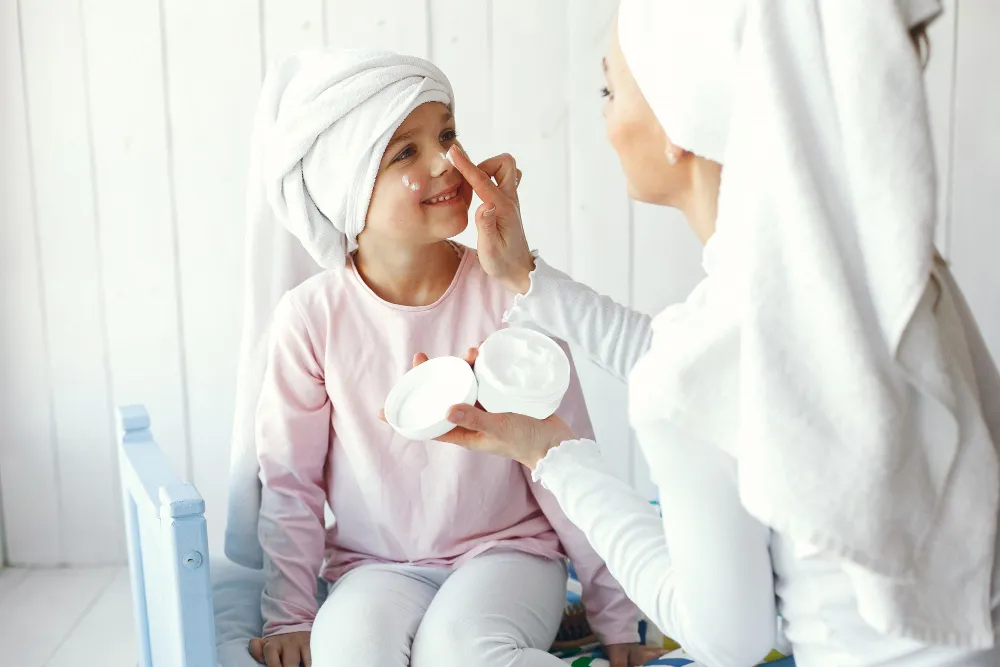
A seven-year-old may accept cream as part of the bedtime script. A twelve-year-old may refuse the same cream if it smells “babyish,” feels sticky under a hoodie, or requires a parent to apply it in front of a sibling. That isn’t vanity. It’s a normal push toward privacy. If we ignore that, the routine quietly dies.
What helps in our house is offering a short menu of acceptable options rather than one non-negotiable bottle. Same job (gentle cleanse, fragrance-free moisturize), different packaging or texture so they can pick without wandering into a harsh “acne set” that wasn’t made for reactive skin.
Help them take ownership without turning it into a fight
The biggest shift for us wasn’t a new ingredient. It was handing over pieces of the routine on purpose.
We started with easy wins: cream on their own arms and legs while we still helped with backs. Then we moved products within their reach. Then we practiced a quiet school version — a small tube in a pouch after handwashing or PE, without making a speech about it.
A few phrases that land better than lectures:
- “You know your skin. If this feels sticky, we can try the other jar.”
- “Let’s change one product this week so we can tell what helped.”
- “If something burns or itches more after you use it, stop and tell me. We don’t tough it out.”
Ownership works best with an exit ramp. Kids and tweens need permission to quit a product that bothers them, not a loyalty contest with a brand they saw online.
Be careful with the “teen skincare” shelf
Somewhere between elementary school and middle school, kids meet a wall of products aimed at looking older: strong face washes, multi-step kits, scented body sprays, scrub pads, and routines copied from short videos. Some are fine for other people. For sensitive or eczema-prone skin, they can be a lot — especially fragrance, alcohol-heavy formulas, and daily physical scrubs.
Our rule at home is simple: new face or body products get a small patch test first, and we introduce one change at a time. If a product needs a long explanation for why a child with reactive skin needs it, we usually don’t need it.
We also talk about goals. “Clear” and “comfortable” are not always the same project. If a tween is dealing with both dryness and breakouts, that is a good moment for a clinician’s input rather than stacking more bottles. Over-washing and piling on too many products can leave skin tighter and more irritated, which makes the next bottle feel necessary when what they needed was less.
Build the day around school, sports, and sleepovers
A home routine that only works in a quiet bathroom will fail by Wednesday. Kids and tweens live in gym clothes, shared sinks, and other people’s houses.
School. A fragrance-free moisturizer that fits in a backpack matters more than a perfect jar on the counter. If the school needs a note for products at the nurse’s office, handle that once at the start of the year. Soft cotton under layers still help when uniforms or team gear rub.
Sports. Sweat, heat, and damp clothes are a common combo for itch. We aim for a rinse — or at least a change out of sweaty gear — after practice, then moisturizer on the spots that usually bother them. Breathable layers beat overheating under extra fabric.
Sleepovers and trips. Pack the known cleanser and cream, not a hotel sample adventure. A small labeled kit means they are less likely to borrow a strongly scented body wash because it was the only thing in the shower.
Clothes and laundry still count. Soft fabrics next to the skin, tags cut when they bother, fragrance-free detergent, and no scented dryer sheets have cut down on more bedtime scratch sessions at our house than any fancy serum.
When to call the pediatrician or dermatologist
Home habits help many families stay more comfortable day to day. They are not a substitute for medical care, and they are not a replacement for anything a doctor has prescribed.
We check in with our kids’ pediatrician or dermatologist when:
- Patches are oozing, crusting, bleeding, or look infected
- Itch is bad enough to wreck sleep for several nights
- A new product causes a fast, widespread reaction
- We’re not sure whether we’re looking at dryness, eczema, irritation, or something else
- A tween’s skin concerns come with pain, swelling, or sudden changes that worry us
Photos on good days and rough days help, because skin loves to calm down in the waiting room. Bring the product list too, including the borrowed face wash, so the clinician can see the whole picture.
What success looks like at this age
For younger kids, success often looks like a calm bedtime and fewer surprise red patches after a new soap. For tweens, success often looks like them running the same gentle steps without a fight — and knowing when to ask for help instead of silently adding product number six.
In our house, the guide stayed short on purpose: lukewarm water, less fragrance in the daily lineup, moisturizer on damp skin, soft clothes, a small kit for real life, and a call to your pediatrician or dermatologist when something feels off. The products may change as kids grow. The idea doesn’t. Simple habits they can carry beat a complicated routine that only works when a parent is in the doorway.
About the author
Minesh Patel is a dad of two kids with eczema and the founder of Eczema Honey, a family skincare company. He writes practical guides for parents navigating sensitive skin as kids grow into the tween years.